Sacraments and Liturgy
Confession Ready: A Calm, Practical Way to Return to God's Mercy
A clear Catholic path for examining conscience, naming sin honestly, and receiving the sacrament with peace.
Site Admin | August 26, 2026 | 69 views
Many Catholics carry a quiet unease about Confession. Some worry they will forget something. Others fear they do not feel sorry enough. Still others have been away for a long time and do not know where to begin. Yet the sacrament is meant to be a place of mercy, not panic. It is one of the Church's most beautiful gifts, because in Confession the sinner does not merely think about forgiveness. He receives it from Christ Himself through the ministry of the Church.
A good confession is not a performance. It is an act of honesty before God. It asks for humility, clarity, and trust. For that reason, a practical making a good confession Catholic guide should not begin with fear but with the Lord's promise. Jesus came not to condemn the world, but to save it John 3:17. He breathed the Holy Spirit on the apostles and gave them authority to forgive sins John 20:22-23. Confession belongs to that mercy-filled mission.
What Confession really is
Confession, also called the Sacrament of Penance or Reconciliation, is the ordinary way the Church restores a baptized person who has sinned after Baptism. In it, the penitent names his sins, expresses sorrow, receives absolution, and accepts a penance. The priest does not forgive by his own power. He acts in the person of Christ, serving the mercy of the Lord who alone can cleanse the soul.
The sacrament has deep biblical roots. After the Resurrection, Christ entrusted the apostles with the ministry of reconciliation [[VERSE|2-corinthians|5|18-20|2 Corinthians 5:18-20]]. The Church has always understood this as a real pastoral authority, not a symbolic gesture. Sin wounds communion with God and with the Church, and sacramental absolution heals that rupture by grace.
This is why Confession is not simply counseling, although it often comforts the heart. It is not only spiritual advice, although prudent guidance may be offered. It is a sacrament, which means an outward sign instituted by Christ to give grace. The penitent comes with a truthful conscience and leaves with forgiveness, unless he knowingly withholds a grave sin or lacks true contrition.
Why it matters for ordinary Catholics
Most Catholics are not trying to live in open rebellion against God. More often, they are trying to live faithfully in the middle of ordinary distractions, habits, compromises, and unfinished conversions. That is precisely why Confession matters. It addresses the real conditions of the Christian life. It does not assume perfection. It assumes need.
Sin weakens charity even when it does not destroy it. Repeated small failures can dull the conscience, while serious sin cuts the soul off from sanctifying grace until repentance and absolution. The sacrament helps the faithful return to the Lord quickly and truthfully. It also trains the conscience. A person who confesses regularly tends to become more alert, more honest, and more grateful.
Confession is also tied to Eucharistic life. Catholics are called to receive Holy Communion with reverence and readiness. If a person is conscious of mortal sin, the Church teaches that he should not receive Communion before sacramental confession, except in grave circumstances where there is no access to confession and there is perfect contrition with the intention to confess as soon as possible. This is not meant to shame. It is meant to protect the holiness of the sacrament and the soul of the communicant.
Most of all, Confession keeps us from despair or self-reliance. It tells the truth: we need mercy, and mercy is real. God does not ask us to heal ourselves before approaching Him. He asks us to come.
How to prepare without overcomplicating it
The best preparation is simple and deliberate. The goal is not to create a flawless report. The goal is to make a sincere confession. A helpful preparation usually includes prayer, examination of conscience, sorrow for sin, and a practical plan to avoid the same sins in the future.
1. Begin with prayer
Ask the Holy Spirit for light. A brief prayer is enough: Lord, show me my sins clearly, and help me be honest and humble. Preparation begins in grace. We do not examine our conscience as though we were collecting evidence for self-criticism. We ask God to reveal what needs healing.
2. Examine your conscience carefully
An examination of conscience is not a psychological inventory of every feeling. It is a moral review of one's choices in light of God's law, the commandments, the duties of one's state in life, and the teachings of the Church. Some Catholics like to begin with the Ten Commandments, the Beatitudes, or the seven capital sins. Others prefer a simple written list of questions.
It may help to ask:
- Have I loved God above all things, or have I placed lesser goods above Him?
- Have I missed Mass on Sundays or holy days without a serious reason?
- Have I used God's name carelessly or treated sacred things lightly?
- Have I been impatient, dishonest, unkind, or resentful?
- Have I entertained impure thoughts, looked at sinful material, or failed to guard my senses?
- Have I been faithful in prayer?
- Have I failed in my duties to family, work, or neighbor?
The point is not to produce anxiety. The point is to see one's life in truth. A good examination is calm, specific, and thorough enough to identify real sins. If a matter is grave, name it plainly. If there is a pattern, say so. If you are unsure whether something was mortal or venial, mention the uncertainty and ask the priest if needed.
3. Be sorry for your sins
Contrition means real sorrow for sin because it offends God and damages the soul. Perfect contrition springs from love of God. Imperfect contrition, which is also sufficient for the sacrament, arises from fear of punishment or from the ugliness of sin itself. Either way, the heart must not be pretending. It must be turning away from sin and toward the Lord.
Many Catholics are troubled because they do not feel dramatic emotions. But the sacrament does not require tears. It requires sincerity. A quiet, firm sorrow can be more genuine than a burst of feeling. If the will says, I do not want this sin anymore, that is already the beginning of grace.
4. Make a concrete purpose of amendment
Confession is not only about the past. It also looks forward. A purpose of amendment means a real intention to avoid sin and the occasions that lead to it. This does not mean promising instant perfection. It means choosing concrete cooperation with grace. If a person keeps falling into the same pattern, he can ask what needs to change: better boundaries, more prayer, less screen time, a reconciliation, a habit of accountability, or a more disciplined schedule.
The Church expects this realism. Grace does not erase human weakness by magic. It strengthens the will so the penitent can begin again with honesty and resolve.
What to say in the confessional
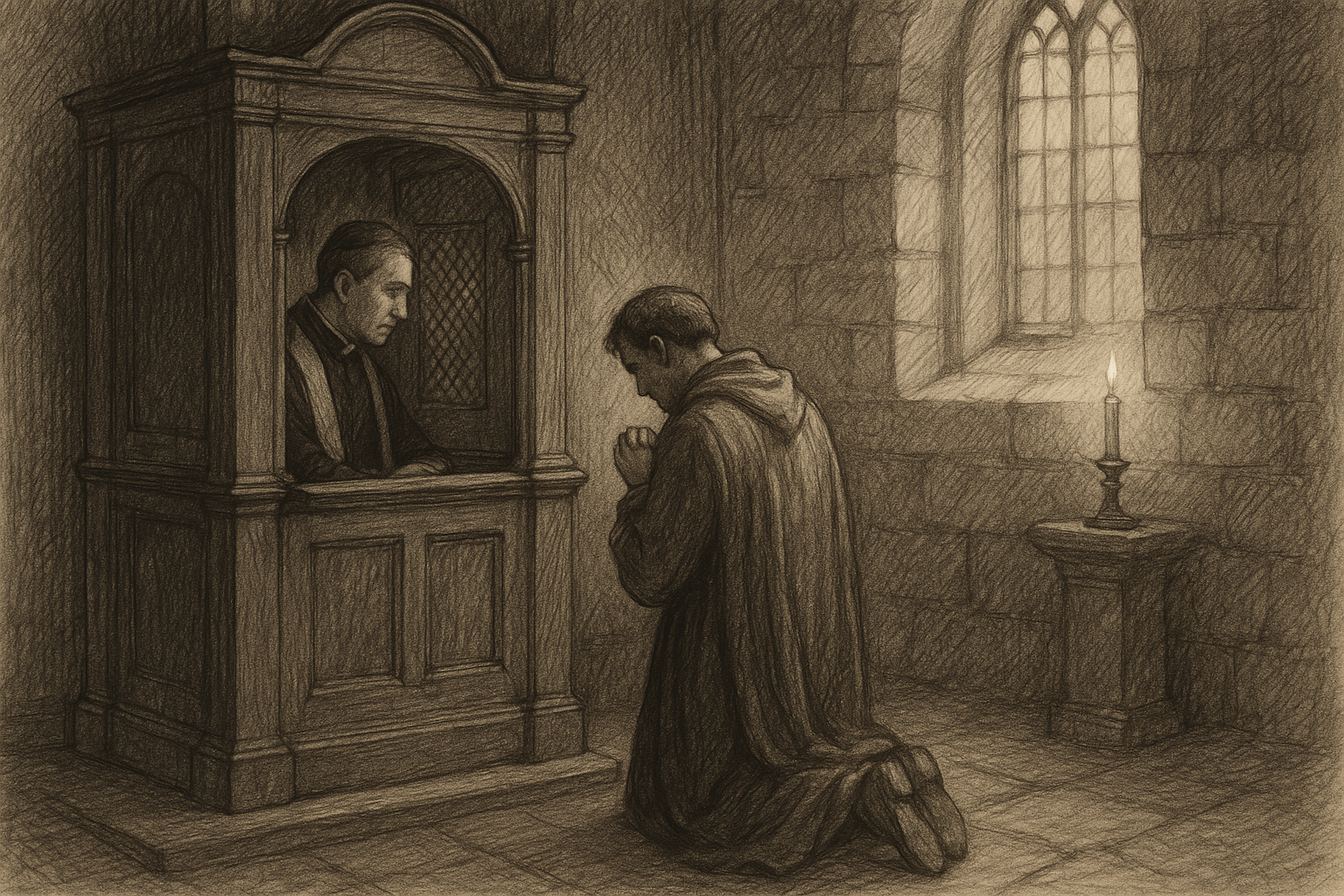
If you have been away for a while, the simplest approach is usually best. After the sign of the cross, you may say how long it has been since your last confession. Then confess your sins clearly and without unnecessary detail. Say what you did, how many times if relevant, and whether something was serious. Do not hide behind vague language. At the same time, do not become graphic or self-focused. The confessional is not a place for explanations unless they help clarify the sin.
If you forget a sin honestly, mention it in your next confession. If you have doubts, ask the priest. If you struggle with shame, say so. Priests are accustomed to hearing difficult things, and the sacrament depends more on humility than eloquence. You do not need impressive words. You need truth.
After confessing, listen to the priest's counsel, if he offers any, and pay attention to the penance. Then pray an act of contrition. There are different forms, but the essential movement is the same: sorrow for sin, trust in God's mercy, and a desire to begin again. After absolution, give thanks quietly. The moment is sacred. The soul has been washed by grace.
Common worries that can keep people away
One of the saddest obstacles to Confession is not rebellion but fear. Some people fear being judged. Others fear embarrassment. Some fear that the priest will be shocked, though priests hear sins every day and are bound by the seal of confession. Some fear that they will fail again and therefore should not bother going at all.
None of these fears should be allowed to rule the conscience.
If shame keeps you away, remember that the sacrament is built for sinners, not for the already perfect. If you fear forgetting something, make a written list before you go. If you fear you have confessed poorly before, do not despair. Simply return and ask for help. If you worry about repeated sin, remember that the struggle itself is not failure if you continue to repent. The Christian life is not measured by never falling, but by returning to Christ whenever we fall.
Sometimes people also fear that Confession will be too demanding. In a way, it is demanding. It calls for truth. But truth is liberating when it leads to mercy. The Lord never humiliates the penitent for healing him. He receives him as a father receives a child who has come home.
Confession is not a tribunal of despair. It is a place where Christ meets the sinner with truth, mercy, and the power to begin again.
Living the sacrament more deeply over time
Those who confess regularly often discover that the sacrament changes their whole spiritual life. It sharpens self-knowledge, softens the heart, and makes prayer more honest. It also helps a person see recurring sins not as private quirks but as patterns to be healed. Over time, confession becomes less about crisis and more about conversion.
A few simple habits can deepen the sacrament:
- Make a brief examination of conscience each night.
- Confess regularly, even when you have not fallen into grave sin.
- Keep your confession concise and truthful.
- Thank God after absolution instead of rushing away.
- Return to prayer and Scripture with renewed attention.
Regular confession also teaches humility. It reminds us that holiness is received, not manufactured. No one confesses his way into self-importance. He confesses his way into mercy. That is a grace worth protecting.
For many Catholics, the deepest fruit of Confession is a new habit of hope. The soul learns that sin is real, but so is forgiveness. Weakness is real, but so is grace. The past matters, but it does not have the final word. In every sincere confession, Christ speaks the stronger word.
And so when the time comes to go, go simply. Bring your conscience, your sins, your sorrow, and your trust. The Church has already prepared the place. The Father is already waiting.
Keep Reading on Lets Read The Bible
Frequently Asked Questions
How often should a Catholic go to Confession?
The Church requires confession of mortal sin before receiving Communion, and Catholics are also encouraged to confess regularly, even when they are only conscious of venial sins, because the sacrament strengthens grace and forms the conscience.
What if I forget a sin during Confession?
If the omission was honest and you later remember the sin, mention it in your next confession. A forgotten sin does not invalidate the sacrament if you confessed sincerely and to the best of your knowledge.
What is the difference between contrition and a purpose of amendment?
Contrition is sorrow for sin and a real turning of the heart toward God. A purpose of amendment is the concrete intention to avoid sin and its occasions in the future. The two belong together in a good confession.