Sacraments and Liturgy
At the Heart of the Mass: Entering the Church's Great Offering
A clear and prayerful look at the Liturgy of the Eucharist, from its biblical roots to the way Catholics can participate with greater faith.
Site Admin | August 25, 2026 | 100 views
The Liturgy of the Eucharist is the center toward which the whole Mass moves. After the readings, the homily, and the Prayers of the Faithful, the Church turns toward the altar and enters the great act of thanksgiving in which Christ's sacrifice is made present sacramentally. Catholics do not merely remember something holy that happened long ago. We are drawn into the Paschal Mystery itself, into the self-offering of Jesus to the Father for the life of the world.
For many people, this part of Mass can feel familiar but still mysterious. The gestures are repeated every Sunday, and yet each word is weighty with meaning. To understand the Liturgy of the Eucharist is to see that it is not an appendix to Mass. It is the summit of the Church's worship, the moment when bread and wine are offered, consecrated, and received as the Body and Blood of Christ.
What the Church Means by the Liturgy of the Eucharist
In the Roman Rite, the Liturgy of the Eucharist includes the preparation of the gifts, the Eucharistic Prayer, the Communion Rite, and the rites connected to receiving Holy Communion. These parts are distinct, yet they form one sacred action. The Church offers the gifts, gives thanks to God, invokes the Holy Spirit, and receives the Lord who gives Himself to His people.
The very word Eucharist means thanksgiving. That is not a decorative name. It points to the deepest meaning of the sacrament. At the Last Supper, Jesus took bread and wine, gave thanks, and said, This is my body and This is my blood [[VERSE|matthew|26|26-28|Matthew 26:26-28]]. He entrusted this act to the Church and commanded, Do this in remembrance of me Luke 22:19. The Church obeys that command at every Mass.
This remembrance is more than mental recall. In biblical worship, remembering often means making present in a liturgical way what God has done. When the priest speaks the words of consecration in the person of Christ, the Church believes that Christ truly becomes present under the appearances of bread and wine. This is the sacred mystery Catholics call the Real Presence.
The Biblical Roots of the Eucharistic Action
The Mass does not begin in the Middle Ages or even with the apostles alone. Its roots reach back through salvation history. The Passover in the Book of Exodus prefigures Christ, the true Lamb whose sacrifice frees God's people from sin and death. Jesus gives the Eucharist during the Passover meal, revealing Himself as the fulfillment of that ancient deliverance.
Saint Paul explains this mystery with striking clarity when he writes, The cup of blessing that we bless, is it not a participation in the blood of Christ? and The bread that we break, is it not a participation in the body of Christ? 1 Corinthians 10:16. Later he warns the Corinthians that the Eucharist is no ordinary meal, for anyone who receives unworthily is guilty of profaning the body and blood of the Lord [[VERSE|1-corinthians|11|27-29|1 Corinthians 11:27-29]]. These words show both the gift and the seriousness of Communion.
The Acts of the Apostles also describes the first Christians as devoted to the breaking of the bread Acts 2:42. This phrase is simple, but it is rich. It tells us that from the beginning, the Church gathered around the Eucharistic mystery. The Liturgy of the Eucharist is not a later invention. It belongs to the life of the apostolic Church and continues that living tradition today.
The Preparation of the Gifts: An Offering of the Church
The first visible movement toward the altar begins with the preparation of the gifts. Bread and wine are brought forward, along with the offerings of the faithful. This moment is often quiet, but it carries real meaning. The Church is not only placing objects on the altar. She is placing herself there. The work, gratitude, suffering, hopes, and daily sacrifices of the faithful are joined to the offering of Christ.
At this point, it is good to remember that the bread and wine are ordinary human gifts. They are fruits of the earth and of human labor. Yet they are also signs of what God can transform. What is brought from creation is taken up into divine worship. Catholics are invited to place their own lives into that same movement. A mother caring for her children, a worker who labors faithfully, a person enduring illness, a penitent returning to the sacraments, all can be spiritually united to the altar.
This is one reason the Liturgy of the Eucharist should not be treated as a performance to watch. It is an act in which the whole Church participates. Even when a person cannot receive Communion, he or she can still make a profound interior offering, joining the self-offering of Christ with the needs of the world.
The Eucharistic Prayer: The Heart of the Sacrifice
The center of the Liturgy of the Eucharist is the Eucharistic Prayer. Here the Church gives thanks to the Father through Christ in the Holy Spirit. The priest calls the assembly to lift up its hearts, and the people answer that they are turned toward the Lord. This exchange is not a formality. It is a spiritual reorientation. The Church is being drawn upward into praise.
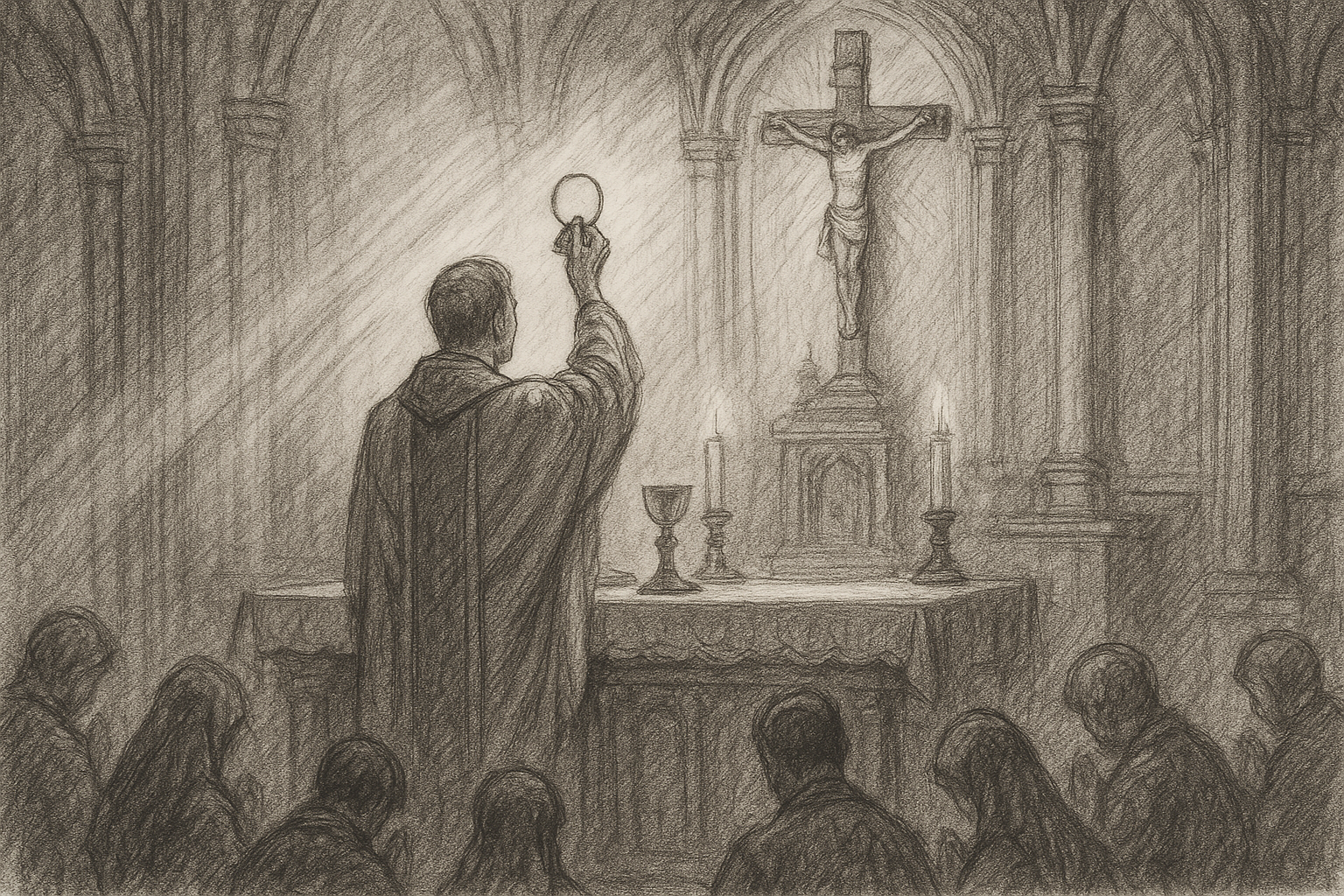
Within the Eucharistic Prayer are several essential moments: thanksgiving, the calling down of the Holy Spirit, the consecration, the memorial acclamation, and the intercessions. The words and gestures are ancient because the mystery they serve is ancient. At the consecration, the priest repeats the words of Christ over the bread and wine. Catholics believe that by the power of Christ and the action of the Holy Spirit, the substance of bread and wine becomes the Body and Blood of the Lord, even though the outward appearances remain.
This change is so profound that the Church has always guarded it with reverence. The host is not treated like ordinary bread. The chalice is not treated like an ordinary cup. After consecration, the gifts are adored because Christ is truly present. The liturgy teaches the faithful to bow, kneel, keep silence, and receive with faith. These outward signs protect an inward truth: God has come near in a way that surpasses every human expectation.
The Eucharistic Prayer is not only spoken over the gifts. It is spoken over the Church as well, because the sacrifice of Christ gathers the baptized into one body and one offering.
Holy Communion: Receiving What Has Been Given
The Communion Rite prepares the faithful to receive the sacrament. The Lord's Prayer reminds the Church that Communion belongs to children who trust their Father. The sign of peace expresses reconciliation and ecclesial charity. The fraction of the bread recalls Christ broken for us. Then the Church kneels before the Lamb of God and hears the words of centurion faith echoed in every Mass: Lord, I am not worthy that you should enter under my roof Matthew 8:8.
Receiving Holy Communion is never a private spiritual transaction. It is an ecclesial act. To receive the Eucharist is to be joined more deeply to Christ and to His Church. It is also to accept the call to live in a manner worthy of the gift received. Communion should strengthen charity, humble pride, and deepen obedience to the Gospel.
For Catholics in a state of grace, Holy Communion is a tremendous gift and a profound obligation of love. For those who are not prepared to receive, the Church encourages a spiritual communion of longing and trust. Such a prayer is not a lesser imitation. It is a genuine act of faith that asks the Lord to deepen desire for sacramental union.
How the Early Church Handed On This Mystery
The Church's Eucharistic worship developed in form, language, and ceremonial detail over time, but the core remained the same: offering, thanksgiving, consecration, and Communion. Early Christian communities gathered on the Lord's Day, read the Scriptures, prayed, and broke bread. As persecution waned and the Church's public worship became more structured, the liturgy took on richer ceremonial expression, yet its center remained the same altar and the same sacrifice.
The writings of the Fathers of the Church bear witness to this continuity. They speak of the Eucharist with reverence, identifying it as the true Body and Blood of Christ and as the sacrifice of the Church. What Catholics celebrate today is not an archaeological recreation. It is the living tradition of the Church, handed down in prayer and doctrine, preserved through centuries of worship.
That historical continuity matters because it reminds us that the Mass is bigger than any one age. It belongs to the whole Church, across time and place. When a Catholic attends Mass today, he or she stands in the same worshipful stream that has flowed from the Upper Room through the saints, martyrs, missionaries, and ordinary believers of every generation.
How to Participate More Faithfully
Many Catholics want to participate more fully in the Liturgy of the Eucharist, but they are not always sure how. The answer is often simpler than we think. Faithful participation begins with interior attention. Try to arrive at the offertory already recollected, not rushed. Let the silence after the readings prepare your heart for the altar.
It also helps to follow the structure of the Mass consciously. When the gifts are brought forward, unite your own intentions to them. When the priest begins the Eucharistic Prayer, make an interior act of adoration. When the words of consecration are spoken, pause in silent reverence if possible. When the congregation sings or says the Memorial Acclamation, let your heart renew its faith in Christ's death, resurrection, and coming again.
Before receiving Communion, examine your conscience honestly. If you are aware of serious sin, seek the sacrament of Reconciliation before approaching the altar. This is not meant to discourage anyone. It is meant to protect the holiness of Communion and to help the soul receive the Lord with purity of heart. If you cannot receive sacramentally, remain prayerfully present and ask for the grace of spiritual communion.
After receiving Communion, do not rush away inwardly. The moments following Communion are precious. Thank the Lord quietly. Speak to Him in simple words. Adore Him for His nearness. Ask Him to reshape your desires. The fruit of the Eucharist is not only personal consolation. It is conversion, unity, and mission.
What the Liturgy of the Eucharist Asks of Us
The Liturgy of the Eucharist asks for reverence, but it also asks for surrender. Christ gives Himself completely. The Church is invited to do the same. That means allowing the Mass to teach us patience, humility, gratitude, and love. It means understanding that worship is not self-expression, but self-offering. It means coming to the altar with empty hands and a willing heart.
In a world that often treats sacred things lightly, the Liturgy of the Eucharist restores the soul's sense of holy reality. Here God acts. Here the Church gives thanks. Here Christ feeds His people with the bread of life. When Catholics participate with faith, they are not merely attending a ceremony. They are standing before the mystery of divine love made present in the Church's prayer.
And so each Mass invites the faithful to say, with renewed gratitude and trust, that what is offered on the altar is not only bread and wine, but the life of Christ given for us, and the lives of His people joined to Him in worship, waiting to be made new in His presence.
Keep Reading on Lets Read The Bible
Frequently Asked Questions
What is the main purpose of the Liturgy of the Eucharist?
Its purpose is to offer thanksgiving to the Father, make present the sacrifice of Christ sacramentally, and unite the faithful to Jesus in Holy Communion.
Why do Catholics kneel during the Eucharistic Prayer and after the consecration?
Kneeling expresses adoration, humility, and reverence before Christ truly present in the Eucharist.
What should I do if I cannot receive Holy Communion?
Remain prayerfully present, make an act of spiritual communion, and ask God to deepen your desire for the sacrament and your readiness to receive it worthily.