Sacraments and Liturgy
At the Altar of Thanksgiving: Entering the Liturgy of the Eucharist with Faith
From the preparation of the gifts to Holy Communion, the Church leads us into the heart of Christ's sacrifice and banquet.
Site Admin | August 24, 2026 | 76 views
What the Liturgy of the Eucharist is
The Liturgy of the Eucharist is the part of the Mass in which the Church offers bread and wine, invokes the Holy Spirit, remembers Christ's saving work, and receives the Body and Blood of the Lord. It is not an added devotion or a symbolic pause in the liturgy. It is the center toward which the earlier parts of Mass move and from which the life of the Church flows.
At the altar, the Church does what Christ commanded at the Last Supper: do this in remembrance of me. The words of Jesus are not treated as a mere memory of the past. In the liturgy, the Church enters the one sacrifice of Christ made present sacramentally, so that the faithful may receive the gift of communion with Him. As Scripture says,
This is my body, which is given for youand again,
This is my body that is for you.
For Catholics, the Eucharist is not simply a powerful sign. It is the true sacrament of Christ's Body and Blood. That is why the Liturgy of the Eucharist is marked by reverence, silence, lifting up of hearts, and careful gestures. The Church is not trying to decorate an idea. She is standing before a mystery.
Where this part of the Mass comes from
The structure of the Liturgy of the Eucharist reaches back to the Last Supper and the earliest Christian worship. The Gospels show Jesus taking bread, giving thanks, breaking it, and giving it to His disciples. The Church recognized that these actions were not merely historical details but the pattern of Christian worship. In the Acts of the Apostles, believers gather in the breaking of the bread, and the first Christians understand the Eucharistic meal as part of the life of the Church.
Saint Paul also gives us one of the clearest early witnesses to Eucharistic faith. He teaches that the bread which we break is a participation in the Body of Christ, and the cup of blessing is a participation in the Blood of Christ. He even warns the Corinthians against receiving in an unworthy manner, a reminder that the Eucharist is holy beyond ordinary food and drink. The Apostle's seriousness helps explain why Catholics still prepare carefully for Communion and why the Church asks the faithful to examine their consciences.
The basic movement of the liturgy is ancient and remarkably stable. Gifts are brought forward, the priest gives thanks and prays over them, the memorial of Christ's Passion, Death, and Resurrection is proclaimed, and the faithful are fed from the altar. Across centuries, languages, music, architecture, and local customs have varied, but the core reality has remained the same: Christ gives Himself to His Church.
The movement from offering to communion
The Liturgy of the Eucharist has a quiet logic. The Church begins with gifts from the people, then returns those gifts to God in thanksgiving, and receives them back transformed by grace. What begins as bread and wine becomes the sacramental presence of Christ. What begins as our offering becomes, through the power of the Holy Spirit and the words of consecration, the Lord's own gift to us.
This is why the preparation of the gifts matters. It is easy to see this part as practical housekeeping, but it has spiritual meaning. The bread and wine represent the work of human hands and the fruit of creation. They also stand for our own lives, our labor, our suffering, our gratitude, and our need. At Mass, the Church places everything on the altar and asks God to sanctify it.
Then comes the Eucharistic Prayer, the high point of the entire Mass. The priest speaks on behalf of the Church, and the congregation enters a posture of awe. The prayer gives thanks to the Father, recalls the saving deeds of Christ, and asks for the Holy Spirit. It is one prayer, but it contains many layers: praise, memory, sacrifice, intercession, and communion.
Within that prayer, the words of consecration are central. Catholics believe that at that moment the bread and wine become the Body and Blood of Christ. The change is real, though invisible to the senses. The Church calls this mystery the Real Presence because Christ is truly, really, and substantially present under the appearances of bread and wine.
I am the living bread that came down from heaven
Jesus' teaching in the Bread of Life discourse is essential here. He does not say merely that He gives bread, but that He Himself is the bread of life. The Liturgy of the Eucharist is the Church's living response to that promise.
Why the Eucharist stands at the center of Catholic life
The Eucharist is not one devotion among many. It is the sacrament in which Christ feeds His people with His own life. Everything in the Christian life tends toward communion with Him, and the Eucharist makes that communion most intimate and concrete. The Mass does not only remind us of Jesus. It joins us to Him.
This is why the Church speaks of the Eucharist as both sacrifice and banquet. It is sacrifice because it makes present the one sacrifice of Calvary in sacramental form. It is banquet because the faithful are invited to receive the Lamb of God and be nourished by His self-gift. These two truths do not compete. They belong together.
When Catholics approach Communion, they are not approaching a symbol of welcome, though welcome is certainly involved. They are approaching the Lord Himself, who gives Himself in mercy. That reality calls for love, humility, and preparation. It also calls for gratitude, because no one earns this gift. We receive it.
The Eucharist shapes the whole Church. It gathers scattered believers into one body. It strengthens charity. It teaches us that worship is first about God, not about ourselves. It also sends us into the world with a transformed identity. The person who receives Christ is meant to become more like Christ, especially in patience, sacrifice, and service.
How an ordinary Catholic can enter it more deeply
Many Catholics attend Mass faithfully but still feel they are watching the Liturgy of the Eucharist from a distance. The answer is not necessarily to do more with outward activity. Often the invitation is to become more attentive, more prayerful, and more interiorly prepared.
One simple help is to arrive at Mass already making an offering. Bring to the altar your gratitude, your needs, your joys, and your burdens. When the gifts are prepared, quietly unite your own life to them. You may even pray in your heart, Lord, receive all I am and all I have.
Another help is silence. The Eucharistic Prayer is not background music for our thoughts. It is holy speech. Learn to let the words of the priest shape your prayer. Listen for the thanksgiving, the remembrance of Christ, the invocation of the Spirit, and the petitions for the living and the dead. Even if you do not understand every liturgical detail, you can still pray with reverence and attention.
It also helps to prepare for Communion well before Sunday. If you are conscious of serious sin, go to Confession. If you are fasting as the Church asks, keep that fast as a small act of longing. If you are able, make a brief act of faith before receiving: Lord, I believe; help my unbelief. Such prayer does not replace the liturgy. It opens the heart to it.
After receiving Communion, resist the urge to rush inwardly or outwardly. Make room for thanksgiving. The Lord has come to you. Speak to Him simply. Adoration, gratitude, sorrow for sin, and trust in His mercy are all fitting responses. A few quiet moments after Communion can shape the soul more deeply than many words spoken elsewhere.
What the gestures and prayers are teaching us
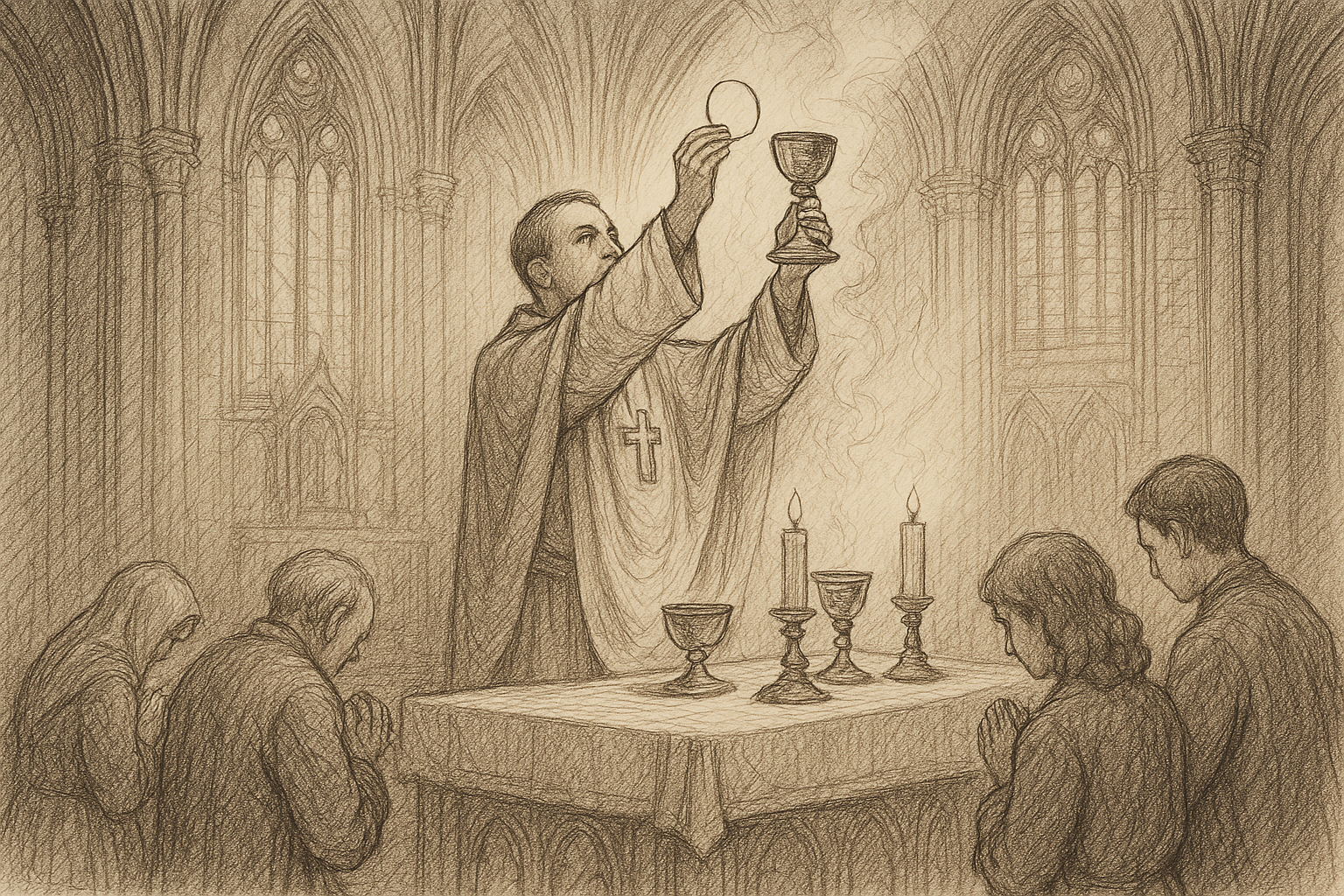
The liturgy teaches through action. When the priest elevates the host and chalice, the Church sees what her faith confesses. When the faithful kneel, stand, and respond, they are not merely following directions. They are entering a sacred pattern of reverence and assent.
The liturgy's repeated words matter too. The prayer of thanksgiving forms the Christian heart. The memorial of Christ keeps the Church rooted in salvation history. The invocation of the Spirit reminds us that grace is gift, not manufacture. The final doxology points everything back to the Father, through the Son, in the Holy Spirit. Nothing in the Eucharist belongs to the Church alone. Everything is received and offered in God.
For this reason, the Liturgy of the Eucharist also teaches humility. We do not control the mystery. We enter it. We do not explain it away. We adore it. And while it is proper to learn the words, the symbols, and the structure, the deeper lesson is always worship. The heart must learn to say with the Church, Amen, not as a formality, but as a real act of faith.
Whoever eats my flesh and drinks my blood remains in me and I in him
That promise gives the liturgy its warmth and gravity. Christ remains in those who receive Him, and they remain in Him. The more a Catholic lives from that truth, the more the Mass becomes not merely something attended, but a life entered.
Living the Eucharist beyond Sunday
The Liturgy of the Eucharist does not end when Mass ends. It sends the faithful outward into a Eucharistic way of life. If Christ gives Himself completely, then the Christian life must become a life of self-gift as well. That may look ordinary from the outside: patient family life, honest work, hidden acts of mercy, forgiveness, prayer, and fidelity in small things.
It can also shape the way Catholics think about the poor, the sick, the lonely, and those who are difficult to love. The same Lord received on the altar is encountered in those who need compassion. Communion with Christ is not meant to remain private. It becomes charity in action.
A practical Catholic life around the Eucharist might include a few steady habits:
- Attend Mass with intentionality, not as a routine obligation only.
- Make a habit of thanksgiving before and after Communion.
- Go to Confession when needed so that Communion is received with a clear conscience.
- Visit the Blessed Sacrament when possible and spend quiet time in adoration.
- Let the Eucharist shape weekly choices in family life, work, and speech.
Even these small practices can deepen love for the Mass. The goal is not spiritual performance. The goal is communion. The more the heart learns to receive Christ reverently, the more it learns to give itself with Him.
In the end, the Liturgy of the Eucharist is the Church standing where she has always stood: before the Lord who feeds His people with His own life. The altar is not an endpoint but a meeting place, where thanksgiving becomes sacrifice and sacrifice becomes communion, and where ordinary Catholics are invited to receive a gift greater than they can measure.
Keep Reading on Lets Read The Bible
Frequently Asked Questions
What happens during the Liturgy of the Eucharist at Mass?
The Church brings forward bread and wine, gives thanks to the Father, invokes the Holy Spirit, and through the words of consecration believes the bread and wine become the Body and Blood of Christ. The faithful are then invited to Holy Communion.
Why do Catholics call the Eucharist both sacrifice and banquet?
It is a sacrifice because it makes present sacramentally the one sacrifice of Christ on the Cross. It is a banquet because Christ feeds His people with His own Body and Blood, uniting them to Himself and to one another.
How can I prepare better for Communion?
Prepare by attending Mass prayerfully, examining your conscience, going to Confession if you are conscious of grave sin, observing the Eucharistic fast, and making a sincere act of faith and gratitude before receiving the Lord.