Sacraments and Liturgy
At the Ambo: Entering the Church's First Great Conversation
A faithful look at the Liturgy of the Word, where God speaks and the Church learns how to listen.
Site Admin | August 23, 2026 | 93 views
The Church gathers to listen
Many Catholics can describe the moment when the priest elevates the host, but fewer can explain the sacred drama that has already unfolded before the Eucharistic Prayer begins. The Liturgy of the Word is not a warm up or a prelude. It is one of the two great parts of the Mass, joined inseparably to the Liturgy of the Eucharist. In it, God speaks to His people, and the Church answers with faith.
When people ask for the Liturgy of the Word explained, they are often looking for more than a list of readings. They want to know why the Church places so much weight on the Scriptures at Mass, how the readings fit together, and what changes when a Catholic learns to listen as if the words were spoken for the first time. The answer is simple, though never small: at Mass, the living God addresses His people through His word, and that word asks for conversion.
In the Roman Rite, the Liturgy of the Word ordinarily includes the first reading, the responsorial psalm, the second reading on Sundays and solemnities, the Gospel, and the homily, followed by the Creed and the Prayer of the Faithful on most Sundays and feast days. This is not a random collection of texts. The Church arranges them so that the salvation story is proclaimed in a living way, and so that Christ Himself remains at the center.
Scripture at Mass is not read like an archive
Catholics do not hear the Bible at Mass as if it were an old record of religious ideas. The Church proclaims Scripture because God still speaks through it. The readings are not merely information about the past. They are the voice of the Lord for the present hour. This is why the lector says, The word of the Lord, and the people answer, Thanks be to God. That exchange is short, but it is not casual. It is an act of faith.
The roots of this way of worship reach deep into Israel's prayer. In the synagogue, the people gathered to hear the Law and the Prophets read aloud. Jesus Himself took part in this pattern, as when He read from Isaiah in the synagogue at Nazareth and declared the Scripture fulfilled in their hearing. The early Church inherited that living practice and placed the apostolic witness and the Gospel at the center of Christian worship. The Mass did not invent hearing the word of God together, but it fulfilled and transformed it in Christ.
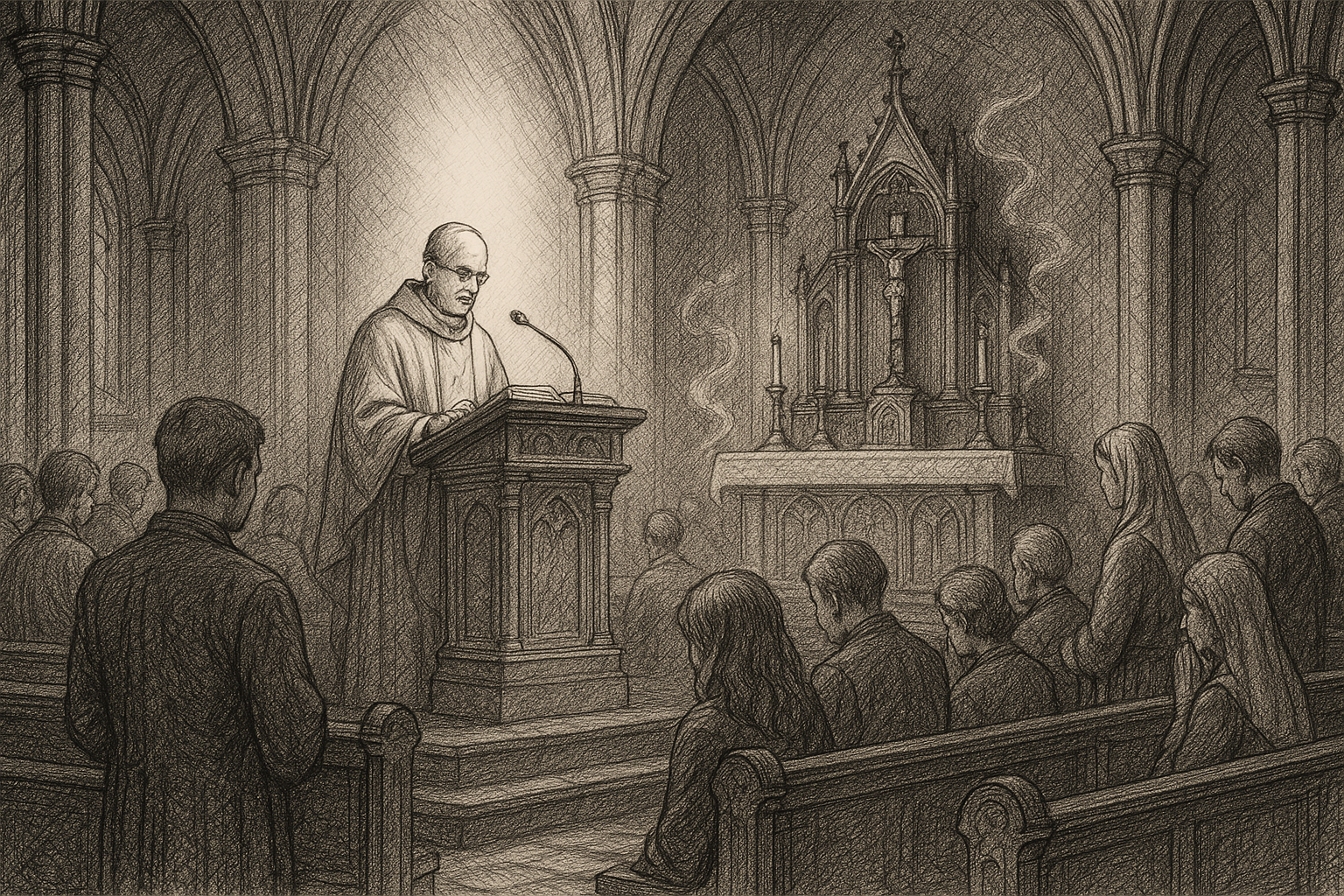
The Constitution on the Sacred Liturgy, Sacrosanctum Concilium, teaches that Christ is present in His word, for it is He Himself who speaks when the Scriptures are proclaimed in the Church. That teaching helps explain why the ambo is treated with reverence. The Gospel is often carried in procession, incense may be used, and the people stand to hear it, because the Church recognizes that the Lord is about to speak in a uniquely solemn way.
How the readings move the soul
There is a wisdom in the order of the Liturgy of the Word. The first reading usually comes from the Old Testament on Sundays, showing that the promises, covenants, and hopes of Israel are ordered toward Christ. During the Easter season, the first reading is often taken from the Acts of the Apostles, so that the Church hears how the risen Lord continues His work through the Spirit.
The responsorial psalm is not filler between readings. It is the Church's own prayerful response to what has just been proclaimed. The psalms teach us how to answer God with praise, lament, trust, and repentance. They are Scripture responding to Scripture, and the congregation takes part by singing or reciting the refrain. In this way, the people do not remain passive listeners. They are drawn into prayer.
The second reading, usually from the apostolic letters or Revelation, gives the Church the teaching and exhortation of the apostles. On Sundays, these readings continue through much of the year, allowing Catholics to hear the moral and doctrinal life of the Church as a sustained witness. Then the Gospel arrives, and everything turns toward Christ's own words and deeds. The people stand because the Church knows that here the Bride hears the voice of her Bridegroom.
The Word proclaimed at Mass is not a human lecture about God. It is God addressing His people within the Church, summoning them to faith, repentance, and communion.
The homily belongs to the same sacred act
Some Catholics think of the homily as an optional commentary, but the Church sees it as part of the liturgy itself. The homily unfolds the Scriptures, connects them to the mysteries being celebrated, and helps the faithful hear the word with understanding. When well preached, it does not replace the readings or distract from them. It serves them.
A faithful homily should keep Christ at the center. It should lead the hearer from the text to the mystery of salvation, from the mystery to conversion, and from conversion to worship. The best homilies do not merely inform the mind. They call the heart to repentance, gratitude, and trust. When the preacher opens the Scriptures faithfully, he helps the assembly hear the living voice of the Shepherd.
This is one reason the Liturgy of the Word explained in Catholic terms is never just about better biblical literacy. Of course Catholics should know the Bible. But the purpose of the readings and homily is deeper than study. At Mass, the word is proclaimed so that believers may be formed as disciples and prepared for sacramental communion. The word and the Eucharist belong together.
From hearing to believing to answering
The Creed and the Prayer of the Faithful show that the Liturgy of the Word does not end with hearing. It presses toward response. The Creed is the Church's act of assent to the revelation just heard. It is not a private opinion but the public faith of the baptized. By reciting it together, the faithful answer God with one voice.
The Prayer of the Faithful follows as a work of intercession. Having listened to God, the Church now brings the needs of the world before Him. She prays for the Church, the world, the suffering, the local community, and the dead. This is a priestly act shared by all the baptized. The Church heard the word, believed it, and now turns that hearing into petition.
In this way, the Liturgy of the Word forms a complete movement. God speaks. The Church listens. The Church responds in praise, assent, and intercession. Nothing about this is decorative. It is the spiritual training of a people learning to live by every word that comes from the mouth of God.
What a Catholic can do to participate more faithfully
Many Catholics desire to pay better attention at Mass but are not sure where to begin. The first step is simple: arrive with the intention to listen. That may sound obvious, but intention matters. Before Mass begins, it helps to ask for the grace to hear the readings as addressed personally and communally by the Lord.
Reading the Scripture passages before Mass can also deepen participation. When the Sunday readings are already familiar, the ear is freer to notice what stands out in the proclamation. But reading ahead should not become an excuse to stop listening. The Mass is not a rehearsal for private study. It is an event of grace happening in real time.
During the readings, a Catholic can make a few quiet acts of attention:
- Listen for repeated words or images.
- Notice how the first reading and Gospel relate.
- Pray the psalm refrains slowly, even inwardly if needed.
- Ask what conversion the word may be asking for today.
- Offer one concrete intention during the Prayer of the Faithful.
It also helps to adopt the bodily signs of reverence that the Church gives. Sit attentively for the readings, stand for the Gospel, and avoid unnecessary distraction. These gestures are not empty habits. They train the soul to recognize that something holy is happening. The body often learns what the mind resists.
When a Catholic leaves Mass with only a single line from the readings or homily, that is not failure. Sometimes the Holy Spirit presses one phrase into the heart more deeply than the rest. A single verse can be enough to guide prayer through the week. The goal is not to collect religious information but to let the word bear fruit.
Why the Liturgy of the Word belongs to the whole Church
The Church does not reserve the Liturgy of the Word for scholars or those with a strong memory for passages. It is given to the whole people of God. Children hear it, the elderly hear it, the newly baptized hear it, and those returning after long absence hear it. In this common hearing, the Church becomes visibly what she already is by grace: a people called together by God.
This is also why the Liturgy of the Word has a missionary character. The Scriptures proclaimed at Mass are not merely for the already convinced. They announce the saving deeds of God in Christ and invite a fresh act of faith. Even when the texts are familiar, they are never exhausted. The word of God is living, and the Church trusts that it still searches hearts, heals wounds, and awakens hope.
The faithful who approach the readings with humility often discover that the liturgy is reading them as much as they are reading it. A passage about trust may expose anxiety. A psalm of repentance may reveal hidden sin. A Gospel miracle may renew hope where discouragement had settled in. This is not accidental. The Scriptures are living because the Lord who inspired them still acts through them in His Church.
For Catholics who want the Liturgy of the Word explained in a way that is practical and true, the simplest answer is this: listen as someone being addressed by God, not as a spectator of sacred language. Let the readings, psalm, homily, Creed, and prayers shape your mind and heart. Then the Mass will no longer feel like a series of parts to get through. It will feel like what it truly is, the Church gathered around the voice of her Lord, waiting to be sent forth in peace.
Keep Reading on Lets Read The Bible
Frequently Asked Questions
What is the Liturgy of the Word in the Catholic Mass?
It is the part of the Mass in which Scripture is proclaimed, the homily is preached, the Creed is professed on most Sundays and solemnities, and the Prayer of the Faithful is offered. It prepares the Church to enter the Liturgy of the Eucharist.
Why does the Church place Scripture readings before the Eucharist?
Because God first speaks to His people, calling them to faith and repentance, before they are invited to sacramental communion. The word and the Eucharist belong together in one act of worship.
How can I pay better attention during the Liturgy of the Word?
Read the Sunday readings beforehand if possible, listen for key phrases, pray the psalm refrain, stand attentively for the Gospel, and ask what the readings are asking you to believe or change in your life.