Sacraments and Liturgy
The Week That Draws Us Into the Heart of Christ
How the Church enters the Passion, death, and Resurrection of Jesus through prayer, liturgy, silence, and hope
Site Admin | September 3, 2026 | 75 views
Holy Week has a different character from every other week of the year. The Church's prayer becomes more solemn, familiar routines give way to ancient rites, and the events at the center of the Christian faith are proclaimed with unusual fullness. We hear the crowds welcome Jesus, sit with him at the Last Supper, stand near his cross, wait beside his tomb, and rejoice at the news that he has risen.
These days are not meant to be observed from a safe distance. Through the liturgy, the Church invites us to enter the mystery of Christ's saving death and Resurrection. We do not pretend that the events are happening again, nor do we merely stage a historical reenactment. Rather, the one Paschal Mystery is made present sacramentally, and the faithful are drawn into its grace.
A useful Holy Week Catholic guide should therefore offer more than a schedule. It should help us understand what the Church is doing and how we can respond with faith.
What Holy Week is
Holy Week begins with Palm Sunday of the Passion of the Lord. It leads through the final days of Lent and into the Sacred Paschal Triduum, which begins with the Evening Mass of the Lord's Supper on Holy Thursday. The Triduum reaches its summit in the Easter Vigil and concludes on Easter Sunday evening.
Although we often speak of Holy Thursday, Good Friday, and the Easter Vigil as separate services, the Triduum has the character of one great movement. The Church passes from the supper room to Calvary, from Calvary to the silence of the tomb, and from the tomb to the light of the Resurrection.
The unity of these days matters. The cross cannot be separated from the Resurrection, and Easter joy cannot be separated from the self-giving love revealed on the cross. Saint Paul connects Christian life with this whole mystery: through Baptism, we are buried with Christ so that we may also walk in newness of life. Romans 6:4
Where the observance comes from
Holy Week grows from the Gospel accounts of Jesus' final days and from the earliest Christian celebration of his Passover from death to life. Christians gathered from the beginning to remember the Lord's death and proclaim his Resurrection, especially in the Eucharist and on the Lord's Day.
Over the early centuries, the annual Christian observance of Pascha took on a richer liturgical form. The Church in Jerusalem had a particular influence because Christians there could pray at places associated with the Passion and Resurrection. As these customs spread, local churches developed solemn celebrations of the Lord's entrance into Jerusalem, the Last Supper, the Passion, the cross, the burial, and the Resurrection.
The biblical roots remain visible throughout the week. On Palm Sunday, the Church remembers Christ entering Jerusalem amid cries of praise: Matthew 21:9. At the Mass of the Lord's Supper, she remembers the institution of the Eucharist, faithfully handed on in the apostolic tradition: [[VERSE|1-corinthians|11|23-26|1 Corinthians 11:23-26]]. On Good Friday, she proclaims the Passion and hears the final words of Christ before his death: John 19:30. At Easter, she receives anew the angelic announcement that the crucified Lord is risen: [[VERSE|luke|24|5-6|Luke 24:5-6]].
Holy Week is therefore not an isolated devotional invention. It is the Church's liturgical contemplation of the mystery proclaimed in Scripture and entrusted to her faith.
The path through the week
Palm Sunday: welcoming the suffering King
Palm Sunday begins with a striking contrast. We carry branches and acclaim Christ as king, but we soon listen to the account of his Passion. Praise gives way to betrayal, abandonment, suffering, and death.
This contrast exposes the instability of the human heart. It is possible to honor Christ with our lips while resisting the kind of kingdom he brings. Jesus does not conquer through worldly force. He reigns through obedient, sacrificial love.
Keep the blessed palm reverently after Mass. It is a sacramental, a sacred sign that disposes us to receive grace. Place it near a crucifix or holy image rather than treating it as a souvenir. Let it recall both your welcome of Christ and your need for deeper conversion.
Monday through Wednesday: remaining close to Jesus
The first days of Holy Week are quieter, but they should not become ordinary days with a religious label. The Mass readings direct attention toward the approaching Passion. These days offer time to simplify plans, finish practical preparations, and make room for prayer.
In many dioceses, the bishop celebrates the Chrism Mass during Holy Week, although pastoral needs may place it on another day. At this Mass, the oils used in the sacramental life of the Church are blessed or consecrated, and priests renew the promises associated with their ministry. The celebration makes visible the unity of the local Church around its bishop and the sacramental mission entrusted to it.
If attending the Chrism Mass is possible, it can be a beautiful way to pray for bishops, priests, deacons, catechumens, the sick, and all who will receive the sacraments in the coming year.
Holy Thursday: the Eucharist and the command to love
The Evening Mass of the Lord's Supper opens the Paschal Triduum. The Church gives thanks for the institution of the Eucharist and the ministerial priesthood, and she contemplates Christ's commandment of fraternal charity.
The washing of feet, when it is celebrated, points to the humble service of Jesus. After washing his disciples' feet, the Lord tells them to follow his example: [[VERSE|john|13|14-15|John 13:14-15]]. Christian love is not sentimental. It kneels, serves, forgives, and accepts inconvenience for the good of another.
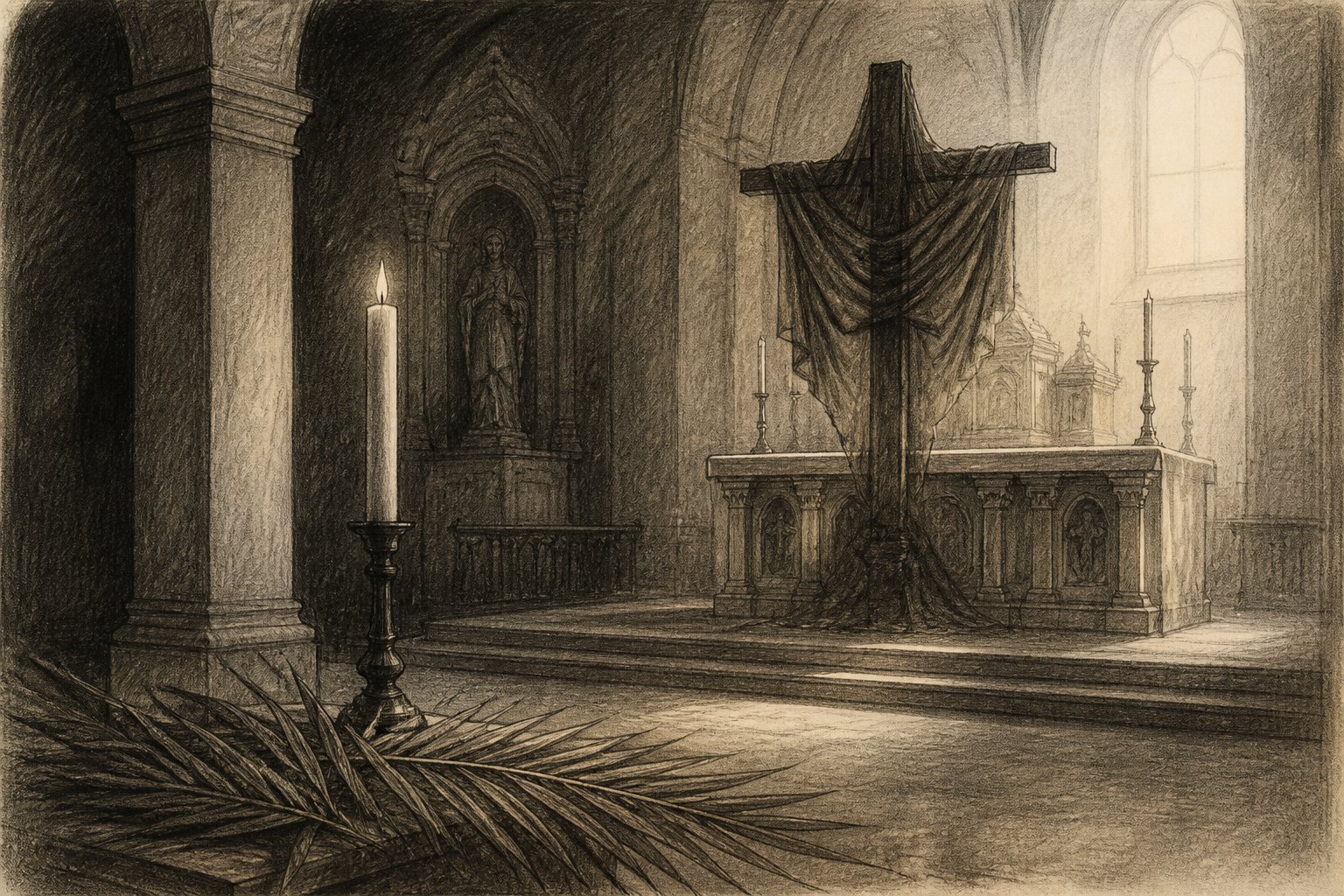
At the end of Mass, the Blessed Sacrament is carried in procession to a place of repose. The altar is stripped, and the mood becomes watchful and sorrowful. Catholics are encouraged to spend time in adoration, remembering Christ's agony and his request that his disciples remain awake with him.
Good Friday: standing before the cross
Good Friday is the solemn commemoration of the Passion and death of the Lord. Mass is not celebrated. The liturgy includes the proclamation of the Passion, the solemn intercessions, the veneration of the cross, and the reception of Holy Communion consecrated previously.
The Church asks Catholics who are able to observe both fasting and abstinence on this day according to her discipline. This bodily practice is not meant to prove spiritual strength. It creates a real, physical space for repentance, prayer, and solidarity with the suffering Christ and with those who hunger.
Veneration of the cross is not worship of an object. The reverence shown to the cross passes to Christ, who offered himself upon it. A bow, genuflection, touch, or kiss can become a simple confession of faith: the instrument of execution has become the sign of redeeming love.
Holy Saturday and the Easter Vigil: waiting for the light
During Holy Saturday, the Church waits at the tomb. Christ has died and been buried. The Gospels describe his body being laid in a new tomb and the entrance being closed with a stone: [[VERSE|matthew|27|59-60|Matthew 27:59-60]]. The restrained silence of this day should not be rushed away.
After nightfall, the Easter Vigil begins with the blessing of the fire and the preparation of the paschal candle. The liturgy moves from darkness into light, and the great sequence of Scripture readings unfolds the history of salvation. Water is blessed, the faithful renew their baptismal promises, and catechumens may receive the sacraments of initiation.
The Vigil is not simply a longer Easter Mass. It is the principal celebration of the Lord's Resurrection and one of the richest liturgies of the year. Its symbols of fire, light, word, water, oil, bread, and wine disclose the new creation brought about in Christ.
How to live Holy Week more deeply
A fruitful Holy Week does not require an elaborate private program. It requires attention, realistic preparation, and a willingness to let the Church set the pace.
- Protect the liturgies on your calendar. Check parish times early. If work, health, caregiving, or transportation limits your participation, choose what is possible without resentment or guilt.
- Receive the sacrament of Reconciliation. If you have not yet gone to confession during Lent, look for an available time before the Triduum. Do not assume that confession will be offered immediately before every major service.
- Read the Passion slowly. Set aside time for one Gospel account. Pause over the words and actions of Jesus, and notice the responses of Peter, Judas, Pilate, the soldiers, the women, and the beloved disciple.
- Reduce unnecessary noise. Consider limiting entertainment, social media, shopping, and casual busyness, especially from Holy Thursday evening through Holy Saturday.
- Practice concrete charity. Forgive an offense, visit someone lonely, give to those in need, prepare food for another household, or perform an unnoticed act of service.
- Prepare children before attending. Explain that some liturgies are long and solemn. Tell them about the symbols they will see, and bring them as fully as their age and circumstances reasonably allow.
- Keep Good Friday plainly. In addition to the required fast and abstinence when applicable, avoid turning the day into an ordinary vacation day. Allow the cross to shape the atmosphere of the home.
- Make room for Easter joy. Preparation for meals and gatherings is good, but it should serve the feast rather than replace it. Easter is first the celebration of Christ's victory.
When you cannot attend everything
Illness, disability, work, military service, distance, or the care of children and vulnerable adults may prevent someone from attending every Holy Week liturgy. The Church does not ask the impossible. Holiness is not measured by the number of services attended.
If you cannot be present, unite yourself spiritually to the Church's prayer. Read the day's Gospel, pray before a crucifix, keep a period of silence, or watch a reverently broadcast liturgy if that is helpful. A caregiver who remains home out of love is not absent from the mystery of Christ. That service can itself become a participation in the Lord's self-giving charity.
At the same time, when attendance is possible, it is worth resisting the temptation to treat the Triduum as optional decoration around Easter plans. These liturgies form the Church's deepest annual act of remembrance and worship.
Let the Church carry you through the mystery
Holy Week can reveal uncomfortable truths. We may recognize our own fickleness in the crowd, our fear in Peter, our weariness in the sleeping disciples, or our desire to avoid the cross. Yet the central figure is not our weakness but Christ's fidelity. He continues toward Jerusalem, gives himself in the Eucharist, accepts the cross, enters death, and rises in glory.
Come to these days without demanding a particular emotion. Listen when the Church listens. Kneel when she kneels. Keep silence when she keeps silence. Sing when she announces the Resurrection. Holy Week bears fruit not because we manufacture an intense experience, but because Christ has acted for our salvation and still draws his people into the life he has won.
Keep Reading on Lets Read The Bible
Frequently Asked Questions
When does Holy Week begin and end?
Holy Week begins with Palm Sunday of the Passion of the Lord. It includes the final days of Lent and the Sacred Paschal Triduum. The Triduum begins on Holy Thursday evening, reaches its summit in the Easter Vigil, and concludes on Easter Sunday evening.
Are Catholics required to attend every Holy Week liturgy?
Catholics are not generally obligated to attend every Holy Week liturgy. Easter Sunday is a holy day of obligation, fulfilled by attending Mass at the Easter Vigil or on Easter Sunday. Participation in the Holy Thursday and Good Friday liturgies is strongly encouraged when possible because these celebrations form one sacred movement through the Lord's Passion and Resurrection.
What should a Catholic do if unable to attend the Triduum liturgies?
A Catholic who cannot attend may read the appointed Scripture passages, pray before a crucifix, observe periods of silence, make a spiritual communion, or follow a reverent broadcast. Those who remain home to care for others can offer that service in union with Christ's sacrificial love.