Prayer and Devotion
A School of Quiet Attention: How the Rosary Shapes Daily Prayer
Its familiar prayers lead the mind through the life of Christ and teach the heart to remain with him.
Site Admin | November 17, 2026 | 37 views
For many Catholics, the Rosary is one of the first prayers learned and one of the last remembered. Its words accompany families, religious communities, pilgrims, hospital patients, commuters, and people sitting alone in quiet rooms. A Rosary may be held with confidence, uncertainty, gratitude, or grief. The prayer is spacious enough to receive all of these.
Yet familiarity can conceal its depth. The Rosary is not simply a chain of Our Fathers and Hail Marys. It is a form of contemplative prayer in which repeated words help us remain attentive to the life of Jesus Christ. Mary does not replace Christ or compete with him. She accompanies the person praying, directing attention toward her Son as she did at Cana:
Do whatever he tells you. John 2:5
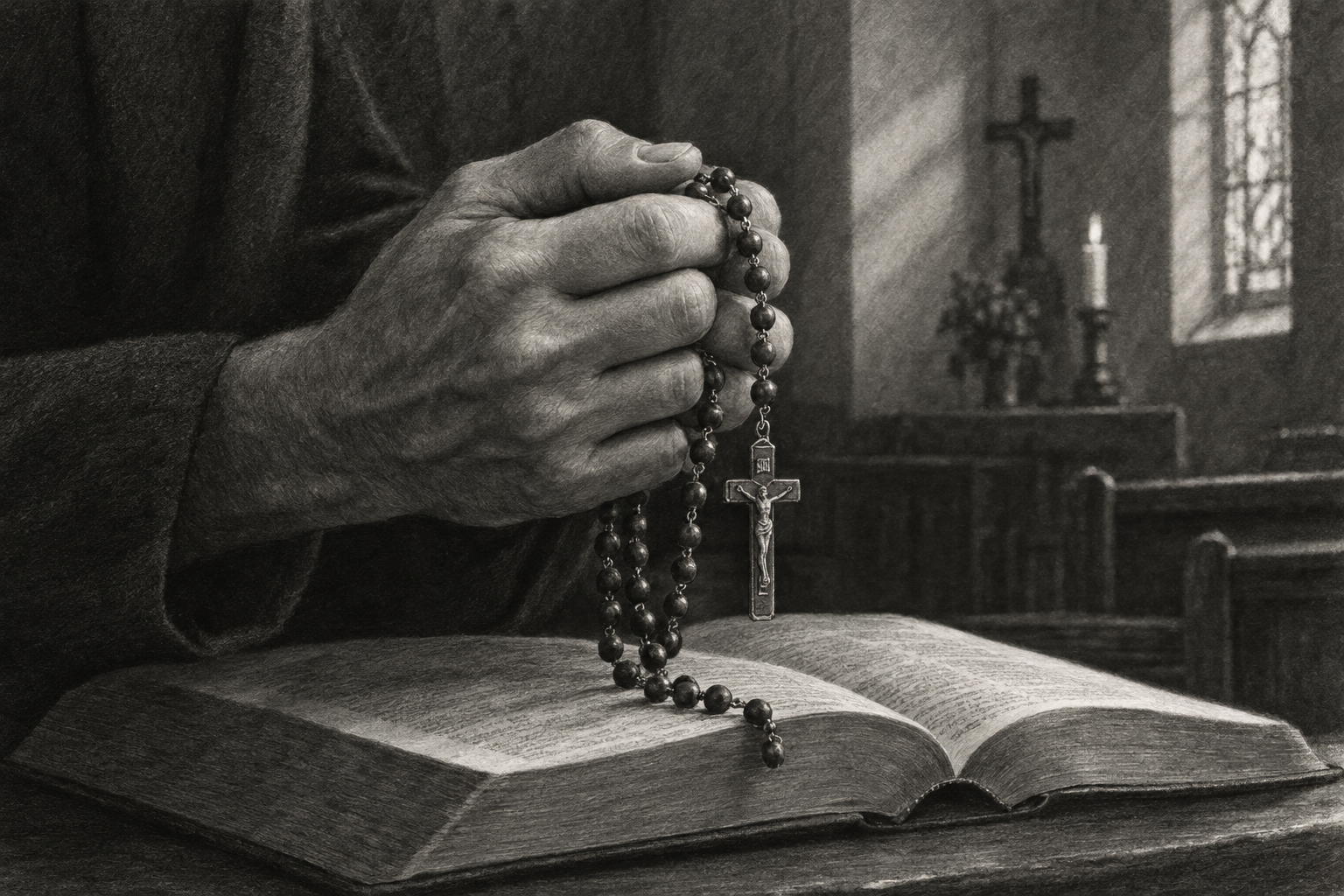
With the Rosary explained in this light, its enduring place in Catholic devotion becomes easier to understand. It gives the mind something holy to consider, the lips something faithful to say, and the hands a simple rhythm to follow.
A prayer centered on the life of Christ
The mysteries are the heart of the Rosary. Each decade places a moment from the life of Jesus before the person praying. The Joyful Mysteries begin with the Annunciation and move through the hidden years of the Holy Family. The Luminous Mysteries recall the public ministry of Christ. The Sorrowful Mysteries lead into his Passion and death. The Glorious Mysteries proclaim his Resurrection, Ascension, the coming of the Holy Spirit, and the glory God gives to Mary.
This is why the Rosary can rightly be described as a prayerful meditation on the Gospel. At the Annunciation, we hear the angel greet Mary as one who has received God's favor: Luke 1:28. At the Visitation, Elizabeth blesses Mary and the fruit of her womb: Luke 1:42. These biblical greetings form the first half of the Hail Mary.
The Our Father also comes directly from the teaching of Jesus. When his disciples ask how they should pray, he gives them words that begin by turning toward the Father and his kingdom: Matthew 6:9. The Glory Be gathers every decade into praise of the Father, Son, and Holy Spirit.
The Rosary therefore joins vocal prayer and meditation. The voice repeats familiar words while the mind attends to a mystery. This does not require a vivid imagination or a strong emotional response. Sometimes contemplation is simply the choice to remain in the presence of Christ and consider what he has done.
How the Rosary took shape
The Rosary developed gradually within the prayer of the Church. Christians have long used repeated prayers, counted with cords or beads, as an aid to attention and perseverance. In medieval Europe, some lay Christians prayed sets of Our Fathers or Hail Marys in a pattern that echoed the 150 Psalms prayed in monasteries. Over time, these prayers became more closely joined to meditation on events in the lives of Jesus and Mary.
Dominican tradition has a special association with the Rosary and with St. Dominic. The Order of Preachers played an important role in promoting and teaching the devotion. At the same time, the form familiar to Catholics today emerged through a long historical development rather than appearing all at once.
For centuries, Catholics commonly prayed 15 mysteries divided into the Joyful, Sorrowful, and Glorious groups. In 2002, St. John Paul II proposed the five Luminous Mysteries, which contemplate Christ's Baptism, the wedding at Cana, the proclamation of the kingdom, the Transfiguration, and the institution of the Eucharist. These mysteries draw attention to the public ministry of Jesus between his childhood and Passion.
This history shows a living devotion formed within the Church's worship, preaching, and meditation on Scripture. Its structure is traditional, but its purpose is never merely to preserve a custom. The Rosary exists to lead people more deeply into communion with Christ.
Why repetition belongs in prayer
Some people worry that repeating the same prayers must be empty or mechanical. Repetition can become careless, but it does not have to be. Human beings often repeat words when love, sorrow, wonder, or need exceeds what can be said once. The problem is not repetition itself. The problem is prayer without attention or sincerity.
In the Rosary, repeated words can quiet the mind's constant search for something new. They create a steady background against which a Gospel mystery can be contemplated. The rhythm resembles the repeated responses of the liturgy. It is not intended to overwhelm God with many words, but to school the heart in faithful attention.
Distraction will still occur. A decade may pass before a person realizes that the mind has wandered. The answer is not frustration. It is a gentle return to the mystery, the words, or simply the awareness that one is standing before God. Every return is itself an act of prayer.
Mary offers a fitting pattern for this interior attention. After the shepherds visit Bethlehem, the Gospel says that she treasures what has happened and reflects on it in her heart: Luke 2:19. The Rosary invites Christians into that same patient remembrance of the works of God.
Mary's place in the Rosary
Catholics do not worship Mary. Adoration belongs to God alone. Catholics honor Mary because of her unique vocation as the Mother of God and ask for her intercession as members of Christ's body ask one another for prayer.
The second half of the Hail Mary makes this request plainly: Mary is asked to pray for sinners now and at the hour of death. The prayer does not end with Mary. It seeks her help in remaining close to Jesus through every season of life, including its final moment.
This Marian character is inseparable from the Rosary's focus on Christ. In the mysteries, Mary is encountered in relation to her Son. She receives him at the Annunciation, presents him in the Temple, searches for him, stands near his Cross, prays with the disciples, and shares in the glory of his victory. Her presence teaches receptivity, trust, courage, and perseverance.
A practical way to begin
A standard five-decade Rosary can be prayed in the following order:
- Begin with the Sign of the Cross.
- Pray the Apostles' Creed.
- Pray one Our Father, three Hail Marys, and one Glory Be. The three Hail Marys are often offered for an increase in faith, hope, and charity.
- Announce the first mystery. Pause briefly to call the event to mind, then pray one Our Father, ten Hail Marys, and one Glory Be.
- Continue through all five mysteries. The Fatima Prayer may be added after each decade according to common custom.
- Finish with the Hail Holy Queen and a closing prayer. End with the Sign of the Cross.
The traditional weekly pattern is also simple:
- Monday and Saturday: Joyful Mysteries
- Tuesday and Friday: Sorrowful Mysteries
- Wednesday and Sunday: Glorious Mysteries
- Thursday: Luminous Mysteries
This schedule is a custom rather than a burden. A person may choose mysteries suited to a feast, a liturgical season, or a particular need. During a time of bereavement, for example, the Glorious Mysteries may offer needed hope. During suffering, the Sorrowful Mysteries can provide a way to remain beside Christ without pretending that pain is easy.
Making room for the Rosary in daily life
A full Rosary usually requires a modest but real commitment of time. For some people, early morning is best. Others pray while walking, riding public transportation, or resting at the end of the day. Families may pray a decade together when a full Rosary would be difficult, especially with young children.
It is better to begin humbly than to establish an ambitious routine that quickly becomes discouraging. One decade prayed attentively each day can become the foundation of a lasting habit. The full Rosary can be added gradually.
Before each decade, it may help to read a verse from the relevant Gospel scene. A brief silence can follow. The person praying might then choose one detail to hold in mind: the angel's greeting, the water changed into wine, Christ kneeling in Gethsemane, or the empty tomb. When concentration fades, that detail provides a place to return.
When prayer feels dry or difficult
The Rosary is sometimes peaceful, but not always. The words may feel dull. The mysteries may seem distant. Fatigue can make attention difficult, and sorrow may leave a person unable to form many thoughts at all.
Dryness does not necessarily mean that the prayer has failed. Christian prayer is an act of faith before it is an emotional experience. A person can offer the Rosary to God precisely as it is, with imperfect attention and little consolation. Perseverance during dryness may express love more honestly than prayer sustained by pleasant feelings.
There is also no need to rush. Slowing down, pausing between prayers, or praying only one decade can restore attention. If intrusive worries continue, they can be entrusted to God rather than treated only as interruptions. A name, a fear, or a difficult decision can be carried through each Hail Mary as an intention.
The Rosary remains valuable because it meets ordinary people within ordinary life. It can be prayed well or poorly, confidently or weakly, alone or with others. Its strength does not depend on perfect concentration. It rests in the Gospel it recalls, the intercession it seeks, and the mercy of God toward those who turn to him.
To take up the beads is to enter a patient school of remembrance. Decade by decade, the Church invites us to look again at Christ with Mary, to receive his words, to remain near his Cross, and to rejoice in his victory. Over time, those mysteries do more than occupy a few minutes of prayer. They begin to shape how suffering is endured, how gratitude is expressed, and how each day is placed in the hands of God.
Keep Reading on Lets Read The Bible
Frequently Asked Questions
Is the Rosary required for Catholics?
The Rosary is not required in the same way that participation in Sunday Mass is required. It is a treasured devotional prayer strongly encouraged by the Church. Catholics may practice other approved devotions, but the Rosary has a special value because it joins familiar prayers with meditation on the life of Christ.
Is it acceptable to pray only one decade of the Rosary?
Yes. Praying one decade attentively is a genuine form of prayer. It can be especially helpful for beginners, families with young children, people facing illness, or anyone with limited time. A daily decade may also become the beginning of a fuller Rosary habit.
Does praying to Mary take attention away from Jesus?
Authentic Marian devotion leads toward Jesus rather than away from him. In the Rosary, Catholics ask Mary to intercede for them while contemplating the mysteries of her Son's life, death, and Resurrection. Her instruction at Cana expresses the direction of true Marian prayer: Do whatever he tells you. [[VERSE|john|2|5|John 2:5]]