Saints and Witnesses
The Life of St. Clare of Assisi and What Catholics Can Learn
A faithful look at the young woman who chose Christ in poverty, prayer, and courage
Site Admin | May 11, 2025 | 81 views
Introduction
St. Clare of Assisi is one of the great saints of the Church because her life shows how complete surrender to Christ can transform everything. The St. Clare of Assisi life is not a story of fame or comfort. It is the story of a young woman who heard the Gospel, believed it with all her heart, and followed Christ with courage that still speaks to Catholics today.
Clare was born into a noble family in Assisi in the late twelfth century. Yet her heart was drawn to something greater than rank, security, or social approval. She wanted the Lord himself. In that desire, Catholics can recognize a pattern found throughout the lives of the saints: grace awakens the soul to a better inheritance, one that cannot be taken away. As Jesus teaches, the kingdom of heaven is worth every sacrifice (The treasure hidden in the field).
Who Was St. Clare of Assisi?
Clare was born in 1194 and raised in a noble household. Her family likely expected her to make a socially advantageous marriage, as was common in her time. But Providence had other plans. She grew up in a city where St. Francis of Assisi was already beginning his public conversion, and his example of repentance, joy, and poverty helped shape the spiritual atmosphere of the region.
Clare first encountered Francis while still young, and his preaching impressed her deeply. She saw in him a life ordered entirely toward Christ. The Gospel call to leave all for the Lord was no theory for Clare. It became personal. Jesus had already said, whoever loses his life for my sake will find it (Whoever loses his life will find it), and Clare believed that promise with remarkable sincerity.
Her Conversion and the Night of Her Departure
Clare's decisive step came on Palm Sunday in 1212. At around 18 years old, she left her family home and went to meet Francis and the brothers. This was not a small gesture. In the social world of her day, it meant leaving behind wealth, status, and a future arranged by others. It also meant conflict with her family, who did not initially understand her choice.
Francis received her and, after a short time, placed her with Benedictine sisters at San Paolo, then later at Sant'Angelo in Panzo, before she eventually settled at the little monastery of San Damiano. There she would remain for the rest of her life. The movement of her vocation was outwardly simple, but inwardly radical: she wanted to belong entirely to Christ.
Scripture often describes such surrender in the language of poverty and trust. Saint Paul writes, though he was rich, yet for your sake he became poor (Christ became poor for our sake). Clare's life was a response to that mystery. She chose to live in simplicity because she had found a treasure more precious than anything the world could offer.
The Poor Ladies of San Damiano
At San Damiano, Clare gathered other women who desired the same way of life. They became known as the Poor Ladies, later called the Poor Clares. Their life was centered on prayer, manual labor, fasting, and radical poverty. Clare wanted the community to depend on God's providence rather than on property or privilege.
This emphasis on poverty was not a rejection of creation or work. Rather, it was a form of evangelical freedom. Clare believed that if the community possessed little, it could cling more easily to God. Her witness reflects the beatitude of Christ: blessed are the poor in spirit (Blessed are the poor in spirit). Poverty, in the Christian sense, is not misery for its own sake. It is interior detachment, lived outwardly so that the heart may be free for God.
Clare also gave her sisters a strong spiritual identity. They were not simply withdrawn from the world. They were consecrated to intercession, adoration, and hidden fidelity. Their cloistered life became a powerful sign that prayer sustains the Church in ways the world often cannot measure.
Clare's Love for the Eucharist
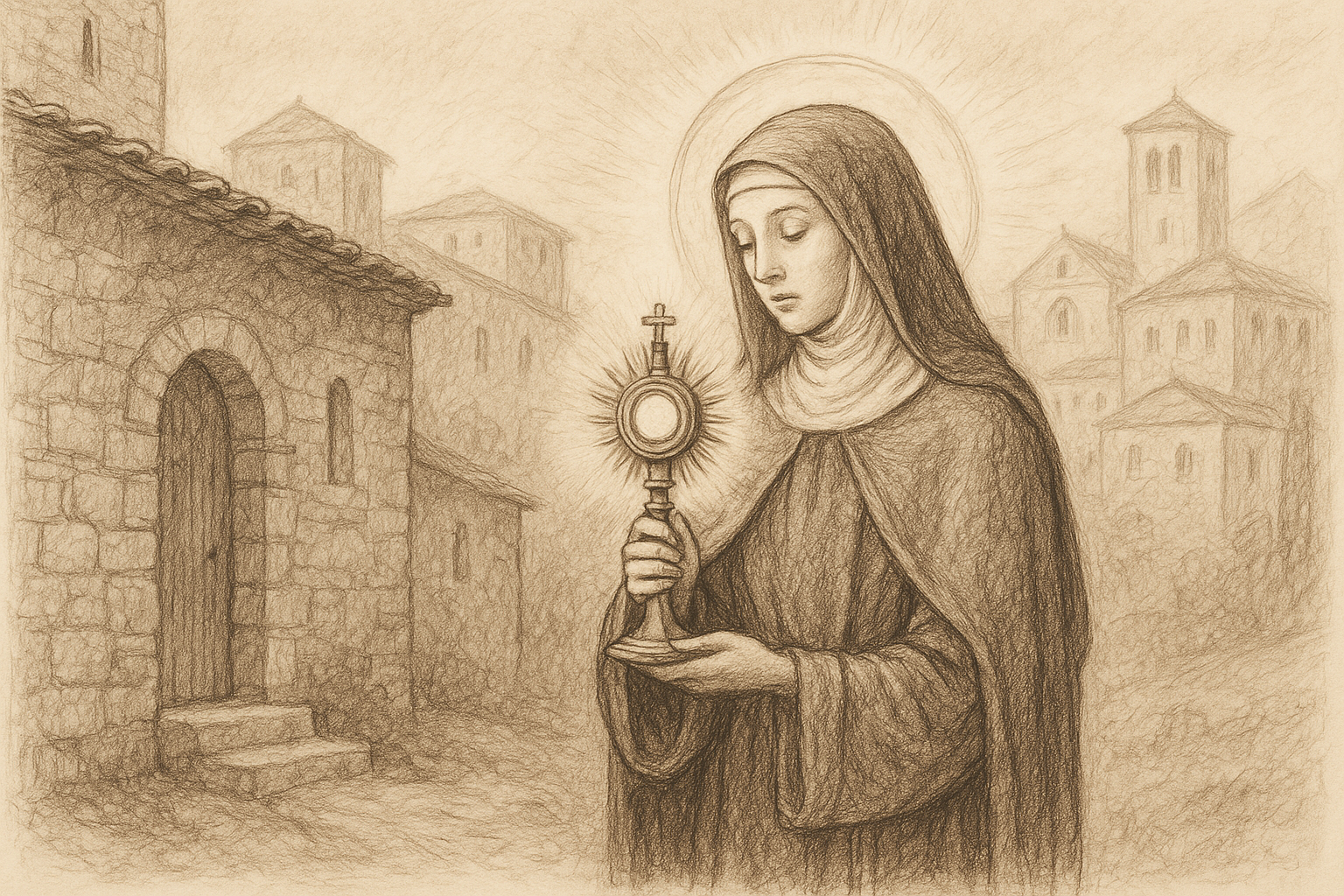
One of the most beautiful parts of the St. Clare of Assisi life is her deep devotion to the Blessed Sacrament. Tradition associates her with a famous defense of San Damiano when hostile forces threatened the monastery. According to the long-standing account, Clare had the Eucharist carried before the attackers and prayed for God's protection. The story expresses something true about her soul: she trusted in the presence of Christ himself.
For Catholics, this devotion is profoundly instructive. The Eucharist is not a symbol only. It is the Real Presence of Jesus Christ. Clare's reverence for the Eucharist flowed from faith in the Lord who gives himself to his people. When Catholics kneel before the tabernacle, or attend Mass with recollection and love, they walk in a path Clare understood very well.
Lord Jesus, I desire nothing apart from you. Keep my heart poor, my hands open, and my trust fixed on your presence.
Her Writings and Spiritual Legacy
Clare was not only an example of holiness; she was also a thoughtful woman with a strong spiritual vision. She wrote a Rule for her community that was eventually approved by Pope Innocent IV shortly before her death. This was historically significant because it safeguarded the way of life she had embraced: strict poverty, enclosure, and total dependence on God.
Her surviving letters, especially those to St. Agnes of Prague, reveal a soul on fire with love for Christ. Clare urged Agnes to cling to Jesus in humility and to imitate him in poverty. Her language is vivid and tender because she is speaking from lived experience. She had learned that holiness grows when the soul looks steadily at Christ.
That is one of the deepest lessons Catholics can take from her life. The saints are not impressive because they were naturally strong, but because grace made them faithful. Clare's perseverance was rooted in prayer, not self-confidence. She desired to be configured to Christ, and this desire shaped her daily choices for decades.
Trials, Illness, and Perseverance
Clare endured serious illness for many years. Even so, she continued to guide her community with wisdom and firmness. Illness did not make her less fruitful. In God's providence, suffering became another way for her to unite herself to Christ. Many Catholics today know the hidden sacrifice of physical weakness, chronic pain, or exhaustion. Clare reminds them that these burdens, when offered to God, are not wasted.
She died in 1253 after a long life of prayer and sacrifice. Two years later, she was canonized by Pope Alexander IV. The Church recognized what many already knew: Clare's holiness was not private sentiment. It was a luminous witness to the Gospel lived faithfully over time.
What Catholics Can Learn from St. Clare Today
Clare's life speaks to several needs of the modern Catholic heart. First, she teaches courage. She did not wait for ideal conditions before answering God. She responded while still young, and she did so against resistance. Her example encourages Catholics who feel torn between worldly expectations and the call of grace.
Second, she teaches simplicity. Most Catholics are not called to the same form of cloistered poverty, but all are called to detachment. Possessions, status, and comfort must never become idols. Clare asks us whether we are free enough to seek God above everything else.
Third, she teaches Eucharistic devotion. A Catholic life becomes weak when it is cut off from the Mass, from adoration, and from reverent faith in the Lord truly present. Clare's whole identity was shaped by the nearness of Christ in the sacrament.
Fourth, she teaches the value of hidden holiness. Not every saint preached publicly or founded large works. Some, like Clare, sanctified the Church by prayer, silence, and steadfast fidelity. In a world that prizes visibility, her life confirms that God sees what is hidden and rewards it generously (The Father who sees in secret).
Practical ways to imitate St. Clare
- Visit the Blessed Sacrament more often, even briefly, and pray with quiet attention.
- Examine one area of attachment, such as money, comfort, or approval, and offer it to the Lord.
- Practice a simple act of charity that is hidden from others.
- Read the Gospels slowly and ask for the grace to follow Christ more closely.
- Pray for the courage to say yes to God without delay.
St. Clare and the Catholic Meaning of Poverty
It is important to understand that Clare's poverty was never about disdain for matter or human dignity. The Church honors creation as good and teaches that possessions can serve the common good. But Clare shows that there is a special evangelical value in renunciation when it is freely embraced for Christ. Her poverty was a sign that God alone is enough.
This is why her witness remains relevant. Catholics today live amid constant pressure to accumulate, display, and secure themselves against uncertainty. Clare offers a gentler and stronger way. She teaches that joy is possible when the heart rests in God. The more a person clings to Christ, the less fear rules the soul.
Her life also harmonizes with the wider saintly tradition of trustful poverty and mercy. Like many saints, she demonstrates that holiness is not a matter of external success but of loving God with an undivided heart. That kind of love is always fruitful, even when it is mostly hidden from view.
In the end, the St. Clare of Assisi life invites Catholics to ask whether Christ is truly first. Her answer was clear. She gave him her youth, her plans, her possessions, her health, and her community. The Church remembers her not because she tried to be remarkable, but because she tried to be faithful. And faithfulness, in the light of grace, is one of the most remarkable things a human life can offer.
Frequently Asked Questions
Who was St. Clare of Assisi?
St. Clare of Assisi was a noble woman from Assisi who left her family and worldly expectations to follow Christ in poverty and prayer. She founded the Poor Clares and lived a life of hidden holiness at San Damiano.
Why is St. Clare associated with poverty?
Clare chose to live without personal or communal wealth so that she and her sisters could depend fully on God. Her poverty was an evangelical witness, not a rejection of creation or human dignity.
What can Catholics learn from St. Clare today?
Catholics can learn courage, detachment, Eucharistic devotion, and perseverance in suffering. Clare shows that holiness often grows through quiet fidelity, simplicity, and deep trust in Christ.