Saints and Witnesses
The Life of St. Francis of Assisi and What Catholics Can Learn
A faithful look at the St. Francis of Assisi life, his conversion, and the lessons his witness still offers Catholics today.
Site Admin | May 9, 2025 | 78 views
St. Francis of Assisi remains one of the most beloved saints in the Catholic Church. His name is often associated with poverty, creation, and peace, but the St. Francis of Assisi life is not best understood as a vague symbol. It is the real story of a man whom God met, changed, and sent on mission. Francis was not born a saint in the human sense. He was formed by grace through repentance, prayer, sacrifice, and close imitation of Christ.
For Catholics today, his life matters because it reminds us that holiness is not reserved for a few extraordinary people. The Gospel can reach a heart that is restless, proud, ambitious, or distracted, and it can reorder that heart around Jesus Christ. Francis shows how conversion often begins when the Lord interrupts our plans and invites us into something far greater than success.
Who Was St. Francis of Assisi?
Francis was born in Assisi, Italy, around 1181 or 1182. His father was a wealthy cloth merchant, and Francis grew up with comfort, social standing, and the hopes of a prosperous future. As a young man, he enjoyed music, friendship, and the rewards of public attention. Like many young nobles of his age, he also dreamed of military glory.
Francis took part in conflict between Assisi and neighboring forces, and he was imprisoned for a time after battle. That experience, along with serious illness, marked the beginning of a deeper interior struggle. The man who once pursued honor and adventure began to ask different questions. What was God asking of him? What kind of life truly mattered? These questions did not vanish quickly, but they opened the door to grace.
The Church honors Francis because his response was not merely emotional. He gradually allowed the Lord to detach him from worldly ambition and draw him toward a life of radical discipleship. This is why the St. Francis of Assisi life is so compelling: it is a conversion story, not simply a story about admired ideals.
The Conversion of St. Francis
Francis's conversion unfolded over time. A well-known moment in his life came while he was praying before a crucifix in the ruined church of San Damiano. Tradition remembers him hearing Christ call him to rebuild His Church. At first Francis understood this quite literally and began repairing damaged chapels. Yet the deeper meaning was spiritual. The Lord was also rebuilding Francis himself.
This pattern is common in the lives of the saints. God often begins with something concrete and visible, then uses it to transform the soul. Francis's work on churches was not wasted, because it trained him in obedience, simplicity, and perseverance. But the greater repair was interior. The Lord was teaching him to love what Christ loves and to trust what Christ commands.
Another decisive moment came when Francis publicly renounced his inheritance. He returned his father's goods and chose a life of evangelical poverty. This was not poverty for its own sake, nor was it contempt for creation. It was a deliberate way of belonging more completely to Christ. Francis wanted nothing to distract him from the Gospel. In that surrender, he found a freedom the world could not give.
"If anyone wishes to come after me, let him deny himself and take up his cross and follow me." Matthew 16:24
Francis's life gave visible form to this verse. He did not merely admire the words of Jesus. He tried to live them with his whole body, his possessions, and his daily choices.
What Did Francis Actually Do?
Francis did not found a movement by chasing influence. He gathered companions by example. Men were drawn to the sincerity of his repentance, his love for prayer, and his joy in serving Christ. Over time, the Friars Minor formed around him, committed to a life of poverty, preaching, and fraternity. Their way of life emphasized humility, dependence on God, and readiness to serve where the Church sent them.
Francis also cared for the poor and the sick. He embraced lepers, an act that revealed how completely grace had reshaped his instincts. What once disgusted or frightened him became an occasion for mercy. In the Christian life, this kind of reversal is one of the clearest signs of conversion. God does not merely improve our behavior. He changes what we love.
Francis also had a deep reverence for the Eucharist and for the priesthood. His love for poverty never meant a rejection of the sacraments or of the visible Church. On the contrary, he desired to live in obedience to the Church and within her sacramental life. That is an important Catholic point. Authentic holiness is not private spirituality detached from the Church. It is a life lived in communion with Christ's Body.
His devotion to Christ's Nativity, especially through the first nativity scene at Greccio, also shows his desire to make the mysteries of faith tangible for ordinary people. Francis wanted hearts to see, touch, and adore the humility of God made man.
Francis and the Love of Creation
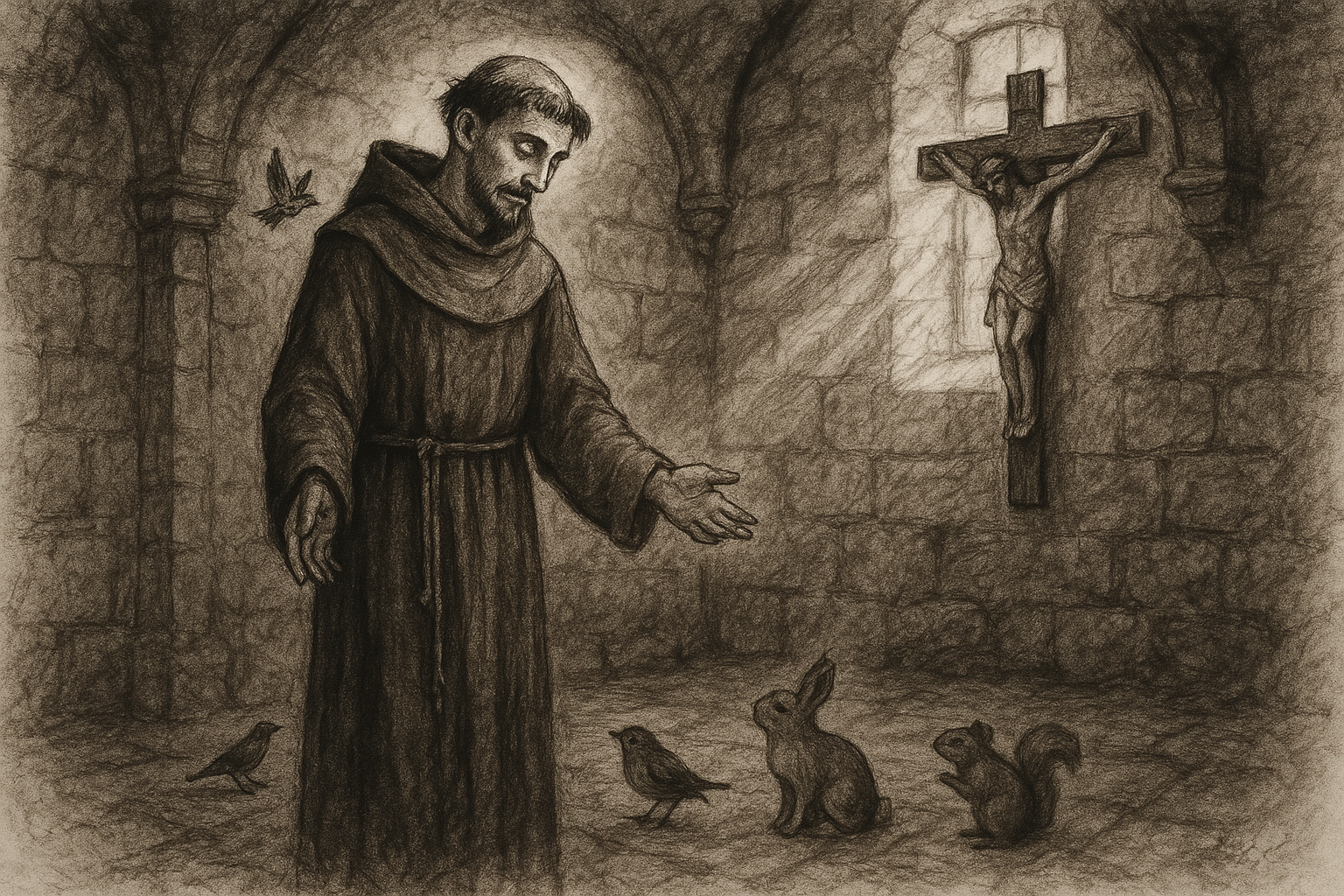
Many people know Francis for his affection toward birds, animals, and the natural world. Catholic tradition rightly sees in him a saint who recognized creation as a gift from the Creator. His famous Canticle of the Creatures praises God through sun, moon, water, fire, and earth, not because creation is divine, but because it reflects the goodness of God.
This matters because Francis did not confuse reverence for creation with worship of creation. He loved the world as something made by God and ordered to God. His praise was always doxological. Creation pointed beyond itself. For Catholics, that is the right posture. The universe is not a replacement for the Creator, but a sign that leads us to thanksgiving.
When Francis called elements of creation brother and sister, he was expressing humility before the order God established. He understood that human beings are not masters in the sense of owning reality absolutely. We are stewards. We receive, we care for, and we return praise to the One who made all things.
The Wounds, Prayer, and Final Witness
In the later years of his life, Francis received the stigmata, the wounds of Christ impressed upon his body. The Church has long understood this as a sign of deep conformity to the Crucified Lord. Whatever mysteries surrounded the event, its meaning is clear: Francis belonged to Christ in an intimate and costly way.
His final years were marked by suffering, weakness, and continued prayer. Yet his peace remained. He composed the Canticle of the Creatures amid hardship, which reminds Catholics that praise is possible even when circumstances are painful. Francis did not preach a comfortable religion. He preached a crucified and risen Lord.
He died in 1226. The Church recognized the holiness of his life quickly, and he was canonized in 1228. His witness endured because it was rooted in the Gospel, not in personal charm or cultural fashion.
What Catholics Can Learn from the St. Francis of Assisi Life
1. Conversion is possible for anyone
Francis began as a young man captivated by status, pleasure, and glory. That does not make him unusual. Many hearts are pulled by the same desires. His life teaches that no one is beyond conversion. The Lord can reach the ambitious, the distracted, the fearful, and the prideful. The question is not whether God can change us. He can. The question is whether we will cooperate.
Prayer, confession, spiritual direction, and fidelity to small acts of obedience are often how conversion deepens. Francis did not become holy in one dramatic moment. He kept saying yes to grace.
2. Poverty is freedom when it serves love
Francis's embrace of poverty was not anti-material in a simplistic sense. It was a choice to live free from attachments that can suffocate the soul. Catholics are not all called to the same external way of life, but we are all called to interior detachment. The heart that clings to money, status, or comfort cannot easily rest in God.
Francis reminds us that simplicity can create room for prayer. When life becomes less crowded with possessions and self-importance, we become more available to the Lord and more generous to others.
3. Charity must become concrete
Francis did not merely speak about mercy. He embraced the poor, served the suffering, and entered the places others avoided. Catholic charity is never only abstract. It becomes visible in acts of almsgiving, hospitality, patience, and compassion. The Gospel asks not only what we believe but how we love.
"Truly, I say to you, as you did it to one of the least of these my brethren, you did it to me." Matthew 25:40
This passage captures much of the Franciscan spirit. To serve the poor is to encounter Christ.
4. Reverence for creation must lead to worship
Francis helps Catholics appreciate creation without drifting into sentimentality. Nature can awaken wonder, but wonder should lead to adoration. The sun, sea, birds, and mountains are signs. God is the source. When Catholics care for creation rightly, they do so as faithful stewards who thank the Lord for His gifts and use them responsibly.
5. The Church and the sacraments are not optional
Francis loved Christ deeply, and that love carried him into obedience to the Church. This is an essential lesson. A saint is not a spiritual individualist. Francis teaches that devotion to Jesus includes fidelity to the sacraments, reverence for priests, and communion with the Church's life. Personal holiness and ecclesial obedience belong together.
How to Apply Francis's Example Today
Catholics do not need to copy Francis's exact lifestyle to learn from him. Most people are not called to beggary or public itinerancy. But we are called to his spirit: simplicity, humility, repentance, and joy.
- Examine your attachments honestly and ask where your heart has become too crowded.
- Practice concrete acts of charity toward the poor, the lonely, or the forgotten.
- Make room for silence and prayer so Christ can reshape your desires.
- Treat creation with gratitude, not possession, and let it lead you to praise.
- Love the Church visibly through the sacraments and obedience to Christ's teaching.
Francis was radiant because he was surrendered. That surrender did not make him smaller in the worldly sense. It made him fully alive in God. The same grace is offered to every Catholic who asks to be renewed.
If the St. Francis of Assisi life speaks to us at all, it is because he shows what happens when a human being lets Jesus become first. The path is demanding, but it is beautiful, and it begins wherever the Lord finds us now.
Frequently Asked Questions
Why is St. Francis of Assisi so important to Catholics?
St. Francis is important because his life shows a dramatic and joyful conversion to Christ. He embraced poverty, cared for the poor and sick, loved the Church, and pointed people toward the humility of Jesus. His witness remains powerful because it is rooted in the Gospel.
Did St. Francis of Assisi reject wealth and creation?
He rejected attachment to wealth, not God's creation. Francis saw the world as a gift from the Creator and praised God through creation. His poverty was meant to free him for love, prayer, and service, not to deny the goodness of what God made.
What is the main lesson Catholics can learn from St. Francis?
The main lesson is that conversion is possible and holiness is practical. Catholics can learn from Francis to live more simply, pray more deeply, love the poor, and follow Christ with greater freedom and joy.