Saints and Witnesses
Why St. Augustine Still Inspires the Church
A Catholic look at the life, conversion, and lasting witness of one of the Church's greatest saints.
Site Admin | May 6, 2025 | 113 views
Why St. Augustine Still Matters
Few saints are quoted as often, studied as widely, or loved as deeply as St. Augustine of Hippo. His writings shaped Catholic theology, his conversion remains one of the Church's most compelling stories, and his prayers still echo the longing of every soul that seeks God. For Catholics, St. Augustine Catholic inspiration is not only about admiration for a brilliant thinker. It is about recognizing a witness who shows how grace can enter a divided heart and bring it home.
Augustine lived in a time of intellectual debate, moral confusion, and social upheaval, yet his experience feels very close to our own. He knew ambition, desire, restlessness, pride, friendship, grief, and the ache for truth. He also learned that none of these human realities is healed apart from Christ. In that sense, Augustine is not simply a figure from the past. He is a companion for anyone who wants to understand conversion more deeply and follow the Lord more faithfully.
A Life Marked by Restlessness and Grace
Augustine was born in 354 in North Africa, in the town of Tagaste. His mother, St. Monica, prayed persistently for his conversion, while his father, Patricius, did not share the same Christian devotion. Augustine was gifted, ambitious, and intellectually restless. He pursued education, success, and philosophical clarity, yet he remained unsatisfied. His famous reflection captures this human condition with unforgettable simplicity: the human heart is restless until it rests in God.
That line resonates because it is true to experience as well as faith. Many people can have talent, opportunity, and even outward success while still feeling inwardly unsettled. Augustine did. His early life included moral compromise and years spent outside the peace of the Gospel. But God did not abandon him. Through Scripture, prayer, the witness of faithful Christians, and the example of his mother, Augustine was slowly drawn toward the truth.
His conversion came in Milan, where he was influenced by the preaching of St. Ambrose. Augustine later described a moment of decisive surrender when he opened the Scriptures and heard the call of God to change his life. The precise details matter less than the spiritual truth: conversion is not merely a private decision or a burst of emotion. It is the action of divine grace meeting a heart ready to yield.
In Romans, St. Paul writes, Be transformed by the renewal of your mind. Augustine's life is a living testimony to that renewal. He did not become holy by willpower alone. He was converted by mercy.
His Story Speaks to the Sacramental Life
One reason Augustine continues to inspire Catholics is that his journey points toward the sacramental life of the Church. Conversion is not a vague spiritual idea. It leads to repentance, baptism, reconciliation, and a new way of living in Christ. Augustine came to understand that grace is not earned but received, and that the Church is not a mere human association but the body through which Christ continues to heal and teach.
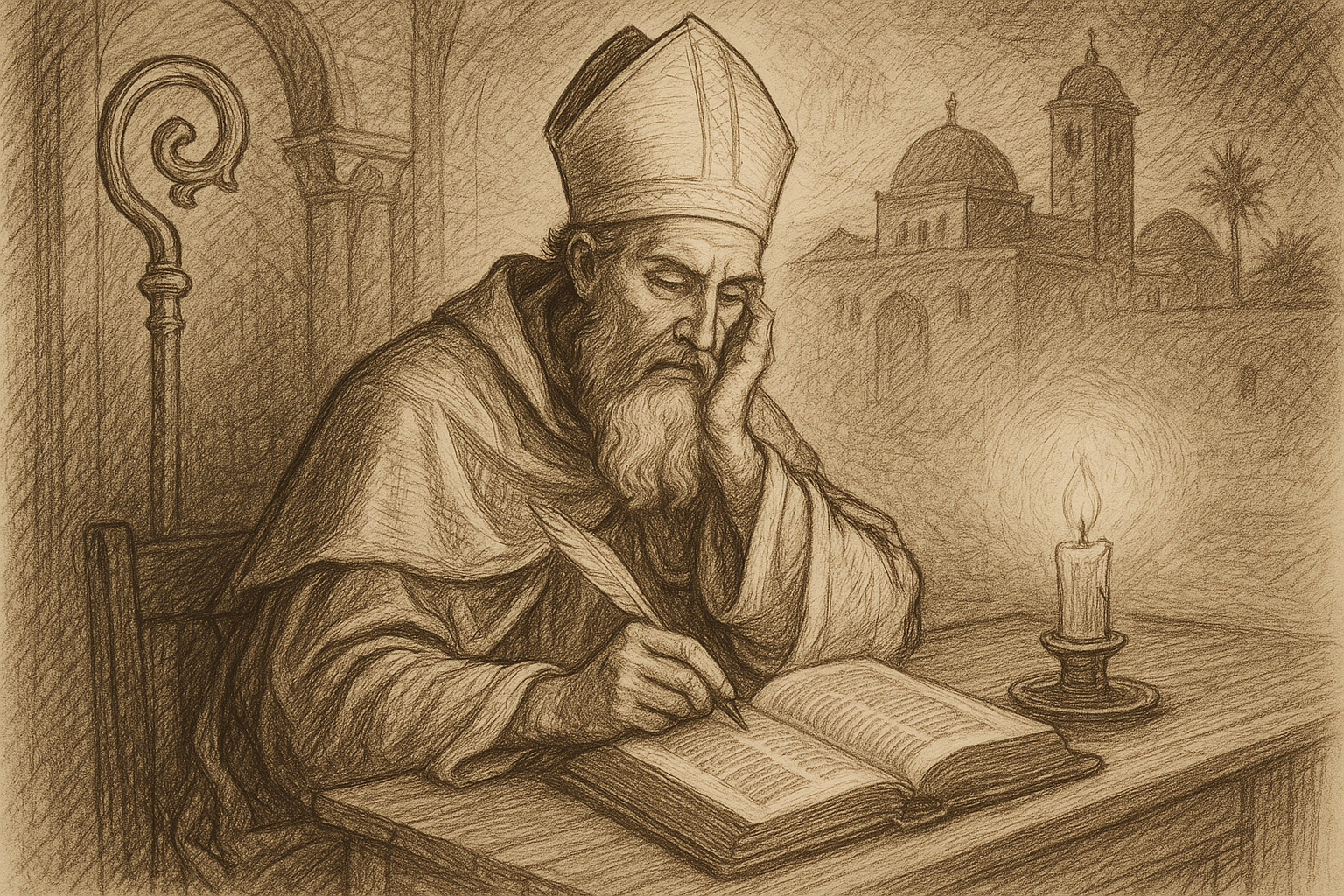
For Catholics, this matters because the saints are not inspirational in a generic sense. They show what it looks like to cooperate with grace in a fully Catholic way. Augustine's faith was intellectual, but it was also sacramental, ecclesial, and moral. He became a priest and then bishop of Hippo, spending his life preaching, writing, defending the faith, and shepherding souls.
His famous line from the Confessions reminds readers that the soul's deepest desire is for God. That truth is not opposed to reason. Rather, reason reaches its fulfillment when it leads us to worship. Augustine's mind did not make faith smaller. It helped him see more clearly that truth is personal, and that truth has a name: Jesus Christ.
Augustine and the Catholic Search for Truth
St. Augustine still inspires the Church because he never separated truth from humility. He was fearless in asking hard questions, but he learned that the highest truths are received on one's knees. Catholics often turn to Augustine when wrestling with Scripture, the problem of evil, the nature of the Church, or the meaning of grace because he combines intellectual rigor with spiritual honesty.
He defended the faith against major errors of his day, including Manichaeism, Donatism, and Pelagianism. These controversies were not abstract academic disputes. They touched the heart of the Gospel. Augustine insisted that salvation is the work of God, that the Church is a visible communion of believers and sacraments, and that human beings need grace at every step.
This is one reason he remains so important in Catholic teaching. His thought helps Catholics avoid two opposite errors. On one side is despair, as if sin and weakness are stronger than God. On the other is self-reliance, as if holiness were a human achievement. Augustine shows that grace does not erase human freedom. It heals it and raises it up.
Do not be afraid to return to God. Augustine's life teaches that the Lord is never tired of calling a soul back to Himself.
What Catholics Learn from His Conversion
Augustine's conversion offers practical lessons for Catholic life today.
- Grace often works slowly. Augustine was not changed in an instant. God prepared him through people, events, and interior struggle.
- Prayer matters. Monica's prayers are a powerful reminder that no prayer offered in faith is wasted.
- Truth requires surrender. Augustine did not merely collect information. He gave himself to Christ.
- Conversion is ongoing. Even after baptism, Augustine continued to grow in holiness, discipline, and pastoral charity.
These lessons are especially important for Catholics who may feel discouraged by repeated struggles. Augustine did not present himself as a saint who had always been strong. He confessed his weakness honestly, and that honesty became part of his witness. In the Christian life, humility is not self-hatred. It is truth before God. Augustine teaches that a person can acknowledge sin without surrendering to it, because the mercy of Christ is greater than sin.
Scripture reflects this same hope. The Lord says through the prophet, You will seek me and find me, and Jesus declares, Come to me, all you who labor and are burdened. Augustine's life makes those words concrete. He sought, he found, and he rested in Christ.
His Love for the Church
Another reason Augustine continues to inspire the Church is his deep love for her. He did not treat Christianity as a private philosophy. He loved the visible Church, preached within it, defended its unity, and understood that the sacraments, apostolic teaching, and communion of believers belong together. This is a great gift to Catholics today, especially in an age that can reduce faith to personal preference.
Augustine knew the Church was holy because Christ is holy, even though her members are sinners in need of mercy. That realism is comforting. Catholics do not need a perfect community to believe the Gospel. They need the true Church, in which the mercy of God is continually at work. Augustine's witness reminds us that the Church is not made holy by our achievements but by Christ's grace.
He also knew how to speak to the wounded. His pastoral writing often reflects compassion for those who struggle. He understood that doctrine is not meant to crush the soul but to lead it toward healing. When Augustine preached on grace, conversion, and charity, he was not filling bookshelves. He was serving souls.
Why He Still Speaks to Modern Catholics
Modern Catholics live amid distractions, ideological pressure, and spiritual fatigue. Augustine speaks into that world with unusual freshness because he names the inner life so accurately. He understands temptation, divided desire, intellectual pride, and the temptation to delay conversion. His life asks a question that remains urgent: what are we really seeking?
Many people today admire Augustine because he reveals that holiness is not reserved for the naturally serene or morally flawless. Holiness begins where a person tells the truth before God. Augustine's story therefore encourages students, parents, converts, cradle Catholics, clergy, and anyone who fears that their past has disqualified them. It has not. Grace can redeem what sin has distorted.
His example also invites Catholics to hold together mind and heart. The Church needs saints who pray and think, who believe and understand, who love God with their whole being. Augustine did all of these imperfectly at first, then more fully as grace matured him. That is part of why he remains so compelling. He does not flatter us, but he does encourage us.
When Catholics read Augustine, they encounter a saint who can speak about sin without exaggeration, about mercy without sentimentality, and about God with reverence. His witness is rooted in a deep conviction: everything in human life finds its true order in relation to God. That truth never becomes outdated.
Three brief reasons Augustine endures
- He shows that conversion is possible at any stage of life.
- He reminds Catholics that the search for truth leads to Christ and His Church.
- He proves that a brilliant mind can become even more radiant when humbled by grace.
Augustine's Enduring Voice
St. Augustine still inspires the Church because his life is a road map of mercy. He was restless, converted, formed, tested, and finally given over to God in a life of service. His witness speaks to those who are tired of sin, hungry for truth, and uncertain whether God can still work in them. He answers by his own life: yes, He can.
For Catholics, Augustine remains a saint to read slowly, pray with often, and return to whenever the heart grows distracted. He leads us back to the center, where grace is greater than weakness and Christ is enough.
Frequently Asked Questions
Why is St. Augustine important to Catholics?
St. Augustine is important because he helped shape Catholic theology on grace, the Church, Scripture, and conversion. His life also gives Catholics a vivid example of how God can transform a troubled heart.
What is the main spiritual lesson from St. Augustine's conversion?
The main lesson is that conversion begins with God's grace and requires a willing response. Augustine teaches that true change comes when the soul stops resisting and returns to Christ.
How can Catholics apply St. Augustine's example today?
Catholics can apply his example by praying for conversion of heart, trusting God's mercy in confession, seeking truth with humility, and remembering that holiness is a lifelong response to grace.