Social Teaching
Faith Cannot Be Commanded: Religious Freedom as a Work of Justice
Catholic social teaching defends the search for truth by protecting every person from coercion in matters of faith.
Site Admin | October 11, 2026 | 32 views
Religious freedom is sometimes discussed as if it were merely a political concession or a privilege granted by the state. Catholic social teaching begins somewhere deeper. The freedom to seek God, embrace religious truth, worship, and live according to a well-formed conscience belongs to the dignity of the human person. Government does not create this dignity, and it cannot rightfully erase it.
This does not mean that every religious claim is equally true or that conscience is beyond moral formation. The Church teaches that truth matters, that every person has a duty to seek it, and that faith must be freely embraced. These convictions belong together. Coercion cannot produce the loving assent that God desires.
Religious freedom Catholic teaching is therefore not a retreat from truth. It is a demand of justice. It protects the conditions in which people can ask the deepest questions of human life, respond to God without force, and order their lives according to conscience within the requirements of the common good.
Freedom begins with the dignity of the person
The biblical foundation of human dignity appears at the beginning of Scripture. Human beings are made in the image and likeness of God, as proclaimed in Genesis 1:27. Every person possesses a worth that does not depend on citizenship, social usefulness, religious affiliation, or the approval of those in power.
Because the person is rational and free, the search for religious truth cannot be reduced to external compliance. A government may regulate conduct when justice requires it, but it cannot enter the sanctuary of conscience and manufacture belief. Nor may one person force another to make an act of faith.
The Second Vatican Council stated this principle directly in its declaration Dignitatis Humanae:
"The human person has a right to religious freedom."
The Council explained that this right means people should be immune from coercion by individuals, social groups, and civil authorities. No one should be forced to act against religious convictions, nor should a person be unjustly prevented from acting according to them, privately or publicly, alone or in association with others.
This civil right is grounded in the nature of the person, not in the sincerity or accuracy of every belief a person may hold. Even someone whose religious conclusions are mistaken retains human dignity. Respect for that dignity does not require agreement with the mistake. It requires refusing to answer error with coercion, humiliation, or unjust discrimination.
Truth and freedom are not enemies
Catholic teaching avoids two opposite errors. The first is religious relativism, which treats all beliefs as interchangeable and truth as a matter of private preference. The second is coercion, which attempts to impose religious conviction through fear, force, or civil penalty.
The Church teaches that people have a moral duty to seek the truth, especially the truth about God. Once the truth is known, they are obliged to order their lives according to it. Yet this duty must be fulfilled in a manner consistent with human freedom. The Catechism of the Catholic Church addresses these principles in its discussion of the first commandment and religious liberty, particularly in paragraphs 2104 through 2109.
Jesus invited discipleship, called people to repentance, and spoke with divine authority. Yet he did not treat forced allegiance as genuine faith. When some disciples left because they found his teaching difficult, he asked the Twelve whether they also wished to go, as recounted in John 6:67. His question reveals the seriousness of freedom. A person can reject grace, but love does not become authentic by eliminating the possibility of refusal.
Faith is a gift from God and a human response to grace. It involves the intellect and will. Pressure may produce outward conformity, silence, or resentment, but it cannot create the free surrender of faith. Evangelization therefore relies on truth, witness, prayer, charity, and persuasion rather than manipulation.
More than permission to worship
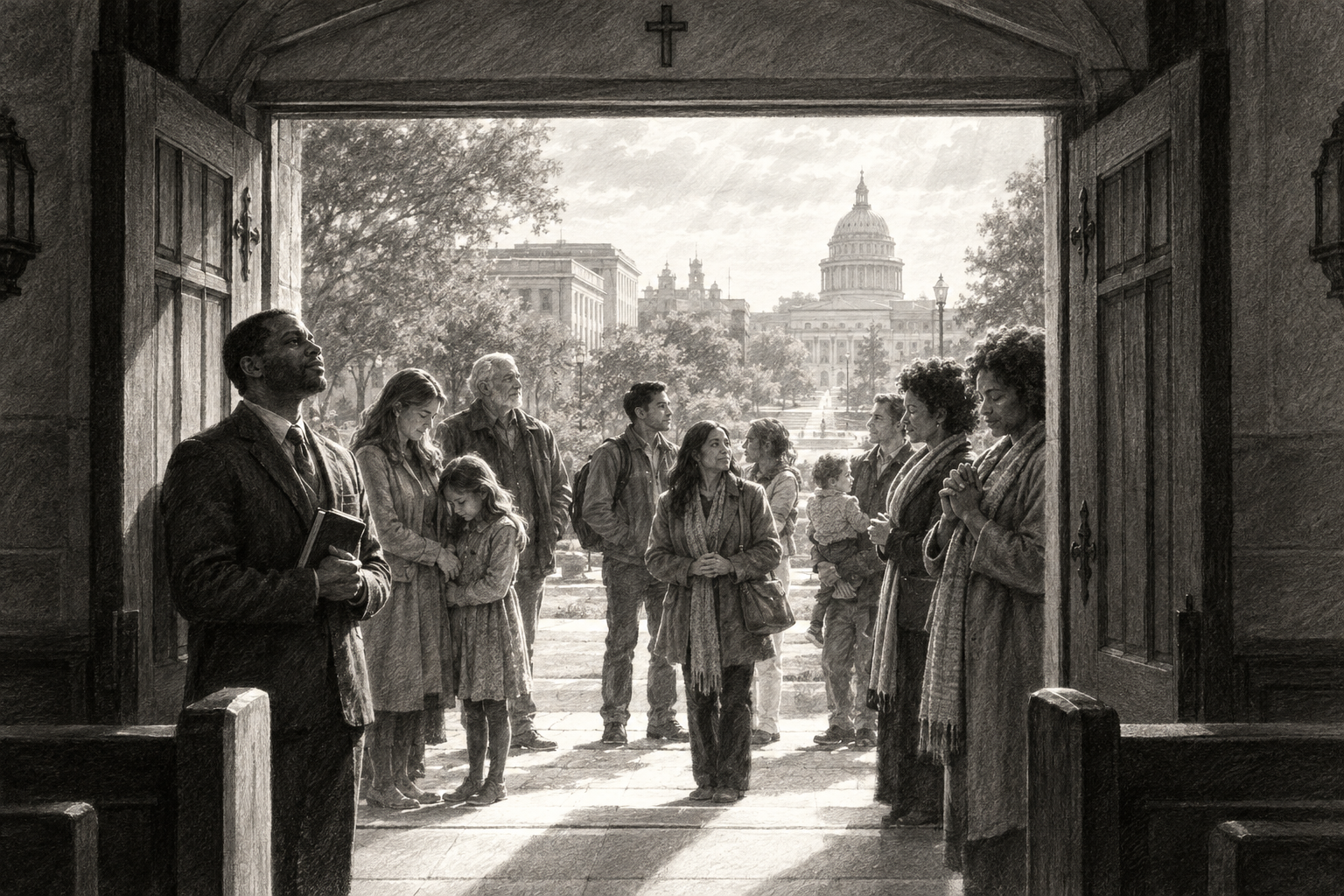
Religious freedom includes worship, but it is not confined to what happens inside a church building. Religion shapes how people understand marriage, family, work, education, service, moral responsibility, and care for those in need. If religious exercise were permitted only in private, believers could be allowed to pray while being forbidden to live according to what prayer requires.
A just understanding of religious freedom includes several related protections:
- The freedom of individuals to worship and profess their faith.
- The freedom to change one's religious affiliation without civil punishment.
- The freedom of parents to direct the religious formation of their children.
- The freedom of religious communities to gather, teach, appoint ministers, and order their internal life.
- The freedom to establish institutions for education, charity, health care, and service, subject to just laws.
- The freedom to express religious convictions in public discussion without being treated as unfit for civic participation.
- The freedom not to be compelled by the state to make a religious profession.
These protections serve believers of many traditions as well as those who do not profess a religion. Catholics do not defend religious freedom only when Catholic institutions are affected. Justice cannot be credible when it is demanded for one's own community but denied to a neighbor.
At the same time, religious freedom does not mean that every action described as religious must receive automatic legal protection. Human sacrifice, abuse, fraud, violence, and violations of another person's basic rights do not become just because someone gives them a religious label. The question is how legitimate limits should be identified and applied.
Just limits and the common good
No civil freedom is exercised in complete isolation. People live in communities where rights and duties meet. Catholic teaching recognizes that religious activity may be subject to just limits related to public order and the rights of others.
Such limits should not be invented as a pretext for suppressing an unpopular faith. They should be grounded in law, applied fairly, and directed toward a real threat to justice or peace. The response should also be proportionate. A narrow measure addressing genuine harm is different from a sweeping restriction that treats religious life itself as dangerous.
The common good does not mean whatever a majority happens to prefer. It refers to the social conditions that allow persons and communities to reach their fulfillment more fully. Respect for religious freedom belongs within those conditions because people cannot flourish when they must hide their deepest convictions, violate conscience, or accept state control over worship and belief.
Civil authority has a positive duty here. It must do more than refrain from direct persecution. It should maintain a legal order in which different religious communities can live peacefully, citizens are protected from coercion, and disputes are resolved without favoritism or contempt. This requires prudence, especially when claims of conscience intersect with health, employment, education, or the rights of others.
Catholic social teaching does not provide a mechanical answer for every legal dispute. It offers principles by which laws and policies can be judged: the dignity of the person, the common good, solidarity, subsidiarity, justice, and special concern for those who are vulnerable.
Conscience must be protected and formed
Appeals to conscience are central to religious freedom, but conscience is not simply a strong feeling. In Catholic teaching, conscience is a judgment of reason concerning the moral quality of an act. It must be formed through prayer, honest inquiry, Scripture, sound moral teaching, and attention to the consequences of one's choices.
Saint Paul describes the moral law as written on the human heart in Romans 2:15. This does not mean every judgment of conscience is automatically correct. People can misunderstand moral truth, ignore evidence, or rationalize wrongdoing. Even so, the solution is not careless coercion. It is patient formation, truthful dialogue, and laws that respect the person's proper moral responsibility.
Christians should examine their own conduct as carefully as they examine civil policy. Religious freedom can be wounded within families, schools, workplaces, and religious communities when authority becomes manipulative or when questions are punished rather than answered. Parents and pastors have real responsibilities to teach the faith, but Christian formation should help a person know, love, and freely follow Christ.
Religious freedom is also a test of solidarity
The strength of a society's commitment to religious freedom is often revealed by its treatment of minorities. It is easy to defend a familiar religious practice. Justice becomes more demanding when the believer speaks another language, follows an unfamiliar custom, belongs to a small community, or lacks political influence.
Catholics should be attentive whenever people are threatened, displaced, imprisoned, denied ordinary civic opportunities, or attacked because of their religion. The suffering of another community is not irrelevant to the Body of Christ. Saint Paul calls Christians to share both suffering and honor with other members in 1 Corinthians 12:26. That habit of solidarity should widen the Catholic response to every person whose dignity is violated.
Solidarity also rejects suspicion directed at entire populations because of the acts of individuals. Public safety is a legitimate concern, but guilt must not be assigned by religious identity. Justice requires careful distinctions, truthful evidence, and respect for innocent people.
How Catholics can practice this teaching
Religious freedom is protected not only in courts and legislatures but also in ordinary relationships. Catholics can help create a culture of freedom through habits that are both practical and spiritual:
- Learn the Church's teaching. Read Dignitatis Humanae and the relevant sections of the Catechism rather than relying only on political summaries.
- Speak accurately about neighbors. Do not circulate rumors about another religion or reduce a whole community to its worst representatives.
- Defend rights consistently. Support just protections even when the person affected does not share Catholic beliefs.
- Distinguish disagreement from hostility. Respect does not require silence about truth, but disagreement should not become contempt.
- Form conscience seriously. Study, pray, seek wise counsel, and resist the temptation to baptize personal preference as moral necessity.
- Use civic freedom for service. Religious liberty is not only protection from interference. It makes room for works of mercy, education, worship, and public witness.
- Pray for those who suffer persecution. Prayer keeps the issue from becoming abstract and places threatened communities before God.
Christ tells his disciples to give to Caesar what belongs to Caesar and to God what belongs to God in Mark 12:17. His words do not erase the proper role of civil authority. They place that authority within limits. The state serves human persons and the common good, but it is not lord of the soul.
Religious freedom is most secure where truth can be proposed without violence, conscience can be formed without manipulation, and neighbors can disagree without denying one another's humanity. Catholics defend this freedom because God made the person for truth and love, and neither truth nor love can be faithfully served by force.
Keep Reading on Lets Read The Bible
Frequently Asked Questions
Does Catholic teaching on religious freedom mean that all religions are equally true?
No. The Church teaches that religious truth is real and that every person has a duty to seek it. Religious freedom concerns immunity from coercion. A person's civil rights do not depend on whether every religious conclusion he or she holds is correct.
Can civil government ever restrict religious activity?
Yes, but only under just conditions. Restrictions should protect public order, the common good, or the rights of others. They should be lawful, necessary, proportionate, and applied without using public safety as a pretext for suppressing a religion.
Does religious freedom protect people who do not practice a religion?
Yes. No one should be forced by civil authority to profess a faith. At the same time, Catholic teaching maintains that every person has a moral duty to seek truth and follow a properly formed conscience.