Doctrine and Questions
Grace at Work in the Soul: How the Sacraments Truly Help Us
A clear Catholic look at sacramental grace, what it is, and why it matters in daily life
Site Admin | July 6, 2026 | 137 views
Grace the Church Does Not Invent
Many Catholics hear the phrase sacramental grace explained and think of a technical idea reserved for theology books. In truth, it touches the daily life of every believer. The Church teaches that the sacraments are not empty signs or religious reminders. They are real actions of Christ, entrusted to the Church, by which God gives grace in a manner suited to each sacrament.
Grace, in the Christian sense, is not something human effort can produce. It is the free gift of God's own life. When Catholics speak of sacramental grace, they mean a particular help given through a sacrament to sanctify, strengthen, heal, and form the soul. This grace is not magic. It does not work apart from faith and conversion. But it is also not merely symbolic. Christ established the sacraments so that what they signify would truly be given.
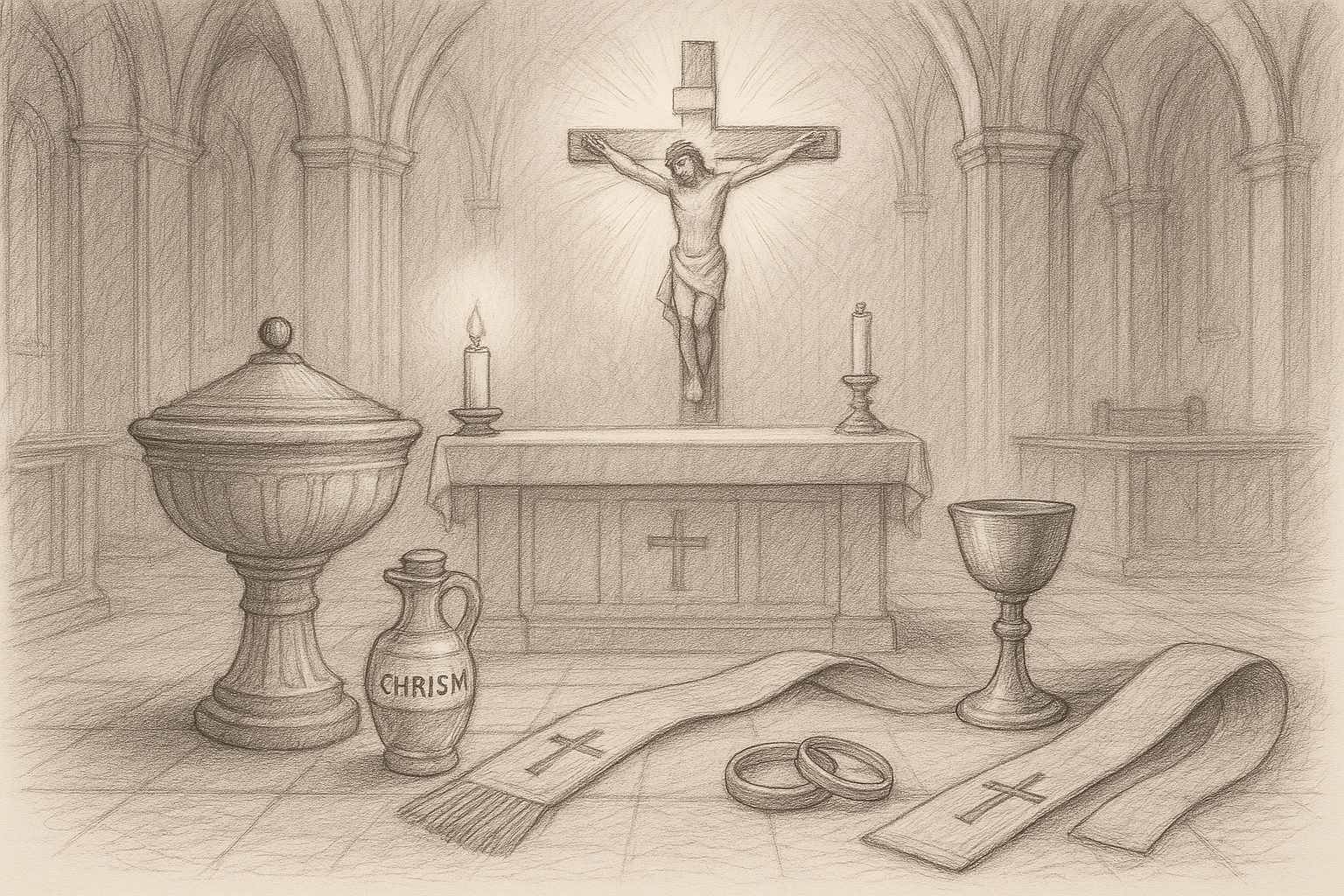
This is one reason the Church treats the sacraments with such reverence. In Baptism, Confirmation, the Eucharist, Penance, Anointing of the Sick, Holy Orders, and Matrimony, the Lord meets His people in visible, tangible ways. He uses matter, words, and ritual actions to communicate His life. The Church has always insisted that this is not a human invention but part of the Lord's own saving plan.
What Sacramental Grace Is
At the simplest level, sacramental grace is the grace given by Christ through a sacrament for the sake of the sacrament's purpose. Each sacrament has its own gift. Baptism gives new birth and cleansing from sin. Confirmation strengthens and seals the baptized. The Eucharist nourishes us with Christ Himself. Penance reconciles sinners to God. Anointing of the Sick offers comfort, healing, and strength in suffering. Holy Orders configures a man for ordained ministry. Matrimony strengthens spouses for their covenant of love and fidelity.
The Church also distinguishes sacramental grace from sanctifying grace and actual grace. Sanctifying grace is the stable life of God in the soul, the grace that makes us adopted children of the Father. Actual graces are the particular helps God gives us to do good, avoid evil, and respond to His call. Sacramental grace belongs to this divine economy in a special way. It is a grace attached to a sacrament and suited to its purpose. It strengthens the soul for what that sacrament is meant to accomplish.
For example, the grace of Confession does not simply wipe away guilt in a legal sense. It also helps heal the spiritual wounds caused by sin and gives strength for a better life. The grace of the Eucharist does not merely remind us of Christ's love. It deepens union with Him and with His Church, and it fortifies charity. The sacrament does what it signifies because Christ is truly acting in and through it.
Scripture Shows God Working Through Visible Signs
The Bible does not present grace as an abstract idea. Again and again, God uses material things to bring about His saving work. Water saves Noah's family through the flood, and later becomes a figure of Baptism. The Passover lamb and its blood mark Israel for deliverance. The laying on of hands appears in the commissioning of leaders and the gift of the Spirit. Elijah's mantle, Elisha's healing, and the anointing of the sick all show a God who works through signs He Himself appoints.
In the New Testament, Jesus continues this pattern. He heals with mud, with touch, with words, and with command. He gives His disciples authority to baptize: Go therefore and make disciples of all nations, baptizing them. He promises living water and new birth: Unless one is born of water and the Spirit. He speaks of eating His flesh and drinking His blood in order to have life: Unless you eat the flesh of the Son of Man and drink his blood, you have no life in you. He breathes on the apostles and says, Receive the Holy Spirit. He gives the ministry of reconciliation: If you forgive the sins of any, they are forgiven them.
The Acts of the Apostles and the letters of St. Paul continue this sacramental pattern. The apostles baptize, lay hands, bless, break bread, and anoint. St. Paul writes of Baptism as participation in Christ's death and resurrection: All of us who have been baptized into Christ Jesus were baptized into his death. He warns the Corinthians about receiving the Eucharist unworthily, which makes sense only if the sacrament is truly holy and truly given: Whoever eats the bread or drinks the cup of the Lord unworthily will be answerable for the body and blood of the Lord.
In other words, Scripture teaches a sacramental world. God does not save us through symbols alone. He acts through signs that carry His power because He has chosen to unite them to His promise.
Christ Is the Source of Every Sacrament
It is important to say clearly that sacramental grace comes from Christ, not from the priest as if he were a source in himself. The ordained minister is an instrument. The power is the Lord's. This protects both humility and trust. Catholics do not place faith in human cleverness or emotional intensity. They trust the fidelity of Jesus, who keeps His promises through the sacraments He instituted.
This also means that the sacraments are objective gifts. Their fruitfulness depends on God's action, not on the private holiness of the minister. At the same time, the grace received can be hindered if a person approaches without repentance or without the openness faith requires. In sacramental theology, the Church speaks of disposition. God always acts truly in the sacrament, but the soul receives according to its openness.
That balance is pastorally important. It guards against superstition on one side and skepticism on the other. Catholics need not wonder whether God is absent because they do not feel anything dramatic. Nor should they assume the sacrament is automatic in the sense that our hearts and lives make no difference. The sacraments are living encounters with Christ, and encounters call for faith.
How Sacramental Grace Shapes Ordinary Catholic Life
The value of this doctrine becomes clear when faith meets routine life. A child is baptized, and the family sees more than a ceremony. God gives new birth and claims the child as His own. A teenager is confirmed, and the Church prays for strength to witness boldly. A tired parent receives the Eucharist on Sunday morning, and Christ feeds that soul for another week of sacrifice and service. A penitent enters Confession burdened by sin and leaves lighter, cleansed, and reoriented toward holiness.
These are not small gifts. They are God meeting human weakness at the points where we most need help. Ordinary life is full of discouragement, temptation, and fatigue. Sacramental grace reminds us that the Christian life is not sustained by willpower alone. The Lord gives what He commands. He also strengthens those whom He calls.
This is especially consoling in suffering. The Anointing of the Sick is not only for the final moments of life. When a Catholic receives it with faith, Christ's mercy enters the place of illness and fear. The sacrament may bring physical healing, if God wills it. Even when it does not, it brings grace for peace, courage, trust, and union with Christ's own suffering. In this way, sacramental grace teaches us that no suffering offered to God is wasted.
Marriage and Holy Orders also show how grace is not merely private. In Matrimony, spouses receive help to love one another faithfully, forgive, endure, and open their home to life. In Holy Orders, a man receives grace to preach, sanctify, and shepherd the people of God in the person of Christ the Head. These sacramental graces do not replace human effort. They make fruitful the very duties each state of life requires.
Why Catholics Should Care About the Doctrine
Some people think doctrinal precision is abstract compared to daily discipleship. But sacramental grace is a practical truth. It tells us where to go when we need mercy, strength, healing, or union with God. It reminds us that the Church is not simply a gathering of believers who share ideas. She is a sacramental body in which Christ continues to act.
That matters in evangelization too. If the sacraments truly give grace, then inviting someone to the Church is not merely inviting them into a community of values. It is inviting them into the ordinary means by which Christ sanctifies souls. That is a larger and more hopeful claim than moralism or sentiment. It says that God has placed His life within reach, in forms we can receive, remember, and return to again and again.
It also gives us a way to interpret spiritual dryness. A Catholic may attend Mass, go to Confession, or pray faithfully and still feel little. Sacramental grace reminds us that the reality of grace does not depend on emotional intensity. The Lord often works quietly. Seeds grow in hiddenness. A soul can be strengthened before it notices the change. Over time, grace bears fruit in patience, humility, charity, and perseverance.
For that reason, the Church urges Catholics not to reduce the sacraments to milestones or family traditions. They are encounters with the living Christ. To approach them well is to bring faith, repentance, attention, and gratitude. To neglect them is to neglect the ordinary channels Christ Himself established for our salvation.
Living Open to the Gift
If sacramental grace is real, then the Christian life becomes both simpler and more demanding. Simpler, because we do not have to invent our own path to holiness. The Lord has given it to us. More demanding, because His gifts ask for a response. Grace is not a substitute for conversion. It is the power that makes conversion possible and fruitful.
So the right response to the sacraments is not nervous analysis but faithful reception. Prepare well. Examine your conscience. Go to Mass with reverence. Confess your sins honestly. Receive the Eucharist with awe. Pray for the grace to live what you celebrate. In that rhythm, sacramental grace becomes not a theory about the Church, but the shape of a Christian life being steadily remade by Christ.
That is the heart of the Church's teaching: the Savior who died and rose for us has not left us without help. He continues to meet His people with grace, and He does so through the sacraments He gave to His Church.
Related reading in this series
See how the sacraments share Christ's life in everyday Catholic practice, and how the Church's sacramental life points back to the Lord who gives it all.
Keep Reading on Lets Read The Bible
Frequently Asked Questions
What does sacramental grace mean in Catholic teaching?
Sacramental grace is the grace given by Christ through a sacrament for the purpose of that sacrament. It strengthens the soul according to the sacrament's specific gift, such as cleansing, healing, nourishment, or strengthening.
Is sacramental grace the same as sanctifying grace?
No. Sanctifying grace is the stable life of God in the soul, while sacramental grace is the grace given through a particular sacrament to help a person live its meaning. The two are related, but they are not identical.
Can a person receive a sacrament without receiving its grace fully?
Yes, if the person is not properly disposed, the fruitfulness of the sacrament can be hindered. The sacrament is still truly given, but the person's openness, repentance, and faith affect how deeply the grace bears fruit.