Doctrine and Questions
When the Bread Is More Than Bread: Standing Before the Eucharist
A clear look at the Church's teaching on the Eucharist, the words of Christ, and the daily faith that grows from kneeling before the Lord.
Site Admin | June 4, 2026 | 99 views
The Catholic faith makes a striking claim at the heart of the Mass: when the Church consecrates bread and wine, Christ gives himself truly, really, and substantially in the Eucharist. This is what Catholics mean by the Real Presence. It is not a poetic way of saying that Jesus is symbolically remembered, nor is it a vague statement that he is spiritually near in some general sense. The Church teaches that after the consecration, the Eucharist is truly the Body and Blood, Soul and Divinity of Jesus Christ.
For many people, that teaching is both beautiful and difficult. Beautiful, because it says that the Lord does not remain distant from his people. Difficult, because it asks faith to accept what the senses cannot prove. The Real Presence in the Eucharist explained plainly is this: Christ keeps his promise to feed his Church with himself, and the appearance of bread and wine remains while their deepest reality is changed by his word and power.
What the Church means by Real Presence
The Church uses careful language because the mystery deserves precision. Catholics do not say that the bread merely reminds us of Jesus, or that the Eucharist is only a symbol of fellowship. A sign can point beyond itself, and the Eucharist certainly does that, but it is more than a sign. Christ is present in a unique and sacramental way.
The traditional term the Church has used to describe this change is transubstantiation. That word means that the substance, or inner reality, of the bread and wine is changed into the substance of Christ's Body and Blood, while the outward appearances remain as bread and wine. The Church does not claim that the Eucharist becomes a visible piece of flesh in the ordinary sense. Rather, it teaches that the whole Christ is made present sacramentally under the appearances of bread and wine.
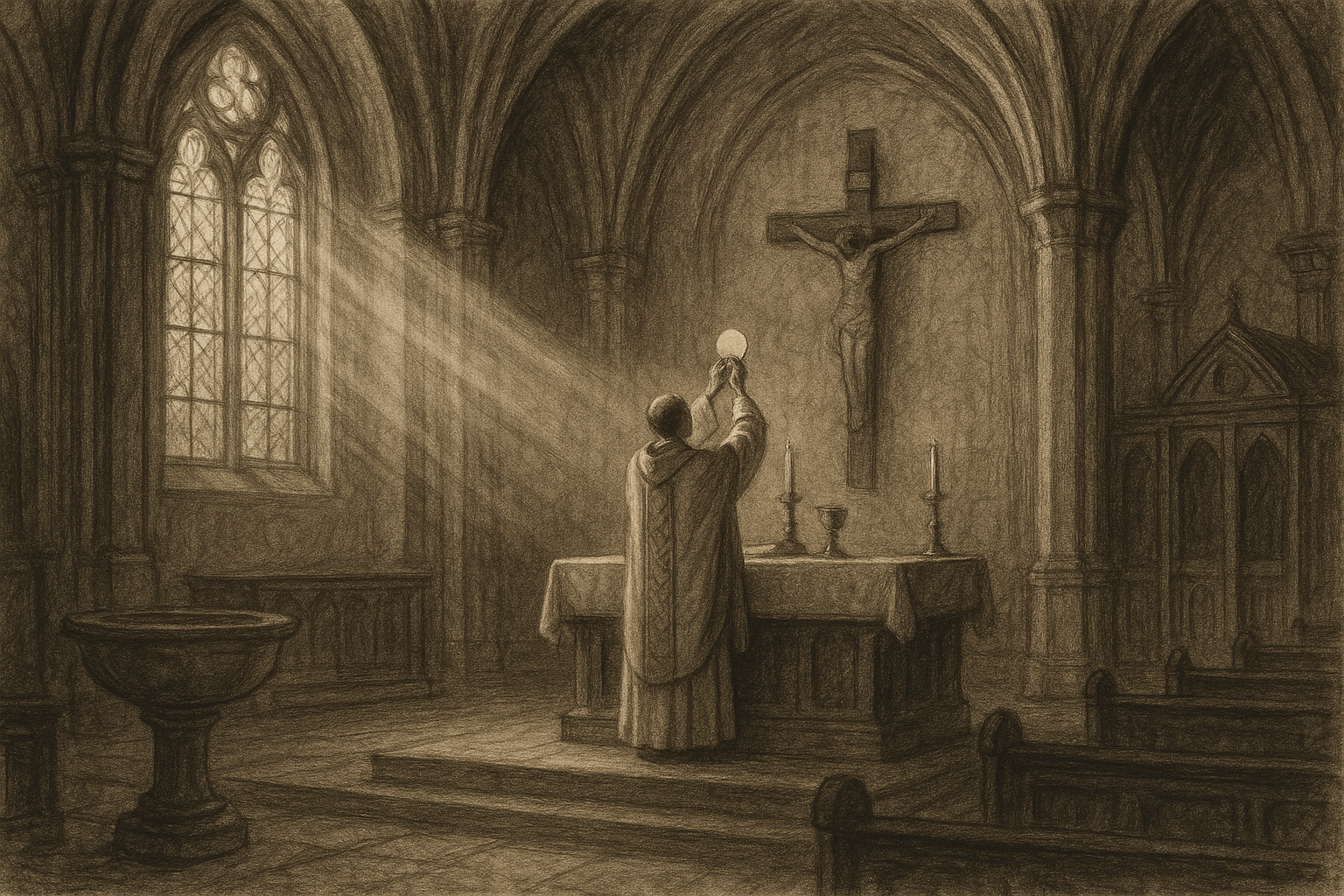
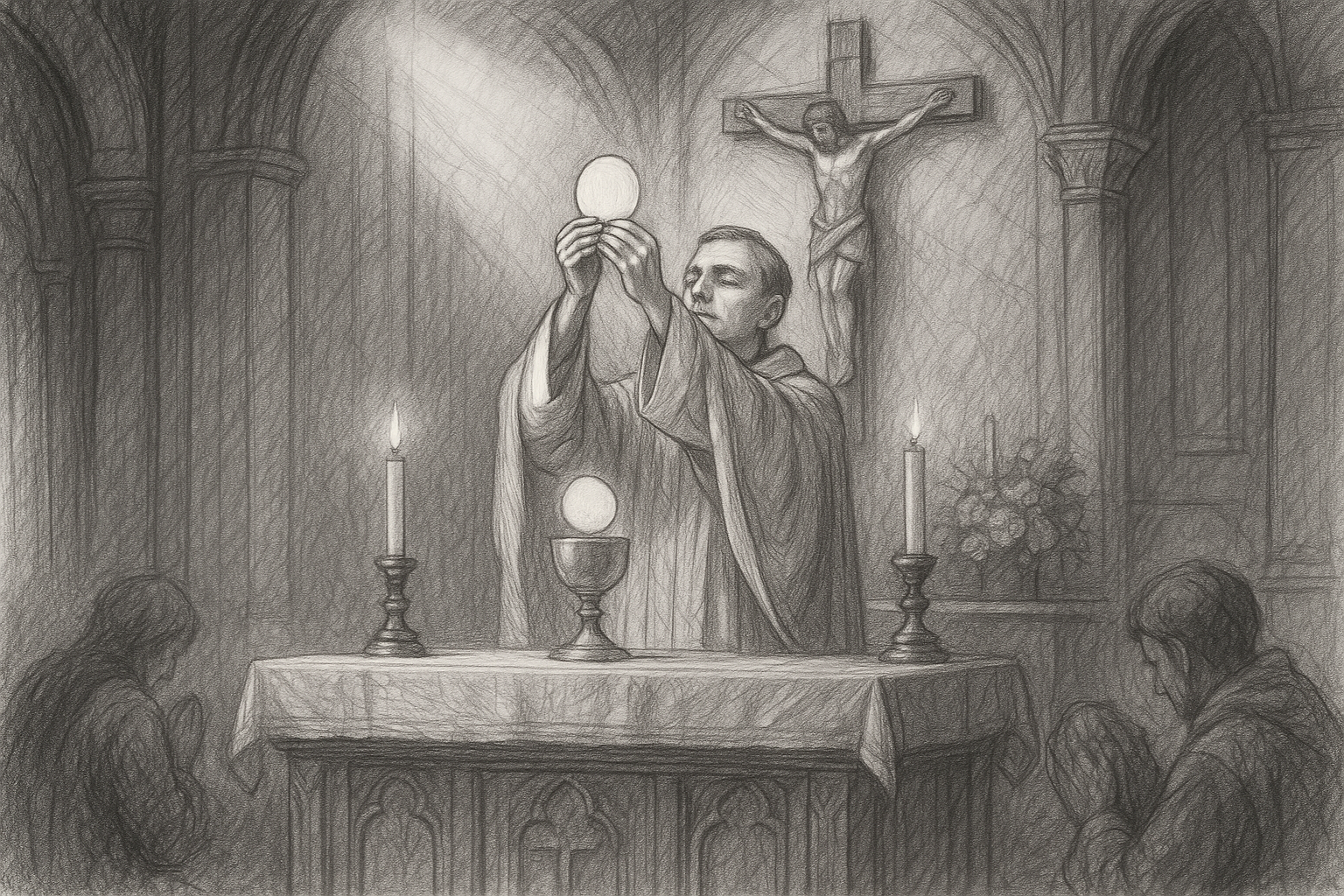
This is why Catholics kneel before the tabernacle, adore the Blessed Sacrament, and speak of the Eucharist with deep reverence. If the Lord is truly present, then the proper response is worship.
The words of Jesus at the Last Supper
The Eucharist begins not with a medieval theory but with Christ himself. At the Last Supper, Jesus took bread, blessed and broke it, and gave it to his disciples, saying, This is my body. He also took the chalice and said, This is my blood of the covenant. The Church has always listened to those words with full seriousness.
Some readers try to soften them into metaphor, but the Gospels do not push us in that direction. Jesus often used images and parables, yet here he speaks in a direct, covenantal setting, at the meal that becomes the foundation of the New Covenant. The Church received these words not as a riddle to be diluted, but as a gift to be obeyed and adored.
Saint Paul repeats the same faith when he writes to the Corinthians that the bread we break is a participation in the Body of Christ, and that whoever eats and drinks without discerning the Body brings judgment upon himself, The bread we break, Discerning the Body. Such language is hard to explain if the Eucharist is only a symbol. Paul treats it as holy reality.
Jesus feeds his people in the Gospel of John
The Sixth Chapter of John is central to Catholic Eucharistic faith. After multiplying the loaves, Jesus speaks of himself as the bread come down from heaven. He says, I am the living bread and later, Unless you eat the flesh of the Son of Man. The crowd reacts strongly, and many are troubled by what they hear. Jesus does not call them back by explaining that he only meant a symbol. Instead, he intensifies the saying.
John's Gospel matters because it shows the Lord preparing his disciples for a gift that goes beyond ordinary categories. The manna in the desert sustained Israel for a time, but Christ gives bread that brings eternal life. The Eucharist fulfills what the older gift only prefigured.
In the Catholic reading, John 6 is not an isolated text to win an argument. It is part of the pattern of revelation. God feeds his people with real bread in the wilderness, gives them the Passover meal, and then fulfills those signs in Christ, who becomes the Lamb and the living bread. The Eucharist gathers all of this into one sacramental act.
The Mass is sacrifice and meal
Another reason the Real Presence matters is that the Mass is not only a memorial meal but also a sacrifice made present sacramentally. Catholics believe that the one sacrifice of Christ on Calvary is not repeated, but made present in an unbloody manner at every Mass. The altar is linked to the Cross, not as a second sacrifice, but as the Church's participation in the one saving offering of Christ.
This is why Eucharistic language in Catholic life is never merely private. The Mass is the Church's act of worship, the place where Christ gives himself to the Father on behalf of his people and then gives himself to the people as food. Sacrifice and communion belong together. The same Lord who offers himself also nourishes those he has redeemed.
That is a difficult truth for a culture that often treats worship as self-expression. The Mass does not begin with what we feel. It begins with what Christ has done and continues to do through the Church. The Real Presence keeps the Mass from becoming a religious performance. It keeps the center where it belongs, on the Lord himself.
How the Real Presence shapes ordinary Catholic life
Belief in the Eucharist is not meant to stay inside theological books. It shapes the daily habits of a Catholic life.
- It deepens reverence at Mass. A person who believes Christ is truly present listens differently, kneels differently, and receives Communion with greater care.
- It strengthens preparation. Catholics are called to examine their conscience and, when necessary, go to confession before receiving Holy Communion.
- It nurtures silence and adoration. If Jesus is truly present, then time before the tabernacle or in Eucharistic adoration is not empty time.
- It changes suffering. The Eucharist unites daily struggles to the offering of Christ and reminds believers that their lives are not sealed off from grace.
- It builds charity. Communion with Christ cannot be separated from love of neighbor. The one who receives the Lord must learn to live as the Lord lives.
These effects may sound simple, but they are profound. When Catholics lose faith in the Real Presence, the Mass can slowly become routine, and prayer can shrink into habit without wonder. When they recover that faith, even a weekday Mass can become a place of awe.
Why the senses are not the final judge
One common objection says: if Christ is truly present, why do the Eucharistic elements still look and taste like bread and wine? Catholic teaching answers that the senses tell us something true, but not everything. The appearances remain, while the inner reality changes. Faith trusts Christ's promise more than sight or taste.
This is not irrational. Human life is full of realities we cannot grasp directly with the senses. We know love by its effects, not by measuring it on a scale. We trust a person's word when the word is reliable. In a still greater way, Catholics trust the word of the Son of God. If he says, My flesh is true food, his word is enough.
The Eucharist therefore trains believers in holy humility. It reminds us that God's ways are not reduced to what we can inspect at a glance. The Lord chooses humble matter to bear divine grace. Bread and wine, lifted up in the liturgy, become the place where heaven meets earth.
Receiving the Lord with faith and gratitude
To speak of the Real Presence is not simply to defend a doctrine. It is to recognize a gift. Every Mass places the Church before a mystery of love. Christ does not give a distant blessing. He gives himself. He comes close enough to be received, and yet remains utterly holy.
That truth invites a certain way of life. Catholics prepare for Communion through prayer, repentance, and fasting. They receive with gratitude, not entitlement. They make acts of thanksgiving after Mass because the gift deserves response. They visit the Blessed Sacrament because love seeks presence. They carry Eucharistic faith into the week because the Lord received at Mass is the Lord to be served in the poor, the sick, and the neighbor at hand.
The Real Presence in the Eucharist explained clearly is not a theory about sacred objects. It is the Church's confession that Jesus Christ keeps his promise to remain with his people until the end of the age. At every Mass, the words of the Gospel become a living nearness: the Lord gives his Body, pours out his Blood, and calls his Church to receive him with faith, reverence, and love.
The Eucharist is the place where the promise of Christ becomes daily bread for the Church, and where ordinary believers learn again that the living Lord is near.
Scripture passages often read with this teaching
- Matthew 26:26 to 28
- John 6:51 to 58
- 1 Corinthians 10:16 to 17
- 1 Corinthians 11:23 to 29
Keep Reading on Lets Read The Bible
Frequently Asked Questions
What does the Catholic Church mean by the Real Presence in the Eucharist?
It means that Jesus Christ is truly, really, and substantially present in the Eucharist after the consecration, under the appearances of bread and wine.
Is the Eucharist only a symbol for Catholics?
No. Catholics believe the Eucharist is a sacrament that truly contains Christ himself, not merely a reminder of him.
Why do Catholics kneel or bow before the Eucharist?
Because Catholics believe the Blessed Sacrament is Jesus Christ truly present, and worship is the proper response to his presence.