Saints and Witnesses
The Life of St. Monica and What Catholics Can Learn
A brief but powerful witness to patient prayer, steadfast hope, and the grace that changes hearts
Site Admin | May 7, 2025 | 82 views
St. Monica's place in Catholic memory
When Catholics speak of perseverance in prayer, St. Monica is often among the first saints remembered. She is not celebrated for public preaching, writing, or martyrdom. Instead, the Church honors her because her ordinary life became an extraordinary witness to grace. The St. Monica life is a story of faithful prayer, deep suffering, and trust in God when the results were slow to appear.
Monica lived in the fourth century in North Africa, in what is now Algeria. She is remembered as the mother of St. Augustine, one of the greatest teachers in the history of the Church. Yet Monica's holiness should not be reduced to motherhood alone. She was a wife, a mother, and a Christian woman who clung to Christ through family tension, sorrow, and years of waiting.
Her life speaks to people who pray for loved ones, endure difficult marriages, or wonder whether hidden sacrifices matter. Monica shows that they do matter, even when they are seen only by God.
What we know about her life
The historical sources for Monica come mainly from St. Augustine's writings, especially his Confessions. From these, we know that she was born into a Christian family and raised with faith. She married Patricius, a pagan man of strong temperament. Their marriage was not easy, but Monica responded with patience and humility. Augustine later praised her restraint and her generous spirit.
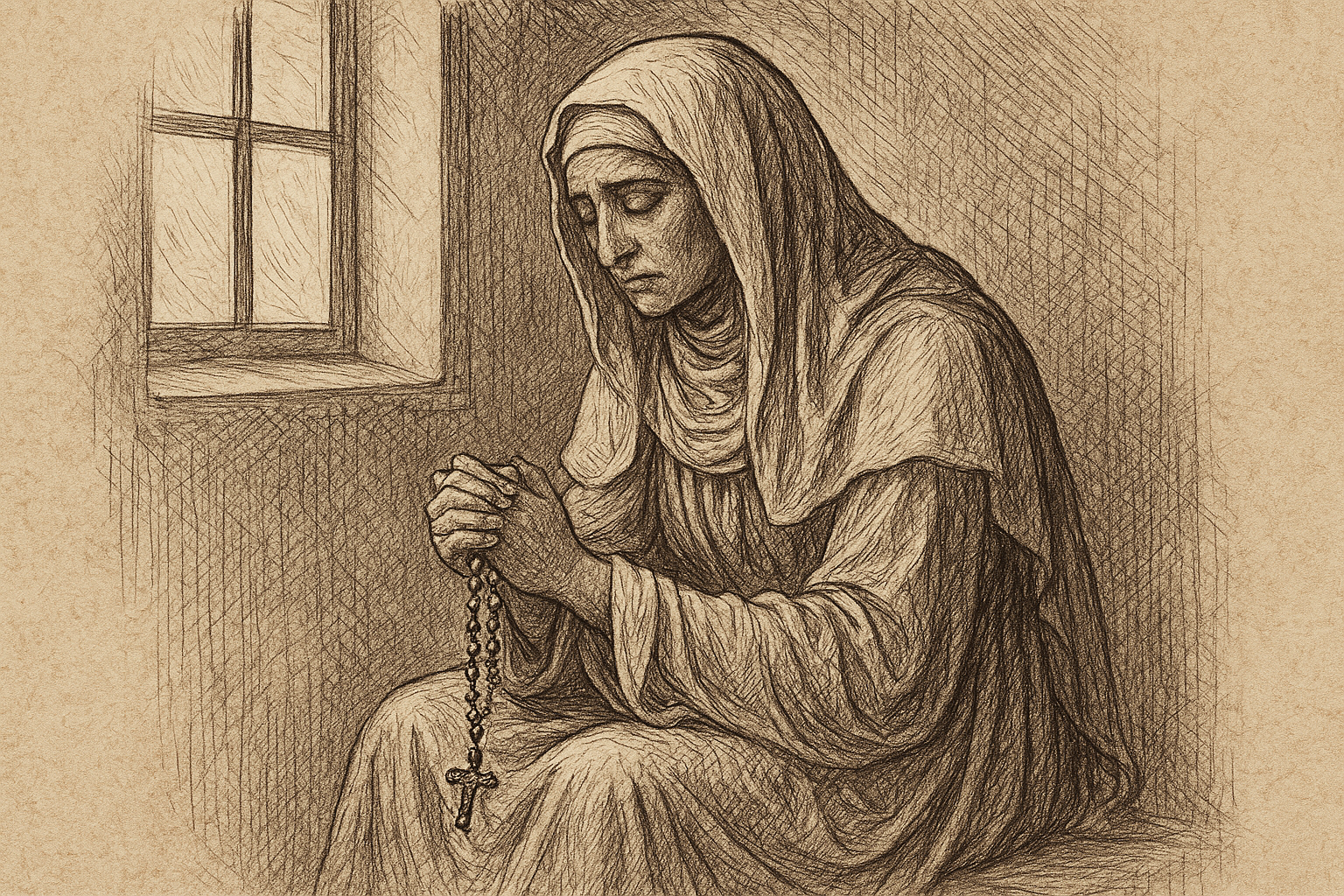
Monica had at least three children: Augustine, Navigius, and a daughter often identified as Perpetua. Of these, Augustine became the most famous. He lived for years in moral confusion and intellectual searching before his conversion to Christianity. Monica loved him deeply, and she never stopped praying for him. Her tears and petitions became part of the Church's memory of conversion.
According to the traditional account, Monica followed Augustine as he moved through North Africa and then to Italy. She was not content to speak only words of rebuke. She pursued him with love, prayer, and hope. In Milan, she came under the influence of St. Ambrose, whose preaching helped prepare Augustine for baptism. Monica's role was not that of a dramatic rescuer, but of a steadfast intercessor who refused to give up.
A mother's prayer and a son's conversion
One of the most famous details of St. Monica's life is the answer given to her by a bishop when she begged him to speak to Augustine. The bishop reportedly told her that the son of such tears could not be lost. Whether one reads this as literal history or as a cherished tradition, it captures the heart of Monica's witness: she believed that no soul is beyond God's reach.
Scripture often presents this same confidence in God's mercy. The Lord hears the cry of the afflicted and draws near to those who call upon him: The Lord hears the cry of the afflicted. A praying mother may not control the pace of conversion, but she can place her child before the mercy of God again and again.
Augustine's conversion did not happen through Monica's effort alone, but her prayers were part of the mystery. Grace worked in Augustine's heart through the preaching of the Church, the example of holy men, the struggle of conscience, and the relentless love of his mother. Catholics can learn from this that family prayer is never wasted. We may not always see immediate fruit, but God is at work in ways that often remain hidden.
Her final years and holy death
After Augustine's conversion, Monica experienced a deep joy. She had asked for one thing above all: to see her son become a Christian and belong fully to God. In Milan, as she neared the end of her life, she spoke with Augustine about heaven and the life to come. Her hope had matured beyond earthly goals. She desired not simply comfort, but eternal communion with God.
Augustine gives a moving account of her last days at Ostia, where mother and son shared a quiet spiritual conversation. Monica told him that she was no longer anxious about anything earthly. Soon after, she became ill and died in peace. Her burial place became associated with the memory of prayer answered and hope fulfilled.
Her death is important because it shows that holiness is not only about endurance under pressure. It is also about surrender. Monica had prayed for years, and when the time came, she entrusted her own soul to God. Her life closed in the same spirit with which it had been lived: faith, patience, and love.
What Catholics can learn from St. Monica
1. Persistent prayer is an act of love
Monica reminds Catholics that prayer for others is not a passive gesture. It is an expression of real charity. She did not give up on Augustine, even when his life seemed far from God. Many Catholics carry similar burdens today, praying for children, spouses, siblings, parents, or friends who are distant from the faith.
Jesus encourages perseverance in prayer. He teaches his disciples to ask, seek, and knock: Ask, seek, knock. Monica lived this teaching with quiet consistency. Her life suggests that persistence in prayer is not a lack of trust. It is trust made durable.
2. Holiness often looks hidden
St. Monica was not known for public miracles or visible leadership. Her holiness was mostly domestic, patient, and long-suffering. Yet God used it powerfully. This matters for Catholics who feel that their daily duties are small or unnoticed. Caring for a family, remaining faithful in an imperfect marriage, and praying in secret can all become paths to sanctity.
The Gospel does not measure greatness by noise. The Lord sees what is hidden, and he rewards faithfulness done in secret: The Father who sees in secret. Monica's life encourages those who may never preach from a pulpit but still labor in love every day.
3. Conversion belongs to God
Monica's example also keeps Catholics humble. She prayed intensely for Augustine, but she could not convert him by force. In the end, conversion is a gift of grace. This frees Catholics from discouragement and from the illusion that they must control outcomes. We cooperate with God, but God alone changes the heart.
That truth is also a comfort. If you pray for someone you love and see little progress, Monica's story says that the situation is not hopeless. God can work in a soul for years before the decisive moment arrives.
4. Suffering can be offered with purpose
Monica did not suffer in vain. Her tears, disappointments, and long waiting were not meaningless because she united them to prayer. Catholics believe that suffering, when joined to Christ, can bear spiritual fruit. This does not make pain pleasant, but it gives pain meaning.
Saint Paul writes that tribulation can produce endurance and hope: Suffering produces endurance. Monica's life embodies that sequence. Her endurance became hope, and her hope rested not in herself but in God's mercy.
Monica and the Catholic life today
Modern Catholics often live in a culture that values speed, results, and control. St. Monica offers a different rhythm. She teaches that the Christian life includes waiting, tears, sacrifice, and trust. She also teaches that family life can be a real school of holiness, even when it is messy.
Parents may find in her a patroness for children who have drifted. Wives and husbands may find in her a companion in difficult marriages. Adult children may find her example helpful when praying for aging parents or for reconciliation in a fractured family. Even Catholics without immediate family concerns can learn from her patience in all spiritual friendships.
Her witness also complements the wider Christian call to intercession. We are not isolated believers. The Church prays for one another across time and space. Monica's prayers for Augustine are a reminder that one person's faithfulness can affect generations. Augustine's own sanctity, writings, and teaching would shape countless Christians after him. In that sense, Monica's hidden fidelity bore fruit far beyond what she could have imagined.
St. Monica teaches that tears offered to God are never wasted, and that love remains faithful even when the path to conversion is long.
Practical ways to imitate St. Monica
- Pray daily for one person by name, especially someone who has drifted from the faith.
- Offer a small sacrifice each week for that person's return to God.
- Receive the sacraments faithfully, trusting that your own holiness supports your intercession.
- Practice patient speech at home, especially when concern could easily become frustration.
- Read a passage of Scripture each day that strengthens hope in God's mercy.
These are simple acts, but Monica's life suggests that God works powerfully through the simple and faithful. Sanctity does not always begin with dramatic change. Often it begins with a heart that keeps turning back to God in trust.
Why St. Monica still matters
The Church remembers St. Monica because her life brings together sorrow and hope in a way many people recognize. She did not live an easy life, but she lived a holy one. She did not see every answer she desired in the moment she desired it, but she trusted the Lord who sees the whole story.
For Catholics today, the St. Monica life is a reminder that prayer is personal, persistent, and powerful. It is also a reminder that God often works through the quiet fidelity of ordinary believers. Monica's love helped prepare a saint, but more importantly, it showed the Church how a Christian woman can endure with dignity, pray with confidence, and hope without surrendering to despair. When we ask her intercession, we ask for the grace to love as she loved and to trust as she trusted, even while the final answer is still unfolding.
Keep Reading on Lets Read The Bible
Frequently Asked Questions
Why is St. Monica important to Catholics?
St. Monica is important because her faithful prayer and endurance show how grace can work through ordinary family life. Catholics especially honor her as a model for persistent intercession and hope.
What is St. Monica known for?
She is best known for praying for the conversion of her son, St. Augustine, and for remaining steadfast through years of sorrow, family tension, and waiting.
How can Catholics imitate St. Monica today?
Catholics can imitate her by praying consistently for loved ones, offering sacrifices for their conversion, receiving the sacraments faithfully, and trusting God's timing rather than demanding immediate results.