Family and Vocation
A Father's Faithfulness Is Built One Day at a Time
Christian fatherhood grows through presence, repentance, prayer, and the grace to begin again.
Site Admin | November 4, 2026 | 6 views
Fatherhood is often described through visible duties: providing for a household, protecting children, setting boundaries, and teaching practical skills. These responsibilities matter, but they do not fully reveal the vocation. Viewed from a fatherhood Catholic perspective, being a father is a lifelong call to receive love from God and make that love tangible within a family.
This does not require a man to be invulnerable, endlessly confident, or naturally gifted in every part of family life. It asks him to become faithful. That faithfulness is usually formed through ordinary choices: listening when tired, keeping a promise, admitting a wrong, praying when words are difficult, and returning to love after failure.
Christian fatherhood is demanding precisely because it concerns persons rather than projects. A project can be completed and set aside. A child must be loved through changing seasons, unexpected needs, and increasing freedom. The father is also changing. He must learn, repent, mature, and allow grace to reshape him.
Fatherhood Begins with God
Catholic faith does not begin with human fatherhood and then project it onto God. It begins with God, from whom all genuine fatherhood receives its meaning. Jesus teaches his disciples to address God as Father in prayer Matthew 6:9. This name reveals intimacy, authority, providence, and a love that gives life.
An earthly father does not replace God or possess his family. His authority is entrusted to him for the good of others. He is called to reflect something of God's patient and generous care while remembering that he remains a son in need of mercy.
This truth protects fatherhood from two opposite distortions. The first is domination, in which authority becomes control. The second is passivity, in which a father withdraws from responsibility because leadership feels uncomfortable or difficult. Catholic fatherhood rejects both. It understands authority as service and responsibility as an expression of love.
Christian fatherhood is not the power to make a family revolve around one man. It is the grace to spend oneself for the life of others.
God's fatherhood is perfect, while every human father is limited. This difference should not lead to despair. It should lead to humility. A father need not pretend to be all knowing or self sufficient. He can seek counsel, receive correction, and entrust what he cannot control to God.
A Vocation Shared Within the Family
In Catholic teaching, fathers and mothers possess equal personal dignity. Their love for their children is not a competition for importance. Within marriage, they are called to cooperate in the good of the family, bringing their gifts, sacrifices, and judgment into a shared vocation.
This cooperation will look different from household to household. Catholic faith does not reduce fatherhood to a single personality type, career arrangement, or list of domestic tasks. Some fathers are quiet and reflective. Others are expressive and energetic. Some work long hours outside the home, while others carry much of the daily care within it. Circumstances may change because of illness, unemployment, disability, military service, bereavement, or other serious burdens.
What remains essential is the father's sincere gift of self. He cannot delegate the whole work of relationship. Material provision, though important, is not a substitute for affection, moral guidance, prayer, or attention. Children need to know not only that their father works for them, but that he knows them.
St. Paul warns fathers not to provoke their children, but to raise them with the discipline and instruction of the Lord Ephesians 6:4. The verse joins authority to restraint. Discipline should guide a child toward virtue, not humiliate, frighten, or crush the child. A father must therefore examine both what he teaches and how he teaches it.
The Sacred Weight of Presence
Presence is more than being physically located in the same room. A father can be at home while remaining absorbed in work, entertainment, worry, or a phone. Genuine presence involves attention. It communicates, without needing an elaborate speech, that another person's joys and fears are worthy of notice.
Children often remember small patterns of presence: being greeted warmly, hearing a familiar bedtime prayer, receiving help after a mistake, or seeing a father put aside his own plans to meet a need. Such moments may appear insignificant, but together they form a child's understanding of trust.
Presence also requires fathers to enter the emotional life of the family. This can be difficult for men who were taught to hide sorrow, uncertainty, or tenderness. Emotional steadiness is valuable, but steadiness is not the same as silence. A father can acknowledge fear without surrendering to it. He can grieve without abandoning hope. He can express affection without embarrassment.
Jesus himself shows compassion openly. He receives children and blesses them Mark 10:16. Christian strength is therefore not coldness. It is love disciplined by truth, courage, and mercy.
When Fatherhood Exposes Weakness
Family life has a way of revealing what a person might prefer to keep hidden. Impatience appears during interrupted sleep. Pride rises when advice is ignored. Anxiety grows when money is tight. Old wounds may surface when a child reaches the age at which the father himself experienced neglect, conflict, or loss.
Many fathers carry a painful sense that they are failing. Some compare themselves with idealized images of family life. Others believe one bad decision has permanently defined them. Shame then encourages distance: if a man feels unworthy, he may withdraw instead of seeking forgiveness.
The Gospel offers a different path. Repentance does not deny the harm caused by sin, but neither does it declare a sinner beyond mercy. In Christ, a father can tell the truth, make amends, and begin again. The father in Jesus' parable sees his returning son from a distance and runs to meet him Luke 15:20. That image does not excuse sin. It reveals the eagerness of divine mercy to restore communion.
A father's apology can become an important act of spiritual leadership. Saying, I was wrong. Please forgive me, does not destroy legitimate authority. It shows that authority itself remains accountable to truth. Children who see repentance practiced at home learn that sin is serious, mercy is real, and relationships can be repaired.
Some struggles require more than private resolve. Persistent anger, addiction, depression, marital conflict, or patterns of abuse should not be hidden behind religious language. Seeking appropriate pastoral, medical, or professional help can be an act of responsibility. Grace does not ask a father to deny reality. It enables him to face reality with honesty and hope.
Grace Enters the Ordinary Routine
Catholic fatherhood is not sustained by determination alone. The sacramental life gives a father what he cannot manufacture for himself. In Confession, he receives mercy and learns to name sin without despair. In the Eucharist, he receives Christ, whose self giving love is the pattern and source of Christian life.
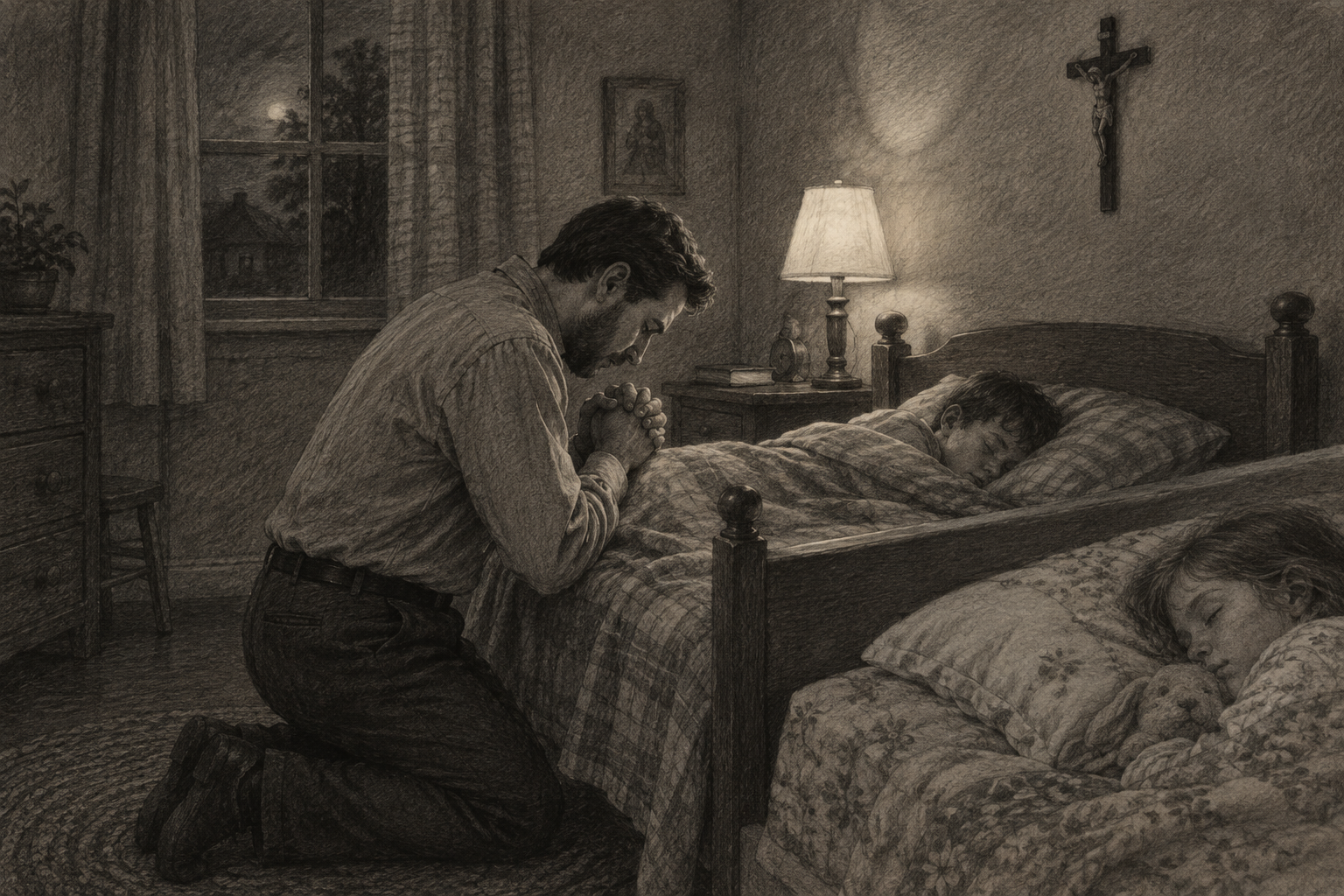
Prayer also changes the atmosphere of a home, even when it is brief and imperfect. A father does not need to deliver a sermon every night. He can make the Sign of the Cross with his children, offer a simple blessing before sleep, pray for someone who is suffering, or read a short passage from Scripture. Consistency matters more than performance.
The Book of Deuteronomy describes God's words being taught through the ordinary movements of the day, at home and along the way Deuteronomy 6:7. Faith is not meant to remain confined to formal religious occasions. It belongs in conversations about honesty, friendship, money, suffering, forgiveness, work, and the dignity of every person.
A father also teaches by allowing his children to see him pray. This does not mean making a display of piety. It means letting faith become visible enough that children understand it is not merely a private opinion. When a father kneels, attends Mass, asks for intercession, or gives thanks, he witnesses that he too lives under God's loving authority.
Practices That Form a Faithful Father
No list can remove the complexity of family life, but several habits can help fatherhood become more intentional:
- Pray for each child by name. Ask not only for success or safety, but for holiness, wisdom, courage, and a loving heart.
- Give undivided attention. Set aside regular moments when devices and work are put away so that conversation can unfold without competition.
- Speak affection clearly. Children should not have to infer that they are loved only from financial support or acts of service.
- Keep discipline calm and proportionate. Correct behavior without insulting the child's identity or using fear as the primary tool.
- Honor the child's mother. Whether family circumstances are peaceful or strained, avoid drawing children into adult resentment or contempt.
- Let Sunday shape the week. Participation at Mass should be treated not as one more obligation, but as the center from which Christian family life receives strength.
- Return quickly after failure. Do not allow pride to turn a moment of impatience into days of distance.
These practices are modest enough to begin today. They also require perseverance. A father may not see immediate results, and children do not always respond as hoped. Love remains an offering rather than a technique for controlling outcomes.
Fathers Who Carry Their Own Wounds
Not every man received a good example of fatherhood. Some grew up with absence, harshness, unpredictability, or abuse. The language of God as Father can even be difficult when human fatherhood has been associated with fear.
The Church should approach these wounds with patience. God's fatherhood is not a magnified version of human failure. It is the truth by which every human father is judged and healed. Scripture describes God as compassionate toward his children Psalm 103:13. That compassion can slowly correct the false images left by painful experience.
A man is not doomed to repeat everything he received. With grace, truthful self examination, sound friendship, and appropriate help, inherited patterns can be interrupted. He may need to learn basic expressions of affection or conflict resolution that others take for granted. This learning is not a sign that his vocation is false. It may be one of the most courageous ways he lives it.
Families also include fathers who grieve children lost through miscarriage, illness, estrangement, or death. Their fatherhood is not erased by grief. Love continues in prayer, remembrance, and entrustment to God. The Church's life should make room for these fathers, including those whose sorrow is quiet or difficult to express.
The Freedom to Be Faithful
A Catholic father is not called to produce a flawless family image. He is called to love real people in real circumstances. His vocation takes shape through meals, bills, disagreements, celebrations, sickness, school days, workdays, and prayers whispered after everyone else is asleep.
The measure of fatherhood is not constant success, but faithful self giving under grace. A father will sometimes need to lead and sometimes to listen. He will protect, provide, teach, apologize, wait, and let go. Through all of it, he can remember that he is not the source of every good gift. He is a steward who has first been loved by the Father.
That knowledge gives him freedom. He does not have to be perfect before he can bless his family. He can begin with the next honest prayer, the next patient answer, the next act of attention, and the next return to mercy. In such ordinary faithfulness, a home can become a place where the love of God is not merely discussed, but encountered.
Keep Reading on Lets Read The Bible
Frequently Asked Questions
What is the Catholic understanding of a father's primary role?
A Catholic father is called to serve the good of his family through faithful love, protection, moral guidance, material care, prayer, and personal example. His authority is not ownership or domination. It is a responsibility exercised in cooperation with the child's mother and under the authority of God.
How can a father lead his family spiritually if he feels unprepared?
He can begin simply by attending Mass faithfully, praying briefly with his family, reading Scripture, receiving the sacraments, and asking forgiveness when he fails. Spiritual leadership does not require expert knowledge or impressive speeches. It grows through sincere, consistent witness and a willingness to keep learning.
Can a man become a good father if his own father was absent or harmful?
Yes. A painful upbringing can leave real wounds, but it does not determine a man's future. Grace, honest reflection, healthy friendships, pastoral support, and professional help when needed can interrupt destructive patterns. God's fatherhood provides the true standard, while repentance and patient practice make new habits possible.