Doctrine and Questions
From Eden to a Family of Nations: How the First Humans Filled the Earth
A careful Catholic look at Genesis, human origins, and the first family of the human race.
Site Admin | July 3, 2025 | 68 views
The question of how Adam and Eve populated the earth explained often begins as a simple curiosity, but it quickly opens onto deeper matters of faith. If Adam and Eve were the first human parents, how did the human family come to be so large? Where did Cain find a wife? What are Catholics to make of the early chapters of Genesis, which speak with solemn beauty rather than modern scientific detail?
The Church does not ask believers to choose between reverence for Scripture and honest reason. Instead, she teaches that Genesis tells us real truths about God, creation, sin, and the human family, even when it uses the language of ancient sacred history rather than a laboratory report. The central point remains clear: all human beings share a common origin in the first parents and a common need for grace.
What Catholic faith says about Adam and Eve
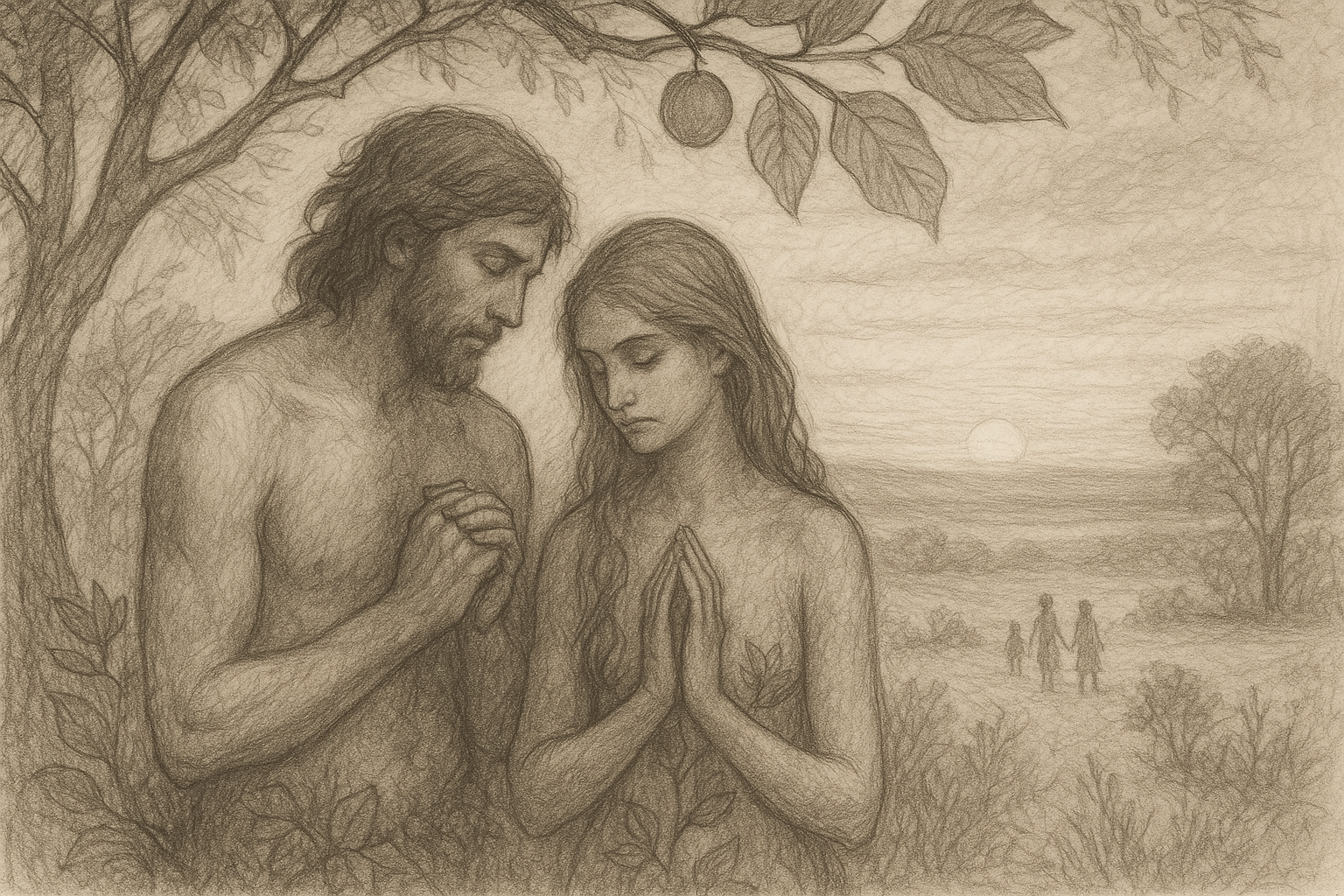
In Catholic teaching, Adam and Eve are not symbols detached from history. They are presented as the first human parents, created by God, endowed with reason and freedom, and called to live in friendship with Him. Genesis teaches that humanity begins in communion with the Creator and that sin entered human history through disobedience, not through blind fate or material necessity.
This matters because the family of mankind is not random. Scripture presents the human race as one. The Apostle Paul later ties the human story to Adam and to Christ, who comes as the new Adam to heal what the first Adam wounded. The unity of humanity is not merely biological. It is also moral and spiritual.
For just as through one man sin entered the world, and through sin, death, and thus death came to all men, inasmuch as all sinned. Romans 5:12
That verse does not answer every question of population growth, but it frames the larger Catholic view. The human family began in one origin, and from that beginning came both the spread of life and the tragic spread of sin.
How the population could have grown
If Adam and Eve were the first human beings, then the simplest answer is that the earth was populated through their children, and through the marriages of their children and descendants. Genesis itself says that Adam and Eve had sons and daughters, not only Cain, Abel, and Seth. The text is brief, but it plainly indicates a larger family than the named children alone.
In the earliest generations, the human family would have grown through close kinship within the one family line. That can sound unsettling to modern ears, but the moral and genetic concerns people rightly raise today belong to a later stage of history, after the human family had expanded and after conditions of civilization had changed. Scripture is not endorsing a permanent pattern for every age. It is recounting the origin of humanity.
When readers ask about Cain's wife, the Bible itself gives the necessary clue. Genesis says that Cain went away and lived in the land of Nod, east of Eden, and later built a city. That only makes sense if there were already other descendants of Adam and Eve or if the first family had grown large enough to form a settled community. The inspired text does not list every birth, marriage, and migration. It gives the outline, not a genealogical register.
Why the Bible names only a few children
Genesis often names only the figures needed for the theological story. Cain and Abel matter because they reveal the tragedy of fraternal violence. Seth matters because through him the line of hope continues. The Bible does not name every brother and sister because the point is not to provide a complete family tree. The point is to show how human life began under God's providence and how sin fractured the first family.
So when Catholics ask how Adam and Eve populated the earth, the answer is not mysterious in principle. They populated it through the ordinary means of human generation, beginning with the children given to them by God, and the descendants of those children. The exact chronology is not revealed, and the Church does not pretend to know details the text does not supply.
What to do with questions about early sibling marriage
Many people stop at the difficulty of close-kin marriage in the first generations. That is understandable. In later human history, the Church recognizes serious reasons to avoid such unions, and civil and ecclesial law regulate marriage accordingly. But the earliest human family is unique. If the whole human race came from one pair, then the first generations necessarily arose from within a very narrow family circle.
That fact does not mean the earliest unions were morally identical to later cases. In the beginning, before humanity spread, there was no other possible path for the race to continue. Catholic thought has long recognized that God can permit things in one stage of salvation history that would not be fitting in another. The key issue is not to force later assumptions back into the world of Genesis.
It is also important not to imagine the first parents and their children in a crude or primitive way. Genesis presents them as real human persons, not as beasts or mythic abstractions. They possessed intelligence, memory, language, and the ability to know God. The first family belongs to history, but to a history marked by extraordinary beginnings.
Does science change the question?
Modern readers often bring genetics, anthropology, and population studies into the conversation. Those fields are useful, but they do not settle the theological question on their own. Catholics may discuss various ways to harmonize scientific evidence with the doctrine that the human race descends from an original pair, but the central issue remains the same: Scripture and Tradition teach a real first human family and a real fall from original holiness.
Some Catholics explore models that try to account for the full complexity of human origins while preserving the truth that all people are one family under God. Such discussions can be helpful, provided they do not deny the doctrinal heart of the matter. Whatever the precise manner of population growth in the earliest age, the Church insists that human beings are not merely the product of anonymous forces. We are created, loved, and accountable before God.
For ordinary Catholic life, that truth is more important than speculation. When the Church teaches that all descend from one family, she is teaching more than a fact about the past. She is teaching humility, solidarity, and responsibility. No one is self-made. No one stands outside the human story. We are all kin, wounded by sin and offered mercy in Christ.
Why this teaching matters in daily Catholic life
The story of Adam and Eve is not a puzzle to solve and then forget. It shapes how Catholics understand marriage, parenthood, suffering, and redemption. If the human race shares one origin, then every child is a brother or sister in the deepest sense. That should change the way we speak about the poor, the unborn, the elderly, the foreigner, and the enemy.
It also sheds light on confession. The fall of our first parents is not merely a tragedy in someone else's past. It explains the interior struggle every person knows. We inherit a wounded nature, and we live in a world where good and evil are mixed. The first family was not perfect, and neither is ours. Yet God's mercy did not end in Eden.
The Catechism teaches that the biblical account of the fall uses symbolic language, but it preserves a real event at the dawn of human history. Catholics need not treat Genesis as a modern news report to believe it faithfully. We read it as sacred history, with reverence for both its theological depth and its real claims about the human condition.
The Lord God said,Keep Reading on Lets Read The Bible
Frequently Asked Questions
Did Adam and Eve have other children besides Cain, Abel, and Seth?
Yes. Genesis says that Adam and Eve had sons and daughters beyond the children named in the text. The Bible names only the figures needed for the inspired story, not every member of the first family.
Where did Cain get his wife?
Genesis does not identify her by name, but the most straightforward reading is that she came from Adam and Eve's extended descendants. The early human family would have grown through successive generations from the first parents.
Does the Catholic Church require a literal reading of every detail in Genesis 1 to 3?
No. The Church teaches that Genesis communicates real truth in sacred language. Catholics must hold that humanity has one origin, that the first parents fell through sin, and that human history needs redemption, while recognizing that the text uses literary forms different from modern reporting.