Doctrine and Questions
Grace You Can Receive: The Seven Sacraments in the Life of the Church
The Church's sacramental life is not theory alone. It is Christ meeting His people in signs that do what they signify.
Site Admin | July 21, 2025 | 82 views
Christ still meets His people through visible signs
When Catholics speak of the seven sacraments explained, they are not describing a set of religious symbols that merely remind us of God. The Church teaches that the sacraments are effective signs of grace, instituted by Christ and entrusted to the Church. In them, the Lord acts. He does not stand at a distance while we perform a ritual for Him. He draws near and gives what He promises.
This matters because Catholic faith is not an idea floating above ordinary life. It is a faith of water, oil, bread, wine, spoken words, laying on of hands, forgiveness, healing, covenant, and blessing. The Son of God took flesh. In the same pattern, He continues to reach us through material signs that carry spiritual power. The sacraments fit the way God has always worked with humanity: He uses what is visible to communicate what is invisible.
The Church recognizes seven sacraments because Scripture and apostolic tradition reveal these chief channels of grace. They accompany every major stage of life, from birth into the Church to healing, vocation, and preparation for eternal life. They are not isolated rites. Together they form the shape of a Catholic life.
Baptism begins the Christian life
Baptism is the doorway to the sacramental life. Through water and the Trinitarian formula, a person is cleansed from sin, reborn as a child of God, and incorporated into the Body of Christ. Jesus makes the necessity and power of baptism clear when He says,
unless one is born of water and the Spirit
The Acts of the Apostles shows the early Church baptizing in response to faith and repentance, and the apostolic letters connect baptism with dying and rising with Christ. [[VERSE|romans|6|3-4|baptized into Christ Jesus]] Baptism is therefore far more than a public announcement. It is a real participation in the saving death and resurrection of the Lord.
For Catholic families, this sacrament is often the first great act of faith in a child's life. For adults, it marks a decisive turning point, the beginning of a new identity. Its grace is foundational because everything else in Christian life builds upon it. The baptized person belongs to Christ and is called to grow into that belonging.
Confirmation strengthens what Baptism begins
Confirmation is the sacrament by which the Holy Spirit deepens baptismal grace and strengthens the Christian for witness. In the Acts of the Apostles, believers who had been baptized receive the Spirit through the laying on of hands. [[VERSE|acts|8|14-17|the apostles laid their hands on them]] This apostolic pattern lies at the heart of Confirmation.
The sacrament does not invent a new faith. It completes and fortifies the grace already given. In Confirmation, the faithful are sealed with the gift of the Holy Spirit, marked as belonging to Christ more fully, and sent to live with courage. That is why the sacrament is closely tied to mission. The Spirit does not strengthen us only for private devotion. He strengthens us for public fidelity.
In ordinary Catholic life, Confirmation matters because discipleship requires more than good intentions. It requires endurance, clarity, and holy boldness. A confirmed Catholic is called to testify to the faith in family life, work, parish service, and the wider world. The sacrament is a gift for a lifetime, not a graduation ceremony.
The Eucharist is the heart of Catholic worship
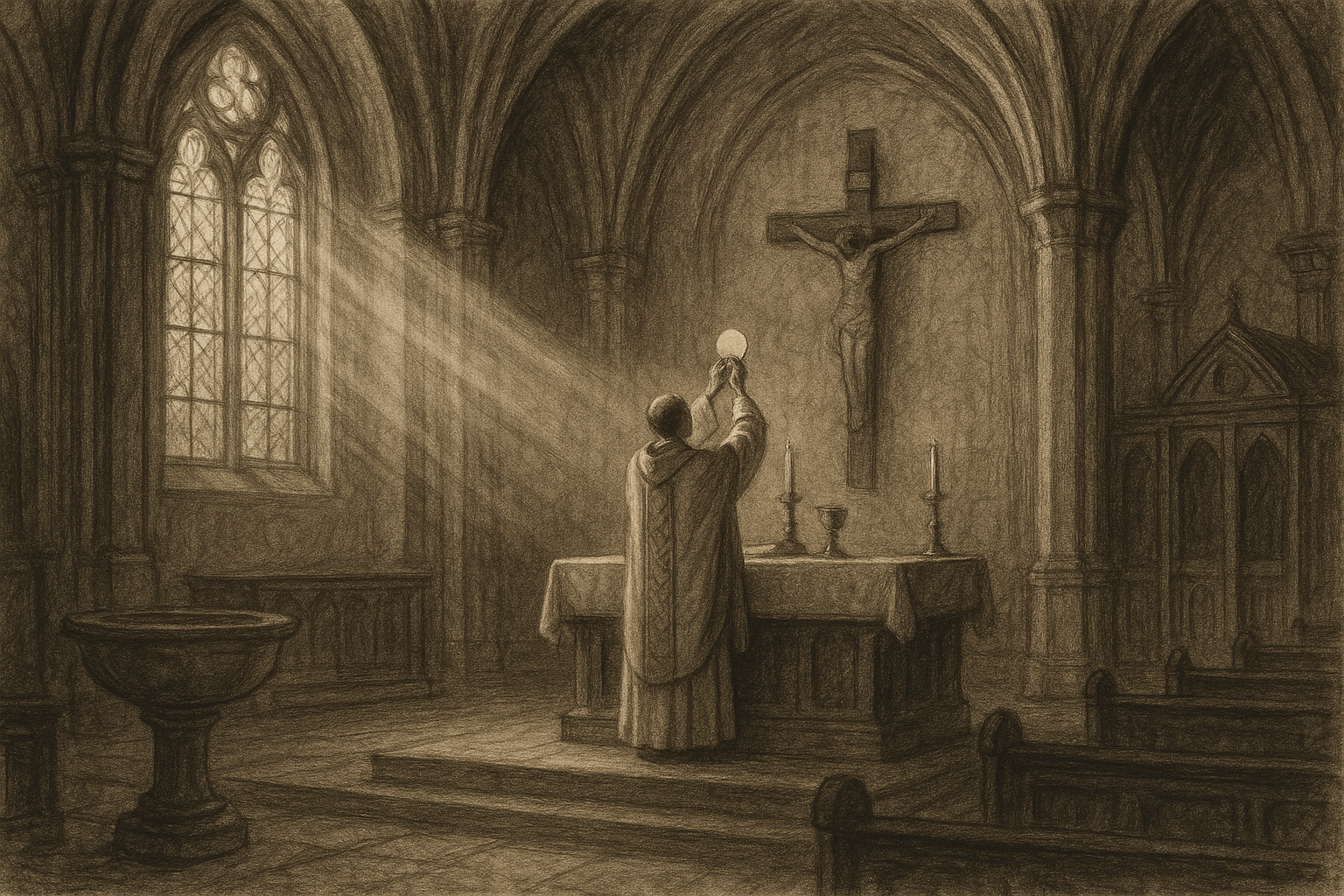
The Eucharist stands at the center of the Church because it is the Body and Blood of Christ, offered sacramentally under the appearances of bread and wine. At the Last Supper, Jesus said,
[[VERSE|luke|22|19-20|this is my body given for you]]and the apostolic witness preserves the Church's unwavering belief that this gift is real. Saint Paul warns the Corinthians that the cup and bread are a true participation in Christ. [[VERSE|1-corinthians|10|16-17|participation in the body and blood of Christ]]
The Eucharist is not simply a memorial in the modern sense of remembering something that is absent. It is the sacramental making present of Christ's one sacrifice. The faithful receive the Lord Himself as spiritual food. This is why the Mass is the summit of Catholic worship and the source from which the rest of Christian life flows.
Practical Catholic life changes when the Eucharist is central. Sunday becomes more than a weekly obligation. It becomes an encounter with the living Christ. Daily concerns, suffering, gratitude, and hope are brought to the altar. The faithful learn that ordinary life is meant to be offered, sanctified, and nourished by divine life.
Penance restores communion after sin
Sin wounds communion with God and with the Church, and the sacrament of Penance, also called Reconciliation or Confession, addresses that wound with mercy and truth. After the Resurrection, Jesus breathes on the apostles and says,
[[VERSE|john|20|22-23|if you forgive the sins of any]]The Church understands this as the institution of sacramental forgiveness through apostolic ministry.
Confession is sometimes resisted because it requires humility. Yet that humility is part of the healing. The sacrament asks the penitent to name sin honestly, receive absolution, and begin again. It does not deny the seriousness of sin, and it does not reduce mercy to sentiment. It reveals mercy as the power of God to restore what sin has damaged.
In daily Catholic life, Penance protects the conscience. It teaches self-examination, gratitude, and trust. It also reminds us that holiness is not the absence of struggle, but the willingness to return to God with a contrite heart. A regular confession pattern can become one of the most peaceful disciplines in a Catholic home, because mercy received is mercy learned.
Anointing of the Sick brings Christ's compassion to suffering
The sacrament of Anointing of the Sick is a gift for those who are seriously ill, weakened by age, or preparing for major surgery, and for the dying when death is near. Its biblical foundation appears in the Letter of James:
[[VERSE|james|5|14-15|let them pray over the sick]]The Church sees in this a direct apostolic instruction to anoint and pray for the afflicted.
This sacrament should not be reduced to a final gesture when all hope is gone. It is a sacrament of comfort, strength, forgiveness if needed, and union with Christ in suffering. The Lord who healed the sick in the Gospels still draws near to the suffering members of His Body. He does not always remove every illness, but He always gives grace suited to the hour.
In ordinary life, Anointing of the Sick reminds Catholics that suffering need not be wasted. Illness can become a place of surrender, prayer, and communion with the crucified Christ. Families who request the sacrament for loved ones often discover that it brings peace not because it pretends death is not serious, but because it places death within God's care.
Holy Orders serves the Church through ordained ministry
Holy Orders is the sacrament by which men are ordained as bishops, priests, or deacons for service in the Church. Christ chose and sent the apostles, and the pastoral letters speak of the laying on of hands in the handing on of ministry. the gift of God through the laying on of my hands The Church has always understood ordained ministry as a sacramental participation in Christ's own shepherding work.
Holy Orders is not about status. It is about service. The ordained minister acts in a particular way on behalf of Christ and His Church, especially in preaching the Word, celebrating the sacraments, and guiding the faithful. Through bishops, priests, and deacons, the Church's visible unity is preserved and her sacramental life is made available across time and place.
This sacrament matters to every Catholic, not only to those who receive it. Without ordained ministry, the Eucharist would not be celebrated, sins would not be absolved sacramentally, and the Church's apostolic continuity would be obscured. Holy Orders therefore serves the entire people of God, helping the Church remain faithful to what Christ established.
Matrimony makes a covenant that reflects Christ and the Church
Matrimony is the sacrament by which a baptized man and a baptized woman enter a lifelong covenant ordered to the good of the spouses and the procreation and education of children. Jesus speaks of marriage as a union joined by God Himself. [[VERSE|matthew|19|4-6|what God has joined together]] Saint Paul deepens this teaching by comparing Christian marriage to the love between Christ and the Church. [[VERSE|ephesians|5|25-32|this mystery is great]]
Marriage is not merely a social contract or private arrangement. In the sacramental order, it becomes a sign of faithful, fruitful, and self-giving love. The spouses minister the sacrament to one another through consent, and God blesses that covenant with grace for fidelity, patience, forgiveness, and generosity.
In practical Catholic life, Matrimony sanctifies the home. It gives married couples a vision higher than convenience or feeling. It teaches them to love through sacrifice, to welcome children as gifts, and to endure trials with hope. The sacrament does not remove difficulty, but it places grace at the center of family life.
The sacraments are a pattern of grace for ordinary days
It is easy to think of the sacraments as occasional moments, but Catholic teaching sees them as a pattern of divine closeness. Baptism gives new birth. Confirmation strengthens. The Eucharist feeds. Penance heals. Anointing comforts. Holy Orders serves. Matrimony sanctifies. Together they reveal that God meets human beings at every important threshold of life.
This sacramental life also protects the Church from reducing faith to mere feeling or moral effort. Grace is not self-improvement with religious language. It is God's own life given to us through Christ. The sacraments teach Catholics to depend on Him concretely, not abstractly. They train the heart to receive before it tries to achieve.
That is why the Church urges the faithful to approach the sacraments with reverence, preparation, and gratitude. Each sacrament asks for faith, but each one also gives what faith seeks. In them, Christ remains faithful to His promise to be with His Church always.
The seven sacraments are the Church's great answer to the question of how God touches human life now. Not in memory alone, but in grace. Not in symbol alone, but in sacramental reality. Not from a distance, but through the living Christ who still saves, heals, feeds, forgives, and sends His people on their way.
Keep Reading on Lets Read The Bible
Frequently Asked Questions
What are the seven sacraments in the Catholic Church?
The seven sacraments are Baptism, Confirmation, the Eucharist, Penance, Anointing of the Sick, Holy Orders, and Matrimony. The Church teaches that each was instituted by Christ and gives grace in a distinct way.
Why do Catholics say the sacraments are necessary?
Catholics do not mean that God cannot save without the sacraments, but that Christ gave them as ordinary means of grace. They are the normal ways He nourishes, heals, and strengthens His people in the life of faith.
Which sacrament matters most in daily Catholic life?
All seven are important, but the Eucharist stands at the center of Catholic worship because it is the sacramental presence of Christ and the source and summit of the Church's life. The other sacraments flow from and lead back to that center.