Doctrine and Questions
Seven Gifts, One Life: Meeting Christ in the Sacraments
A clear look at how the seven sacraments shape Catholic life from baptism to anointing of the sick.
Site Admin | July 20, 2025 | 83 views
The seven sacraments Catholic teaching are sometimes discussed as if they were a neat list for memorization, a set of rites added onto the faith for ceremonial beauty. In reality, they are much more than that. The sacraments stand at the center of Catholic life because they are ways Christ continues his saving work among his people. Through them, God does not merely remind us of grace. He gives it.
This is why Catholics speak of the sacraments with reverence and confidence. They are not human inventions meant to symbolize invisible truths from a distance. They are visible signs instituted by Christ and entrusted to the Church, signs that truly confer grace when received rightly. The Church has always taught that the sacraments belong to the ordinary life of discipleship. They accompany birth, growth, conversion, healing, vocation, and death. In other words, they are not extras for especially devout people. They are part of the normal Christian path.
Christ and the life of grace
To understand the seven sacraments, it helps to begin with Christ himself. The Gospels show the Lord healing bodies, forgiving sins, restoring broken relationships, and gathering a people into communion with the Father. After the Resurrection, he does not abandon that saving work. He sends the Holy Spirit and gives the apostles authority to teach, baptize, forgive sins, and shepherd the flock. The Church receives these gifts not as abstractions, but as living means by which Christ remains active.
That is the heart of sacramental life. Grace is not an idea. It is God's own life shared with us. The sacraments are a fitting way for that grace to be given because human beings are both spiritual and bodily. We hear words, see gestures, taste bread and wine, feel oil, and sense the laying on of hands. God meets us in a manner suited to our nature. He does not save us as disembodied minds, but as persons made of body and soul.
Scripture gives many signs of this pattern. Jesus lays hands on the sick, spits on the blind man's eyes, speaks forgiveness to sinners, and blesses bread before multiplying it. After his Ascension, the apostolic Church continues to act in visible and tangible ways. The Catholic understanding of the sacraments grows from that biblical world, where God works through material things without ever being limited by them.
The seven sacraments in Catholic teaching
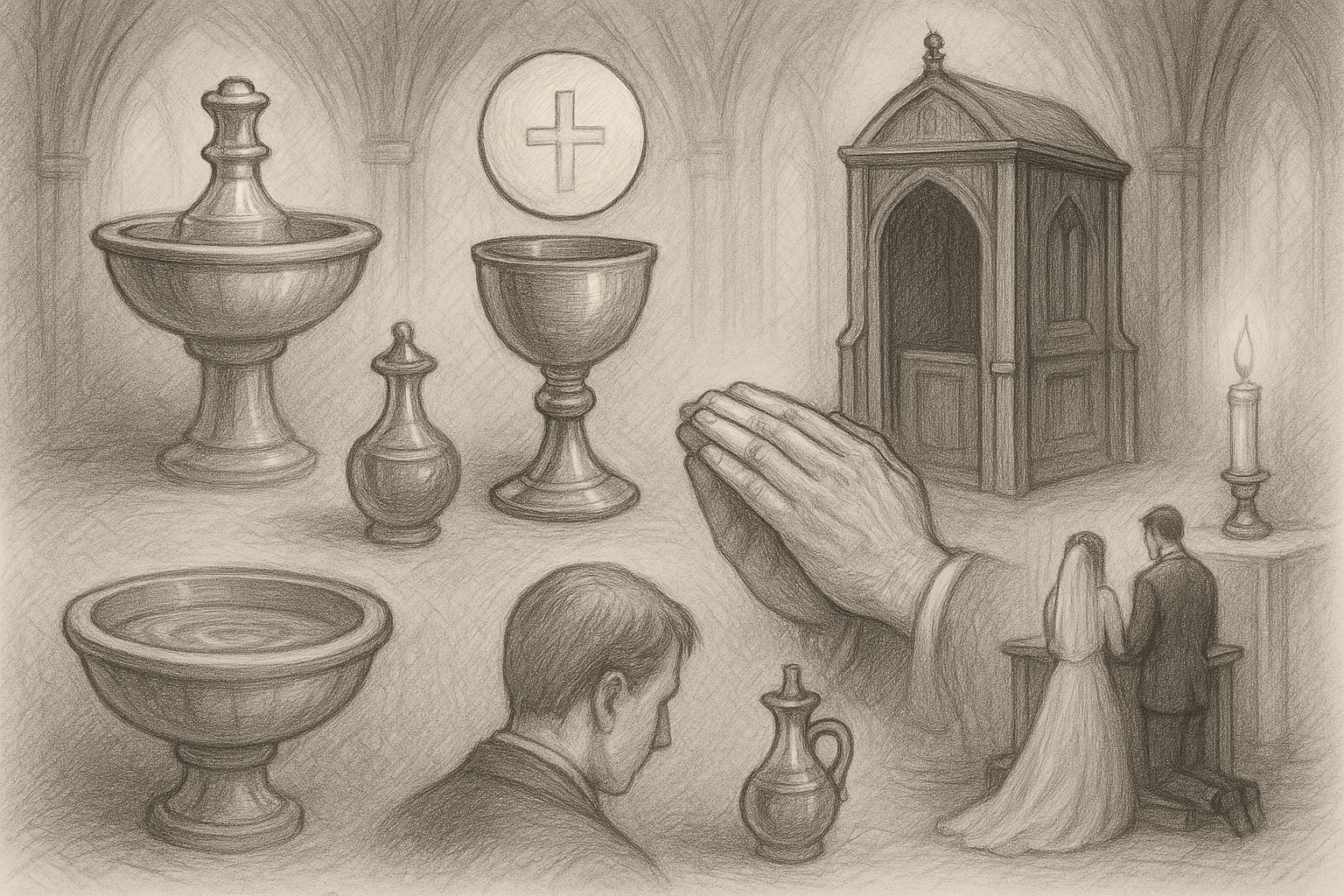
The Church names seven sacraments: Baptism, Confirmation, Eucharist, Penance, Anointing of the Sick, Holy Orders, and Matrimony. They are often grouped into sacraments of initiation, healing, and vocation. That grouping helps us see the shape of Christian life. Some sacraments bring us into the Church and nourish us there. Others restore us when sin and suffering wound us. Still others order us to a lifelong mission of service.
Baptism
Baptism is the gateway to the sacramental life. In it, a person is cleansed from sin, reborn in Christ, and made a member of the Church. Jesus tells Nicodemus,
Unless one is born of water and the Spirit, he cannot enter the kingdom of Godand after the Resurrection he commands the apostles to baptize all nations. The Church has always understood Baptism as more than a sign of belonging. It truly gives new life.
For Catholics, Baptism is the beginning of a long journey. It does not mean a person will never struggle, but it does mean that God has claimed that person as his own. The baptized are marked with an indelible spiritual seal. This is why Baptism is received only once.
Confirmation
Confirmation completes baptismal grace and strengthens the believer with the gifts of the Holy Spirit. The Acts of the Apostles shows the laying on of hands after Baptism as believers receive the Holy Spirit in a fuller way for witness and mission. The sacrament is not a graduation ceremony. It is an outpouring of power for Christian maturity.
Confirmation reminds Catholics that faith is not meant to remain private or fragile. The Spirit equips the baptized to confess Christ openly, to resist evil, and to serve the Church with courage. In a world that often treats belief as a temporary preference, Confirmation is a sign that discipleship is a public calling.
The Eucharist
The Eucharist is the center of Catholic worship and the sacrament that most fully nourishes the Church. At the Last Supper, Jesus took bread and wine and said,
This is my body, which is given for you. Do this in remembrance of meand the Church has always taken his words with awe. Catholics believe the Eucharist is truly the Body and Blood of Christ under the appearances of bread and wine.
This teaching is not meant to diminish mystery. It deepens it. In Holy Communion, Christ gives himself as food for the journey. The Eucharist unites believers to him and to one another, building the Church as one body. It also looks forward to the heavenly banquet, where faith will become sight. Among the seven sacraments Catholic teaching, the Eucharist holds a unique place because it contains Christ himself in a manner unlike the others.
Penance
Penance, also called Reconciliation or Confession, is the sacrament of mercy. After the Resurrection, Jesus breathes on the apostles and says,
Whose sins you forgive are forgiven them, and whose sins you retain are retainedCatholics see in this gift the authority Christ gave to the Church to forgive sins in his name.
This sacrament answers a very human need. Sin does not remain an abstraction. It wounds the conscience, weakens charity, and can estrange us from God and neighbor. In Confession, the penitent names sin honestly, expresses contrition, receives absolution, and begins again. Far from being a spiritual humiliation, this is one of the Church's clearest encounters with divine mercy. The sinner does not need to pretend. He needs to be forgiven.
Anointing of the Sick
Anointing of the Sick brings Christ's healing presence to those who are seriously ill, weakened by age, or facing grave suffering. The Letter of James urges the Church to pray over the sick, anointing them with oil in the name of the Lord. Catholic teaching sees in this sacrament both comfort and strength. Sometimes God grants physical healing. Always he offers grace for patience, trust, and union with Christ's own suffering.
This sacrament corrects two common misunderstandings. First, it is not only for the moment of imminent death, though it may be received at that time. Second, it is not a sign that God has abandoned the person. On the contrary, it is a sign that Christ draws near in affliction. The sick are not pushed to the margins of the Church. They are placed close to the Lord who bore our wounds.
Holy Orders
Holy Orders is the sacrament by which men are ordained as deacons, priests, or bishops for service in the Church. It continues the apostolic mission through a ministry of teaching, sanctifying, and governing. The ordained act not for themselves, but in service to Christ and his people. Priests are especially configured to offer the Eucharist, forgive sins, and shepherd the faithful under the bishop's care.
Holy Orders is sometimes misunderstood as a merely administrative role. In reality, it is a sacramental participation in Christ's own ministry. The ordained are called to humility, fidelity, and sacrifice. Their office exists for the sake of the Church, so that the faithful may be fed by Word and sacrament and led toward holiness.
Matrimony
Matrimony is the sacrament through which a baptized man and a baptized woman enter a covenant of lifelong partnership ordered to the good of the spouses and the procreation and education of children. Jesus restores marriage to its original dignity when he speaks of the permanence of the union God joins together. St. Paul also describes marriage as a sign of Christ's love for the Church.
Catholics do not reduce marriage to sentiment or social convenience. Matrimony is a vocation of mutual self-gift, fidelity, and fruitful love. It is a holy path by which spouses help one another toward heaven. When marriage is lived with faith, patience, and forgiveness, it becomes a luminous witness to the covenant love of Christ.
Common misunderstandings about the sacraments
One frequent misunderstanding is that sacraments are merely symbolic reminders. Symbols matter, but the Catholic faith says more than that. The sacraments truly do what they signify because Christ acts through them. Their power does not come from the personal holiness of the minister alone, though holiness always matters. Their power comes from Christ, who remains faithful to his promises.
Another misunderstanding is that sacraments are magic. They are not. God is not manipulated by rituals. The sacraments work by divine power and according to God's promise, but they call for faith, repentance, and proper disposition. A person may receive a sacrament externally and yet fail to bear its fruit inwardly if the heart is closed. Grace is gift, not automation.
It is also common to think that the sacraments are only for the especially religious. But the whole point of sacramental life is that God meets ordinary people in ordinary conditions. Babies, newly converted adults, married couples, the sick, the dying, sinners seeking mercy, and men ordained for service all find their place here. The sacraments map the whole Christian journey.
How the sacraments shape the Christian life
When Catholics speak of the seven sacraments Catholic teaching, they are speaking about a pattern of life. Baptism gives birth to faith. Confirmation strengthens it. The Eucharist nourishes it. Penance restores it when we fall. Anointing of the Sick carries us through suffering. Holy Orders serves the Church's sacramental life. Matrimony sanctifies family life and makes love fruitful. Together, they reveal that God is not distant from human history. He enters it, heals it, and raises it toward himself.
There is also a profound wisdom in the way the sacraments address different needs. We are born needy, and Baptism answers that need with rebirth. We grow weak, and Confirmation answers with strength. We hunger, and the Eucharist answers with communion. We sin, and Penance answers with mercy. We suffer, and Anointing answers with consolation. We need shepherds and parents, and Holy Orders and Matrimony answer with vocations of service and love. The sacramental life is not a set of isolated rites. It is a coherent divine response to the whole human condition.
For this reason, Catholics should approach the sacraments with gratitude rather than routine. Familiarity can dull wonder, but the Church's sacramental life deserves steady reverence. Every time the Church baptizes, absolves, anoints, ordains, or celebrates the Eucharist, Christ is acting for our salvation. Every sacrament says something about who we are, but more importantly, it says something about who God is: generous, faithful, and near.
To live well as a Catholic is not to collect religious experiences. It is to let the Lord shape us through the means he himself has given. The seven sacraments are not separate from the Gospel. They are the Gospel made present in signs we can see, hear, touch, and receive, until the day faith gives way to sight and the sacraments find their fulfillment in the direct vision of God.
Keep Reading on Lets Read The Bible
Frequently Asked Questions
Are the seven sacraments found directly in the Bible?
The sacraments are rooted in Scripture through Christ's actions, his words, and the apostolic practice of the early Church. The Catholic Church recognizes them as instituted by Christ, even though the full list and theological language developed over time.
Do the sacraments work automatically?
No. The sacraments are real acts of Christ, but we are called to receive them with faith and the proper disposition. God's grace is offered truly, yet a closed heart can fail to bear that grace fruitfully.
Why does the Catholic Church have seven sacraments and not more or fewer?
Catholics believe Christ established these seven as the principal sacramental signs of grace for the Church's life, covering initiation, healing, and vocation. The Church does not add to that number because it sees them as the fullness intended by Christ.