Doctrine and Questions
The Saints Are Not Far Away: A Catholic Look at Intercession
Scripture, tradition, and the quiet comfort of asking heaven to pray with us
Site Admin | June 23, 2025 | 75 views
Many Catholics know the practice of asking a saint for help, yet the doctrine behind it can still feel unfamiliar. Some wonder whether it distracts from Jesus, or whether it means treating saints like spiritual shortcuts. In truth, the intercession of the saints is one of the Church's most comforting teachings. It says that those who belong to Christ are united, even across the boundary of death, and that prayer can be shared within that holy communion.
To speak of the intercession of the saints explained clearly, we first need to say what it is not. Catholics do not believe saints replace Christ, who is the one mediator between God and man in the fullest and unique sense. Rather, we believe the saints pray for us as members of Christ's Body, just as Christians on earth pray for one another. Their charity has not ended. It has been perfected in heaven.
What Catholics mean by intercession
Intercession simply means praying on behalf of another. Scripture is full of this kind of prayer. Paul asks believers to pray for him, and he urges the Church to pray for all people, especially rulers and those in need. That basic Christian instinct has never disappeared. If you ask a friend to pray for you, you are already practicing intercession in an ordinary way.
The saints in heaven are not less alive because they have died in Christ. Jesus says God is not the God of the dead, but of the living. Those who are with him are alive to him, gathered into his presence and made perfectly holy by grace. Because they are alive in Christ, they can pray. Because they are holy in Christ, their prayer is powerful.
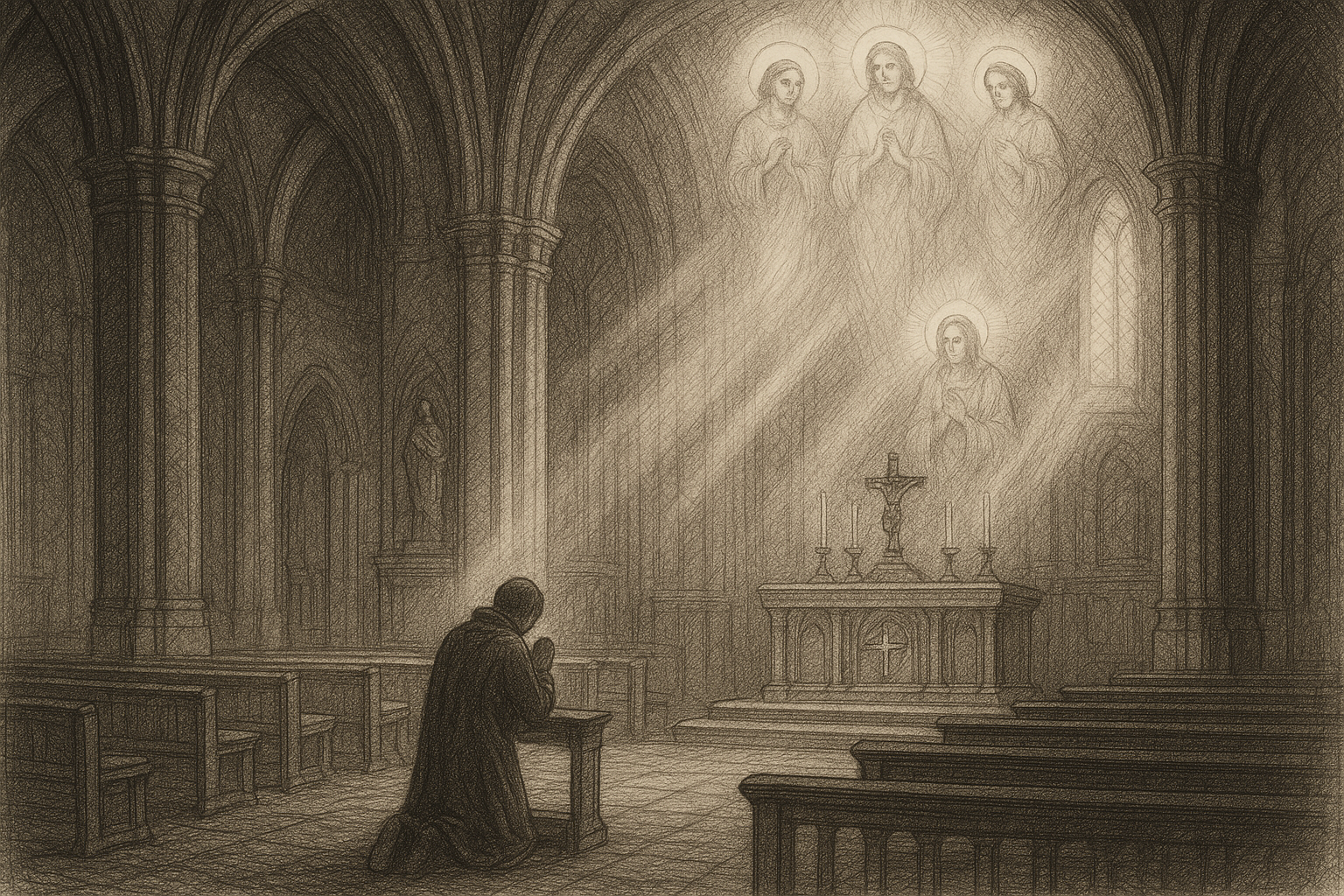
The heart of the teaching is simple: the Church is one body. The faithful on earth, the souls being purified, and the saints in heaven are united in Christ. Death does not shatter that communion. It changes our mode of presence, but not our belonging.
Biblical roots for asking the saints to pray
Several passages help Catholics understand why saintly intercession makes sense. First, Scripture shows that heavenly beings present prayers to God. In Revelation, the elders offer golden bowls full of incense, which are said to be the prayers of the holy ones. This image is not accidental. Heaven is not sealed off from the petitions of the faithful. It is already engaged with them.
Second, Scripture gives us examples of heavenly witnesses who are aware of God's saving work. Hebrews speaks of a great cloud of witnesses surrounding us, and the book of Revelation presents the martyrs crying out before the throne of God. Their concern for God's justice and for the people of God is not erased by death. It is brought into glory.
Third, the Transfiguration offers a glimpse of the communion between heaven and earth. Moses and Elijah appear with Christ in glory. They are not isolated spirits, but living persons in God's presence. The scene reminds us that the Lord's saving plan includes both the living and those already with him.
Finally, Scripture repeatedly commends intercessory prayer among believers. If a righteous person's prayer is powerful, then the prayers of those made perfectly righteous by God's grace can be understood as especially fruitful. This does not diminish Christ's mediation. It shows his mediation at work through his Body.
For there is one God. There is also one mediator between God and men, the man Christ Jesus. 1 Timothy 2:5
This verse is often raised as an objection, but Catholics gladly affirm it. Christ alone is the mediator in the unique and saving sense. Every grace comes through him. When Catholics ask saints to pray, we are not adding a rival mediator. We are asking fellow members of Christ's Body to join their prayers to his.
Why this does not compete with Jesus
Some Christians worry that asking saints for intercession weakens devotion to Christ. The opposite is usually true. Catholic prayer to the saints depends on faith in Christ's victory over sin and death. If the saints are alive in him, then his saving power has truly reached them. If they can hear us by God's gift, then his lordship extends beyond the grave.
It helps to remember how grace works throughout Christian life. No one thinks that asking a priest to pray, or asking a friend to pray, takes anything away from Jesus. We know that all fruitful prayer comes from him. The saints are simply the fullest expression of that same logic. They are not rivals to Christ, but trophies of his mercy.
There is also a beautiful humility in asking the saints for help. It acknowledges that we are not meant to walk the journey alone. Catholic life is communal at its core. We lean on the prayers of the Church because we belong to the Church. The saints make that communion visible and tender.
The communion of saints in daily Catholic life
The doctrine matters not only for theology, but for ordinary life. Many Catholics first turn to the saints in moments of need: illness, grief, temptation, family conflict, fear, or decision. In those moments, saintly intercession can make prayer feel less solitary. It reminds us that heaven is not indifferent to our suffering.
Consider a mother praying for patience, a student asking for wisdom, or a grieving son asking for peace. The saints are not remote icons for stained glass windows only. They are companions who have known weakness, sacrifice, and trust. Some were martyrs, some were pastors, some were parents, some were ordinary believers who lived hidden lives of holiness. Their variety matters. It tells us that holiness is possible in many callings.
This is one reason Catholic devotion to the saints can be so practical. Different saints are often associated with different needs because their lives illuminate particular virtues. Yet the point is never superstition. The point is imitation and intercession. We ask for prayer and learn from example at the same time.
In family life, this can become beautifully concrete. Parents may teach children to ask a favorite saint for help before exams or difficult days. A parish may turn to a patron saint during a time of trial. An adult may keep a simple daily habit of asking for the prayers of Mary and the saints before beginning work. These gestures form the imagination. They teach us that holiness is near, personal, and shared.
Mary and the saints
Any Catholic discussion of intercession should include the Blessed Virgin Mary. Her role is unique among the saints, not because she stands apart from Christ, but because her whole life points to him in a singular way. At Cana, she intercedes quietly when the wine runs out. Her words to the servants remain a model for all Christian prayer: do whatever he tells you.
Catholics honor Mary as the Mother of God because the child she bore is truly divine. That title safeguards Christ's identity and magnifies God's grace. When we ask Mary's intercession, we are not setting her beside Jesus. We are asking the mother of the Lord to pray with maternal care for the family of her Son.
The other saints share in that same family love in lesser ways. They are all servants of Christ, glorified by his mercy. Their intercession is generous because charity in heaven is complete. They do not compete for attention. They direct it to God.
How to pray with the saints without confusion
For Catholics, the most helpful approach is to keep prayer simple and Christ-centered. If you are new to the practice, you do not need complicated formulas. You can begin with a direct request: Saint Paul, pray for me. Saint Joseph, pray for our family. Holy Mary, intercede for us. These brief prayers are not magic words. They are acts of trust in the living communion of the Church.
It is also wise to keep Scripture close. The saints are best understood in the light of the Bible, where holiness is always a response to God's initiative. When Catholics pray with saints, we are not leaving Scripture behind. We are entering more deeply into its world of communion, praise, and intercession.
Three habits can help keep devotion balanced:
- Begin with God. Every prayer ultimately belongs to the Father, through the Son, in the Holy Spirit.
- Ask for prayer, not power apart from God. Saints are intercessors, not independent sources of grace.
- Let devotion lead to virtue. The point of honoring the saints is to grow in faith, hope, and charity.
When prayer is lived this way, it becomes less about spiritual techniques and more about friendship in Christ. The saints draw us upward because they have already been drawn into the life we hope to share.
What this teaching offers to a weary heart
For people carrying grief, uncertainty, or loneliness, the intercession of the saints can be deeply consoling. It tells us that death does not break love. It tells us that the Church is larger than what we can see. It tells us that our petitions do not vanish into the air, but are heard within a communion that reaches heaven itself.
This is especially meaningful when prayer feels dry. There are seasons when a person can barely find words. In those times, the saints remind us that prayer is not sustained by our eloquence alone. We are held by the prayer of the Church. We are surrounded by those who have already made the journey and who now stand before God with joy.
That does not remove sorrow, but it gives sorrow a horizon. The Christian does not grieve as one without hope. We grieve with Christ, in Christ, and toward Christ. The saints are part of that hope because they are the evidence of what grace can do.
The intercession of the saints explained in the light of Catholic faith is therefore not a side doctrine. It is a living sign of the Resurrection. It tells us that holiness endures, charity continues, and the family of God remains united across heaven and earth.
So when Catholics ask the saints to pray, we are not turning away from the Lord. We are stepping more fully into the communion he has made possible. We are speaking to friends who already stand before his face, confident that the same Savior who has welcomed them also hears the prayers they lift for us.
Keep Reading on Lets Read The Bible
Frequently Asked Questions
Do Catholics believe saints can hear our prayers?
Catholics believe the saints live in God and can intercede for us by his power. Their awareness is not a human talent on its own, but a gift of sharing in God's presence. This is why Catholics confidently ask for their prayers.
Is asking saints for intercession the same as worshiping them?
No. Worship belongs to God alone. Asking saints to pray is like asking any Christian to pray, except that the saints are already with the Lord and are perfectly united to his will.
Why do Catholics ask certain saints for help with specific needs?
That practice reflects the memory of each saint's life and witness. It is not superstition. It helps the faithful remember concrete examples of virtue and trust God through their intercession.