Saints and Witnesses
A Fire in the Dark: St. John of the Cross and the Hard Road to Holy Union
A careful look at St. John of the Cross life, his reforming zeal, and the quiet lessons his writings still offer Catholics today.
Site Admin | May 21, 2025 | 79 views
St. John of the Cross life: a brief portrait of a saint shaped by prayer and trial
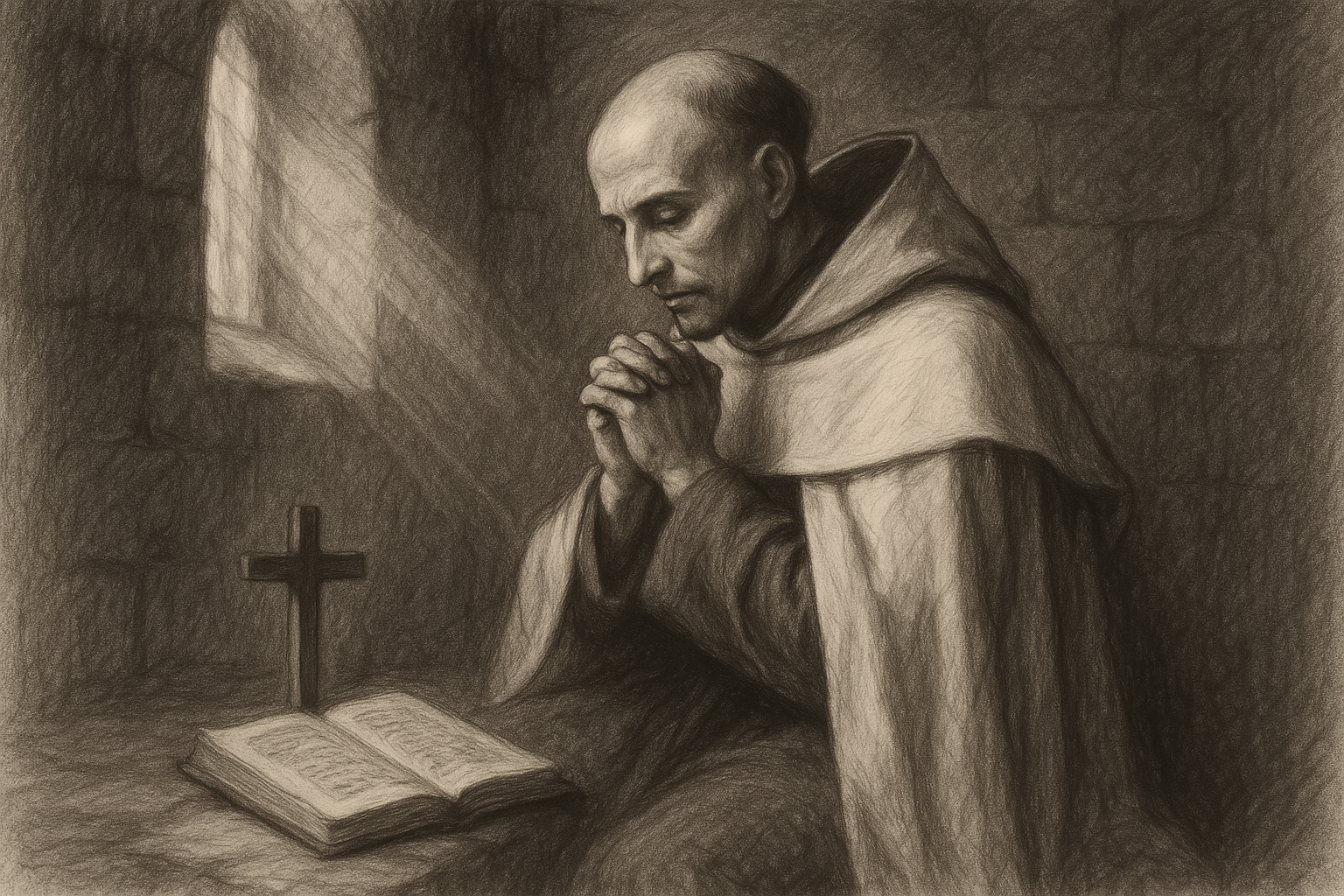
St. John of the Cross stands among the great spiritual masters of the Church because his life joined contemplation, reform, suffering, and fidelity in a way that still speaks clearly to Catholics. He is often remembered for the phrase dark night of the soul, but that phrase only makes sense when we place it inside the whole story of St. John of the Cross life. He was not a theorist writing from comfort. He was a Carmelite friar and priest who loved prayer, served souls, endured misunderstanding, and remained faithful when his own religious family was divided by reform.
Born Juan de Yepes in 1542 in Fontiveros, Spain, he came from a poor family and knew hardship early. His father died when he was still young, and his mother struggled to support the family. That background did not make holiness automatic, but it gave him a real familiarity with dependence, labor, and loss. Before he entered the Carmelites, he studied at a Jesuit college, where he received a solid human and spiritual formation. Later, after becoming a Carmelite, he was ordained a priest in 1567. Soon after, he met St. Teresa of Jesus, also known as St. Teresa of Avila, whose call to renewed Carmelite observance would shape his future.
Teresa recognized in him a soul fitted for reform and contemplation. She persuaded him to help with the Carmelite reform she had begun, which aimed to return the order to a stricter life of prayer, poverty, silence, and enclosure. John accepted this work with generosity, and in 1568 he helped found the first house of the Discalced Carmelites for men. The reform was not a side project. It was a costly path that demanded courage, patience, and obedience.
Reform, misunderstanding, and the cost of fidelity
The reform did not go smoothly. Many in the older Carmelite observance resisted Teresa's changes, and John found himself caught in conflict between loyalty to the Church and loyalty to a renewed religious discipline. In 1577, he was seized by members of the unreformed Carmelites and held prisoner in Toledo. For months he endured harsh confinement, poor conditions, physical deprivation, and psychological pressure. He was beaten and isolated, yet he continued to pray and even composed poetry in captivity.
It is difficult to read the story of his imprisonment without recognizing how deeply the saints can suffer for the sake of what they believe God asks of them. John did not become holy because suffering was pleasant. He became holy because he did not let suffering rule his heart. In one of the most painful periods of his life, he was inwardly free enough to compose lines that later became part of the Church's treasury of mystical poetry. His escape from prison in 1578 was dramatic, but his deeper victory had already happened inside. He had surrendered himself to God when his circumstances gave him little else to hold onto.
After his escape, John continued serving the reform, teaching, writing, and helping form communities according to the Discalced Carmelite life. He held leadership roles, preached, and guided souls. Yet conflict remained. He experienced marginalization, opposition, and at times loss of position. In the final years of his life, he was not universally admired. Like many saints, he died before the full beauty of his witness was widely acknowledged. He died in 1591 at Ubeda, Spain, after an illness. The Church later recognized what his life had already shown: holiness can look hidden while it is being forged.
The genius of his teaching on the soul's purification
Many Catholics know St. John of the Cross through his teaching on purification, especially The Dark Night and The Ascent of Mount Carmel. These works are not meant to glorify sadness or to suggest that God delights in making people miserable. Rather, they explain how God purifies the human heart so that it can receive divine love more fully. John understood that we often cling to consolations, habits, and spiritual experiences instead of clinging to God Himself. He wrote with precision because he wanted souls to be free.
His teaching is demanding, but it is also merciful. John saw that spiritual growth involves detachment from disordered attachments. That can mean the loss of familiar comforts, the fading of emotional sweetness in prayer, or the painful exposure of self-will. In such seasons, a believer may feel abandoned, yet John insists that God may be working more deeply than before. This is why his teaching matters for ordinary Catholics. Not every dry prayer time is a mystical dark night, and not every hardship is a hidden grace. Still, his work teaches us not to panic when prayer becomes barren or when the Lord seems silent. Scripture itself gives language for this path: As the deer longs for running streams, My thoughts are not your thoughts, and God works for good with those who love Him.
John's mysticism is not escapism. It is Christ-centered purification. He never suggests that souls move beyond the faith of the Church into private spiritual superiority. He wants believers to become simpler, humbler, and more available to God. That is why his writings remain useful for people who have no special mystical experiences at all. The ordinary Christian life already includes hidden purifications: disappointment, delayed hopes, unanswered questions, and the slow stripping away of self-reliance.
Poetry, doctrine, and the beauty of disciplined love
One of the striking features of St. John of the Cross life is that he was both a theologian and a poet. His poetry expresses the soul's longing for God with remarkable beauty, while his prose explains the spiritual journey with rigor. The two belong together. For John, truth and beauty are not rivals. Beauty can stir desire, and doctrine can protect desire from confusion. The soul needs both.
His most famous poem begins with the cry of a soul seeking the Beloved in the night. That image has resonated for centuries because it captures something many believers recognize: the sense that God is near, yet not graspable in the ways we prefer. John's poetry does not deny pain. It transfigures pain by placing it before God. He knew that love matures when it is no longer driven by possession. In that sense, his writings echo the Gospel call to lose one's life in order to find it. The saintly life is not a polished life. It is a surrendered life.
His spirituality can also help Catholics understand why discipline matters. Silence, fasting, fidelity to prayer, frequent confession, and recollection are not merely rules. They are ways of making room for God. John believed that love requires purification because love is easily entangled with ego. If we want to belong to Christ more fully, we must let Him prune what is in the way. That teaching can sound severe, but it is rooted in hope. God removes only what prevents deeper communion.
What Catholics can take from his witness today
St. John of the Cross is especially helpful for Catholics who feel discouraged by dryness, confusion, or slow progress in the spiritual life. His witness says that holiness is not measured by spiritual excitement. It is measured by fidelity. If prayer feels empty, a believer is not necessarily failing. If obedience costs something, that cost may be part of growth. If God seems hidden, He may be drawing the soul toward a love less dependent on feelings.
His life also offers a bracing reminder about reform within the Church. John loved the Church enough to work for renewal without leaving communion behind. He did not respond to conflict by creating his own religion or by retreating into bitterness. He bore opposition within the Church and remained a son of the Church. That matters now, because Catholics in every age are tempted to think that zeal must become division. John's example shows another way: patient reform, grounded in prayer and obedience.
For lay Catholics, his witness can be translated into ordinary habits. A parent caring for a difficult family, a worker experiencing disappointment, or a person waiting through illness can all find something in John. He teaches that God is not absent in the hard parts of life. Sometimes those very places become the chisel by which divine love shapes the soul. The Christian does not seek suffering for its own sake, but when suffering comes, it can be united to Christ. My grace is sufficient for you remains a fitting light for John and for every disciple who learns weakness before God.
A saint for those who are learning to trust what they cannot see
Devotion to St. John of the Cross is not meant to make prayer more complicated. It is meant to make it truer. He invites Catholics to trust God when comfort fades, to remain faithful when the heart is dry, and to let the Lord purify love in His own time. His life shows that holiness can flourish in prison, in reform, in conflict, in illness, and in obscurity. It also shows that the deepest things of God are not always loud. Sometimes they are hidden, patient, and nearly silent.
That is why the story of St. John of the Cross life still matters. He was a priest who prayed, a reformer who suffered, a mystic who obeyed, and a poet who let the Church hear the music of a soul being purified by God. For Catholics who are weary, uncertain, or waiting in the dark, he remains a steady companion, pointing not to himself but to the God who leads souls through night into union.
Keep Reading on Lets Read The Bible
Frequently Asked Questions
Who was St. John of the Cross in the Catholic tradition?
St. John of the Cross was a Carmelite friar, priest, reformer, poet, and doctor of the Church. He is remembered for his teaching on the purification of the soul and for helping reform the Carmelite Order with St. Teresa of Avila.
What does the dark night of the soul mean in St. John of the Cross?
In his teaching, the dark night refers to a purifying period in which God weans the soul from attachments, consolations, and self-will so that it can love Him more purely. It is not a general label for every hardship, but a spiritual process of purification.
How can Catholics apply St. John of the Cross life today?
Catholics can learn from his patience in suffering, his fidelity to prayer, his love for reform within the Church, and his insistence that spiritual dryness does not mean God has abandoned the soul.