Saints and Witnesses
A Life Offered Twice: St. Maximilian Kolbe and the Shape of Christian Courage
A clear look at the Franciscan friar, the martyr of Auschwitz, and the quiet disciplines that formed his witness.
Site Admin | May 14, 2026 | 118 views
A saint remembered for a final act, but formed long before it
When Catholics speak of St. Maximilian Kolbe, the mind often goes first to Auschwitz and to the extraordinary moment when he stepped forward to take the place of another prisoner. That final sacrifice is rightly central to his memory. Yet the St. Maximilian Kolbe life was not shaped in a single hour. It was formed over decades of prayer, study, missionary ambition, and a deep love for the Blessed Virgin Mary.
Kolbe was born Rajmund Kolbe in 1894 in what is now Poland. As a child, he experienced a moment that his family and later biographers often noted as decisive: a prayer before the Blessed Mother that seemed to open his heart to a life given wholly to God. Whatever the exact interior details, his later vocation was unmistakable. He entered the Conventual Franciscan friars and took the name Maximilian. In religious life, he became a man of ideas and action, not content with private piety alone.
His witness matters because it joins doctrine, devotion, and sacrifice. Kolbe did not treat holiness as a vague sentiment. He believed the Church's mission could be served through thoughtful preaching, the press, formation, and an ordered life of prayer. He also believed, with complete seriousness, that love of neighbor could demand the gift of one's own life.
Formation in faith and a vocation marked by Marian devotion
Kolbe entered the Franciscan order in his youth and pursued studies with unusual seriousness. He was drawn to apologetics and to the use of modern means for evangelization. That is one reason his life can feel surprisingly contemporary. He knew that the Church speaks not only through sermons from a pulpit but also through printing presses, schools, and organized apostolic work.
His Marian devotion was not sentimental decoration around his spirituality. It was the center of it. Kolbe founded and promoted the Militia Immaculatae, or Army of the Immaculate, a movement aimed at fostering conversion and holiness through complete trust in Mary and renewed dedication to Christ. In his mind, devotion to the Immaculate Conception led not away from the Gospel but deeper into it. Mary never replaces Christ. She leads to Him.
That conviction gave his apostolic life real shape. He wanted people to know the truth of the faith, to repent of sin, and to place their lives under the protection of the Mother of God. His zeal was strong, but it was not merely aggressive. It was rooted in the hope that grace can reach hearts that seem far from God.
Niepokalanow and the disciplined work of evangelization
One of the most remarkable chapters in the St. Maximilian Kolbe life is the foundation and growth of Niepokalanow, the Friars' City of the Immaculata. There, Kolbe and his brothers built a large center for publishing and religious apostolate. The place became known for its order, simplicity, and astonishing productivity.
This was not holiness by accident. It was holiness organized. The friars prayed, worked, and published with a steady rhythm. They produced materials intended to form Catholic minds and strengthen the faith of ordinary people. Kolbe saw that evangelization should be intelligent, accessible, and available to as many as possible.
There is something instructive in that for Catholics today. We often imagine witness only in dramatic terms. Kolbe reminds us that the Church also advances through faithful systems, patient labor, and disciplined collaboration. A holy life is not opposed to planning. In the right hands, planning can become an instrument of charity.
Kolbe's apostolic imagination suggests that love of neighbor includes the hard work of making truth available, beautiful, and usable.
Return to Poland and the darkening of history
As political storms gathered in Europe, Kolbe's work continued under increasing pressure. He returned to Poland and remained committed to his Franciscan life and his apostolate. The rise of Nazism brought a brutal anti-Christian ideology that would eventually engulf millions in suffering. Kolbe's monastery and printing work had already shown him how fragile human projects can be when confronted by violence and tyranny.
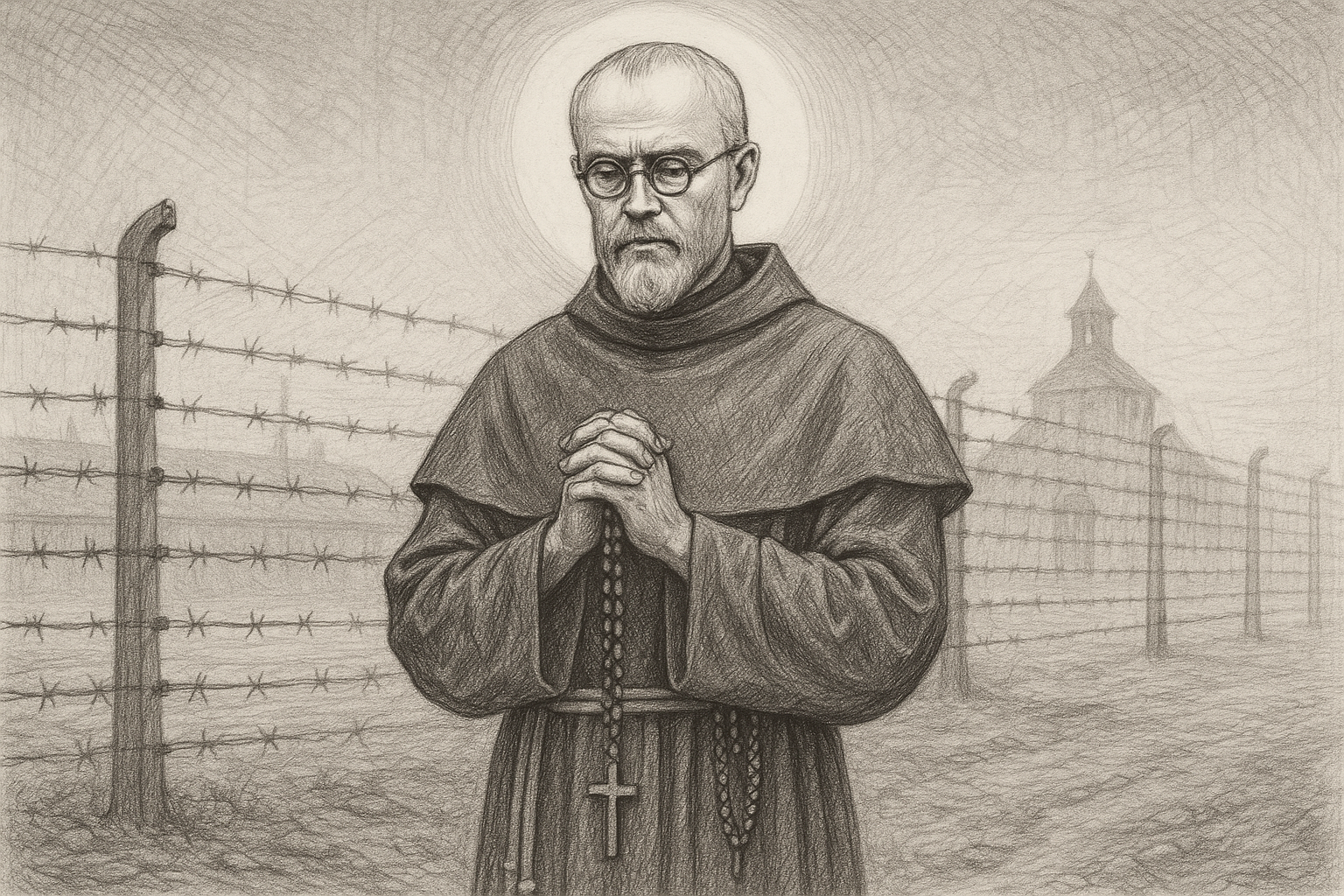
During the German occupation of Poland, he was arrested by the Nazis and sent to the concentration camp at Auschwitz. There, everything in human life was reduced to scarcity, fear, and dehumanization. Faith itself had to survive in conditions designed to crush it.
Yet the camp did not erase what had been formed in him. If anything, it exposed the depth of it. Kolbe was a priest, a friar, and a man trained by years of self-offering. He did not invent charity in the camp. He carried it there.
The choice in the bunker of starvation
The event for which St. Maximilian Kolbe is best known took place after a prisoner escaped from Auschwitz. In retaliation, camp authorities selected ten men to die by starvation. One of those chosen, Franciszek Gajowniczek, cried out that he had a wife and children. Kolbe stepped forward and offered to take his place.
This was not a symbolic gesture. It was a deliberate exchange of one man's life for another. The guards accepted Kolbe's offer, and he was placed in the starvation bunker with the other condemned prisoners. There, he continued to minister. Witnesses later remembered him praying with the men, encouraging them, and helping to sustain their dignity in conditions meant to destroy it.
After two weeks, he was still alive. The Nazis killed him by lethal injection on August 14, 1941, the vigil of the Assumption of the Blessed Virgin Mary. The timing seems fitting to many Catholics, though it should be treated with reverence rather than triumphalism. His death was the fruit of a whole life offered to God, not a sudden burst of emotion.
The Church later recognized him as a martyr of charity. That title is important. Kolbe was not killed simply for a private act of kindness. His death was bound up with hatred for the human dignity that flows from God's image, and with a love so strong that it freely surrendered itself for another.
What his witness teaches about holiness
The life of St. Maximilian Kolbe offers several practical lessons for Catholics. First, holiness is usually built long before it is tested. Kolbe's final sacrifice was made possible by years of prayer, Marian devotion, religious obedience, intellectual effort, and missionary discipline. The ordinary days of faith were not separate from the extraordinary day of his martyrdom. They prepared it.
Second, love of Mary is meant to deepen Christian courage. Kolbe did not see devotion to the Mother of God as an escape from the world. He saw it as a path into fidelity. Catholics who entrust themselves to Mary should expect to become more available to Christ, more willing to serve, and more ready to endure hardship for love.
Third, the Church needs both contemplation and action. Kolbe prayed, but he also built, organized, wrote, and taught. His example challenges the false idea that one must choose between spiritual life and practical service. A Catholic life rooted in grace can and should embrace both.
Fourth, sacrifice is not meaningful only when it is dramatic. Most Christians will never face the moment Kolbe faced, but many will be asked for quieter forms of self-gift: patience in family life, fidelity in work, forgiveness when it costs, and courage when the truth is unpopular. The same charity that moved Kolbe in Auschwitz is meant to shape the daily life of the baptized.
A martyr whose memory still calls the Church to charity
St. Maximilian Kolbe was canonized by Pope St. John Paul II in 1982. During the canonization, the Church honored him as a martyr of charity, a phrase that captures both the uniqueness and the breadth of his witness. He did not merely die well. He lived well in a way that made his death intelligible.
For Catholics, this is perhaps the deepest reason to return to his story. The world remembers courage in many forms, but Christian courage is always joined to charity. Kolbe's life shows that holiness can be intellectually serious, apostolically creative, Marian at its core, and ready for the final cost when love demands it.
His life does not ask us to imitate the exact circumstances of his death. It asks us to cultivate the same interior readiness to belong to Christ without reserve. That readiness begins in prayer, grows in obedience, and is tested in the ordinary places where self-love gives way to sacrifice. In that sense, the St. Maximilian Kolbe life remains not only a story to admire, but a pattern to learn from, one act of faithful charity at a time.
Keep Reading on Lets Read The Bible
Frequently Asked Questions
Who was St. Maximilian Kolbe?
St. Maximilian Kolbe was a Conventual Franciscan friar, priest, writer, and missionary who founded and promoted apostolic work centered on the Blessed Virgin Mary. He is best known for offering his life in place of another prisoner at Auschwitz.
Why is St. Maximilian Kolbe called a martyr of charity?
He is called a martyr of charity because he freely gave his life for another man in the concentration camp. The Church recognizes that his death was an act of heroic love shaped by his whole life of Christian charity.
What can Catholics learn from St. Maximilian Kolbe today?
His life teaches Catholics to combine prayer with action, to trust Mary more deeply, and to practice sacrificial love in ordinary life. He shows that holiness is formed over time and can shine even in extreme suffering.