Saints and Witnesses
Padre Pio and the Quiet Fire of Holiness
A closer look at the friar whose hidden sacrifices, sacramental life, and steady witness still draw Catholics toward confession, prayer, and trust in grace.
Site Admin | May 13, 2026 | 134 views
St. Padre Pio remains a striking figure in modern Catholic memory. Even people who know little about him often recognize his capuchin habit, his wounds, or his deep association with confession. Yet the heart of his witness is not curiosity or controversy. It is holiness lived under pressure, hidden in prayer, and offered in suffering.
For many Catholics, St. Padre Pio Catholic inspiration does not come from a single dramatic moment. It comes from the steady pattern of his life: fidelity to daily Mass, long hours in the confessional, devotion to Our Lady, trust in Divine Providence, and a willingness to accept trials without turning away from Christ. He reminds believers that sainthood is not an idea reserved for the extraordinary. It is the fruit of grace received and answered day after day.
A friar formed by prayer and sacrifice
Born Francesco Forgione in 1887 in Pietrelcina, southern Italy, Padre Pio entered the Capuchin friars as a young man and took the name Pio. He was ordained a priest in 1910 and spent most of his priestly life at San Giovanni Rotondo. There, in a place far from the centers of worldly influence, he became known for his ministry, his counsel, and his unusual physical sufferings.
One of the most discussed signs in his life was the stigmata, the wounds associated with Christ's Passion, which appeared in his body in 1918 and remained for decades. Catholics do not treat such phenomena as proof of holiness by themselves. The Church approaches them carefully. What mattered most was the way his life was marked by prayer, obedience, penance, and patient endurance. Signs may draw attention, but virtue gives them meaning.
Padre Pio lived during a century of war, skepticism, and spiritual confusion. His life was not polished for public approval. He was often misunderstood, investigated, and criticized. Yet he continued the ordinary work of a priest. He heard confessions, celebrated Mass, prayed the Rosary, and counseled souls. In that sense, his life speaks clearly to Catholics who feel the temptation to measure holiness by visibility or success.
The confessional as a place of mercy
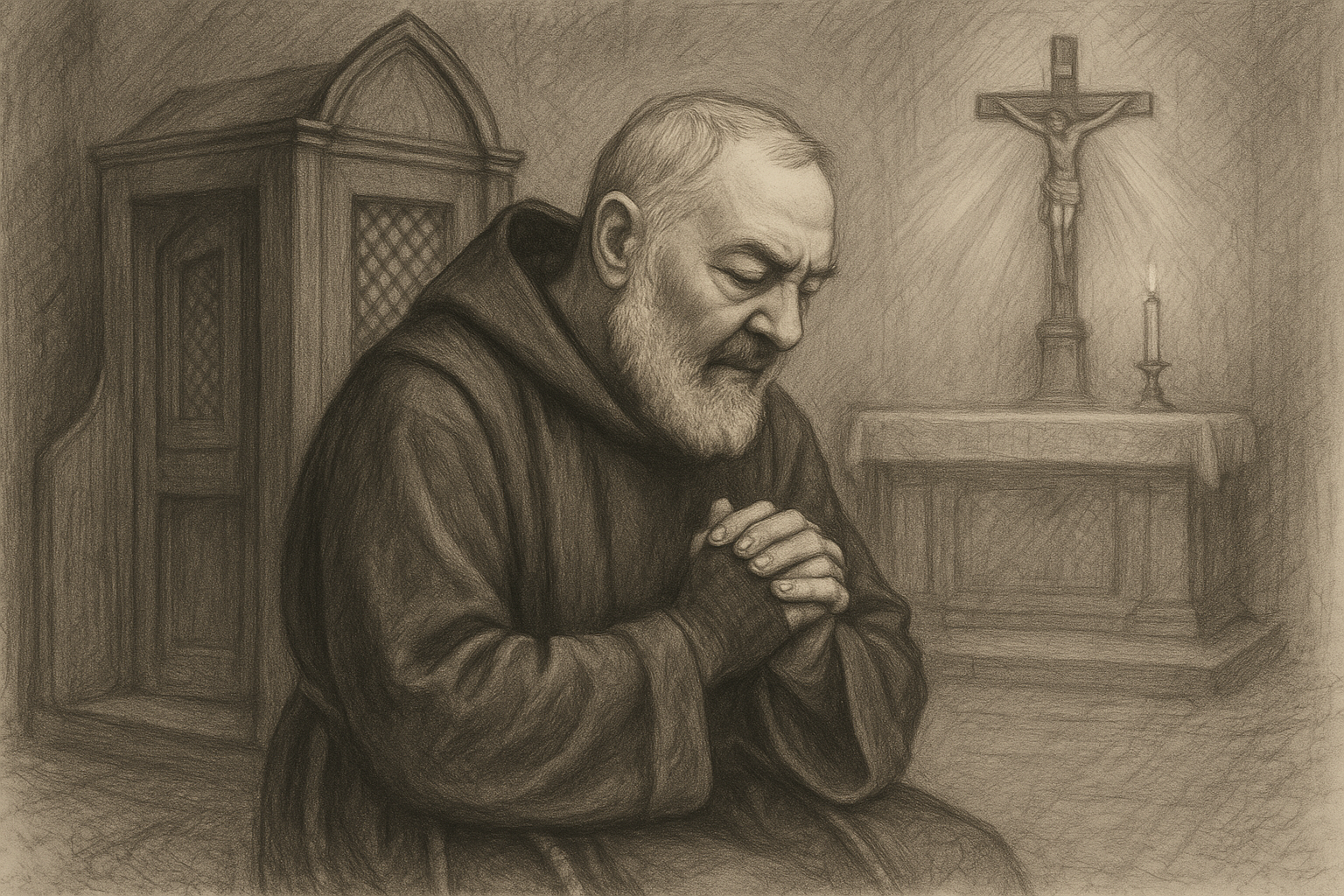
Few aspects of Padre Pio's ministry have left a deeper mark than his love for Confession. Many people sought him out because they believed he could read hearts, but the deeper reason was simpler and more profound. He treated the sacrament as a meeting with mercy, not a routine exercise.
Confession can be difficult to approach honestly. Pride resists it. Shame resists it. Spiritual laziness resists it. Padre Pio's example cuts through all of that. He spoke to people as one who knew the seriousness of sin and the greater seriousness of grace. He did not excuse sin, but he also did not despair over it. He brought sinners to the mercy of Christ, who alone can heal what is broken.
Scripture shows the same movement from repentance to mercy. The psalmist prays,
Create in me a clean heart, O Godand the parable of the prodigal son reveals the Father running to welcome the repentant child home. Padre Pio's confessional ministry reflected that same Catholic confidence: the grace of God is not abstract. It is personal, sacramental, and available to those who return in humility.
This is one reason he continues to inspire Catholics today. He did not speak about mercy as a vague reassurance. He built his priesthood around the concrete place where mercy is received. For anyone who has delayed Confession out of fear or discouragement, his witness is a reminder that the sacrament is not a tribunal for the strong but a medicine for the weak.
Holiness hidden inside ordinary faithfulness
Padre Pio is sometimes remembered only for extraordinary signs, but his sanctity was rooted in habits that belong to every Christian life. He prayed. He fasted. He accepted suffering. He remained attached to the Mass and the sacraments. He lived under obedience, even when obedience was painful.
That is important, because the Church does not present saints as spiritual celebrities. She presents them as witnesses to grace. Padre Pio's greatness was not that he escaped the human condition. It was that he offered the human condition to God with remarkable perseverance. His life helps Catholics see that holiness is often less about feeling holy and more about remaining faithful when prayer is dry, relationships are strained, or suffering lingers without explanation.
Saint Paul writes,
My grace is sufficient for you, for power is made perfect in weaknessPadre Pio's life gives that verse flesh and blood. He did not appear to move through life with ease. He seemed to carry conflict and suffering for long stretches. Yet he remained centered on Christ. That kind of witness matters because it keeps Christian hope anchored in grace rather than temperament.
His love for the Eucharist and the Mass
Another reason Padre Pio still inspires Catholics is his reverence for the Mass. He is often remembered for celebrating the Eucharist with intense concentration and devotion. Those who knew him or heard accounts of his ministry frequently noted that he approached the altar with awe. For him, the Mass was not a performance or an obligation. It was the living sacrifice of Christ made present to the Church.
This should speak powerfully to Catholics who struggle with distraction in worship or who are tempted to treat the liturgy casually. Padre Pio invites believers to recover wonder. The Mass is not ordinary time. It is the Church standing at the foot of the Cross and before the risen Lord. A saint who loved the Eucharist so deeply reminds the Church that reverence is not a matter of style alone. It is a matter of faith.
His devotion also points to a central Catholic truth: the sacraments are not merely symbolic reminders. They are real encounters with Christ. Padre Pio spent himself for souls because he believed Christ was truly present and truly acting through the Church. That conviction gave his priesthood force. It can still renew our own.
Obedience in the midst of misunderstanding
Padre Pio's life included long periods of scrutiny and restriction from Church authorities. These episodes are part of his story and should be acknowledged honestly. They show that sanctity does not exempt a person from being tested, evaluated, or corrected. In fact, the saints are often purified through precisely those experiences.
For Catholics, this is a sobering and hopeful lesson. Obedience is not always easy to admire when it costs something. Yet Padre Pio remained within the Church, submitted to authority, and continued his priestly life. That fidelity matters. It keeps his witness from becoming private spirituality detached from the Church Christ founded.
There is a mature Catholic wisdom in that. Real devotion is not simply intensity. It is communion. A person can have powerful experiences and still need the discipline of obedience. Padre Pio's life shows that extraordinary gifts do not replace ordinary fidelity. They are meant to serve it.
Why his witness still reaches modern Catholics
Padre Pio's enduring appeal may be explained in part by the needs of the present age. Many Catholics hunger for authenticity. They want prayer that is real, repentance that is serious, and mercy that is not sentimental. They want a faith that can stand up to pain, guilt, and confusion. Padre Pio speaks to all of that because he did not offer a softened Christianity. He offered a cruciform one.
He also speaks to Catholics who feel spiritually overwhelmed. In an age of constant noise, his deep interior life suggests another pace. In an age that often avoids repentance, his love for Confession suggests another path. In an age that prizes self-assertion, his obedience suggests another kind of strength. His witness is not nostalgic. It is bracing.
His popularity around the world also shows that the saints are not relics of a distant age. They are living members of the Church triumphant whose example remains fruitful. Padre Pio continues to draw people toward prayer, penance, and sacramental life because those things do not expire. The human heart still needs mercy. The Church still needs priests who love souls. Every generation still needs reminders that suffering can be joined to Christ and made fruitful.
What Catholics can learn from his example today
Padre Pio does not ask Catholics to imitate his particular experiences. Most believers will never bear stigmata or guide crowds in the same way he did. But his life suggests several concrete practices that are within reach of ordinary people.
- Go to Confession regularly and approach it with honesty.
- Pray daily, even when prayer feels dry or distracted.
- Attend Mass with reverence and attention.
- Accept suffering without wasting it, and unite it to Christ.
- Remain obedient to the Church even when life feels confusing.
- Trust that grace can work deeply in hidden places.
These are not dramatic achievements, but they are the building blocks of holiness. Padre Pio's life gives them credibility because he lived them under pressure. He shows that Catholic discipleship is not mainly about self-expression. It is about surrender, trust, and perseverance.
That is why St. Padre Pio Catholic inspiration remains so strong. He stands as a witness that grace can be fierce without being loud, merciful without being soft, and faithful without being self-protective. His life invites Catholics to come back to the essential things: prayer, confession, the Eucharist, and the cross carried with love.
For anyone seeking a saint who can steady the soul, Padre Pio offers a powerful answer. He points away from himself and toward Christ, where every saint finally belongs.
Selected Scripture for reflection
Reflect on these passages as you pray with Padre Pio's witness:
- Create in me a clean heart, O God
- My grace is sufficient for you, for power is made perfect in weakness
- While he was still a long way off, his father saw him
Keep Reading on Lets Read The Bible
Frequently Asked Questions
Why is Padre Pio so closely associated with Confession?
Padre Pio was known for spending long hours hearing confessions and for urging sinners to approach the sacrament sincerely. His example highlights Confession as a real encounter with Christ's mercy, not a merely formal ritual.
Did Padre Pio's holiness depend on his extraordinary signs?
No. While many people are drawn to the stigmata or other remarkable reports connected with his life, the Church honors him chiefly for his virtue, prayer, obedience, and sacramental fidelity. The signs pointed to a deeper holiness already present.
What can ordinary Catholics learn from St. Padre Pio today?
They can learn to pray faithfully, confess regularly, reverence the Mass, accept suffering in union with Christ, and trust that holiness grows through daily obedience and grace.