Saints and Witnesses
The Small Path That Changed the Church: St. Therese of Lisieux's Hidden Strength
A careful look at the short life, deep faith, and enduring witness of the Little Flower.
Site Admin | May 10, 2026 | 110 views
A saint whose greatness was hidden on purpose
The St. Therese of Lisieux life is easy to summarize in facts and still miss the force of her witness. She was born in 1873, lost her mother when she was still very young, entered the Carmelite convent at Lisieux as a teenager, and died of tuberculosis in 1897. Those facts are true, but they do not by themselves explain why so many Catholics return to her again and again. Therese did not leave behind a large public ministry, write treatises from a bishop's chair, or found a visible movement in the ordinary sense. She lived hiddenly, and that hiddenness became part of her message.
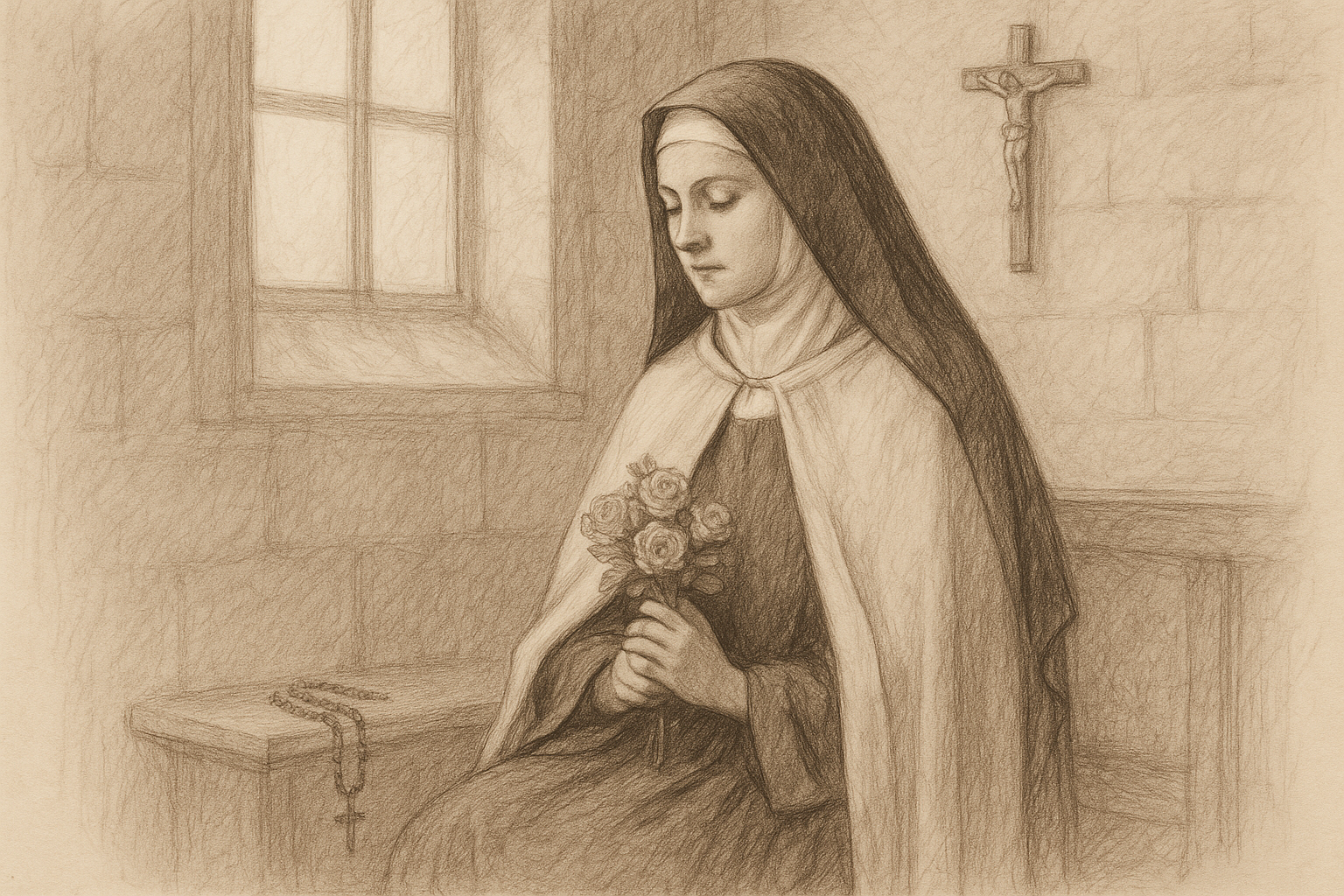
She is remembered as the Little Flower because she trusted that God could be glorified in small, unnoticed acts done with love. That instinct was not sentimental. It was forged in suffering, discipline, prayer, and a growing recognition that holiness is not reserved for the naturally impressive. Her life speaks to Catholics who feel ordinary, weak, or too small for great sanctity. Therese shows that God is not limited by human scale.
Early loss, early faith, and the shaping of a child soul
Therese Martin was born in Alencon, France, into a deeply Catholic family. Her parents, Louis and Zelie, were later canonized, and their home was marked by prayer, work, and affection. Yet her childhood was not carefree. Her mother died when Therese was four, and the loss left a deep wound. From that point onward, her life was shaped by a sensitivity that could turn toward discouragement, but which also made her responsive to grace.
After her mother's death, Therese became especially close to her father and sisters. The family eventually settled in Lisieux, where she was educated by the Benedictines. She was intelligent, imaginative, and intense. She also experienced scrupulosity and emotional fragility. In retrospect, these are not minor details. They help explain why her later spirituality did not come from strength of temperament. It came from surrender. The child who knew grief early also learned that she could not save herself by force of will.
Therese later spoke of a decisive grace on Christmas Eve in 1886, when her childish emotional reactions seemed to fall away and she received what she understood as a kind of interior healing. Catholics often point to this moment as a turning point in her maturity. It did not make her perfect. It helped her begin the long work of letting God reshape her from within. In her own words and in the testimony of her life, this was not a sudden escape from weakness but the beginning of a new way of bearing it.
Entering Carmel at fifteen
Therese desired the religious life from an early age. She felt drawn to Carmel, where prayer, silence, and hidden sacrifice would become the rhythm of her days. Her request to enter was resisted because of her youth, but she persisted. In 1888, after perseverance and with permission, she entered the Carmel of Lisieux at the age of fifteen. That decision reveals much about her. She was not chasing novelty. She wanted a life given wholly to God.
Carmelite life was austere. It involved enclosure, prayer, manual labor, fasting, silence, and the constant rhythm of community life. For a young woman with sensitive health and a lively imagination, the hidden demands of convent life could have become an occasion of quiet discouragement. Instead, Therese came to see that every annoyance, every dryness, every ordinary duty could become an offering. She did not imagine that sanctity was found only in extraordinary experiences. She discovered that daily fidelity was the place where love was tested.
Her years in Carmel were marked by hidden suffering, some of it physical and some of it interior. She also experienced the deaths of loved ones and the burden of caring for her sisters in community. There were no dramatic public triumphs to report. That is part of the point. Therese's holiness was not spectacular in the worldly sense. It was steady, self-giving, and deeply real.
The Little Way and the logic of confidence
Therese's spiritual insight is often called the Little Way. At its heart is the conviction that a soul does not need to become spiritually grand in order to be loved by God. Rather, a person can approach the Lord with childlike trust, acknowledging weakness and depending on mercy. The Little Way is not spiritual laziness. It is the opposite. It asks for total confidence, but a confidence that rests in God rather than in personal achievement.
Therese knew the words of Scripture and drew upon them with special tenderness. She was struck by the Gospel image of the child and by the Lord's mercy toward the lowly. Her own language often circles around confidence, trust, and love. She understood that love can be shown in the smallest details: a patient response, a hidden sacrifice, the cheerful acceptance of inconvenience, and the choice not to dwell on wounded pride. In this way her spirituality remains intensely practical.
One of the best ways to understand her is to read her alongside the words of Christ: Become like children, Come to me, all you who labor, and Love one another as I have loved you. Therese did not invent a new Gospel. She received the old one with unusual clarity. She saw that the path to holiness is marked by humble trust, not spiritual self-construction.
Service in small things, love in hard places
Therese is often associated with flowers, sweetness, and simplicity, but that image can flatten her if it is not held together with the truth of her sacrifice. She lived in a community where personalities did not always blend easily. She struggled with bodily weakness. She faced monotony. She bore misunderstandings. Yet she tried to offer each moment to God without complaint. That does not mean she never felt difficulty. It means she chose not to treat difficulty as proof that love had failed.
Her memoir, Story of a Soul, reveals a woman who paid close attention to the movements of her heart. In the monastery she performed ordinary services, did her work faithfully, and sought to bear with the imperfections of others. This is where her witness becomes especially useful to lay Catholics. Most people will never be called to dramatic sacrifice in public view, but nearly everyone is called to do small things with patience. Therese teaches that those small things matter before God.
Her own life also offers a sober reminder that holiness does not mean the absence of suffering. In her final illness, she underwent terrible pain. She also experienced what she described as a trial against faith, a darkness that made prayer feel emptied of consolation. Catholics should not rush past this. It shows that her trust was not based on feelings. It was a choice made in obscurity. Her confidence in God's love was purified by suffering, not protected from it.
Her death, her words, and the spread of her influence
Therese died in 1897 at only twenty-four years old. Those who knew her did not yet know how widely her witness would spread. After her death, the publication of Story of a Soul brought her spiritual teaching to a far larger audience. The simple power of her writing was part of her apostolic fruitfulness. She wrote as one who believed that love offered to God, however hidden, is never wasted.
Her influence grew quickly in the Church because her message met a real need. Many Catholics had longed for a holiness that was approachable without being watered down. Therese did not lower the bar for sanctity. She changed the way many people understood the climb. The summit remained love of God, but the path was illuminated by mercy. In a culture that often prizes visible success, her life offered another measure of greatness.
The Church eventually recognized her sanctity formally. She was canonized in 1925, declared a Doctor of the Church in 1997, and honored for the depth of her spiritual insight. These honors did not create her significance. They confirmed what many had already found in her life and writing: a profound and trustworthy witness to the Gospel.
What Catholics can take from Therese today
Therese's example can be translated into daily Catholic life without much difficulty, though it takes real discipline to live it. Her witness asks a few simple questions. Do I trust that God can sanctify my ordinary duties? Do I resent the hiddenness of my life, or can I offer it? Do I wait for ideal conditions before I try to love well? Therese answers these questions by her example, not by theory.
For parents, her life can be a reminder that faith is formed in the home as much as in the sanctuary. For workers, it is a call to do small tasks with integrity. For the sick and elderly, it offers dignity: suffering, when united to Christ, is not pointless. For those who feel spiritually insignificant, Therese is a consoling companion. She did not become a saint by becoming someone else. She became a saint by yielding her smallness to God.
There is also a moral warning in her story. The desire to be noticed can quietly corrupt even good works. Therese teaches Catholics to prefer hidden fidelity over public acclaim. That is not easy, especially in a time when display is rewarded. But her life says that heaven sees what the world overlooks. The Lord who notices the widow's mite also notices the quiet act of patience, the hidden act of repentance, and the prayer spoken when no one else can hear it.
Therese did not make holiness small. She made smallness holy by placing it in God's hands.
That sentence captures something essential about her witness. She did not invite Catholics to settle for mediocrity. She invited them to love fully in the place where they already stand. If the Christian life often feels too large, too demanding, or too exposed, Therese offers a gentler road that is no less demanding: to trust, to repent, to pray, and to begin again in the ordinary duties of the day. That is the road she walked, and it remains open to anyone willing to take the first small step.
Keep Reading on Lets Read The Bible
Frequently Asked Questions
What is the Little Way of St. Therese of Lisieux?
The Little Way is Therese's spiritual insight that holiness can be lived through humble trust in God, especially by doing small things with great love. It emphasizes confidence in God's mercy rather than reliance on personal strength or spiritual success.
Why is St. Therese called the Little Flower?
She is called the Little Flower because she saw herself as a small flower in God's garden, content to bloom in hiddenness and to glorify God in an ordinary, humble way. The image reflects her belief that even unnoticed lives can be beautiful before God.
What can Catholics learn from St. Therese's life today?
Catholics can learn that sanctity grows through ordinary fidelity, patient suffering, and trust in God's mercy. Her life encourages believers to offer daily work, hidden sacrifices, and small acts of charity as real paths to holiness.