Saints and Witnesses
A Poor Heart, a Clear Light: St. Clare of Assisi and the Grace of Undivided Faith
How St. Clare's hidden life, firm poverty, and Eucharistic devotion continue to offer a Catholic witness of joy, courage, and trust in Christ.
Site Admin | April 29, 2026 | 90 views
St. Clare of Assisi remains one of the most quietly luminous figures in the history of the Church. She never built a public movement in the modern sense, never wrote treatises for scholars, and never tried to make her life impressive by worldly standards. Yet her witness has endured for centuries because it was centered on something lasting: complete trust in Jesus Christ.
For Catholics today, St. Clare of Assisi Catholic inspiration does not come from spectacle. It comes from clarity of purpose. She was a woman who chose Christ with such simplicity that her whole life became a sign of the freedom God gives when the heart is no longer divided. In a time that prizes control, status, and self-protection, Clare speaks with unusual force.
A young woman who chose the narrow road
Clare was born in Assisi in 1194 into a noble family. She lived in a world where her future could have been arranged through comfort and social standing. Instead, she encountered the radical preaching of St. Francis, whose own life had been turned upside down by the Gospel. Clare recognized in him not a passing enthusiasm but a call to the same Lord.
Her decision was bold. At a time when women of her class were expected to marry advantageously and preserve family honor, she chose poverty, consecration, and hiddenness. According to the traditional account, she left her home at night to join Francis and the brothers, surrendering the security of noble life for a life rooted in God alone.
That choice was not an escape from reality. It was a response to a different reality, the reality of the Kingdom. Clare understood that Christ Himself had lived in poverty and humility. She believed that to follow Him was not merely to admire Him from a distance but to conform one's whole life to His way. Her witness reminds Catholics that discipleship is always concrete. It asks for more than ideas. It asks for surrender.
The poverty that made room for joy
One of the most striking features of Clare's life is her embrace of poverty. For her, poverty was not romanticized misery and not a technique for spiritual achievement. It was a form of freedom. By owning little, the Poor Ladies of San Damiano could live in greater dependence on God and in greater solidarity with Christ crucified and risen.
This is one reason Clare still matters. Many people assume poverty means lack, but the Gospel reveals a deeper truth. When material things become our source of identity, we are easily afraid of losing them. When we receive everything as gift, we are freer to love, to give, and to rejoice. Clare's poverty was Eucharistic in spirit. It pointed away from possession and toward communion.
The Lord's own words illuminate her path: No one can serve two masters and seek first the kingdom of God. Clare believed these words were not poetic ideals but practical truth. To seek first the Kingdom is to build one's life on Christ rather than on accumulation. Her witness therefore challenges modern Catholics to ask not only what they possess, but what possesses them.
Clare's poverty also had a Marian quality. It was receptive, humble, and open to grace. Like Mary, she did not cling to self-importance. She allowed God to do great things in her through simplicity. That kind of life can look small from the outside, but in the eyes of faith it is immense.
The Eucharist at the center of her hidden life
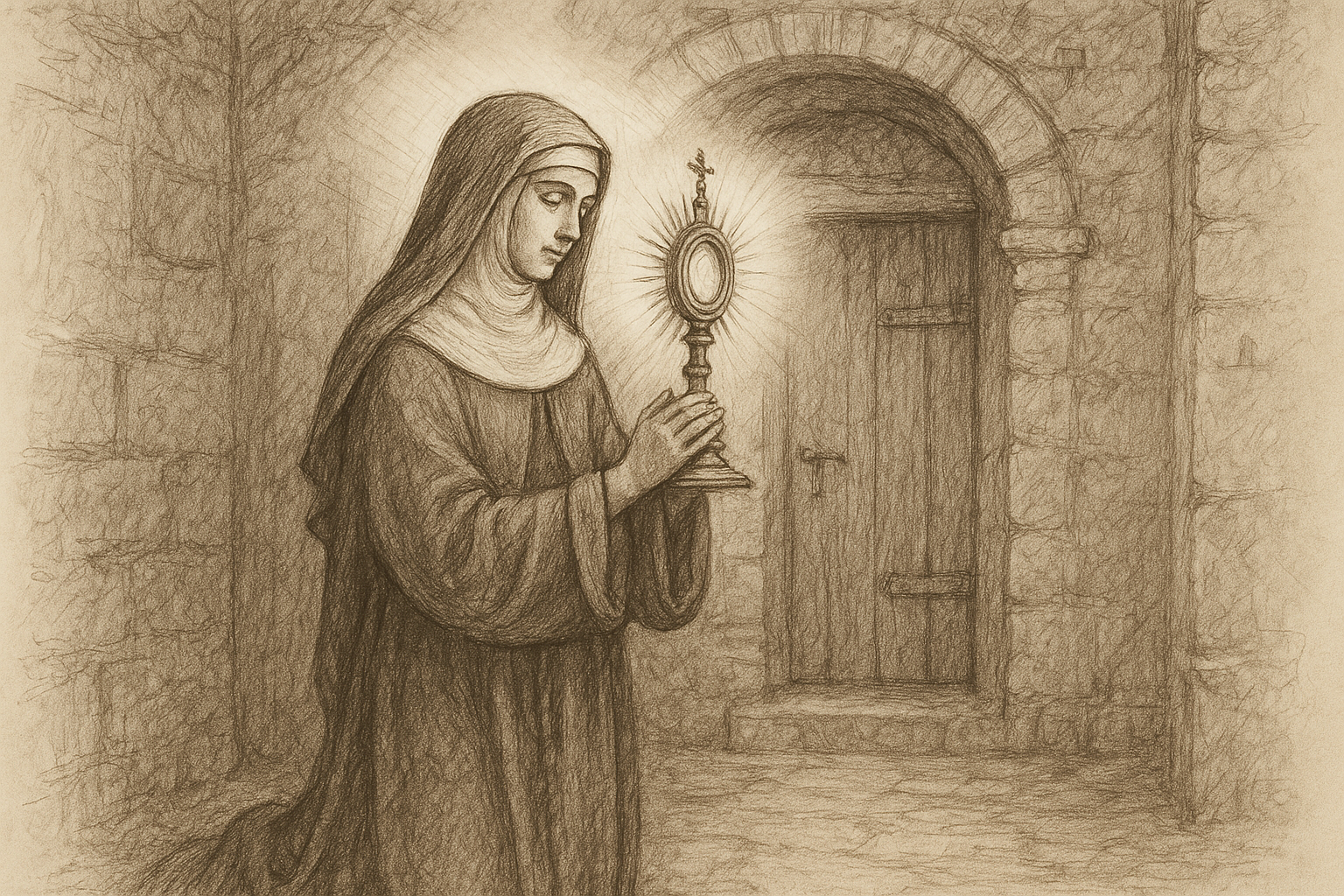
St. Clare is often remembered for her devotion to the Eucharist, and rightly so. Catholic tradition tells of a famous moment when she held the Blessed Sacrament in prayer and trust before enemies at the convent gates, asking Christ to protect the community. Whether remembered in detail or in broad historical outline, the meaning is clear: Clare believed that Jesus in the Eucharist was not distant or symbolic in a weak sense. He was present, near, and worthy of total confidence.
This Eucharistic faith gave shape to everything else. Clare was not simply a woman of ascetic discipline. She was a woman who loved the Lord in sacramental nearness. Her life of enclosure was not a retreat from the world out of fear. It was a way of dwelling more deeply in the presence of the One who feeds and sustains His people.
For Catholics who receive the Eucharist often, Clare offers a searching example. Do we approach the Sacrament as the center of life, or as one devotion among many? Do we allow the Real Presence of Christ to reorder our desires? Clare's witness suggests that Eucharistic adoration and Eucharistic reception are not separate from holiness. They are among its sources.
Clare's life teaches that reverence for the Eucharist is not only expressed in words, but in the way a person organizes time, possessions, relationships, and trust.
Strength that looked like weakness
Clare's long life was marked by illness and physical weakness, especially in her later years. Yet her weakness did not silence her spiritual authority. In fact, it deepened it. She lived through suffering without surrendering her identity as a bride of Christ. That is a profoundly Catholic witness, because it shows that holiness is not the same as visible success.
Many people today worry that illness, limitation, or hidden labor means their lives are somehow less fruitful. Clare says otherwise. In the mystery of God's providence, the hidden offering of a suffering person can become a source of grace for the Church. Her life recalls the pattern of Christ Himself, whose victory came through the Cross. My grace is sufficient for you is not only a comforting verse. In Clare's life, it became visible.
She also stood firm in protecting the vocation of her community. She sought and defended the privilege of poverty, wanting her sisters to remain faithful to the evangelical form of life they had embraced. This took courage, especially in a world where stability often meant compromise. Clare was gentle, but she was not vague. Her love for Christ gave her moral clarity.
What her witness offers Catholics now
St. Clare of Assisi does not belong only to medieval history. Her life addresses concerns that remain very contemporary. Catholics today live amid distraction, consumer pressure, anxiety about the future, and a constant temptation to measure worth by visibility. Clare answers these pressures with a serene but demanding alternative.
First, she reminds us that holiness begins with a decision to belong to Christ. Many people admire saints in the abstract, but Clare shows the beauty of a concrete yes. She did not wait until life became easy. She responded when grace came near.
Second, she shows that poverty of spirit is not gloomy. It is liberating. A Christian who is no longer trying to secure identity through possessions can become more available to God and to neighbor. Clare's life supports the Beatitude: Blessed are the poor in spirit.
Third, she teaches that hidden life matters. Not every saint stands in the public square. Some serve God through silence, enclosure, prayer, and fidelity in places few people notice. Clare's convent became a spiritual lighthouse precisely because it was not built on noise.
Fourth, she demonstrates that devotion to Christ in the Eucharist should shape daily choices. A Eucharistic Catholic life is not confined to the church building. It extends into patience, simplicity, mercy, and readiness to trust God when circumstances are uncertain.
Finally, Clare shows that feminine sanctity is neither passive nor fragile. She governed wisely, prayed intensely, and defended her way of life with strength. She was not trying to imitate men, and she was not trying to defy her femininity. She was offering it to God. That makes her a lasting model for women and men alike.
Her friendship with Francis, and the beauty of shared holiness
The friendship between Clare and St. Francis deserves notice because it reveals something important about Christian holiness. The saints are not isolated geniuses. They are often formed by holy companionship. Francis helped Clare discern her call, and Clare in turn became a witness to the same Gospel shape of life through female religious consecration.
Their shared love of poverty was not an eccentric preference. It was an answer to Christ's own life. Both wanted the Church to remember that the Lord entered the world humbly. Both believed that the Gospel is credible when Christians actually live it. Their lives continue to complement each other: Francis the joyful poor man, Clare the clear and steadfast poor woman.
That friendship also gives Catholics a gentle reminder that sanctity can be contagious. The grace God gives to one person often becomes an invitation to another. Clare did not simply admire Francis. She let grace carry her into her own vocation. In that sense, she stands as a witness to the way God often uses holy people to awaken holiness in others.
Learning to prefer Christ above all
The deepest lesson of St. Clare is not merely that we should be simpler, or more disciplined, or less attached to money. It is that Christ is enough. Everything in her life points to that conviction. She believed that nothing taken from us in fidelity to Christ can truly impoverish us, because He Himself is the treasure that does not fail.
That is a difficult lesson in any age. It is especially difficult when fear asks us to store up more, protect more, and control more. Clare's life does not deny prudence, but it relativizes every earthly security. She tells the Church that the heart becomes light only when it rests in God.
For Catholics seeking St. Clare of Assisi Catholic inspiration, the invitation is clear. Let Christ be first in prayer. Let the Eucharist be central. Let possessions be used without being worshiped. Let hidden faithfulness count for more than public applause. Let the poor in spirit be blessed not as a theory, but as a way of living.
St. Clare did not need to be loud to be unforgettable. Her life remains bright because it was turned toward the light of Christ. That is why her witness still reaches us, quietly and firmly, across the centuries.
Keep Reading on Lets Read The Bible
Frequently Asked Questions
Who was St. Clare of Assisi in the Catholic tradition?
St. Clare of Assisi was a 13th century Italian saint who followed St. Francis and founded the Poor Clares. She is remembered for her poverty, prayer, Eucharistic devotion, and steadfast love for Christ.
Why is St. Clare associated with poverty?
Clare embraced evangelical poverty as a way of depending more fully on God and imitating Christ. For her, poverty was not mere lack, but a spiritual freedom from attachment to possessions and status.
What can Catholics learn from St. Clare today?
Catholics can learn from Clare's simplicity, courage, hidden fidelity, and Eucharistic faith. Her life encourages believers to place Christ first, trust God more deeply, and value holiness over worldly success.