Saints and Witnesses
A Quiet Fire: St. Therese of Lisieux and the Courage of Small Things
How the young Carmelite saint still teaches Catholics to trust grace, embrace hiddenness, and love God in ordinary duties.
Site Admin | May 11, 2026 | 96 views
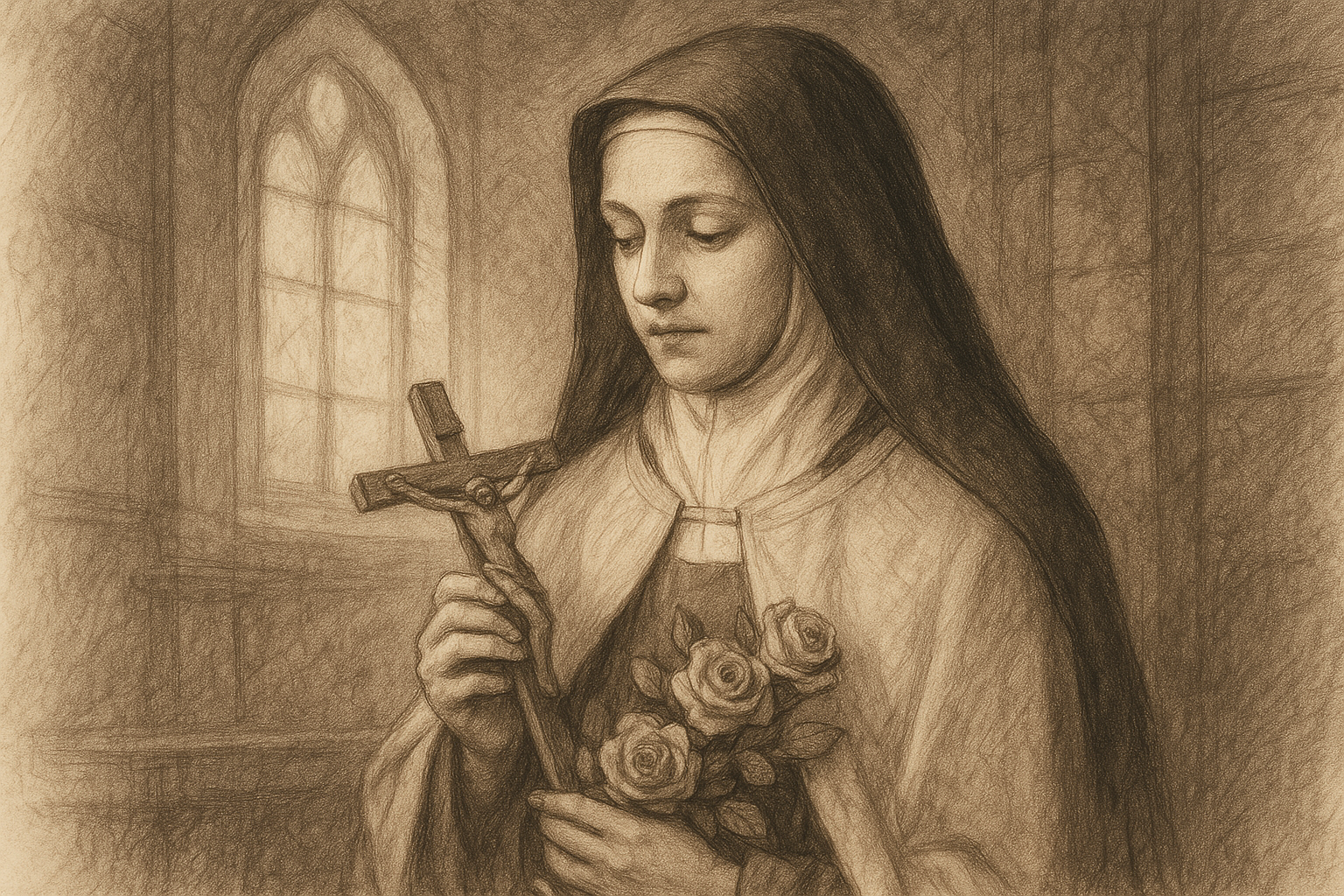
St. Therese of Lisieux remains one of the most beloved saints in the Catholic Church, and not because she lived a dramatic public life. She entered a Carmelite convent as a teenager, lived most of her years in hidden religious life, and died at 24. Yet her witness has reached far beyond the walls of the cloister. For many Catholics, St. Therese of Lisieux Catholic inspiration comes precisely from the fact that her holiness looked so ordinary on the outside and so luminous on the inside.
Therese Martin was born in 1873 in Alencon, France, to Saints Louis and Zelie Martin, the first married couple canonized together in the modern era. After her mother's death, the family moved to Lisieux. Therese grew up in a deeply Christian home, but her spiritual maturity did not come from ease. She knew grief, sensitivity, illness, and the struggle to surrender her own will. At 15, she asked to enter the Carmelite convent in Lisieux, and after receiving special permission, she began a life of prayer, sacrifice, and hidden service that would shape the Church long after her death in 1897.
The holiness of a hidden life
Many saints are remembered for public preaching, theological brilliance, or dramatic conversions. Therese is different. Her sanctity developed in the small, unseen places of convent life: in work, silence, sickness, fraternal charity, and repeated acts of trust. That hidden pattern matters. It reminds Catholics that holiness is not reserved for those with visible influence. God sanctifies souls in kitchens, classrooms, offices, hospitals, parish halls, and family homes just as surely as He does in monasteries.
This is one reason her witness continues to speak so strongly. Modern life often praises productivity, visibility, and accomplishment. Therese gently corrects that logic. She shows that what matters most is not scale but love. A soul can do very little outwardly and still offer God everything inwardly.
Therese once said, I will seek out a means of getting to Heaven by a little way, a way that is very straight, very short, and totally new. That little way was not small because it was weak. It was small because it was entirely surrendered.
The Little Way is confidence in mercy
Therese's Little Way is often described too simplistically as doing little things with love, and that is true as far as it goes. But her spiritual insight goes deeper. At the center of the Little Way is not self-improvement but trust. Therese knew that she was weak, limited, and unable to climb to God by her own strength. Instead of pretending otherwise, she placed her hope in the mercy of Christ.
This is profoundly Catholic. The faith does not teach that we save ourselves through willpower or spiritual performance. We cooperate with grace. We respond to God who comes first. Therese understood that a child does not climb into the arms of a father by strength of muscle, but by trusting love. She wanted to be little before God, not because she despised effort, but because she refused to rely on herself as if holiness were a private achievement.
Her spirituality is strongly shaped by the Gospel. Jesus praises childlike trust: become like children, and He calls the weary to come to Him for rest: Come to me, all you who labor. Therese took these words seriously. Her path was not sentimental. It was disciplined, realistic, and marked by daily renunciation. But the root of it all was confidence that God is more eager to give grace than we are to earn it.
Why Therese speaks so clearly to modern Catholics
Therese lived in a world very different from ours, yet her appeal feels especially current. Many Catholics today struggle with discouragement because they compare themselves to saints, leaders, or visible apostolates. Others feel that their ordinary duties leave little room for spiritual greatness. Therese answers both worries.
She teaches that sanctity is not measured by public recognition. A mother who patiently cares for children, a father who works honestly, a student who resists cynicism, an elderly person who prays in suffering, and a priest who serves quietly in parish life can all live the Little Way. In fact, this path can make hidden duties holy in a uniquely beautiful way. It turns the repeated and routine into an offering.
Therese also speaks to Catholics who feel spiritually dry. She did not build her life on emotional intensity. She knew darkness, aridity, and temptation to doubt. Yet she persevered. Her witness assures believers that holiness is not the absence of struggle. Holiness is fidelity within struggle, carried by grace.
She shows that love has real spiritual weight
Therese was convinced that even the smallest act matters when done for God. A smile, a patient word, a silent sacrifice, a hidden obedience, or a restraint of pride can become an act of love that pleases God. This is not a denial of great works. It is a reminder that great works are often built from ordinary fidelity. Scripture says, Whatever you do, do from the heart, as for the Lord, and that is exactly the logic Therese embraced.
This perspective helps correct a common temptation: the belief that unless one is doing something impressive, one is doing nothing. Therese would not agree. She would ask whether the heart is given to God. In Catholic life, grace perfects nature rather than bypassing it. The ordinary is not an obstacle to sanctity. It is one of its primary places.
Her suffering was not ignored by grace
Therese is sometimes remembered only for sweetness, but her final years were marked by profound suffering. She endured illness, interior trial, and a painful weakening of body and spirit. She also wrote with striking honesty about the night of faith, a difficult interior experience in which she felt the weight of unbelief around her and was tempted by darkness. Even there, she remained faithful.
This matters because it keeps her from becoming a sentimental saint. Her trust was not based on a constant feeling of consolation. It was an act of perseverance. For Catholics, that distinction is important. Prayer is not always warm. Faith is not always emotionally clear. Yet the soul can still remain fixed on God.
Therese's final words and her last months show a person who was being purified. Her suffering did not erase her Little Way. It deepened it. She offered weakness itself to God. In that, she resembles the Crucified Lord she loved so deeply. Christian holiness is never merely self-assertion. It is participation in Christ's own self-gift.
Therese and the communion of saints
Her influence after death has been remarkable. Pope Pius XI canonized her in 1925, and Saint John Paul II later declared her a Doctor of the Church in 1997. That title is not given lightly. The Church recognized that her teaching, though simple in style, has lasting doctrinal and spiritual depth. She did not write as a theologian in the academic sense, but she taught the faithful how to live as children of God.
Her life also shows the power of the communion of saints. A young cloistered nun, unknown to the world, now helps believers across continents and centuries. This is a sign of how God works through His saints. The Church does not remember them merely out of admiration. She asks their intercession because they are alive in Christ and can help us draw nearer to Him.
Therese's famous promise to spend her heaven doing good on earth expresses this confidence in the living bond between heaven and the Church. Catholics who pray to her are not turning to a distant historical figure. They are asking a sister in Christ to pray with them before the throne of God.
Concrete ways her witness can shape daily Catholic life
St. Therese of Lisieux Catholic inspiration becomes practical when it changes habits. Her Little Way can be lived in very concrete ways:
- Begin the day with a simple offering of ordinary work to God.
- Accept small annoyances without resentment, offering them for a soul in need.
- Choose patient charity in family life, even when it goes unnoticed.
- Pray briefly but sincerely when full prayer feels difficult.
- Refuse spiritual comparison and ask only for the grace to be faithful today.
These are not dramatic acts, but Therese never asked Catholics to become dramatic. She asked them to become faithful. Her path is accessible because it is rooted in grace. It does not depend on unusual gifts, only on a willing heart.
Her witness also encourages devotion to the Eucharist, the Blessed Virgin Mary, and the ordinary discipline of prayer. Therese loved Mary with a daughter's trust and saw in her a model of hidden fidelity. She also understood that Christ is the center of every vocation. The Little Way is not about self-focused spirituality. It is a path to Jesus through surrender, confidence, and love.
In a noisy age, Therese's witness is still refreshing because it is so free of performance. She does not ask Catholics to be impressive. She asks them to be available to grace. That is a demanding invitation, but also a consoling one. The road to holiness is not closed to the weak, the young, the tired, or the unnoticed. In Therese, the Church sees that God can make a saint out of a hidden life offered in love.
Keep Reading on Lets Read The Bible
Frequently Asked Questions
What is St. Therese of Lisieux best known for?
She is best known for her Little Way, a spiritual path of humble trust in God, childlike confidence in His mercy, and faithful love shown through ordinary duties.
Why is St. Therese called the Little Flower?
The name reflects her desire to be small before God and to bloom where He planted her, offering simple acts of love instead of seeking greatness for herself.
How can Catholics practice St. Therese's Little Way today?
Catholics can practice it by offering daily work to God, accepting small sacrifices patiently, serving others with hidden charity, and trusting God's grace instead of relying on their own strength.