Doctrine and Questions
A Free Heart for a Gifted Life: Clerical Celibacy in the Catholic Church
A careful look at how the Church understands priestly celibacy, why Scripture matters, and how this discipline serves the life of the faithful.
Site Admin | July 15, 2025 | 64 views
Clerical celibacy is one of those Catholic teachings that often gets discussed in public before it is understood. Some people hear the word and think only of sacrifice. Others think of Church law. Still others wonder whether it is a doctrine, a discipline, or simply a tradition from another age. The truth is more textured than any of those first impressions.
When Catholics speak about clerical celibacy explained, we are speaking about a way of life chosen for the sake of priestly service. In the Latin Church, men preparing for priestly ordination ordinarily live in celibacy, meaning they freely renounce marriage in order to give themselves more fully to Christ and his Church. This is not a denial of marriage, which the Church honors as a sacrament, but a distinct vocation ordered to a different kind of fruitfulness.
What clerical celibacy is, and what it is not
Clerical celibacy is not the claim that marriage is impure or lesser in dignity. The Catholic Church teaches the goodness of marriage, family life, and conjugal love. Nor is celibacy a denial of the body. It is a bodily and spiritual offering, a real act of freedom by which a man embraces a life of undivided service.
It is also important to distinguish celibacy from continence. Celibacy means remaining unmarried. In the priestly context, it usually includes the promise of continence, or abstinence from marital relations, because the man has freely chosen not to marry. The point is not simply lack of family life, but a different form of belonging. The priest becomes available in a particular way for the people he serves.
The Church does not teach that every cleric in every tradition must be celibate in the same way. Eastern Catholic Churches have married priests in some circumstances, while preserving the venerable discipline of celibate bishops and the esteem for celibate priesthood. This shows that the Church sees celibacy as a profound and ancient good, while also recognizing legitimate diversity within the Catholic communion.
Roots in Scripture and the example of Christ
The first and deepest Christian reason for celibacy is Christ himself. Jesus was unmarried, not because marriage was unworthy, but because his mission was singular and total. He came as the Bridegroom of the Church, giving his life for her. Priestly celibacy points toward that same self-gift.
Saint Paul also speaks clearly about the value of undivided devotion. He writes that an unmarried man is anxious about the affairs of the Lord, how to please the Lord, while a married man is concerned about worldly things, how to please his wife, and his interests are divided [[VERSE|1-corinthians|7|32-34|1 Corinthians 7:32-34]]. Paul is not condemning marriage. He is naming a spiritual reality: celibacy can make room for a form of service that is focused and free.
In the same passage, Paul adds, the unmarried man is anxious about the affairs of the Lord and wishes to be holy in body and spirit [[VERSE|1-corinthians|7|32-34|1 Corinthians 7:32-34]]. The Church has long seen in this teaching a pattern for priestly life. A priest is called to belong to Christ in a way that mirrors, in a limited human form, the total self-gift of the Savior.
Jesus himself speaks of those who renounce marriage for the kingdom of heaven: There are eunuchs who have made themselves eunuchs for the sake of the kingdom of heaven. Let anyone accept this who can Matthew 19:12. The Lord presents this as a gift, not as a command for all. That distinction matters. Celibacy is not imposed on every Christian, but is freely embraced by some as a sign of the coming kingdom.
Why the Church asks priests to live this way
The Church does not maintain clerical celibacy simply because it is old. She keeps it because it serves the priesthood in concrete ways. A celibate priest is freer to move where he is sent, freer to make himself available at difficult hours, and freer to give his attention to the parish, the sick, the poor, and the sacraments.
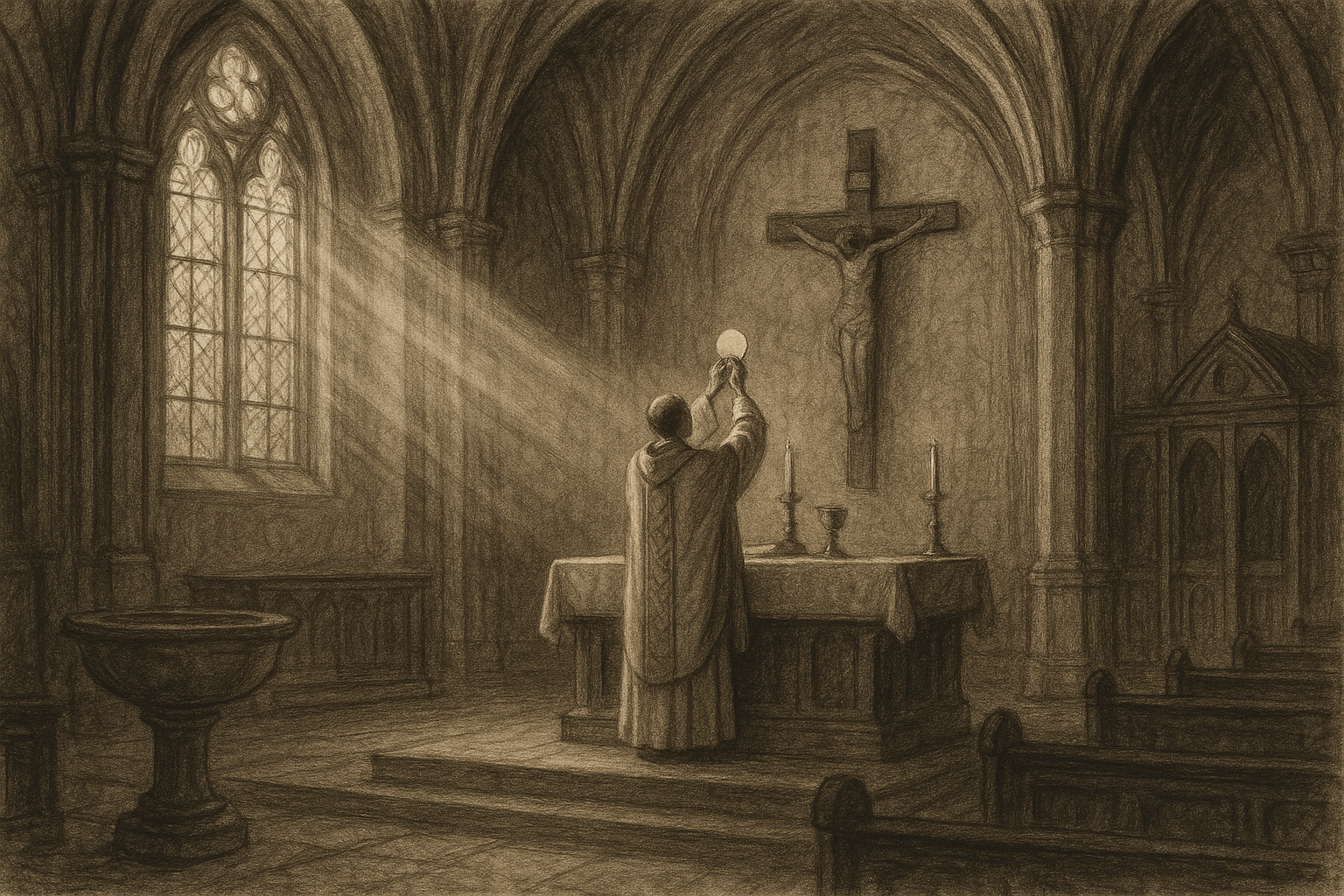
This freedom is not merely practical. It is also symbolic. The priest stands at the altar in persona Christi, especially when he offers the Eucharist. His life is meant to echo the gift he celebrates. Celibacy helps make that sign more visible: Christ gives himself entirely, and the priest is configured to that self-offering.
The Church also sees celibacy as an eschatological sign. In the resurrection, people neither marry nor are given in marriage Matthew 22:30. Celibate priesthood quietly points to that future life in God, where earthly marriage gives way to the fulfillment of all communion in him. In that sense, celibacy is not a rejection of human love. It is a witness that human love is meant for more than this age.
Historical growth in the Western Church
Clerical celibacy did not appear overnight as a merely administrative rule. It developed within the Church's life as Christians reflected on Scripture, apostolic example, and the demands of ministry. By the early centuries, bishops, priests, and deacons in the Latin tradition were increasingly expected to live in continence, especially in connection with ordination. Over time, this discipline became more clearly established in the Western Church.
That history matters because it shows the Church discerning how best to live an apostolic pattern rather than inventing a novelty. The discipline was shaped by pastoral experience and theological reflection. It was not meant to burden priests for the sake of burdening them, but to help them belong more fully to the Lord and to his people.
At the same time, the Church has always known that a discipline can be affirmed without pretending it is a dogma of faith in the same way as the Trinity or the Real Presence. Clerical celibacy is a venerable and binding discipline in the Latin Church, not because marriage is suspect, but because the Church believes this way of life bears real spiritual fruit.
Common objections, honestly considered
One common objection is that clerical celibacy causes loneliness or makes priests less human. That concern deserves a serious answer, because priestly life can indeed be demanding. But the answer is not to assume that marriage would solve every difficulty. Marriage brings its own obligations, pressures, and sacrifices. Celibacy, lived well, is not isolation. It is communion offered in another form, sustained by friendship, prayer, fraternity, and service.
Another objection is that a married priest would understand families better. There is some truth here in the sense that marriage gives direct experience of household life. Yet priests are not called only to understand one particular state of life. They are called to serve all the faithful. Their fatherhood is spiritual and sacramental. A celibate priest can enter deeply into the joys and burdens of families precisely because he is not limited to one household of his own.
Some also point to scandals and say celibacy must be the cause. But sin does not follow automatically from celibacy, and abuse is not explained by a vow alone. The roots of moral failure are more complicated and more tragic. The Church must continue to demand holiness, maturity, accountability, and sound formation. Celibacy is not a magic shield, but neither is it the enemy.
How clerical celibacy touches ordinary Catholic life
For many lay Catholics, clerical celibacy can seem remote until they see what it allows. A celibate priest can anoint the sick at midnight, hear confessions without calculating a family schedule, move to a new assignment when asked, and give himself to parish life with a kind of pastoral immediacy that is hard to overstate. The ordinary Catholic often feels that availability in the most human moments of life: crisis, grief, confession, baptism, marriage preparation, funerals, and daily Mass.
Celibacy also reminds the whole Church that we do not belong to ourselves. Every Christian is called, in some state of life, to ordered self-gift. Married couples do this through fidelity and openness to life. Single Catholics do it through consecrated service, friendship, and discipline. Priests do it through sacramental ministry and a celibate heart. The forms differ, but the offering is the same in spirit: a life given to Christ.
There is also a quiet lesson here for the modern imagination. Our age often treats fulfillment as personal choice, comfort, or self-expression. Clerical celibacy says something countercultural. It says a human life can be fruitful without possession, rich without accumulation, and complete without claiming everything as one's own.
The priest's celibacy does not erase love. It asks love to become visibly, and sometimes painfully, available for more people than one family circle alone.
A discipline that points beyond itself
In the end, clerical celibacy is not about proving that priests are stronger than other people. It is about allowing a particular vocation to shine with clarity. The Church asks for celibacy because she believes the priest should be a sign of Christ's total gift, a servant available to the altar and to the flock, and a witness to the world to come.
That is why this teaching can never be reduced to policy alone. It belongs to the Church's spiritual imagination, to her reading of Scripture, and to her confidence that grace can make a human life fruitful in unexpected ways. For Catholics trying to understand their Church more deeply, clerical celibacy is not just a rule to remember. It is a way of seeing priesthood as gift, sacrifice, and promise all at once.
When viewed with faith, the celibate priest does not appear as a man who has lost something essential. He appears as a man who has placed everything at the service of Christ so that others may more easily encounter him. That is the quiet beauty behind clerical celibacy, and it remains part of the Church's witness to a world hungry for a love that does not keep back its best part.
Keep Reading on Lets Read The Bible
Frequently Asked Questions
Is clerical celibacy a doctrine of the Church or a discipline?
In the Latin Church, clerical celibacy is a long-standing and binding discipline, not a dogma in the same sense as central doctrines of the faith. The Church can preserve, adapt, or in some cases dispense with disciplines, but she values celibacy as a deeply fitting form of priestly life.
Does the Catholic Church think marriage is less holy than celibacy?
No. Marriage is a sacrament and a holy vocation. Celibacy is not superior because marriage is flawed, but because it serves a different calling. Both are gifts from God, and both lead to holiness when lived faithfully.
Why do some Catholic priests marry while others do not?
In the Eastern Catholic Churches, some married men may be ordained priests according to their tradition and law. In the Latin Church, priestly celibacy is ordinarily required. These different practices show legitimate diversity within the one Catholic Church.