Doctrine and Questions
When the Church Prays with Her Friends in Heaven
A clear look at how Catholic teaching understands the saints, prayer, and the communion that unites heaven and earth.
Site Admin | June 22, 2025 | 85 views
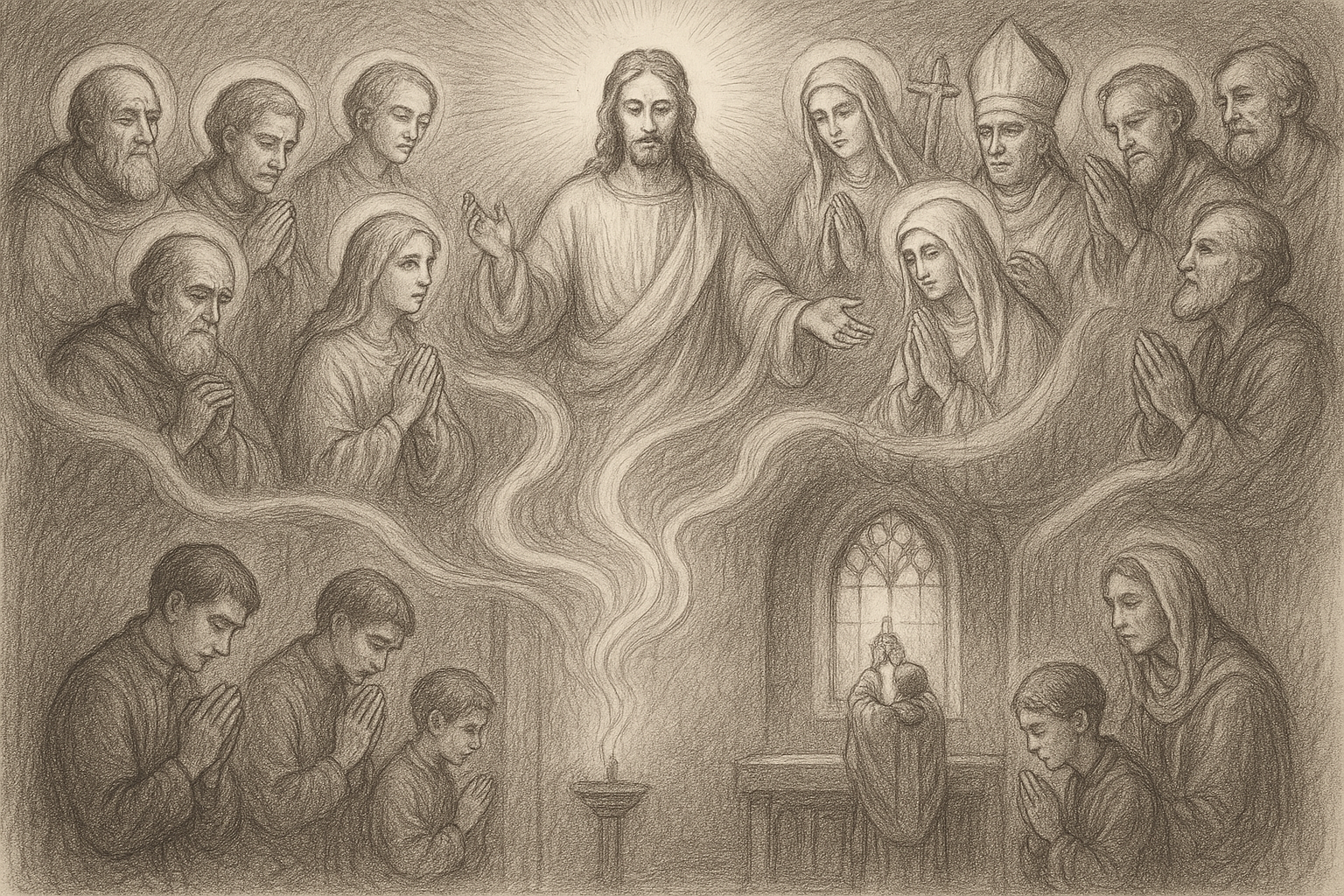
Many Catholics can explain the intercession of the saints in a sentence or two, but the deeper meaning is often easier to sense than to express. The Church teaches that those who are united to Christ in heaven are not absent from his people. They are alive in him, still belonging to the same family, still bound to us by charity, and still able to pray. That is the heart of the intercession of the saints Catholic teaching: the saints do not compete with Christ, but serve his saving work by joining their prayers to his.
This teaching is sometimes misunderstood by Christians who worry that asking a saint for prayer somehow distracts from Jesus. Catholics should answer that concern plainly and respectfully. Christ is the one mediator between God and man, as 1 Timothy 2:5 says. The Church believes this completely. Yet the same Bible also urges believers to pray for one another, and it presents heaven as alive with prayer. The saints are not isolated spectators. They are members of the one Body of Christ, perfected in love and able to present petitions before God.
The saints are alive in Christ
The starting point is not an idea about spiritual powers or religious heroes. It is the resurrection of Jesus. Because Christ is risen, death does not sever his members from his Body. In the Gospel, Jesus says that God is not the God of the dead, but of the living Luke 20:38. Catholics read this as a sign that those who belong to the Lord are truly alive to him. The saints are not shadows in the past. They are living persons in the presence of God.
Scripture also gives a vivid glimpse of heavenly prayer. In Revelation, the elders in heaven hold golden bowls full of incense, which are the prayers of the saints Revelation 5:8. Later, an angel offers incense with the prayers of all the saints before God Revelation 8:3. These images matter because they show that prayer does not stop at death, and that heaven is not silent. The saints are engaged in worship and intercession before the throne of God.
Catholic teaching therefore begins with a living communion. The faithful on earth, the souls being purified, and the blessed in heaven are all united in Christ. This is often called the communion of saints. It is not merely a poetic phrase. It names a real spiritual bond within the one people of God.
What intercession means
Intercession simply means praying on behalf of another. Catholics do this every day. A mother asks friends to pray for her child. A parish asks prayers for the sick. A believer requests prayer from a trusted friend. None of that replaces Christ. It is a sign that God invites his people to cooperate in love.
When Catholics ask the saints to intercede, they are doing the same thing, but with members of the Church who are already perfected in charity. The saints know the Lord not by faith alone but by sight. They are closer to him, not because they have become independent of him, but because his grace has completed its work in them. Their prayers are precious precisely because they are united to his will.
This is why the Church is careful to say that the saints intercede, not that they save themselves or act apart from Christ. Every grace comes from God. Every answer to prayer comes through Jesus Christ. The saints can only pray because they belong to him. Their intercession is participation, not replacement.
Scripture gives room for shared prayer
Some Christians object that no one in heaven can hear prayers on earth. Catholics answer first by noting that Scripture does not set such a limit on God. The Lord can make his purposes known as he wills. Scripture repeatedly shows heaven and earth joined in God's action. In Hebrews, believers are described as surrounded by so great a cloud of witnesses Hebrews 12:1. That image suggests more than distant memory. It points to the ongoing reality of the faithful before God.
There are also biblical examples of heavenly beings carrying messages and offering prayers, as in the books already mentioned from Revelation. Catholics do not claim that the saints are omniscient or that they hear us by nature. Rather, they believe God can make our petitions known to them. This is not unlike the way God can use created instruments for his purposes without diminishing his own sovereignty.
Another important passage is the scene of the rich man and Lazarus. Even after death, Abraham is aware of the condition of others Luke 16:19-31. Catholics do not build the whole doctrine from that passage alone, but it fits the larger biblical pattern. The dead in God are not portrayed as cut off from all awareness.
Christ remains the one mediator
Any honest Catholic explanation must stay anchored here. Jesus Christ is the unique mediator because he alone is the Savior, the one who reconciles us to the Father by his cross and resurrection. The Church does not put the saints in the place of Christ. She invokes them because they belong to him. Their power to help is derived entirely from his grace.
Think of it this way: asking a saint to pray is not a rival claim to Christ's mediation. It is a form of living within it. The same Lord who saves us also gives his members the dignity of praying for one another. If a Christian can ask another Christian on earth for prayer, then death does not break the communion of charity that Christ has established. The saint's prayer is not a second source of grace. It is a beautiful extension of the one grace that flows from Jesus.
This is one reason Catholics are careful with language. They do not worship saints. Worship belongs to God alone. The saints are honored, loved, and remembered with gratitude, but adoration is reserved for the Holy Trinity. That distinction protects the truth that all holiness comes from God.
Why the Church asks saints for prayer
In ordinary life, Christians know that prayer changes the one who prays and also strengthens the one prayed for. The Church asks the saints for prayer for the same reason she asks fellow believers on earth. Charity unites us, and charity acts. The difference is not the nature of the request but the state of the helper. The saints are already with the Lord, perfectly conformed to his love, and therefore their prayers are especially fitting.
Popular devotion often reflects this in simple and moving ways. A person burdened by illness may turn to Saint Joseph, Saint Luke, or Saint Theresae of Lisieux. A student may ask Saint Thomas Aquinas for help in study. A parent may seek the prayers of a patron saint known for patience or courage. These habits are not superstitious when understood rightly. They are expressions of family life within the Church.
At their best, these prayers also educate the heart. By asking a saint's intercession, Catholics learn that holiness is concrete. The saints were real men and women, with real struggles, who were transformed by grace. Their lives remind us that the Gospel is not abstract. It can be lived in every state of life, every culture, and every age.
Common misunderstandings
One misunderstanding is that intercession means the saints somehow take attention away from Jesus. In reality, the opposite is meant. A true devotion to the saints leads us toward Christ because every saint is a witness to his power. The better the saint, the more clearly Christ shines through that saint's life.
Another misunderstanding is that Catholics pray to the saints as if they were gods. This is false. The Church is clear that prayer addressed to the saints is not worship but request. The language may sound unusual to some Protestants because Catholics sometimes say they are
Keep Reading on Lets Read The Bible
Frequently Asked Questions
Do Catholics think saints are equal to Jesus?
No. Catholics believe Jesus Christ alone is Lord, Savior, and the one mediator between God and humanity. Saints do not replace him. They are members of his Body who pray for us by grace.
Can the saints actually hear our prayers?
Catholic teaching does not claim that saints hear by their own power. Rather, the Church believes God can make our petitions known to them, since the saints are alive in him and united to the communion of the Church.
Is asking a saint for prayer the same as worship?
No. Worship belongs to God alone. Asking a saint to pray is more like asking a holy friend to intercede, except that the saint is already perfected in Christ and present with him in heaven.