Saints and Witnesses
From Assisi to the Open Road: The Remarkable Shape of St. Francis's Life
A reverent look at the conversion, poverty, and enduring witness of one of the Church's most beloved saints.
Site Admin | April 26, 2026 | 116 views
Few saints are as widely loved, or as widely simplified, as St. Francis of Assisi. He is often remembered through birds, animals, and a general spirit of gentleness. Yet the St. Francis of Assisi life was far more demanding and far more concrete than a sentimental image can hold. He was a medieval Italian layman turned penitent, a founder of religious life, a servant of the poor, and a man whose love for Christ led him into serious conversion, real sacrifice, and steady obedience to the Church.
Francis was born in Assisi around 1181 or 1182, in a prosperous merchant family. As a young man, he enjoyed wealth, status, and the expectations that came with both. He was known for energy, charm, and a taste for public life. Like many young men of his class, he could imagine a future shaped by honor and success. But God had other plans. The path that made Francis famous was not the path of worldly advancement. It was the path of surrender.
From ambition to repentance
The turning points in Francis's life did not happen all at once. They came through disappointment, illness, prayer, and a growing unease with the life he had been living. He experienced imprisonment after military conflict, and later a period of serious illness. These were not romantic experiences. They were humiliating and painful, yet they opened space for grace.
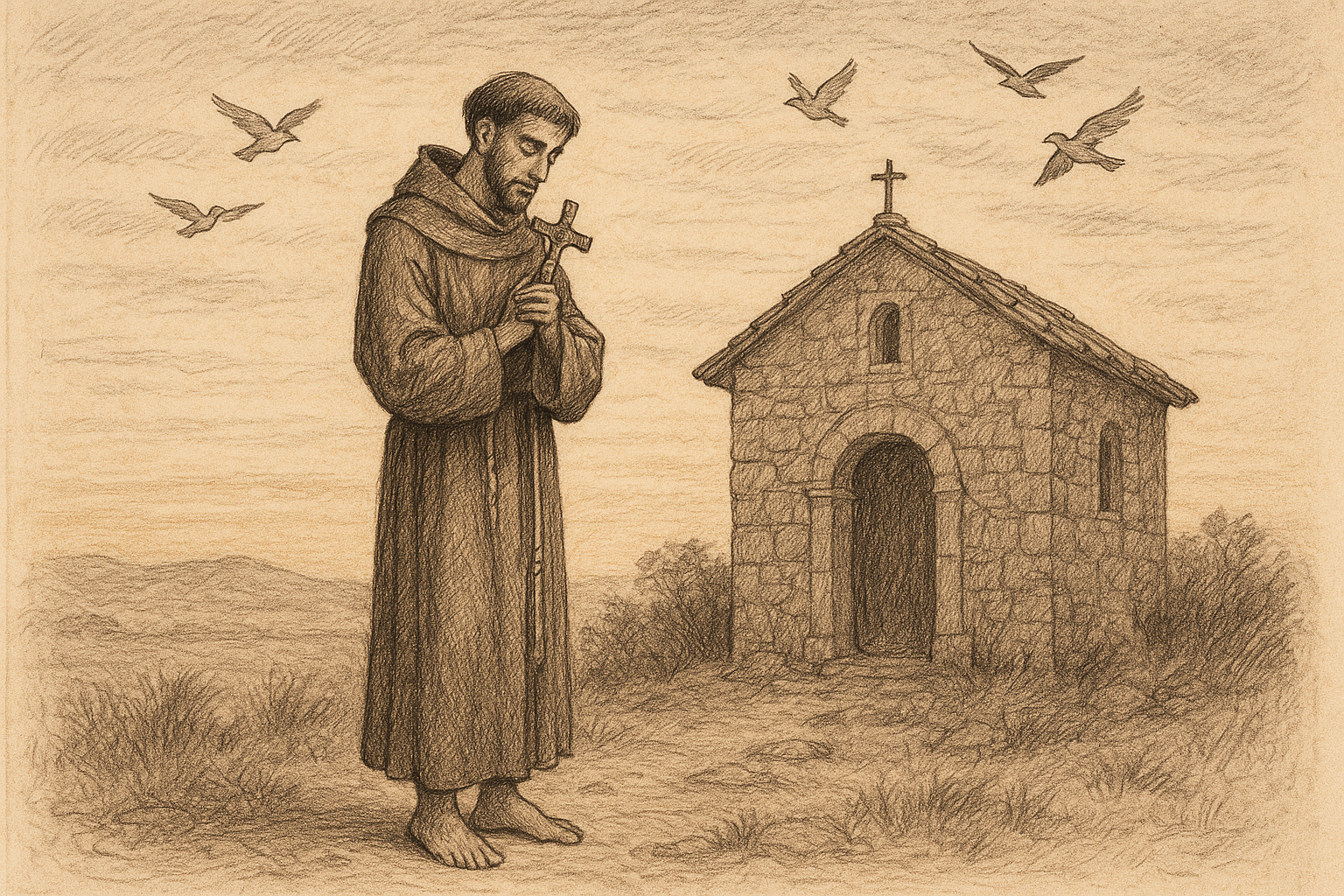
In time, Francis began to seek Christ in a more direct and costly way. A famous moment came when he heard the Lord call him to rebuild the Church. Francis first understood that call in a literal sense, repairing damaged chapels near Assisi. But the deeper meaning soon became clear. He was being summoned to help renew the Church not by power or prestige, but by holiness, poverty, and fidelity.
This pattern is important. Francis did not invent his own spirituality out of private inspiration alone. He responded to grace within the living Church. Catholic holiness is never merely self-expression. It is a response to a call. Francis's life shows that conversion often begins with one obedient step, then another, as God reveals more of the road.
If any man would come after me, let him deny himself
That Gospel word was not theoretical for Francis. He began to detach himself from possessions, family expectations, and the desire to be admired. In one striking public act, he renounced his former life before the bishop of Assisi. The gesture was dramatic because the break was real. Francis was choosing a new identity, not as an escape from responsibility, but as a belonging to Christ above all else.
Poverty as a form of freedom
Francis's love of poverty has sometimes been misunderstood. He did not love misery for its own sake, and he was not building a philosophy that treated material need as spiritually superior in every respect. Rather, he desired to live without worldly attachment so that nothing would hinder his trust in God. Poverty, for Francis, was a way of making room for divine providence, fraternal charity, and joyful dependence.
He took seriously the words of Christ to the apostles and the example of the Lord who was born in humility, lived without property, and embraced the cross. Francis wanted his life and his brotherhood to mirror that pattern. This was not vague idealism. He and his followers sought to live simply, work honestly when possible, and rely on alms with gratitude.
His embrace of poverty also carried moral force. In a society marked by class difference and commercial ambition, Francis testified that the poor are not to be treated as invisible. He did not merely speak about them; he lived among them, served them, and called others to see Christ in them. That is one reason his witness remains powerful. He joined contemplation with action, and personal renunciation with compassionate attention to others.
Blessed are the poor in spirit
The Gospel does not praise poverty as such, but it does bless the poor in spirit. Francis embodied that interior poverty. He became a man unburdened by possessions because he had become captivated by a greater treasure. In Catholic life, such freedom is not abstract. It is tested in habits of money, comfort, image, and control.
Brotherhood, preaching, and service to the Church
Francis did not set out to become a lone reformer. As others were drawn to his way of life, he helped shape a fraternity centered on penance, prayer, and preaching. The early Franciscan movement grew quickly, and Francis himself was careful, though not always without difficulty, to keep it rooted in the Church's sacramental and hierarchical life.
His preaching was simple and urgent. He called people to repentance, peace, and reverence for God. He was not a university theologian, and he did not need to be. His authority came from holiness and from the clarity of his witness. People were moved because they saw in him a man who tried to live what he preached.
Francis also loved the Eucharist, the name of Jesus, and the goodness of creation as a gift from the Creator. His reverence was not sentimental nature mysticism. It was rooted in worship. He saw all created things as pointing beyond themselves to God. That is why he could speak of brother sun and sister moon while still remaining profoundly orthodox in his devotion.
He also devoted himself to peace. During the era of crusades and conflict, Francis is remembered for meeting the Sultan al-Kamil during the Fifth Crusade. The encounter stands as a striking example of courage and missionary openness. Francis did not deny the truth of the faith, but he approached others with humility rather than contempt. The meeting remains a reminder that charity and conviction are not enemies.
The stigmata and the hidden cost of love
In the later years of his life, Francis's union with the crucified Christ became even more intense. Tradition holds that he received the stigmata, the wounds of Christ, on Mount La Verna. Whatever one does with the mystery of that event, the broader fact is clear: Francis's life was increasingly marked by suffering, fasting, and bodily weakness. He bore the cost of a love that had become total.
This detail matters because sanctity is not a decorative ideal. The closer a soul comes to Christ, the more it learns that love passes through self-denial. Francis's joy was never the joy of comfort. It was the joy of belonging to Jesus, even when that belonging reshaped his body and his plans.
His final years were not triumphant in worldly terms. He suffered physically and grew weaker. Yet he remained spiritually luminous. Near the end, he composed the Canticle of the Creatures, a hymn of praise that reveals a man who could still bless God in weakness. He died in 1226, at the Portiuncula, the little chapel he loved. The Church canonized him only two years later, a sign of the immense and immediate impact of his witness.
What Catholics can receive from Francis today
Francis does not ask modern Catholics to copy every external detail of his vocation. Most people are not called to his form of poverty, his itinerant life, or his particular founding role. But every Catholic can learn from the interior logic of his holiness.
- Let conversion be concrete. Francis did not remain in vague regret. He changed his life in visible ways.
- Treat poverty of spirit as a real discipline. Simplicity in money, speech, and ambition can make room for God.
- Love the Church as she is, not as an ideal abstraction. Francis worked within the Church, not against her.
- Pray and serve together. His compassion flowed from adoration, not from activism alone.
- See creation as gift, not possession. Gratitude changes how believers use the world.
There is also a warning in Francis's story. It is easy to admire saintly poverty while remaining attached to comfort. It is easy to praise peace while avoiding repentance. Francis forces honest questions. What do I cling to? What would I fear losing? Where am I still living as if Christ were not enough?
The best answer to the St. Francis of Assisi life is not a slogan but a conversion of heart. Francis became great by becoming small before God. He let Christ take the center, and once Christ was there, everything else found its proper place. That is why the saint of Assisi continues to speak with such freshness: he shows that joy grows deep when the soul is freed for God.
Keep Reading on Lets Read The Bible
Frequently Asked Questions
When was St. Francis of Assisi born?
St. Francis of Assisi was born around 1181 or 1182 in Assisi, in present-day Italy.
Why did St. Francis renounce his wealth?
Francis renounced wealth because he came to believe that Christ was calling him to a life of radical poverty, repentance, and freedom from worldly attachment.
Did St. Francis reject the Church or try to start a separate religion?
No. Francis remained within the Catholic Church and sought to renew Christian life through humility, obedience, preaching, and fraternity.