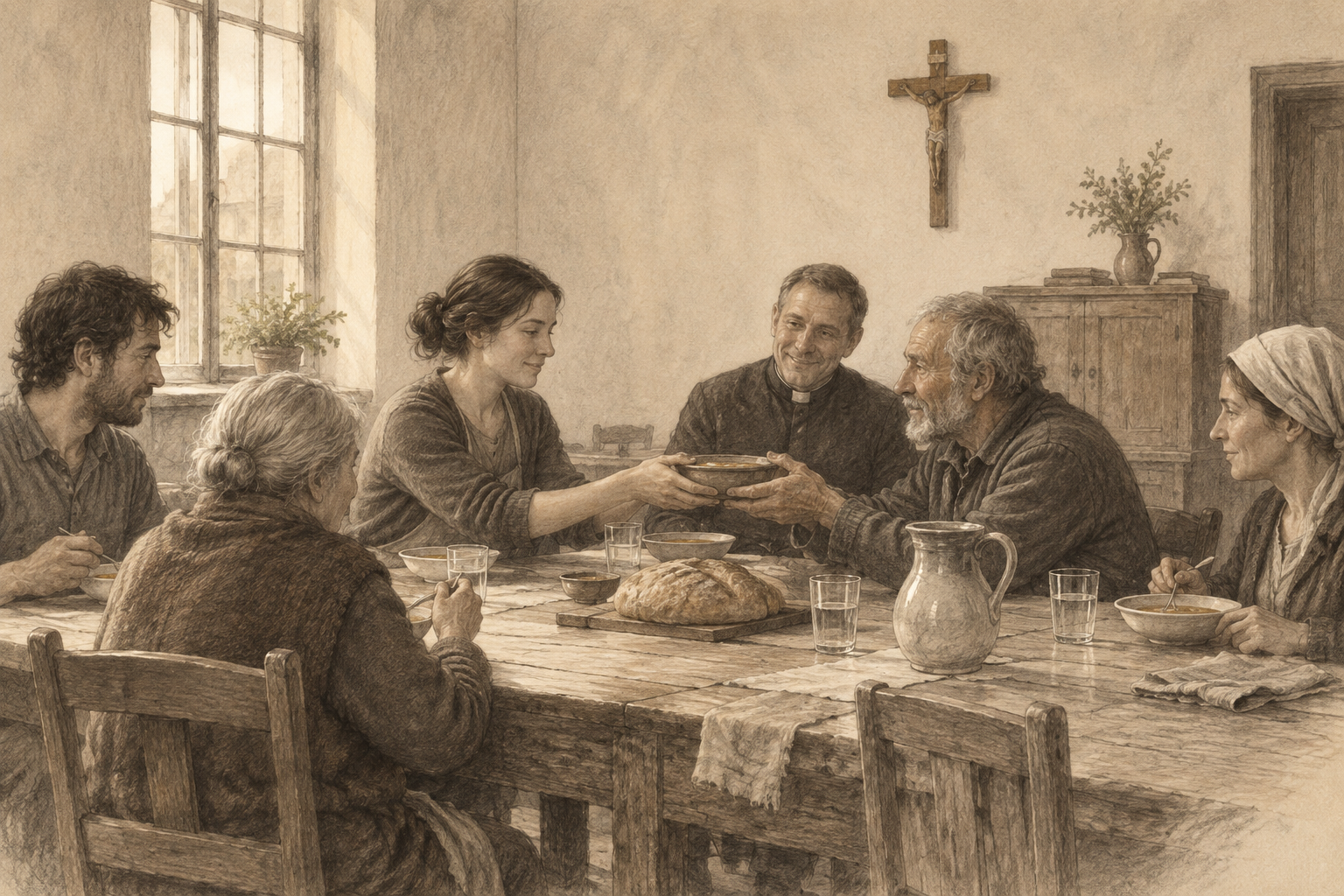
Social Teaching
Making Room for the Poor in an Ordinary Catholic Life
Care for people in poverty belongs at the heart of Christian discipleship, where mercy, justice, and the dignity of every person meet.
Site Admin | September 21, 2026 | 6 views
A request for help often arrives at an inconvenient moment. Someone needs groceries when the household budget is tight. A parish collection comes when another expense is already waiting. A neighbor's trouble becomes visible just as we feel we have little left to give. These encounters can awaken compassion, but they can also bring uncertainty: What would actually help? What do I owe this person? Where should I begin?
Catholic teaching does not answer every practical question with a fixed formula. It begins with something more demanding and more hopeful: the person before us has a dignity that poverty cannot erase. Care for the poor belongs to the Christian life because love of God cannot be separated from love of neighbor. It is neither a fashionable cause nor a task reserved for unusually generous people.
A person comes before a problem
The foundation of Catholic social teaching is the dignity of the human person. Scripture describes humanity as created in God's image, a truth that precedes every distinction of income, ability, nationality, or social standing: Genesis 1:27. A person does not become more worthy by earning more, and does not become less worthy by needing help.
This sounds straightforward until poverty becomes personal. We may unconsciously divide people into those whose hardship makes sense to us and those whose choices we dislike. Prudence sometimes requires difficult judgments about how to help. It never permits us to treat another person as disposable.
People experiencing poverty also have gifts, responsibilities, relationships, and hopes. They are not merely recipients of someone else's kindness. A parish that welcomes a struggling family should make room for their friendship and participation, not only their name on a distribution list. Assistance should honor their agency wherever possible.
Christ makes the encounter personal
In his account of the judgment of the nations, Jesus identifies himself with people who are hungry, thirsty, strangers, without clothing, sick, and imprisoned. Service offered to the least of his brothers is service offered to him: Matthew 25:40. These are concrete needs, not merely symbols of an interior spiritual condition.
The parable of the Good Samaritan likewise refuses to leave love at the level of good intentions. The Samaritan approaches the wounded man, tends his injuries, and provides for his continued care. Jesus ends by telling his hearer to act in the same way: Luke 10:37. Compassion becomes neighborly love when it takes responsibility for something real.
James makes the same point with unsettling simplicity. Wishing a poorly clothed and hungry person well, while withholding the necessities of life, does not meet the person's need: James 2:16. Prayer and material assistance are not rivals. Prayer should make us more attentive to suffering, while practical service should remain rooted in love rather than self-importance.
Giving special attention without excluding anyone
The Church often expresses this responsibility through the preferential option for the poor. The phrase means that the needs of people who are poor and vulnerable deserve particular attention in our personal choices and in the life of society. It does not mean that God loves other people less or that one economic class is morally flawless.
Think of a family caring for a sick child. The child receives extra attention because the need is greater, not because the other children have ceased to matter. Similarly, concern for the poor asks us to notice whose needs are most urgent and whose voices are most easily overlooked.
The Catechism describes the Church's love for the poor as part of her constant tradition and recognizes that human misery includes more than material deprivation (Catechism of the Catholic Church, 2444, 2448). Loneliness, exclusion, sickness, and spiritual suffering also call for care. Recognizing those forms of suffering, however, must not become an excuse to overlook an empty cupboard or an unpaid heating bill.
Charity meets the need; justice asks what is owed
Charity and justice belong together. Charity moves us to give, accompany, forgive, and serve. Justice asks whether people receive what is due to them: fair treatment, respect for their rights, and the conditions necessary for a life consistent with human dignity.
A meal can relieve hunger tonight. Fair wages, reliable access to essential services, and protection from exploitation can help prevent that hunger from returning. Neither level of response makes the other unnecessary. A family cannot wait for every social problem to be solved before eating dinner, but repeated emergencies should also lead us to ask why the family remains trapped.
The Catechism warns against presenting as charitable gifts what is already owed in justice (2446). An employer cannot substitute a generous donation for paying workers fairly. Nor can a community congratulate itself on emergency relief while refusing to examine practices that predictably leave vulnerable people without necessities.
This is also where the Church's teaching on the universal destination of goods becomes practical. The goods of creation are intended for the benefit of the whole human family. Private property is legitimate, but ownership carries responsibilities. What we possess is not morally isolated from the needs of our neighbors (2402-2404).
Solidarity and subsidiarity work together
Solidarity means recognizing that we belong to one human family and have responsibilities toward one another. It challenges the idea that another person's suffering is simply someone else's problem. In ordinary life, solidarity may mean supporting a struggling coworker, making a parish accessible to people without reliable transportation, or listening seriously to families facing housing insecurity.
Subsidiarity means that larger institutions should support, rather than needlessly absorb or replace, the proper work of persons, families, and smaller communities. People closest to a difficulty often understand important parts of it. Their knowledge and initiative should not be swept aside.
Subsidiarity does not mean leaving local communities to manage needs beyond their resources. Larger institutions have real responsibilities when smaller bodies cannot adequately respond. Nor does solidarity mean that every decision should be centralized. Together, these principles encourage help that is sufficient for the need while respecting the people and communities involved.
For Catholics considering public policy, this calls for moral seriousness without partisan shortcuts. The Church provides principles for judgment, not a ready-made technical answer to every question. Catholics may disagree about particular measures while remaining accountable to human dignity and the common good. Such disagreement cannot make concern for the poor optional.
Help that protects dignity
Good intentions need the guidance of prudence. A useful first step is often to ask what would help rather than assuming we already know. Someone requesting food may also lack a stove. A person who misses appointments may have no dependable transportation. Listening can reveal why an apparently simple solution has not worked.
Respect also requires discretion. A person's hardship is not material for a moving social media post without free and informed consent. Parish assistance should protect confidentiality and avoid unnecessary humiliation. Gratitude should never become a performance demanded in exchange for help.
There are situations in which directly providing an item or service is wiser than giving cash. There are also situations in which flexible financial assistance allows a person to address a need outsiders have missed. No single method is best in every case. Where addiction, coercion, or other serious risks are involved, experienced services can help shape a compassionate response.
Boundaries are compatible with Christian love. We may be unable to meet a request, or unable to meet it safely. We can still speak respectfully, avoid contempt, and offer a realistic alternative when one is available. Saying no to a particular request need not mean closing the heart to the person.
A sustainable pattern of generosity
Most households cannot respond to every appeal. Parents have genuine duties to their children, and caregivers must consider those entrusted to them. Catholic generosity is not measured simply by how exhausted or financially exposed someone becomes. Yet legitimate responsibilities should lead to honest discernment, not an automatic exemption from sacrifice.
A sustainable practice can begin with a few deliberate commitments:
- Make giving intentional. Set aside an amount or a regular opportunity to help, according to your means, instead of relying only on passing emotion.
- Choose dependable service. Support a parish ministry or trustworthy organization whose work you can reasonably understand.
- Offer useful time. Regular help with meals, transportation, paperwork, or companionship may be more valuable than an occasional burst of activity.
- Examine daily responsibilities. Consider how you pay workers, conduct business, use possessions, and treat people with less influence.
- Listen and learn. Let the experience of people facing poverty inform your judgment without expecting anyone to represent every person in need.
Those who are themselves struggling should not read these commitments as a demand to give away necessities. Receiving help is not a failure of faith. The Church is a communion in which burdens are shared, and the person who needs assistance today remains a full member of Christ's body.
Let worship widen the heart
The Eucharist draws Catholics into communion with Christ and with one another. That communion must shape how we treat people beyond the church doors. The Catechism explicitly connects receiving the Eucharist with commitment to the poor (1397). We cannot honor Christ sacramentally while becoming deliberately indifferent to neighbors who lack what they need to live.
Care for the poor is not a way of purchasing God's favor. It is a response to grace, an expression of faith working through love. Confession, prayer, and the Eucharist can help uncover the fears and attachments that narrow our generosity. They also sustain us when service is slow, complicated, or unnoticed.
There may be no dramatic beginning. It may be a quiet conversation, a recurring gift, a fairer decision at work, or an offer to drive someone to an appointment. The next faithful step is often close at hand: notice the person, listen without rushing, and offer the help you can honestly give. An ordinary Catholic life makes room for the poor one act of love and justice at a time.
Keep Reading on Lets Read The Bible
Frequently Asked Questions
What does the preferential option for the poor mean?
It means giving particular attention to people who are poor or vulnerable when making personal, communal, and social decisions. It rests on the equal dignity of every person and the urgency of unmet needs. It does not mean excluding others from concern or assuming that poverty automatically makes someone morally virtuous.
Does Catholic teaching require giving money to everyone who asks?
Catholic teaching requires genuine love and concern, but not the same response to every request. Prudence considers the person's needs, your responsibilities, and possible risks. Giving money, providing food, supporting a reliable service, or offering practical assistance can each be appropriate. Whatever the response, the person should be treated respectfully.
How are charity and justice connected in caring for the poor?
Charity responds with generous love to a person's needs. Justice asks whether people receive what they are owed, including fair treatment and respect for their rights. Catholic care for the poor includes both immediate assistance and attention to conditions that cause or prolong hardship. Charitable donations cannot replace obligations such as paying workers fairly.