Saints and Witnesses
St. Catherine of Siena and the Courage to Love the Church Honestly
A close look at the life, prayer, and public witness of one of the Church's great women saints
Site Admin | May 4, 2026 | 88 views
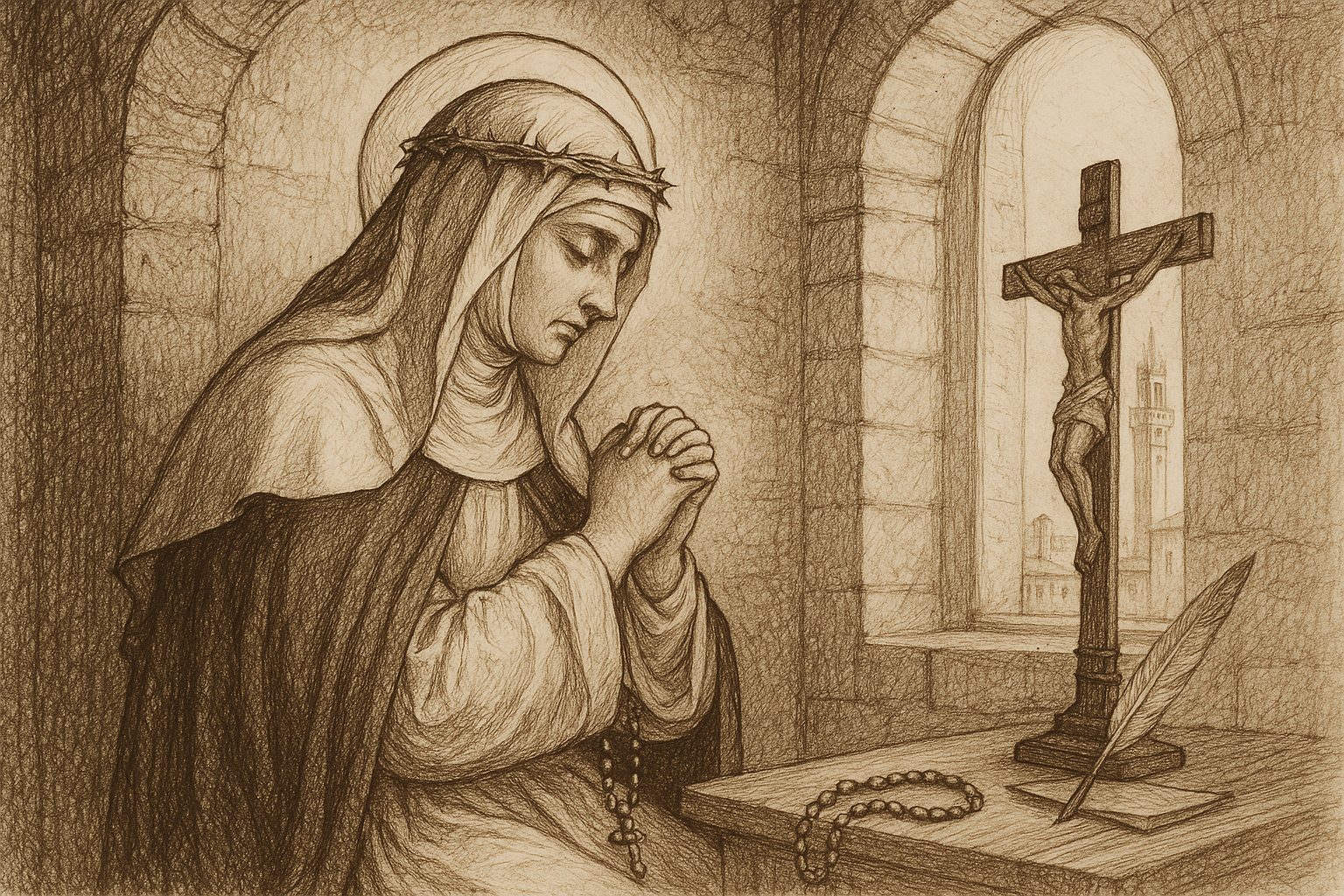
Few saints feel as vivid and immediate as St. Catherine of Siena. She was not a distant figure wrapped only in legend, but a woman of prayer, intelligence, discipline, and extraordinary spiritual force. Her St. Catherine of Siena life began in the busy city of Siena in the 14th century, but it unfolded into a witness that still speaks to Catholics who want to love Christ with greater honesty and courage.
Catherine was born in 1347, the daughter of a wool dyer. From an early age she was drawn to prayer, and her desire for God became more demanding as she grew. While many around her expected a conventional family life, Catherine pursued a consecrated path shaped by fasting, solitude, and service. She joined the Dominican Third Order, living in the world while giving herself to a life of prayer and penance. Her holiness was not passive. It had direction, clarity, and a strong sense of mission.
Early life in Siena
Like many saints, Catherine did not begin with public importance. Her childhood and youth were marked by a deep interior attraction to God and a resistance to ordinary expectations. According to the broad outline of her life, she was known for prayer even as a young girl and gradually embraced a life of severe discipline. She wore the habit of the Dominican tertiaries and chose a path that centered on Christ, especially in His Passion.
This early period matters because it shows that sanctity often takes root in hidden places. Catherine did not build her witness through status, public approval, or academic prestige. She formed her soul through prayer, repentance, and a willingness to belong to God before belonging to herself. In that sense, her life echoes the Gospel call: seek first the kingdom of God and let everything else find its place after that Matthew 6:33.
A life shaped by prayer and service
Catherine's prayer was not an escape from the world. The more deeply she entered into contemplation, the more she was drawn toward works of charity and active concern for souls. She cared for the poor and the sick, and she came to be known for spiritual direction. Men and women, priests and religious, and even civic leaders sought her counsel. What is striking is not only that people listened to her, but that she spoke with an authority born from prayer rather than ambition.
Her letters, prayers, and spiritual teaching show a woman who understood the Christian life as a total gift to God. She wrote with urgency about repentance, peace, mercy, and reform. Yet her tone was rarely cold or merely corrective. Even when she challenged corruption or negligence, she did so because she loved the Church and desired the salvation of souls. That balance remains one of the most compelling features of her witness: truth without cynicism, zeal without self-importance, devotion without softness toward sin.
Holiness does not withdraw from the suffering of the Church. It enters that suffering with prayer, truth, and mercy.
Serving the Church in a time of turmoil
Catherine lived during a troubled century for the Church and for Europe. The Avignon papacy, factional conflict, plague, and political instability formed the background of her adult life. She became involved in urgent Church concerns, including efforts to encourage the pope to return to Rome. Her influence was not the result of office or rank. It came from the force of her conviction, her spiritual credibility, and her willingness to speak plainly.
This is one of the most remarkable parts of her story. Catherine loved the Church enough to tell the truth about its wounds. She did not confuse criticism with rejection, nor did she pretend that the failures of churchmen were small things. At the same time, she never abandoned communion with the Church herself. Her love was filial and fierce. She wanted reform, but reform through conversion, prayer, and fidelity to Christ.
For Catholics today, that is an important lesson. It is possible to be deeply troubled by sin in the Church and still remain steadfast in love. Catherine shows that faithful criticism must be ordered toward holiness. A bitter spirit can point out faults, but only love can help heal them. Her example reminds us that the Church is purified not by contempt, but by saints.
Her writings and spiritual teaching
Catherine's best-known spiritual work is The Dialogue, a text that presents her mystical conversations with God. It is a work of theological intensity and interior fire, yet it remains accessible because it comes from a woman who knew suffering, repentance, and longing. The central themes are consistent with Catholic life: God's mercy, the dignity of the human person, the need for humility, and the path of obedience.
One of the most important ideas in her teaching is that love must be purified by truth. Human beings do not become holy by self-assertion, but by surrender to God. Catherine's spirituality often returns to the image of the soul drawn into union with divine charity through self-knowledge and surrender. In practical terms, she believed that a Christian grows by recognizing both God's goodness and one's own poverty. This is not self-hatred. It is clarity before God.
Her writing also shows a deep affection for Christ crucified. For Catherine, the Cross was not a distant symbol. It was the place where love became visible. She urged Christians to meditate on Christ's suffering not in a sentimental way, but as a summons to repentance and courage. In this, she stands close to the heart of the Gospel, where Jesus says, if anyone would come after me, let him deny himself and take up his cross daily and follow me Luke 9:23.
What her life reveals about sanctity
It is easy to imagine that saints are impressive because they are gentle, polished, or naturally inspiring. Catherine complicates that picture. She was certainly compassionate, but she was also forceful, intense, and at times uncompromising. Her sanctity was not the absence of strong personality. It was the transformation of strong personality by grace.
That is encouraging for ordinary Catholics. A person does not need to become bland in order to become holy. Instead, the Lord asks that our gifts, temperaments, and desires be brought under His lordship. Catherine's life suggests that zeal can become sanctified, intelligence can become service, and even a hard season of history can become a stage for witness.
Her holiness also reminds us that sanctity is not measured by comfort. Catherine prayed, fasted, served the sick, and endured misunderstanding. She accepted suffering as part of her union with Christ. Her witness aligns with the apostolic conviction that weakness can become a place of divine power, since God often works most clearly where human strength is insufficient 2 Corinthians 12:9.
Lessons Catholics can bring into daily life
Catherine's example can be translated into ordinary Catholic life without turning it into something impossible. Her witness suggests a few concrete habits and attitudes:
- Pray before speaking, especially when Church troubles or public disputes tempt you toward anger.
- Love the Church enough to want her reform, but never separate reform from humility and repentance.
- Make room for silence and penance, even if your vocation is active and full of responsibilities.
- Let charity guide truth, so that correction serves healing rather than winning an argument.
- Keep Christ crucified at the center, since the Cross orders both zeal and mercy.
These are not lofty ideals reserved for mystics. They are habits that can shape family life, parish life, and personal prayer. A parent who speaks firmly but lovingly, a teacher who corrects without humiliation, a Catholic who prays for the Church while resisting cynicism, all of these can draw something from Catherine's witness.
It is also worth remembering that Catherine had no need to be famous in the modern sense. She became influential because her life was transparent to something greater than herself. That is often how holiness works. When a soul belongs to God, it becomes available for the good of others.
Why St. Catherine still speaks to Catholics
The Church continues to honor St. Catherine of Siena because her life gathers several vital truths into one powerful witness. She loved Christ passionately. She served the poor. She spoke to leaders without fear. She desired reform without breaking communion. She prayed with intensity and suffered with patience. She was not a perfect illustration of quiet balance, but she was a luminous example of ordered love.
In a time when Catholics can feel pulled between discouragement and defensiveness, Catherine offers a better way. She teaches that fidelity is not passive. It can be courageous, intelligent, and even outspoken, as long as it remains rooted in prayer. She also teaches that one cannot truly love the Church apart from loving Christ's Cross, because the Church is renewed by the same grace that saves us personally.
For anyone looking back at the St. Catherine of Siena life, the central lesson is not that extraordinary saints are untouchable. It is that God can take a determined, prayerful, even difficult person and shape that life into a gift for the whole Church. Catherine's voice still calls Catholics to deeper conversion, clearer charity, and a more honest love of the Body of Christ.
Keep Reading on Lets Read The Bible
Frequently Asked Questions
Who was St. Catherine of Siena?
St. Catherine of Siena was a 14th century Dominican tertiary, mystic, writer, and adviser who became one of the great saints of the Church. She is remembered for prayer, penitence, care for the sick, and strong appeals for reform and fidelity within the Church.
What is St. Catherine of Siena best known for?
She is best known for her spiritual writing, especially The Dialogue, her devotion to Christ crucified, and her bold efforts to encourage renewal in the Church during a time of crisis. She is also remembered as a Doctor of the Church.
What can Catholics learn from St. Catherine of Siena today?
Catholics can learn to combine prayer with courage, love for the Church with honest reform, and charity with truth. Her life shows that holiness does not require weakness of character, but the surrender of character to God.