Saints and Witnesses
St. Clare of Assisi and the Quiet Strength of a Poor Life
A closer look at the woman who embraced radical Gospel poverty and gave the Church a luminous witness of prayer, courage, and fidelity.
Site Admin | April 28, 2026 | 87 views
The St. Clare of Assisi life is one of those saintly stories that seems simple at first and then grows deeper the longer one sits with it. She did not found an empire, write a large body of theological works, or travel widely as a public preacher. Instead, she gave the Church something quieter and in some ways more difficult: a life marked by evangelical poverty, adoration, and steadfast fidelity to Christ.
In Clare, Catholics encounter a woman whose holiness was not hidden by weakness but made visible through it. She was young, noble by birth, and deeply drawn to the Gospel witness of St. Francis. Yet her response was not merely admiration. She chose Christ with her whole life, and that choice shaped an entire movement of women religious who came to be known as the Poor Clares.
From Assisi to a new path
Clare was born in Assisi around 1194, into a noble family. In a world where family status and marriage arrangements carried great weight, her decision to follow a radically different path would have been startling. Like many saints, she did not begin with a dramatic public mission. She began with a heart stirred by grace.
At some point in her youth, Clare encountered the preaching and example of Francis of Assisi. Francis had already begun to live a form of poverty that was both visible and challenging. He took the Gospel seriously in a way that could not be ignored. Clare saw in him a concrete image of freedom, and she desired the same freedom for herself, not as self-expression, but as a way of belonging entirely to Christ.
On Palm Sunday in 1212, Clare left her home secretly and went to Francis. There she renounced the world she had known and began a new life of consecration. The gesture was decisive. It was not an escape from responsibility, but a surrender to a greater claim: the call of Christ in the Gospel.
Scripture gives words to this kind of surrender: If anyone wishes to come after me, let him deny himself, take up his cross daily, and follow me.
Her life of hidden service
Clare first lived near the Benedictine community of San Paolo and later at San Damiano, where she would remain for the rest of her life. There she gathered other women who wanted to live in the same spirit of poverty and prayer. This was not a worldly kind of leadership. It was quiet, disciplined, and rooted in imitation of Christ.
Clare became abbess of the community, but her authority did not depend on prestige. It flowed from example. She embraced austerity, vigilance, and prayer, and she asked the sisters to do the same. The community would not be built on comfort, but on trust in divine providence. The logic was simple and demanding: if Christ is enough, then a life stripped of excess can become a place of freedom rather than fear.
In this sense, Clare's witness is especially relevant in a culture that often measures security by possessions and control. She shows that poverty, when freely embraced for the love of Christ, is not misery. It is a spiritual discipline that creates room for charity, dependence on God, and interior peace.
The privilege of poverty
One of the most striking elements in the St. Clare of Assisi life is her insistence on what later came to be called the privilege of poverty. Clare wanted her community to remain free from property in order to live more directly by faith. This was not a rejection of order or common sense. It was a deliberate choice to make Christ the only security of the sisters.
Clare received support for this ideal from several churchmen, and Pope Innocent IV approved her Rule shortly before her death. Her Rule was significant because it formally established the way her community would live. She desired a way of life that held together enclosure, prayer, fraternity, and evangelical poverty.
There is a theological depth here that Catholics should not miss. Poverty, in Clare's vision, was not valuable because material deprivation is good in itself. It was valuable because it made visible a deeper truth: human beings are not self-sufficient. We live before God as beggars who receive everything from his mercy.
That truth echoes throughout Scripture. It appears in the Beatitudes, in Mary's Magnificat, and in the Lord's own life. Clare wanted to conform herself and her sisters to that pattern with unusual clarity.
Prayer at the center
Clare's holiness was not only austerity. It was deeply eucharistic and contemplative. She spent her life in prayer, and her letters to St. Agnes of Prague reveal a soul fixed on Christ with remarkable intensity. In those letters, Clare encourages Agnes to look to the crucified and poor Christ and to persevere in the path of humility and love.
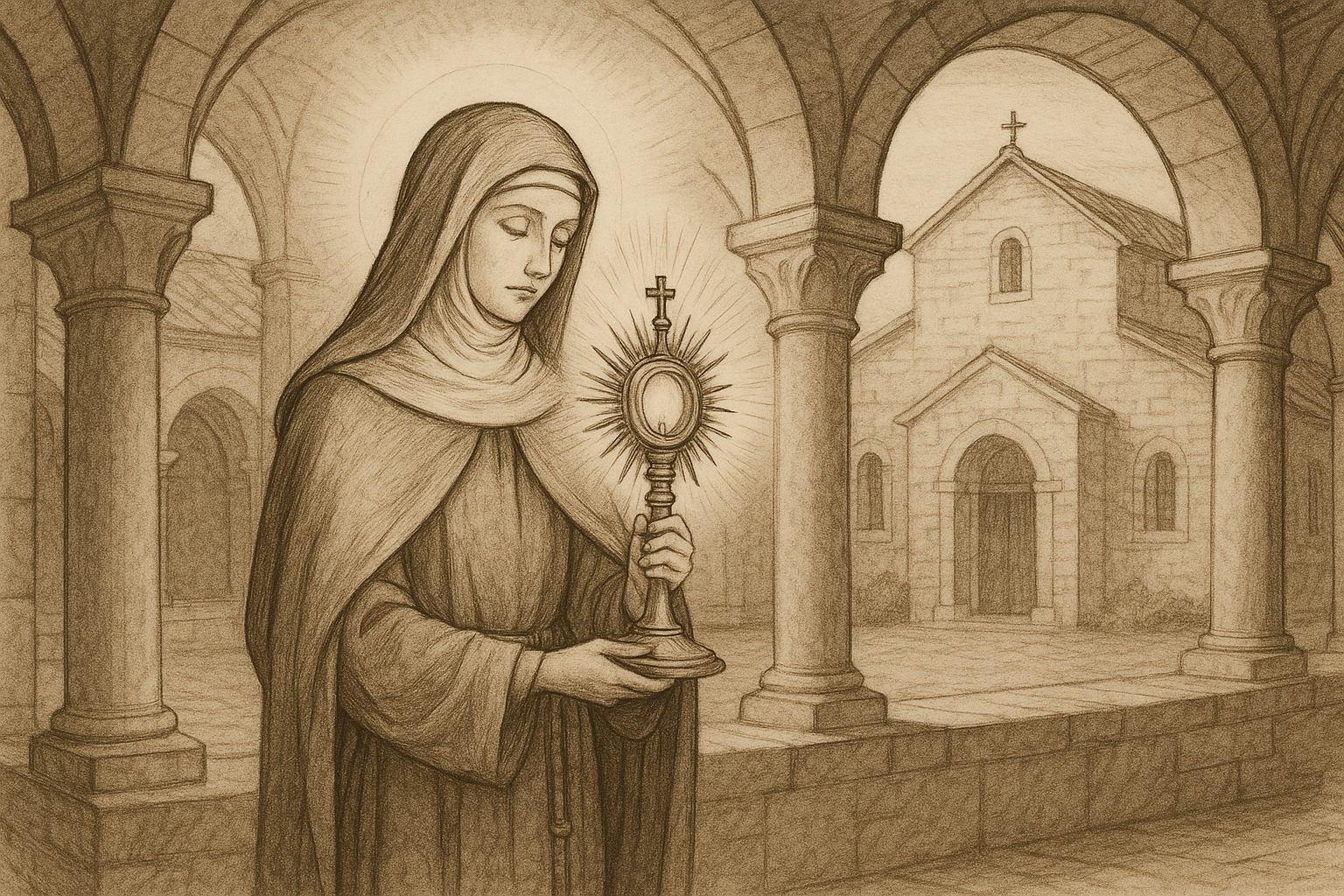
Her famous devotion to Christ present in the Eucharist is also part of her witness. A well-known tradition recounts that during a threat to the convent, Clare held up the Blessed Sacrament and asked for God's protection. Whether one focuses on the historical details or the spiritual meaning, the point is clear: Clare's confidence rested in Christ's nearness, not in human strength.
For Catholics, this offers an important reminder. Prayer is not a supplement to action. It is the source of Christian action. A life with God at the center can remain hidden and still shape the Church in lasting ways.
Clare's desire can be heard in the Psalmist's words: One thing I ask of the Lord, this I seek: to dwell in the house of the Lord all the days of my life.
Suffering, perseverance, and fidelity
Clare spent the later years of her life in poor health. She suffered physically for a long time, yet she remained faithful to her vocation. This detail matters because it reveals that her poverty was never merely a youthful ideal. She lived it to the end, in weakness as well as in strength.
Saints are often admired for their beginnings, but their endings may be even more instructive. Clare did not become less faithful when life became harder. She remained rooted in the same Christ whom she had chosen years earlier. That steadfastness is a form of witness many Catholics need today, especially in seasons when prayer feels dry or sacrifice feels prolonged.
Clare died in 1253 and was canonized shortly afterward. The speed of her canonization reflects the clarity of her reputation for holiness. The Church recognized in her a woman whose life pointed unmistakably to Christ.
What Catholics can take from Clare now
It is easy to admire St. Clare from a distance and leave her in the thirteenth century. But her life presses into ordinary Catholic life with real force. She invites believers to consider a few questions that remain urgent.
- Do I live as though Christ is enough, or do I quietly rely on possessions, control, and self-protection?
- Do I value prayer as the center of Christian life, or as something that can be postponed?
- Do I see hidden fidelity, especially in suffering, as a genuine form of holiness?
Clare does not ask Catholics to copy her exact form of life. Most people are not called to enclosure or to Franciscan poverty in the same way. But she does ask something universal: an undivided heart. Every Christian is called to let Christ take first place, to hold material things loosely, and to seek a freedom that the world cannot give.
Her witness also helps correct a common misunderstanding about holiness. Holiness is not always loud. It does not need public recognition to bear fruit. Clare's life was largely enclosed, yet it radiated far beyond the walls of San Damiano. In the Church, hidden lives can carry immense grace when they are united to Christ.
When Catholics remember Clare, they remember that poverty can become praise, that silence can become strength, and that a woman who belongs wholly to God can continue to guide the faithful centuries later. Her life remains a luminous sign that the Gospel is not diminished by renunciation. It is often made most visible by it.
If the world measures greatness by possession, Clare offers another scale. She teaches that a poor heart can be a strong heart, and that the soul who clings to Christ can remain free even when the body is weak and the circumstances are small.
Keep Reading on Lets Read The Bible
Frequently Asked Questions
Why is St. Clare of Assisi associated with poverty?
Clare embraced evangelical poverty as a deliberate way of following Christ more closely. She wanted her community to depend on God rather than on property or worldly security.
What is the main lesson Catholics can learn from St. Clare's life?
Clare shows that holiness grows from prayer, trust in Christ, and freedom from attachment to riches or control. Her life is a witness to undivided love for God.
Did St. Clare found the Poor Clares?
Yes. Clare gathered women who wanted to share her way of life, and her community became the foundation for what later came to be known as the Poor Clares.