Saints and Witnesses
St. Dominic and the Grace of a Life Set on Fire for the Word
A closer look at the friar who preached with clarity, poverty, and confidence in Christ.
Site Admin | April 30, 2026 | 93 views
St. Dominic life is often remembered in a few familiar images: a friar walking the roads of Europe, a man of prayer, a preacher with a clear mind and a poor heart, and the founder of a religious family devoted to the truth of the Gospel. Those images are accurate, but they only begin to tell the story. Dominic was not simply a skilled organizer or a gifted speaker. He was a man shaped by Scripture, compassion, repentance, and a deep trust that souls are converted not by force, but by grace.
His life still matters because the Church still needs what he lived: a love of truth that does not grow cold, a zeal for preaching that is rooted in prayer, and a readiness to give oneself for the salvation of others. In an age that can separate conviction from charity, Dominic offers a united witness. He preached because he believed Christ was worth proclaiming. He prayed because he knew preaching without prayer becomes noise. He embraced poverty because he wanted the messenger to resemble the message.
Born into a Church in need of renewal
Dominic was born in the late twelfth century in Castile, in present day Spain, near Caleruega. The world into which he was born was marked by political conflict, doctrinal confusion, and spiritual hunger. The Church was alive, but many regions needed stronger preaching and deeper formation. In that setting, Dominic received a solid Christian upbringing and later studied at Palencia. He became known not only for intelligence, but for mercy. A traditional story tells of him selling his books to help the poor during a famine. Whether remembered in every detail or not, the tale reflects a pattern consistent with his life: he did not treat learning as a possession to be guarded, but as a gift to be placed in service of love.
Before becoming a friar, Dominic served as a canon at Osma. That role mattered. It gave him a life of prayer, discipline, and liturgical order. It also taught him the value of the Church's common life. Dominic was never interested in novelty for its own sake. He wanted reform that remained obedient to the faith of the Church. His later work as a preacher grew from this foundation. He was not a wandering teacher inventing a private message. He was a servant of the apostolic faith, convinced that the truth already given in Christ needed to be spoken clearly and faithfully.
A journey that changed the direction of his mission
One of the decisive moments in Dominic's life came through his travels in southern France, where he encountered the Cathar heresy. The Cathars rejected core Christian teaching about creation, the sacraments, and the goodness of the material world. Dominic saw that argument alone would not be enough. People needed preachers who were humble, doctrinally sound, and visibly detached from wealth and status. He understood that a messenger who lived like the Gospel could better open hearts to the Gospel.
This insight shaped the rest of his mission. Dominic did not respond with anger or spectacle. He responded with preaching, prayer, and a radical simplicity of life. He and his companions traveled lightly, relying on alms and trusting divine providence. Their poverty was not a performance. It was a sign that the Kingdom of God could not be bought. In this, Dominic echoed the apostolic pattern found in the New Testament. Christ sent His disciples to preach with trust in God's provision, and Dominic wanted to recover that same apostolic freedom.
[[VERSE|matthew|10|7-10|Proclaim as you go, saying, the kingdom of heaven is at hand]]
Dominic's method was never separated from the Church's teaching authority. He wanted conversion, but not at the expense of truth. He wanted zeal, but not a zeal detached from communion. That balance makes his life especially useful for Catholics today. It reminds us that evangelization is neither aggressive debate nor vague encouragement. It is the patient, faithful presentation of Christ as the Church has received Him.
The founding of the Order of Preachers
Dominic's preaching mission eventually gave rise to what became the Order of Preachers, commonly known as the Dominicans. The order was approved by the Church in 1216. Its purpose was beautifully simple: to preach the Gospel, to study sound doctrine, and to live in community so that truth would be carried not by isolated individuals but by a shared apostolic life. This was not a retreat from the world. It was a disciplined way of entering the world's needs with clarity and mercy.
The Dominican charism joined contemplation and action in a striking way. Dominic wanted his friars to pray deeply and study seriously so that their preaching would be fruitful. He knew that human words have limited power unless they are formed by God's truth and supported by God's grace. That is why the Dominican tradition came to value Scripture, theology, and liturgy alongside apostolic labor. The friar preacher was meant to be a man who had first listened to God.
There is wisdom in that pattern for every Catholic, not only for religious men and women. Many people want to speak about the faith but have not yet learned to sit before the Lord. Others want to be active, but their activity becomes scattered. Dominic's example suggests a better order: prayer first, then study, then witness, then service. These are not separate lanes. They belong together.
Preaching that begins in prayer
Dominic's reputation as a preacher should not lead anyone to imagine that he relied on eloquence alone. He was known for spending long hours in prayer, often with tears. Tradition preserves the memory of his compassion for sinners and his grief over the loss of souls. That sorrow was not despair. It was the sorrow of a man who believed in the seriousness of salvation. He did not preach as though conversion were optional. He preached as though Christ truly saves.
This seriousness can sound severe to modern ears, yet Dominic's severity was joined to tenderness. He was said to show kindness in conversation and to encourage his companions with warmth. A true preacher, for him, was not a harsh scold. He was a witness whose life made the message believable. That is one reason his legacy remains important. The Church never needs less truth, but she always needs truth spoken in charity.
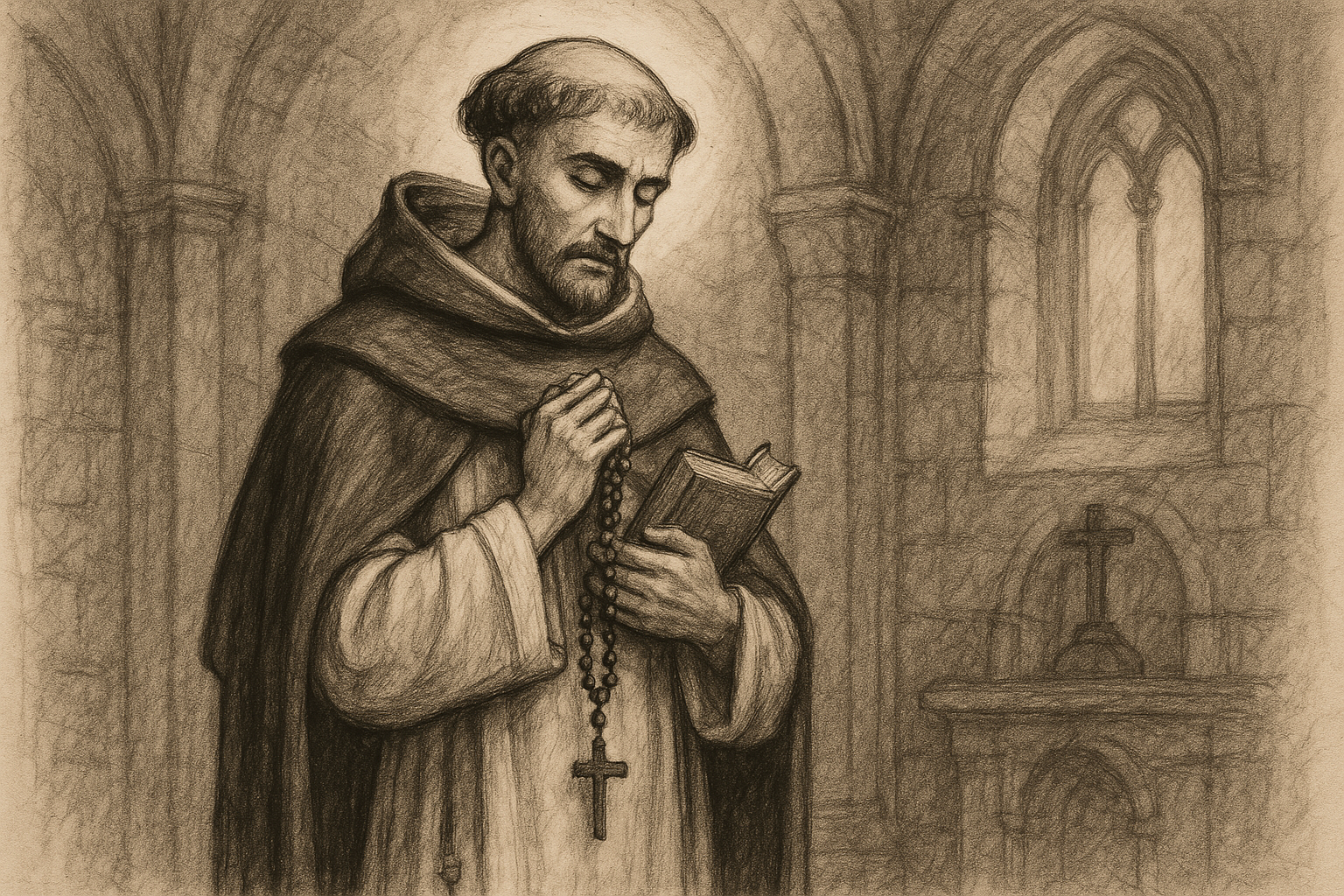
Dominic's preaching also had a Marian dimension. The Rosary, as later developed in Dominican tradition, became associated with contemplation of the mysteries of Christ through the prayers of the Church. Even where historical details are complex, the spiritual instinct is clear. Dominic wanted hearts fixed on Christ through prayerful repetition, meditation on the Gospel, and trust in the intercession of the Blessed Virgin Mary. That instinct remains fruitful for Catholics who seek a steady rhythm of prayer in a distracted age.
[[VERSE|romans|10|14-15|How are they to hear without someone to preach?]]
Holiness marked by humility and order
Dominic was not interested in being noticed. He was interested in souls. Accounts of his life consistently emphasize humility, simplicity, and perseverance. He traveled, organized, encouraged, corrected, and preached, but he did so as a servant. Even his leadership had a pastoral aim. He formed communities so that the work would endure beyond his own life. Great saints do not build around themselves. They build around Christ.
There is also a quiet strength in the way Dominic combined intellect and devotion. The Church has always needed scholars, but she has also needed scholars who kneel. Dominic understood that truth is not a cold abstraction. Truth is personal because Christ is personal. To love truth is to love Christ. To preach truth is to seek the salvation of real men and women, with their wounds, temptations, and hopes. That perspective kept his ministry from becoming merely academic.
His death in 1221 at Bologna was fitting for a man whose life had been poured out for the Gospel. By then the Order of Preachers had already begun to grow. The work would continue, not because Dominic controlled it, but because he had rooted it in a charism larger than himself. His life was brief by worldly standards, but abundant in fruit.
What St. Dominic teaches Catholics now
St. Dominic life offers more than historical interest. It gives Catholics a pattern for fidelity in ordinary circumstances. First, he shows that evangelization begins with a living relationship to Christ. If we are not prayerful, our witness will easily become anxious or self directed. Dominic's example calls us back to adoration, the sacraments, Scripture, and silence before God.
Second, he shows that truth and charity belong together. Catholics today are often tempted either to soften the faith until it says little, or to speak it sharply without tenderness. Dominic avoids both errors. He preached what the Church teaches and did so because he loved the people who needed to hear it. His life suggests that orthodoxy is not sterile when it is animated by mercy.
Third, Dominic reminds us that study is a form of service. Catholics who learn the faith more deeply are not merely collecting information. They are preparing to love better, answer more patiently, and witness more clearly. A well formed mind can become an instrument of peace. A shallow faith, by contrast, is easily shaken. Dominic's devotion to learning was never for prestige. It was for the Gospel.
Fourth, his poverty challenges our attachment to comfort. Most Catholics are not called to the same radical form of religious poverty, but all are called to detachment. If we cling to reputation, possessions, or control, our words about Christ lose weight. Dominic's freedom came from belonging first to God. That freedom made his preaching credible.
Finally, Dominic teaches perseverance. The Church's work is often slow. Conversion rarely happens on our timetable. Dominic lived in a time of doctrinal conflict and pastoral need, yet he did not give up on preaching. He trusted that God works through patient witness. That is a consoling lesson for anyone who prays for family members, serves in parish life, or feels discouraged by the slowness of reform.
Preach the word; be ready in season and out of season
Standing in the Dominican tradition with a Catholic heart
The Dominican family that grew from Dominic's vision has given the Church many saints, theologians, missionaries, and pastors. But the deepest legacy is not found only in famous names. It is found wherever Catholics pray, study, and speak of Christ with confidence and humility. Dominic's life remains a reminder that the Church is renewed when her members become more closely conformed to the Lord they proclaim.
For readers who want to imitate St. Dominic, the first step is simple: make room for God. Let prayer shape the day. Let Scripture sharpen the mind. Let charity soften the voice. And when there is a chance to speak of Christ, do so with reverence, courage, and peace. Dominic did not belong to himself, and that is precisely why his life still speaks so powerfully.
Keep Reading on Lets Read The Bible
Frequently Asked Questions
Who was St. Dominic in the Catholic Church?
St. Dominic was a thirteenth century Spanish priest and founder of the Order of Preachers, known for his deep prayer, poverty, and preaching against heresy with fidelity to Catholic doctrine.
What is St. Dominic best known for?
He is best known for founding the Dominican Order and for uniting preaching, study, and prayer in service of the Church's mission.
What can Catholics learn from St. Dominic life today?
Catholics can learn to pray more deeply, study the faith seriously, speak the truth with charity, and trust that conversion is the work of grace rather than human persuasion alone.