Saints and Witnesses
St. Joan of Arc: A Young Saint Who Would Not Yield
A clear look at Joan's life, her witness, and the courage that still speaks to Catholics today.
Site Admin | May 18, 2026 | 150 views
A life marked by grace and resolve
St. Joan of Arc remains one of the most striking figures in the history of the Church and of France. She was not a theologian, a religious superior, or a scholar. She was a peasant girl from Domremy who came to believe that God was calling her to a specific work in a troubled time. Her St. Joan of Arc life is remarkable not because it was long, but because it was wholly given.
Born around 1412, Joan grew up during the Hundred Years' War, when France was torn by conflict and uncertainty. As a child she was known for her piety, her devotion to the Mass, and her care for prayer. Later testimony and historical records show that she spoke of hearing voices and receiving guidance from saints. The Church has always treated such claims with caution, but Joan's own life and judgments must be read in the light of her steadfast faith, her obedience, and her desire to serve God above herself.
What stands out first is not spectacle, but simplicity. Joan belonged to a world of fields, villages, and ordinary labor. Yet she believed that the Lord could ask something demanding of her. That conviction, tested by years of uncertainty, became the center of her vocation.
The call to serve France and the Church
Joan's public mission began when she was still very young. She sought out local authorities and then the French dauphin, Charles, insisting that she had been sent by God to help lift the siege of Orleans and guide him toward his rightful coronation. To modern readers, this may sound improbable, even impossible. But Joan did not present herself as a strategist or a political expert. She presented herself as a servant under command.
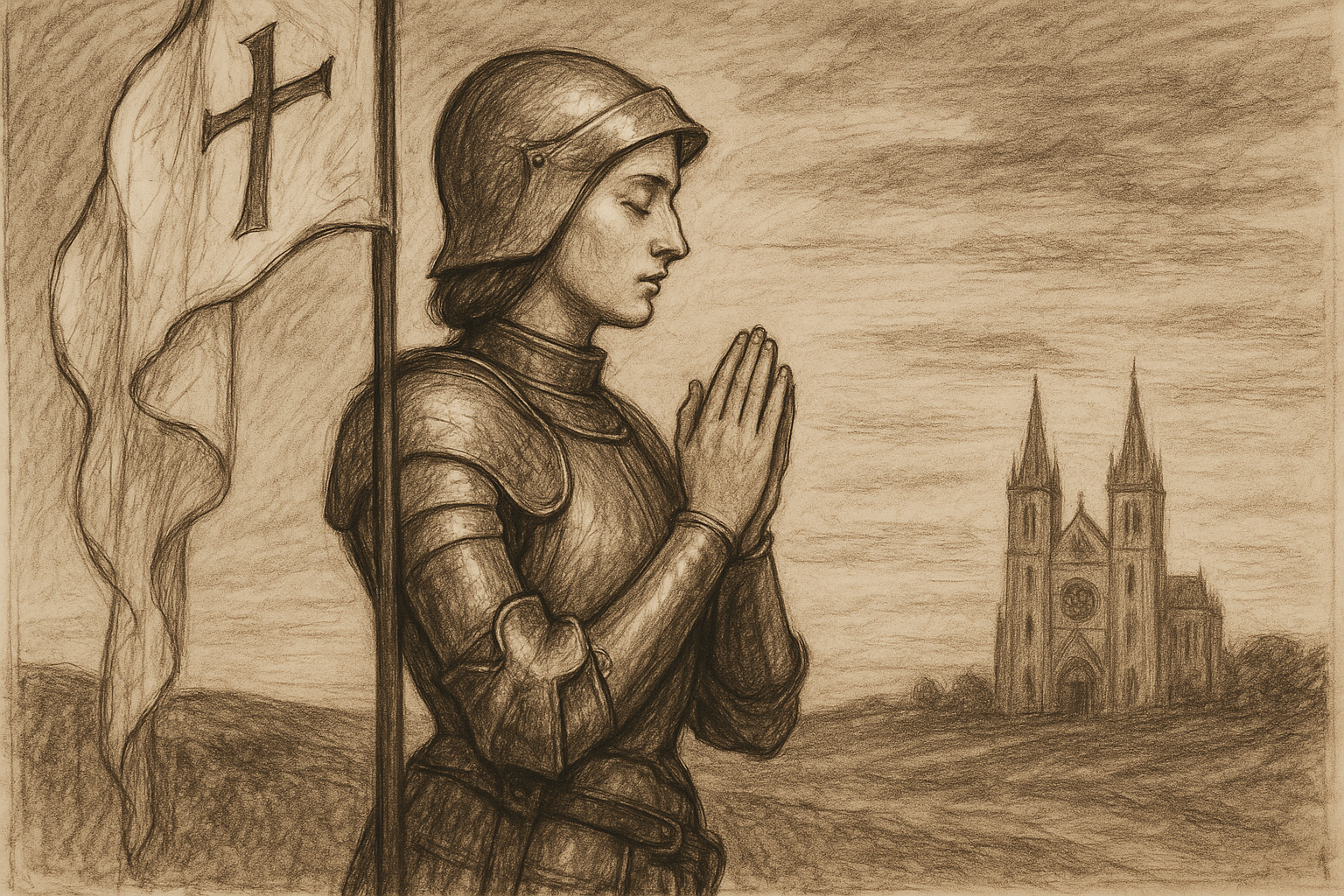
That distinction matters. Joan's life was not a claim to independence from the Church or from moral order. It was an act of obedience, however unusual the path. She prayed, fasted, went to confession, and received the sacraments. She asked that chaplains accompany the army. She carried a standard rather than a sword. Her presence was moral as much as military.
Her role in the French campaign became famous because it was effective. In 1429, the siege of Orleans was broken. That victory helped turn the war. Soon after, Charles was crowned at Rheims, fulfilling the task Joan had long pressed upon him. These events were interpreted by many as signs that God had not abandoned France.
Yet Joan did not become a worldly hero in the usual sense. She continued to speak as a believer who knew that success belonged to God, not to herself. In this, her witness is deeply Catholic. She acted decisively, but she did not place her trust in raw human power.
Prayer, discernment, and fidelity under pressure
It is easy to admire Joan only for her bravery in battle. But her greater witness may be the interior strength that made such bravery possible. She lived at a time when obedience to God could look foolish to others. She had no social standing to protect her, no education to defend her, and no public platform that guaranteed support. Her confidence came from prayer and from a conscience shaped by the life of faith.
The Church has long seen in the saints a union of courage and humility. Joan fits that pattern. She did not claim holiness for its own sake. She desired fidelity. She wanted to do what she believed the Lord had asked, even when powerful men disagreed or used her. That is one reason her story still touches Catholics. She shows that discernment is not merely a matter of thinking carefully. It is also a matter of being willing to obey when the path becomes costly.
Her trial later revealed the depth of her courage. Captured in 1430, Joan was handed over to an English-backed ecclesiastical court at Rouen. The proceedings were unjust in many respects, and she was questioned relentlessly about her voices, her clothing, her faith, and her authority. Again and again she answered with intelligence and composure. She was young, isolated, and under threat, yet she did not collapse into panic or deceit.
Joan's endurance before her judges shows a rare kind of witness: not noisy defiance, but steadfast truth under fire.
She was eventually condemned and burned at the stake in 1431. She was about nineteen years old. Her death was not the end of her influence. A later Church investigation reviewed the trial, and in time the injustice of her condemnation was formally addressed. She was canonized in 1920.
What her holiness looks like from a Catholic perspective
Joan of Arc is sometimes reduced to a national symbol or a military heroine, but Catholics remember her as something more profound. She is a saint because her life points to God. Her holiness was not built on comfort or human success. It was formed in prayer, tested in suffering, and purified by obedience.
There are several Catholic lessons woven through her story.
- Holiness can begin in hidden places. Joan was formed in a village, not a court.
- God can work through the young. Her age did not prevent grace from bearing fruit.
- True courage does not exclude reverence. Joan fought for her people while remaining devoted to the sacraments.
- Faithfulness may look costly in the short term. Joan lost her freedom and her life, yet her witness endured.
Her story also reminds Catholics that sanctity is not the same as safety. The saints often walk into misunderstanding. They may be doubted, mocked, or even condemned. But the measure of sanctity is not popularity. It is fidelity to God.
Joan's witness for Catholics today
Many Catholics know the temptation to think that holiness belongs to specialists, clergy, or people with unusually visible gifts. Joan disrupts that assumption. She was a laywoman. She was young. She lived in a violent era. Yet she listened for God's will and acted with seriousness. Her life asks each believer to consider where courage and obedience are needed now.
That might mean a student refusing to hide the faith. It might mean a parent protecting prayer in the home. It might mean a worker choosing integrity when compromise would be easier. It might mean remaining faithful to the Church even when the surrounding culture treats belief as naïve. Joan did not live in a time of comfort. Still, the inner questions were familiar: Will I obey God when others disagree? Will I keep my conscience clear? Will I trust grace more than fear?
Her example is especially valuable because it joins action with devotion. Joan did not separate public duty from spiritual life. She prayed before she acted. She sought the sacraments. She believed that visible work should be ordered to God. For Catholics today, that balance is a strong corrective to both passivity and self-reliance.
The Church does not ask believers to imitate Joan by repeating her historical role. It asks them to imitate her faith, her purity of intention, and her courage. That can mean accepting misunderstood callings with patience. It can mean speaking truth without bitterness. It can mean serving the common good without losing sight of heaven.
A saint for ordinary people who are asked to be brave
St. Joan of Arc life shows that God can raise up a witness from the most unexpected place. A country girl became a commander. A teenager became a martyr. A condemned prisoner became a saint whose name still inspires prayer and resolve centuries later.
For Catholics, that is not just a story of history. It is a reminder that the Lord still calls ordinary people to extraordinary fidelity. Most of us will never face a battlefield or a tribunal. But all of us face moments when fear, compromise, or silence seem easier than truth. Joan's life does not remove those fears. It gives them a different measure. If God could strengthen a young woman to stand firm in such a moment, then His grace is still able to sustain His people now.
In that sense, Joan remains close to the Church not because she was distant and legendary, but because she was human, prayerful, and available to God. Her courage was not self-made. It was received. And that is why her witness still speaks with force.
When Catholics ask what it looks like to belong to Christ without reserve, Joan of Arc offers an answer that is brief, bright, and enduring.
Keep Reading on Lets Read The Bible
Frequently Asked Questions
Was St. Joan of Arc a nun or a religious sister?
No. Joan of Arc was a laywoman. She remained in the world and served God in the midst of public events, military action, and political upheaval.
Did the Church fully support Joan of Arc during her trial?
No. Joan was tried by an ecclesiastical court in a process that was deeply flawed and unjust. Her condemnation was later revisited, and the injustice of the original trial was addressed by the Church.
What is the main Catholic lesson from Joan of Arc's life?
Her life shows that holiness is possible through prayer, obedience, courage, and fidelity to conscience, even when a person is young, misunderstood, or under pressure.