Saints and Witnesses
St. Maximilian Kolbe and the Courage to Belong to Christ
A Catholic meditation on sacrifice, Marian devotion, and the quiet strength that still speaks through one martyr's life.
Site Admin | May 15, 2026 | 140 views
St. Maximilian Kolbe is remembered above all for the final gift of his life in Auschwitz, when he offered to die in place of another prisoner. That act is so dramatic that it can overshadow the long preparation behind it. Yet the power of his witness lies precisely there. He did not become holy in a single instant. He was formed by prayer, discipline, Marian devotion, missionary zeal, and a steady desire to belong completely to Christ.
For Catholics, that is one reason the St. Maximilian Kolbe Catholic inspiration remains so enduring. His life shows that martyrdom was not a strange interruption to his vocation. It was the final expression of a life already given over to God. He reminds the faithful that sanctity is built in ordinary fidelity long before it is tested in extraordinary suffering.
A Saint Shaped by Faith and Mission
Born in 1894 in Poland, Raymond Kolbe entered the Conventual Franciscans and took the name Maximilian. He lived during a time of great upheaval, when Europe was marked by war, political violence, and growing hostility to the faith. Rather than retreat into fear, he became a tireless apostle of the Gospel.
He loved evangelization, especially through the means available to him in his age. He used print, preaching, and organization to spread devotion to the Blessed Virgin Mary and to call people back to Christ. He founded the Militia of the Immaculata, a movement dedicated to winning souls for Jesus through Mary. His missionary instinct was not sentimental. It was practical, courageous, and rooted in a deep conviction that grace could reach even the most wounded places.
Kolbe also understood that modern people do not always reject truth because they have studied it and found it lacking. Often they are simply distracted, isolated, or wounded. His apostolic efforts met people where they were. He believed that the Church should speak clearly, use every honest means available, and trust God with the fruit. That lesson still matters for Catholics who want to witness with both conviction and charity.
His Marian Devotion Was Not an Escape from Christ
One of the most important things to understand about St. Maximilian Kolbe is that his devotion to Mary was deeply Christ-centered. In Catholic life, true Marian devotion never competes with Christ. It leads to Him. Kolbe's love for the Immaculate Conception was a way of surrendering himself more fully to the Lord who saves through grace.
He believed that Mary's role was to form Christians who are more available to God. That insight is beautifully Catholic because it recognizes that holiness is not self-generated. We are made holy by grace, received in humility, and nurtured in the life of the Church. Kolbe's Marian spirituality helped him live with confidence, not self-reliance.
This is one reason his witness remains fruitful today. Many Catholics struggle to think of devotion as something strong and active. Kolbe shows another way. Devotion can strengthen the will, clarify the mind, and train the heart for sacrifice. It does not make a person passive. It makes a person available.
"The Immaculata is our heavenly Mother. Let us belong to her entirely, so that she may lead us to Jesus."
Whether one knows his writings closely or only his life story, the pattern is clear. He trusted that a soul given to Mary would become more ready for Christ's mission. That is not an abstract spirituality. It is a disciplined way of living that shapes habits, speech, priorities, and courage.
The Final Act Was Born from a Lifetime of Offering
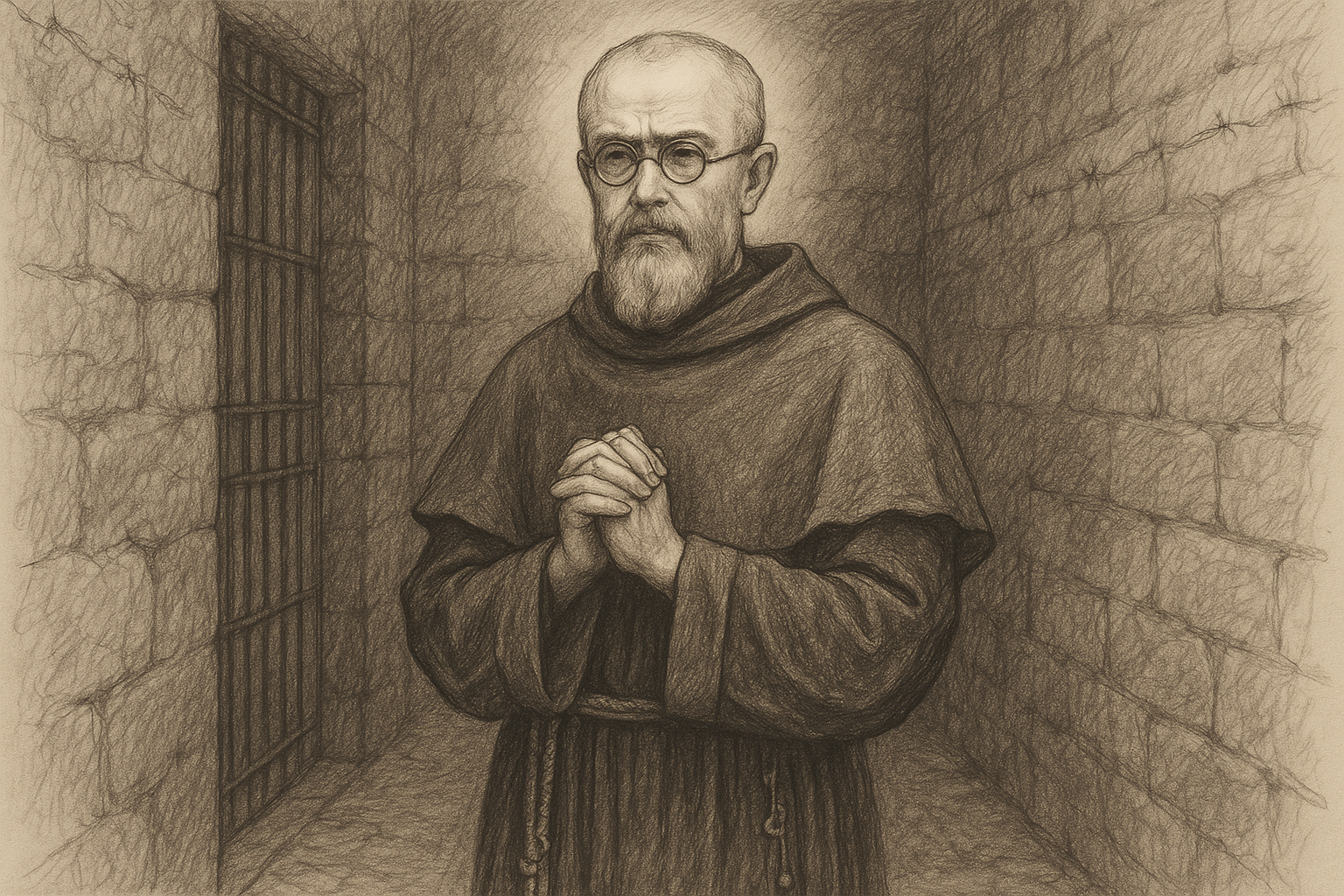
In the prison camp at Auschwitz, after a prisoner escaped, the Nazis selected men to die in retaliation. Kolbe stepped forward to take the place of a husband and father who had been chosen. The man he replaced survived the war. Kolbe endured a long final period of deprivation and then was killed by lethal injection on August 14, 1941.
This was martyrdom in the fullest Christian sense. He did not merely accept death with calm resignation. He made an intentional act of charity. He offered his life for another. In that moment, the Gospel became visible in a way few images ever can.
Christians recognize something familiar here. Jesus said, "Greater love has no man than this, that a man lay down his life for his friends" John 15:13. Kolbe's act does not replace Christ's sacrifice. It participates in its logic. His death points back to the Lord who first gave Himself for us. In that sense, his witness is both terrible and consoling. It reveals what grace can do in a human soul.
It is also important not to romanticize suffering. Kolbe did not seek pain for its own sake. Catholic faith never treats death as noble simply because it is hard. What makes his sacrifice holy is love. He freely surrendered himself in an act shaped by charity, courage, and trust in God.
Why His Witness Still Reaches Catholics Today
St. Maximilian Kolbe speaks to modern believers because his life answers several deep anxieties at once. He shows that holiness is possible in a noisy age. He shows that a Catholic can be intellectually serious and spiritually tender. He shows that courage is not the absence of fear, but fidelity under pressure.
His witness also speaks to Catholics who feel small in the face of cultural hostility. Kolbe did not possess worldly power. He had convictions, a clear sense of mission, and the willingness to suffer for truth. That combination is often enough for sanctity. The Church does not need every saint to be famous, influential, or protected from hardship. It needs witnesses who remain faithful.
There is also a healing dimension to his example. Many people today carry a quiet sense of powerlessness. They see suffering in the world and wonder whether love can really matter. Kolbe answers with his life. Love matters because it is real. Sacrifice matters because it is united to Christ. A hidden act of charity may never make the news, but it can still change eternity.
His witness is especially compelling for parents, priests, religious, catechists, and anyone who teaches the faith. He reminds them that words gain credibility when they are backed by a life of integrity. The Church has always known that martyrs evangelize not only by what they say, but by what they are willing to endure for the truth.
Three concrete lessons from his life
- Start with ordinary fidelity. Kolbe's final act was prepared by years of prayer, obedience, and apostolic work.
- Let devotion lead to mission. His Marian spirituality did not turn inward. It pushed him outward in service of souls.
- Believe that charity is stronger than fear. His sacrifice in Auschwitz shows that love can remain free even in the darkest place.
Kolbe and the Catholic Vision of Freedom
Modern culture often defines freedom as the ability to choose anything without constraint. Kolbe points to a different and more demanding vision. In the Catholic sense, freedom is fulfilled when it is given to the good. A person is most free not when he clings to himself, but when he can love without reserve.
That is why martyrdom can seem so paradoxical. To the world, surrender looks like defeat. To the Church, self-offering in Christ is a victory of love over fear, cruelty, and despair. Kolbe's death illustrates this beautifully. The Nazis could imprison his body, but they could not force him to stop being a disciple.
This matters for everyday Catholic life too. Most believers will never face a martyr's death. But every Christian faces small tests of freedom: patience under insult, fidelity in family life, honesty in work, courage in confession, and perseverance in prayer. Kolbe's witness tells us that these hidden choices prepare the soul for larger ones. Holiness is built through repeated acts of surrender.
He also reminds us that the Church's martyrs are not relics of a distant age. They are alive in the communion of saints. Their lives continue to teach, strengthen, and correct us. When Catholics ask what it means to love Christ in a difficult time, St. Maximilian Kolbe answers with clarity: belong to Him, trust Him, and do not withhold yourself.
That is a demanding path, but it is also a beautiful one. His life asks not whether suffering will come, but whether love will remain when it does. For that reason, his memory continues to draw Catholics back to the heart of the Gospel, where grace and sacrifice meet, and where a human life can become a testimony that still speaks long after the prison gates have closed.
Keep Reading on Lets Read The Bible
Frequently Asked Questions
Why is St. Maximilian Kolbe important to Catholics?
He is important because his life shows how Marian devotion, missionary zeal, and sacrificial love can come together in a single Catholic witness. His martyrdom at Auschwitz makes the Gospel of self-giving love visible in a powerful way.
Was St. Maximilian Kolbe a martyr in the Catholic sense?
Yes. The Church honors him as a martyr because he freely offered his life in an act of charity during Nazi imprisonment. His death was the fruit of a deliberate sacrifice for another man.
What can ordinary Catholics learn from St. Maximilian Kolbe?
His life teaches that holiness grows through daily prayer, obedience, and courage in small things. He shows that real Christian freedom is found in giving ourselves to Christ and serving others with trust.