Saints and Witnesses
St. Padre Pio and the Quiet Force of a Holy Life
A Capuchin friar, confessor, and stigmatist whose ordinary fidelity still draws Catholics toward prayer, repentance, and trust in grace.
Site Admin | May 26, 2025 | 81 views
St. Pio of Pietrelcina, better known as Padre Pio, has a way of staying close to the Catholic imagination. Some saints are admired from a distance. Padre Pio feels different. His life was marked by prayer, hidden suffering, fidelity to the Church, long hours in the confessional, and a striking attachment to the Holy Eucharist. He was not a saint of polished impressions. He was a friar whose holiness came through endurance, discipline, and surrender to grace.
That is part of the reason St. Padre Pio Catholic inspiration remains so strong. Catholics do not merely remember him for extraordinary signs, though his stigmata and reported miracles drew attention during his lifetime. They remember him because he pointed insistently to the ordinary means by which God transforms souls: confession, Mass, prayer, penance, obedience, and trust in Christ. In a culture that often asks for novelty, Padre Pio continues to remind the faithful that sanctity is still possible where the Church has always said it is found.
A Capuchin friar shaped by prayer and trial
Padre Pio was born Francesco Forgione in 1887 in Pietrelcina, a small town in southern Italy. He entered the Capuchin Franciscans as a young man and took the name Pio. Like many saints, he did not begin with public fame. His early life was marked by illness and weakness, and this physical fragility remained with him throughout much of his life. Yet it was in that weakness that his priestly vocation matured.
He was ordained in 1910 and eventually lived at San Giovanni Rotondo, where much of his ministry unfolded. There he became known for intense prayer, austere discipline, and a deep seriousness about sin and conversion. His life also drew scrutiny. Reports of supernatural phenomena surrounding him inspired devotion, but they also led to investigations and restrictions. For years he lived under close observation and was at times limited in the exercise of his public ministry.
That history matters because it shows that Padre Pio was not simply a personality or a devotional figure detached from the Church. He lived within the concrete, sometimes difficult life of ecclesial obedience. Catholic holiness is never just intensity of feeling. It is faith lived under authority, in the light of the sacraments, and within the Church Christ founded.
Confession at the center of his ministry
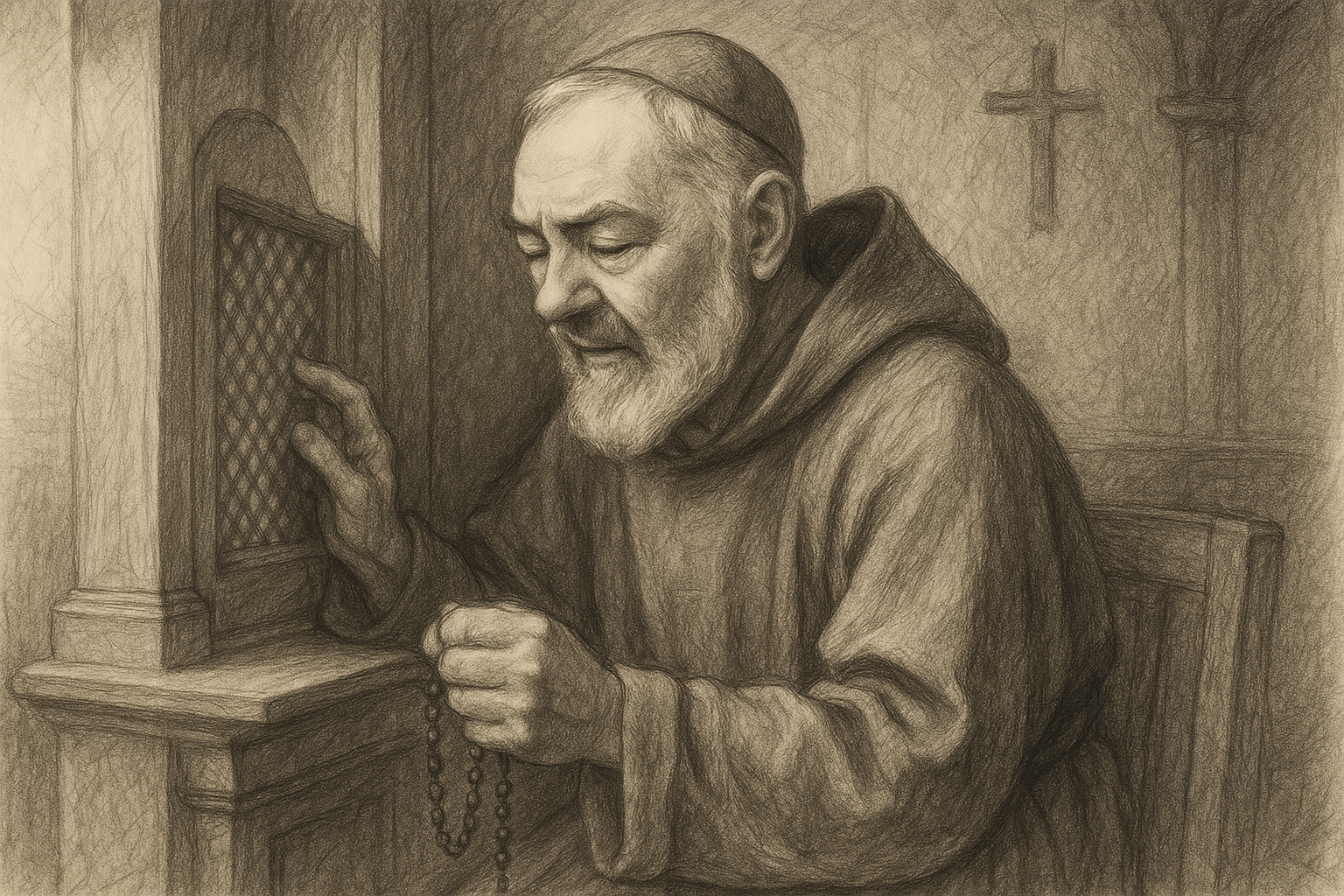
If one theme defines Padre Pio for many Catholics, it is confession. He spent long hours in the confessional, listening, correcting, absolving, and urging penitents toward serious conversion. People came to him because they sensed he saw beyond appearances. He was known for probing questions, direct spiritual advice, and a refusal to treat sin lightly. This could make him seem severe, but severity is not the same as lack of mercy.
In fact, his ministry reflected a deeply Catholic conviction: the Sacrament of Penance is not a burden added to Christian life, but a gift by which Christ restores the sinner. Padre Pio understood that confession is not merely a psychological release. It is an encounter with divine mercy mediated through the Church. For Catholics weary of vague spirituality, his witness is bracing. He points to the truth that grace heals us through repentance, not around it.
"Confession is the soul's bath. Even a linen handkerchief becomes dirty if it is not washed often. How much more does the soul need to be cleansed by the Blood of Christ."
That image, often attributed to him in devotional collections, captures a central instinct of his preaching: sin is real, but so is mercy. The Christian life is not about pretending to be clean. It is about allowing Christ to cleanse us again and again.
His suffering was not wasted
Padre Pio is remembered for the wounds of Christ, the stigmata, which he bore for decades. Catholics do not claim that suffering is good in itself. The faith does not romanticize pain. But in Christ, suffering can become united to redemption. That is one reason the saints matter so much. They show that pain need not become meaningless, bitterness, or self-pity. Joined to the Cross, it can become an offering.
Padre Pio endured physical pain, misunderstanding, and criticism. He also bore the hidden burden of being watched, questioned, and, at times, isolated. Yet his response was not rebellion. He remained rooted in prayer and the sacraments. This is one of the most persuasive aspects of his witness. Many people are attracted to heroic holiness when it looks triumphant. Padre Pio reminds us that holiness often looks like patience, fidelity, and continued trust when nothing seems to be resolved.
For Catholics who suffer chronic illness, family strain, loneliness, or discouragement, his life can be a quiet consolation. It says that God is not distant from pain. He is able to unite it to Christ if we hand it over in faith.
Why his witness still feels immediate
There are many reasons Padre Pio continues to inspire. One is that he speaks to a modern hunger for authenticity. Catholics can sense when piety is decorative. Padre Pio did not seem decorative. He prayed hard, fasted seriously, heard confessions endlessly, and spoke bluntly about the need for conversion. Even his admirers often note that he was not easy. But perhaps that is part of his gift. He refuses the idea that holiness is softness without truth.
Another reason is that he makes the spiritual life concrete. He did not recommend vague optimism. He recommended daily Mass when possible, frequent confession, the rosary, obedience, and trust. These are not dramatic tools. They are the ordinary instruments of sanctification. Yet in his hands, they become luminous. He shows that the Catholic life does not need to be redesigned. It needs to be lived.
He also gives Catholics a way to think about spiritual warfare without superstition. Padre Pio often warned people to cling to Christ and reject fear. He knew that temptation is real, but he did not treat the devil as a spectacle. Instead, he returned constantly to prayer, penance, and the sacraments. This balance is important. Catholic devotion should not become fascination with darkness. It should become confidence in the victory of Christ.
What his life teaches about obedience
It is easy to admire a saint who seems powerful. It is harder to value a saint who submits. Yet Padre Pio's obedience is one of the most significant parts of his witness. He did not choose the Church from afar. He belonged to her concretely, and at times painfully. Restrictions were placed on his ministry, and he accepted them. That kind of obedience is not passive weakness. It is a form of trust that God is at work even when human circumstances are frustrating.
For Catholics today, obedience can sound unfashionable. We often prefer self-direction and personal spiritual branding. But Padre Pio's life suggests that holiness grows where the soul yields to God through the Church's sacramental life and pastoral order. Obedience does not eliminate personality. It purifies it. It makes room for grace to act without our need to manage everything.
This is one of the deepest reasons he remains compelling. He shows that a saint can be both forceful and submissive, intense and surrendered, exacting and merciful. Those qualities are not contradictions when they are rooted in Christ.
Devotion without sentimentality
Many Catholics love Padre Pio because he makes devotion feel serious again. His example can cut through the temptation to reduce religion to comfort. He reminds believers that devotion has shape, cost, and discipline. Prayer is not merely soothing. It is transformative. Confession is not merely reassuring. It is liberating. The Eucharist is not merely symbolic. It is the living center of Christian life.
At the same time, his life is not a call to harshness. Padre Pio's severity was ordered toward mercy. His aim was always conversion and healing. The saints do not magnify themselves. They make Christ visible. In that sense, the strongest thing about Padre Pio is not his notoriety, but his transparency. He points beyond himself to Jesus Christ, who alone can save.
That is why his witness endures. He is a saint for Catholics who need more than encouragement. He is a reminder that the path to holiness is still open, still sacramental, and still marked by the mercy of God. In an age that doubts both sin and grace, Padre Pio stands as a sober friend of the soul, calling each person back to the confessional, back to prayer, and back to Christ.
Small ways to receive his witness
- Make a sincere and regular confession, even when it feels difficult.
- Set aside time each day for quiet prayer, especially the rosary.
- Offer suffering, inconvenience, or disappointment to Christ instead of resisting it in bitterness.
- Ask for a deeper love of the Mass and the Eucharist.
- Practice obedience in small daily choices, especially when they cost pride.
Padre Pio's life does not ask Catholics to imitate his particular gifts. It asks them to imitate his surrender. That is a path the Church has always known, and it remains open in every generation.
Keep Reading on Lets Read The Bible
Frequently Asked Questions
Why is St. Padre Pio so closely associated with confession?
Because he spent many years hearing confessions and urging people to repentance with seriousness and mercy. Catholics often remember him as a confessor who helped souls return to grace through the sacrament.
What makes Padre Pio's witness appealing to Catholics today?
He joined clear teaching, sacramental life, prayer, and suffering into a concrete example of holiness. Many Catholics find his life credible because it is rooted in ordinary Catholic practice, not spiritual trendiness.
Did Padre Pio's suffering have spiritual meaning in Catholic teaching?
Catholic faith teaches that suffering, when united to Christ, can become part of a person's offering to God. Padre Pio's life is often seen as an example of that truth lived with patience and trust.