Family and Vocation
Marriage, Grace, and the Long Fidelity of Ordinary Days
In the sacrament of marriage, Catholic life meets daily love, daily sacrifice, and daily mercy.
Site Admin | October 26, 2025 | 88 views
Marriage as a sacrament is more than a blessing on a wedding day
In the Catholic perspective, marriage as a sacrament is not simply a religious layer added to an otherwise ordinary arrangement. It is a holy covenant that belongs to the life of the Church. When a man and a woman freely give themselves to one another in marriage, the Church sees more than a legal contract or a beautiful ceremony. She sees a sign that points to Christ and His love for His Bride, the Church. That sign is not only symbolic. It is effective. God truly gives grace through it.
Scripture begins with the mystery of man and woman in creation. In Genesis, God forms humanity male and female and blesses their union. The first pages of the Bible already show that human love is meant to be ordered toward communion, fruitfulness, and gift. Later, Jesus confirms the dignity of marriage when He speaks of the union of husband and wife as something God has joined together: What God has joined together It is a sober and beautiful reminder that marriage is not made merely by human desire, but received as part of God's design.
For Catholics, this design becomes sacramental because Christ raised marriage to a new dignity. He did not abolish the natural goodness of marriage. He fulfilled it. In Christian marriage, spouses are called to be signs of a love that is faithful, fruitful, and enduring. That call is both beautiful and demanding, because it is no small thing to love another person with consistency over a lifetime. The sacrament exists precisely because human love needs healing, strengthening, and elevation.
The shape of sacramental love
Marriage as a sacrament teaches that love is not only a feeling. Feelings matter, but they cannot bear the whole weight of a covenant. Catholic marriage asks for a decision renewed over time: to remain faithful, to seek the good of the other, to forgive, to endure, to serve, and to pray. This is why the sacrament speaks so clearly to ordinary life. It does not belong only to grand ceremonies or anniversaries. It belongs to morning routines, difficult conversations, financial strain, parenting fatigue, sickness, misunderstandings, and the quiet work of staying kind.
St. Paul gives one of the most profound passages on marriage in Ephesians, where he compares the love of husband and wife to the love of Christ and the Church: Christ loved the Church That comparison is not poetic exaggeration. It is the measure of Christian marriage. Husbands are called to sacrificial love. Wives are called to faithful, generous self-gift. Both are called to reverence Christ in one another. The passage does not flatten the difference between spouses, nor does it turn marriage into a mere spiritual metaphor. Instead, it shows that Christian marriage participates in the self-giving love that flows from the Cross.
Because marriage is sacramental, grace is not an extra decoration. Grace is the hidden strength that makes fidelity possible. A couple may begin with affection, trust, and joy, but over time they will face weakness, disappointment, and the limits of personality. The sacrament does not pretend these things are absent. It gives spouses what they need to live through them with faith. That is one reason the Church speaks of marriage as a vocation. It is a path of holiness, not an escape from holiness.
Daily grace in the midst of real struggle
Many people are surprised by how much effort it takes to remain gentle in marriage. The promise is made in a moment, but the covenant must be lived over decades. The practical struggles are familiar: communication that breaks down, habits that irritate, wounds from the past, differing temperaments, disappointment about money or children or work, and seasons when prayer feels dry. None of these realities means marriage is failing. They mean marriage is being lived in the world as it is, not as we imagine it should be.
The Catholic view does not minimize these burdens. Instead, it places them under grace. A sacramental marriage is not a guarantee of an easy life. It is a promise that God is present in the struggle. Spouses are not expected to manufacture sanctity from sheer willpower. They are invited to receive it. That can begin in small ways: a patient reply, a decision to listen again, a willingness to apologize first, or the humility to ask for help when conflict has become too heavy.
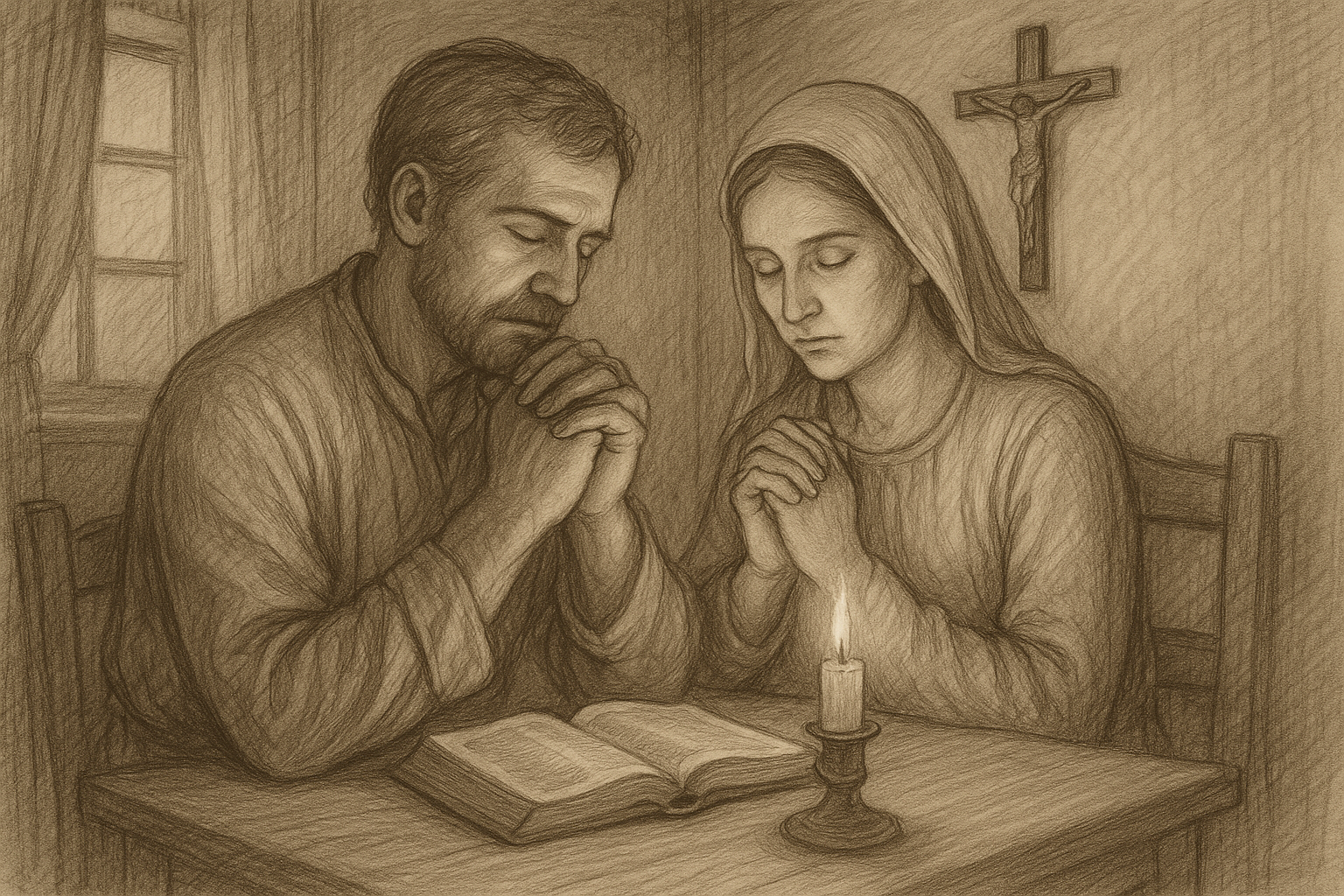
Prayer matters here in a very concrete way. Couples often discover that they cannot solve every problem by talking alone, because some difficulties are moral and spiritual before they are practical. Anxiety can harden into control. Resentment can become a way of protecting the heart. Pride can make reconciliation feel impossible. In those moments, prayer becomes a work of surrender. Even a brief prayer before a hard conversation can remind spouses that they belong first to God and only then to one another. That order protects marriage from becoming possessive or self-enclosed.
The sacrament of marriage does not remove human weakness. It meets weakness with grace, so that love can keep becoming what it was meant to be.
Forgiveness is one of the clearest places where sacramental grace becomes visible. Every marriage includes offenses, large and small. Some are careless words. Others are deeper wounds. Christian spouses do not forgive because the hurt was harmless, but because they have first been forgiven by Christ. The Lord's Prayer places this truth before every believer: Forgive us our trespasses Marriage becomes more livable when spouses remember that forgiveness is not a sign that sin does not matter. It is a sign that mercy matters more than resentment.
Fruitfulness, openness, and the wider life of the Church
Marriage is sacramental not only because it sanctifies the spouses, but because it serves the life of the Church and the world. Catholic teaching holds that marriage is naturally ordered toward the good of the spouses and the generation and education of children. That does not mean every marriage will be blessed with children in the same way or at the same time. It does mean that marital love is meant to be open, generous, and not closed in on itself.
This fruitfulness also takes forms beyond biological parenthood. Some couples are called to foster, mentor, serve, or offer hospitality in ways that make their home a place of welcome. Others carry the hidden cross of infertility or childlessness with great sorrow. The Church does not ask such couples to pretend the ache is small. She asks them to unite it to Christ, who also knew longing and offered His life in love. Their marriage remains fruitful when it becomes a channel of prayer, service, and mutual sanctification.
Children, when they are given, are not possessions. They are gifts entrusted to the spouses. Christian parents therefore see their marriage as a domestic church, a place where faith is learned in ordinary ways. A child learns about God not only from lessons or catechism classes, but from the patience of parents, the peace of an apology, the steadiness of an evening prayer, and the habit of returning to one another after strain. In that sense, the sacrament extends beyond the couple. It becomes a small school of communion for the whole household.
Marriage and the cross are never far apart
It is tempting to speak of marriage only in terms of romance, companionship, or family life. Those are real goods, but the Cross must remain close to the center of Catholic reflection. Jesus does not ask spouses to avoid sacrifice. He teaches them how to sanctify it. When a husband or wife chooses fidelity in difficulty, there is a real participation in Christ's own offering. This does not romanticize pain, and it certainly does not excuse abuse, injustice, or manipulation. The Church is clear that no one is obliged to endure harm as if harm were love. But when the ordinary demands of self-gift weigh heavily, grace can transform them into a place of union with the Lord.
That is why the sacrament has both joy and discipline. It calls for chastity, not as a rejection of desire, but as the ordering of desire toward the good. It calls for permanence, not as a prison, but as the freedom to be faithful. It calls for tenderness, not as sentimentality, but as the deliberate choice to treat the other as sacred. When this vision is lived well, marriage becomes a witness to the world that love is not disposable and commitment is not naive.
At times, even faithful couples may wonder whether their efforts matter. The answer is often hidden in the slow work of grace. A marriage may not look dramatic from the outside, but its hidden acts of patience, mutual service, and shared prayer can shape a family for generations. The holiness of marriage is often quiet. It is found in meals prepared, burdens carried, tears shared, and tempers softened. It is found in choosing one another again after disappointment, and in trusting that God is present even when feelings are thin.
Living the sacrament in ordinary time
The Catholic perspective on marriage is not an ideal placed far above real life. It is a path walked in real time, with ordinary schedules, difficult habits, and real grace. Spouses grow by returning again and again to the sources of that grace: the Eucharist, Reconciliation, prayer, Scripture, and the concrete practice of charity at home. The sacrament does not replace human effort. It makes human effort fruitful.
For engaged couples, this means preparation should go beyond planning the wedding. It should include asking what kind of life the marriage is meant to form. For married couples, it means every season can become an invitation to deeper fidelity. For those who are wounded by marriage, widowed, divorced, or longing for a spouse, it means the Church does not reduce their vocation to one status alone. She honors the many ways God's grace works in human life. Still, for those called to this covenant, marriage remains a luminous and demanding sign: a promise that Christ can dwell in the home, in the silence, in the arguments, and in the healing.
In the end, marriage as a sacrament Catholic perspective is not about perfection. It is about participation. Two baptized persons are drawn into the life of Christ and into each other's salvation in a daily, embodied way. The promises spoken before the altar continue long after the flowers fade. And when spouses let grace shape the smallest choices, the sacrament remains alive in the world as a witness that love can endure, forgive, and grow.
Practical habits that help grace take root
- Pray together, even briefly, so that God remains at the center of the home.
- Practice prompt forgiveness before resentment becomes a pattern.
- Speak plainly and gently, especially in moments of stress.
- Make Sunday Mass a shared priority, not an optional extra.
- Offer small acts of service without keeping score.
Keep Reading on Lets Read The Bible
Frequently Asked Questions
What makes marriage a sacrament in the Catholic Church?
Marriage is a sacrament because Christ raised the natural covenant between baptized man and woman to a sign that truly conveys grace. It points to His faithful love for the Church and strengthens spouses for holiness, fidelity, and fruitful love.
Does sacramental grace remove the hard parts of marriage?
No. Grace does not remove weakness, conflict, or suffering. It helps spouses meet those realities with patience, forgiveness, prayer, and perseverance so that the marriage can grow in holiness.
How can a married couple live the sacrament more fully each day?
By praying together, receiving the sacraments, forgiving quickly, serving one another concretely, and treating ordinary responsibilities as part of their vocation. The sacrament becomes more visible when daily life is shaped by charity.