Sacraments and Liturgy
Walking the Days of Redemption: A Catholic Way to Enter Holy Week
Holy Week is not only remembered by the Church. It is entered, prayed, and lived as the Paschal Mystery draws near.
Site Admin | September 16, 2025 | 81 views
Holy Week stands at the heart of the Church year because it brings us to the center of the Christian faith: the Passion, death, and resurrection of Jesus Christ. This is not merely a season of remembrance. The Church does not treat these days as a historical reenactment or a spiritual mood. She leads her children into the saving events themselves, so that we may worship, repent, keep watch, and receive grace with renewed attentiveness.
For many Catholics, Holy Week arrives with a certain tension. Life remains busy, schedules do not disappear, and the demands of work or family do not pause. Yet the Church asks us to move differently now. She invites us to slow our pace, listen more closely, and let the liturgy shape our hearts. A good Holy Week Catholic guide should do more than explain the calendar. It should help ordinary believers recognize the sacred rhythm of these days and respond with faith.
What Holy Week is, and why the Church keeps it
Holy Week begins with Palm Sunday of the Lord's Passion and continues through the sacred Triduum, culminating in Easter Sunday. In these days the Church contemplates the final steps of Jesus' earthly life: His entry into Jerusalem, His institution of the Eucharist at the Last Supper, His agony and arrest, His trial and crucifixion, His burial, and finally His glorious resurrection. The heart of it all is the Paschal Mystery, the saving passage through suffering into life.
The Church keeps Holy Week because Christ commanded His apostles to remember Him in a sacramental way. At the Last Supper He took bread and wine and said, Do this in memory of me. That command is not a vague suggestion to think about Him from time to time. It is a liturgical summons. The Church obeys it when she celebrates the Eucharist, proclaims the Passion, venerates the Cross, and keeps vigil for the risen Lord.
Holy Week also reveals that the Christian life is never built on sentiment alone. We follow a Savior who loved us unto death. The liturgy does not hide that suffering. It places it before our eyes in order to show that divine love is not weak or theoretical. It is cruciform, sacrificial, and victorious. As St. Paul writes, He humbled himself, becoming obedient to death, even death on a cross.
The biblical roots of Holy Week
Holy Week is deeply biblical because the Church's liturgy grows out of Scripture itself. Palm Sunday echoes the Lord's entry into Jerusalem, when the crowd greeted Him with branches and cries of praise. Yet the same crowd's enthusiasm quickly turns to rejection. That movement from welcome to condemnation is one of the sobering truths of the Gospel. It reminds us how unstable the human heart can be when it resists suffering or misreads the kind of Messiah Christ came to be.
The Last Supper gives Holy Thursday its meaning. Jesus interprets His death ahead of time, offering His Body and Blood as the new covenant. The Passover setting matters. The older Passover recalled Israel's deliverance from Egypt; Christ's Passover accomplishes a deeper liberation, not merely from slavery in one land but from sin and death themselves. The lamb of sacrifice is fulfilled in the Lamb of God who takes away the sin of the world.
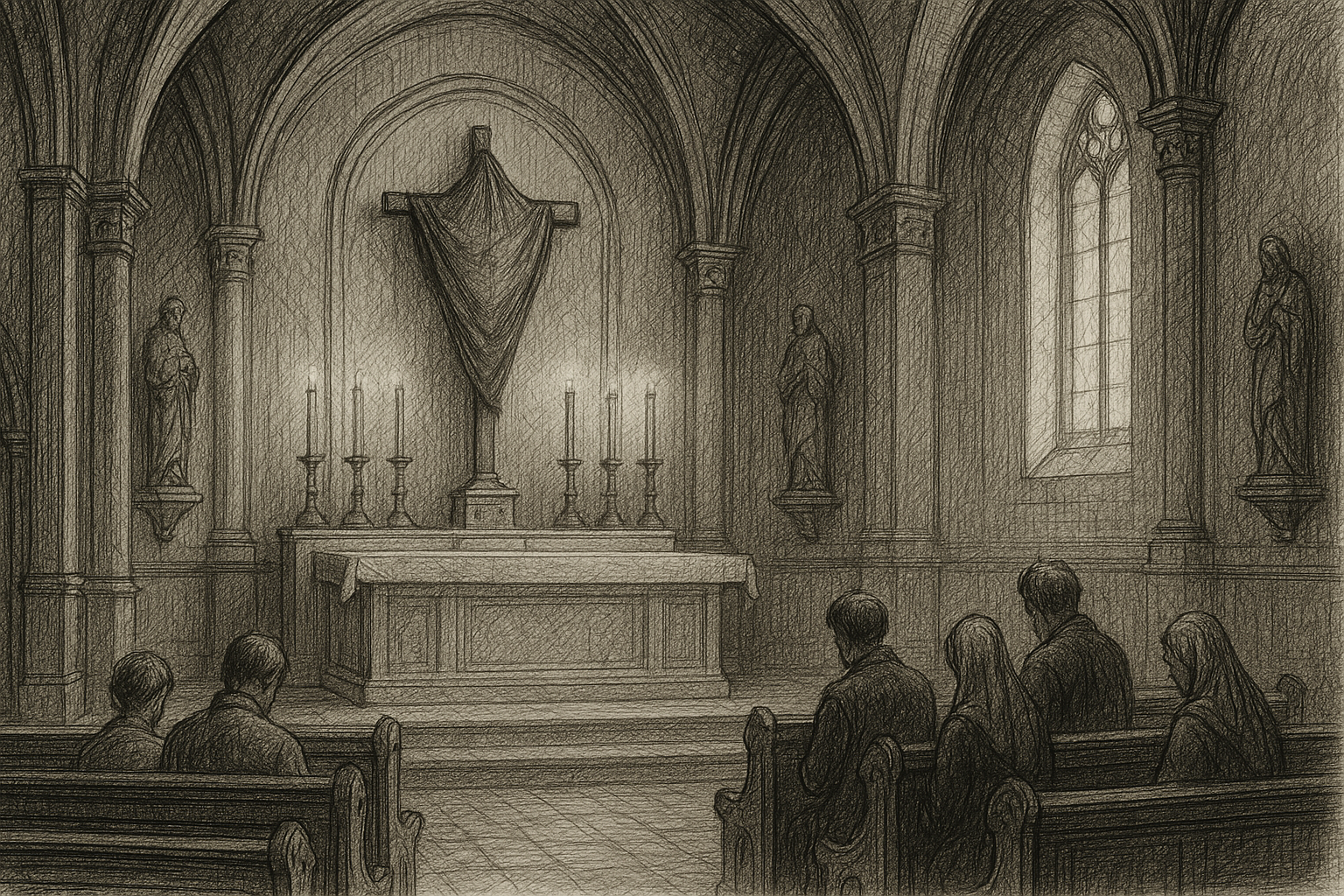
Good Friday places the Passion before us with unusual solemnity. The Church listens to the Gospel account of Christ's suffering, offers prayers for the world, venerates the Cross, and receives Holy Communion from hosts consecrated the day before. The stripped altar and silence of the day say what words cannot. We stand before the mystery of redemption and confess that our salvation comes at a cost beyond measure.
The Easter Vigil then turns from darkness to light. Fire is blessed, the Paschal candle is carried, the Exsultet is sung, salvation history is proclaimed, and baptismal promises are renewed. The liturgy moves from the tomb to life, not as a decorative ending, but as the divine answer to everything that has come before. The women who went to the tomb at dawn are not left in despair. They hear the angel's message: Christ is risen.
How Holy Week came to be celebrated in the Church
The Church's observance of Holy Week developed over time as Christians sought to honor the events of the Lord's Passion with increasing depth and care. From the earliest centuries, believers gathered around the Paschal Mystery, especially at Easter, because they knew that the resurrection could not be separated from the cross. As Christian worship became more publicly ordered, the Church gradually shaped these sacred days into a distinct liturgical pattern.
This development was not a matter of invention in the casual sense. It was a process of faithful reflection on what the apostles had handed on. The liturgy is the Church's memory, but it is a living memory. She does not merely preserve facts. She enters them sacramentally. That is why Holy Week feels so different from ordinary time. The readings, gestures, silence, chant, fasting, and processions all work together to draw the faithful into the mystery.
In the Catholic tradition, the liturgy is never just a lesson. It is an act of worship, and worship forms the believer. Holy Week teaches by experience as much as by explanation. When the Church kneels before the Cross, when she keeps watch at the altar of repose, when she sings of the Lord's glory rising from the tomb, she is not performing a religious pageant. She is allowing the grace of Christ's saving work to touch the present moment.
Why these days matter for ordinary Catholics
Holy Week matters because the Christian life is not meant to remain abstract. It is easy to speak about grace in general terms and still live unchanged. Holy Week presses the faith into concrete form. It asks whether we will accompany Christ in prayer, or remain distant. It asks whether we will let His suffering confront our sin, our indifference, and our need for mercy.
For an ordinary Catholic, these days can become a school of discipleship. They teach us to keep vigil when we would rather be distracted. They teach us to fast when we would rather consume. They teach us to remain at the foot of the Cross when our instinct is to flee from pain. They teach us, above all, that the road to Easter passes through surrender.
There is also a sacramental reason Holy Week matters. The liturgies are not symbolic extras layered onto private devotion. They are the Church's public worship, and in them Christ acts. In the Eucharist, in the proclamation of the Word, in the veneration of the Cross, and in the sacraments tied to the Easter Vigil, the Lord continues to gather, cleanse, heal, and strengthen His people. To participate well in Holy Week is to place oneself where grace is offered abundantly.
How to live Holy Week with greater fruitfulness
A fruitful Holy Week does not require a complicated program. It requires attention, reverence, and some real willingness to make room for God. The simplest advice is often the most difficult: attend the liturgies if you can, arrive a little early, and be present without rushing. Let the Church's prayers set the tone rather than your own habits of hurry.
It also helps to pray with the Passion narratives in advance or alongside the liturgies. Read the accounts of Jesus' suffering slowly. Pause where something strikes you. Notice the silence of Christ before His accusers, His mercy toward sinners, His care for His mother, His thirst, His abandonment, and His final trust in the Father. These are not distant scenes. They are revelations of divine love.
Fasting can deepen the week as well, especially on Good Friday and, where possible, on Holy Saturday in a spirit of quiet expectation. Fasting is not punishment. It is hunger offered to God. It helps reorder the heart so that the joy of Easter is received as gift rather than taken for granted.
Confession before Holy Week, if possible, can also be a great mercy. The purpose is not to make the week feel perfect or emotionally polished. The purpose is to enter the mysteries with a cleansed heart. A soul reconciled to God is better able to stand with Christ in His Passion and rejoice in His resurrection.
Some Catholics also find it helpful to create small signs of recollection at home. A crucifix placed in a visible location, a quiet corner for prayer, a reduction in noise and unnecessary media, and a more measured pace can all support the liturgical spirit of the week. The goal is not aesthetic discipline for its own sake. The goal is to leave room for Christ.
The shape of the sacred Triduum
Many Catholics speak of Holy Thursday, Good Friday, and Holy Saturday as three separate days, but the Church understands them as one sacred liturgy stretched across time: the Triduum. This unity matters. It helps us see that the Lord's gift is whole. The Supper leads to the Cross, the Cross leads to the Tomb, and the Tomb leads to Resurrection.
Holy Thursday is marked by gratitude and love. The Church remembers the institution of the Eucharist and the priesthood, and she also recalls the Lord washing the feet of His disciples. This is the night when service and sacrifice are inseparable. Christ feeds His Church by giving Himself, and He teaches His Church to live by the same pattern.
Good Friday is marked by solemn silence and prayer. The Church does not celebrate Mass, because the sacrifice of Calvary is being contemplated in its stark reality. Yet she does not abandon hope. She adores the Cross because she knows what it means. The instrument of execution has become the tree of life.
Holy Saturday is often the most overlooked day, but its quiet is spiritually important. The Church waits beside the tomb. This waiting is not empty. It is pregnant with promise. Many Catholics experience Holy Saturday as a day of restraint and stillness, and rightly so. It teaches us that God is at work even when nothing visible seems to happen.
The Easter Vigil then breaks the silence. The Church gathers in darkness and receives the light of Christ. Salvation history unfolds, the waters of baptism are honored, and the Alleluia returns with force. All the waiting is answered, not by human optimism, but by divine victory.
Living the feast after the fasting
Holy Week should not end in exhaustion or emotional spillover. Its purpose is to dispose us to receive Easter more deeply. If the week has been entered with prayer, then the joy of the resurrection can be lived with greater gratitude and less superficiality. Easter is not just a bright note after a dark one. It is the Church's proclamation that Christ has conquered sin and death.
That is why the best way to live Holy Week is to let the liturgy do its work. Do not demand that every moment feel profound. Do not measure fruitfulness by intensity alone. The Church asks for fidelity. She asks us to come, to kneel, to listen, to fast, to adore, and to keep watch. If we do these things with an open heart, the grace of Christ will bear fruit in its own time.
Holy Week remains one of the Church's greatest gifts because it brings us close to the center of reality. We are not saved by an idea. We are saved by a Person who loved us to the end. In these holy days, the Church allows us to stand near Him, to hear His words, to witness His sacrifice, and to wait for the dawn that no tomb can hold back.
Keep Reading on Lets Read The Bible
Frequently Asked Questions
What is the difference between Holy Week and the Triduum?
Holy Week includes Palm Sunday through Holy Saturday, while the Triduum is the three-day summit of Holy Thursday evening, Good Friday, and the Easter Vigil into Easter Sunday. The Triduum is the heart of Holy Week and the Church's most sacred liturgical time.
Do Catholics have to attend every Holy Week liturgy?
The Church strongly encourages participation in the Holy Week liturgies, especially the Triduum, because they are the fullest expression of the Paschal Mystery. While obligations can differ by parish or circumstance, Catholics should strive to attend as much as they reasonably can.
How can I pray during Holy Week if I cannot make it to every service?
Read the Passion accounts slowly, spend time before a crucifix, pray the rosary or the Stations of the Cross, and keep a quieter schedule if possible. Even brief, reverent prayer can help unite daily life with the Church's worship.