Sacraments and Liturgy
Entering the Mystery: The Introductory Rites of Mass and the Art of Beginning Well
A close look at the opening moments of Mass, where the Church gathers, repents, and prepares to hear the Lord speak.
Site Admin | September 3, 2025 | 79 views
The first moments of Mass can pass quickly if we are not paying attention. The entrance chant begins, the priest approaches the altar, and the assembly rises. Yet in these opening rites, the Church is already doing something holy and carefully ordered. She is gathering the baptized, turning hearts toward God, and preparing us to hear the Word and offer the sacrifice of praise.
When people speak about the Introductory Rites of Mass explained, they are often asking a simple but profound question: what is happening at the beginning, and why does it matter? The answer is that these rites are not a preface to real worship. They are worship. They are the Church's way of entering the mystery together, with reverence, humility, and joy.
What the Introductory Rites are for
The Roman Missal gives the Introductory Rites a clear purpose: they help the faithful gather into one community, dispose themselves to listen to the Word of God, and prepare worthily to celebrate the Eucharist. In other words, these opening moments are meant to unite us, focus us, and cleanse our hearts.
That purpose is visible in the structure itself. The priest and ministers approach the altar, the people stand, the sign of the cross is made, greeting is exchanged, sin is confessed, mercy is invoked, and praise rises in the Gloria when prescribed. Every step has a pastoral and spiritual function. None of it is accidental.
The Mass begins not with private prayer, but with a common act of faith. The Church is not a crowd of individuals arriving at a religious event. She is the Body of Christ, assembled before the Father. The Introductory Rites make that truth tangible from the first moment.
A brief history of these opening rites
The Mass developed over time from the Church's earliest liturgical life. The basic movement of Christian worship was always there: gathering, reading Scripture, prayer, offering, and Communion. As the liturgy matured, the opening rites took shape in ways that expressed the Church's need for order, penance, and communal preparation.
In the Latin tradition, some elements familiar today became more defined over centuries. The Entrance Chant, greeting, penitential act, Kyrie, Gloria, and Collect reflect a long inheritance of prayer. Their present form is the fruit of the Church's worshiping life, shaped by Scripture, the Fathers, monastic prayer, and liturgical discipline.
It is helpful to remember that liturgy is not invented by one generation. It is received, purified, and handed on. The Introductory Rites bear witness to that continuity. They connect us to Christians who have gathered for the Eucharist across centuries, often under far more difficult conditions than our own.
The Entrance Chant and procession
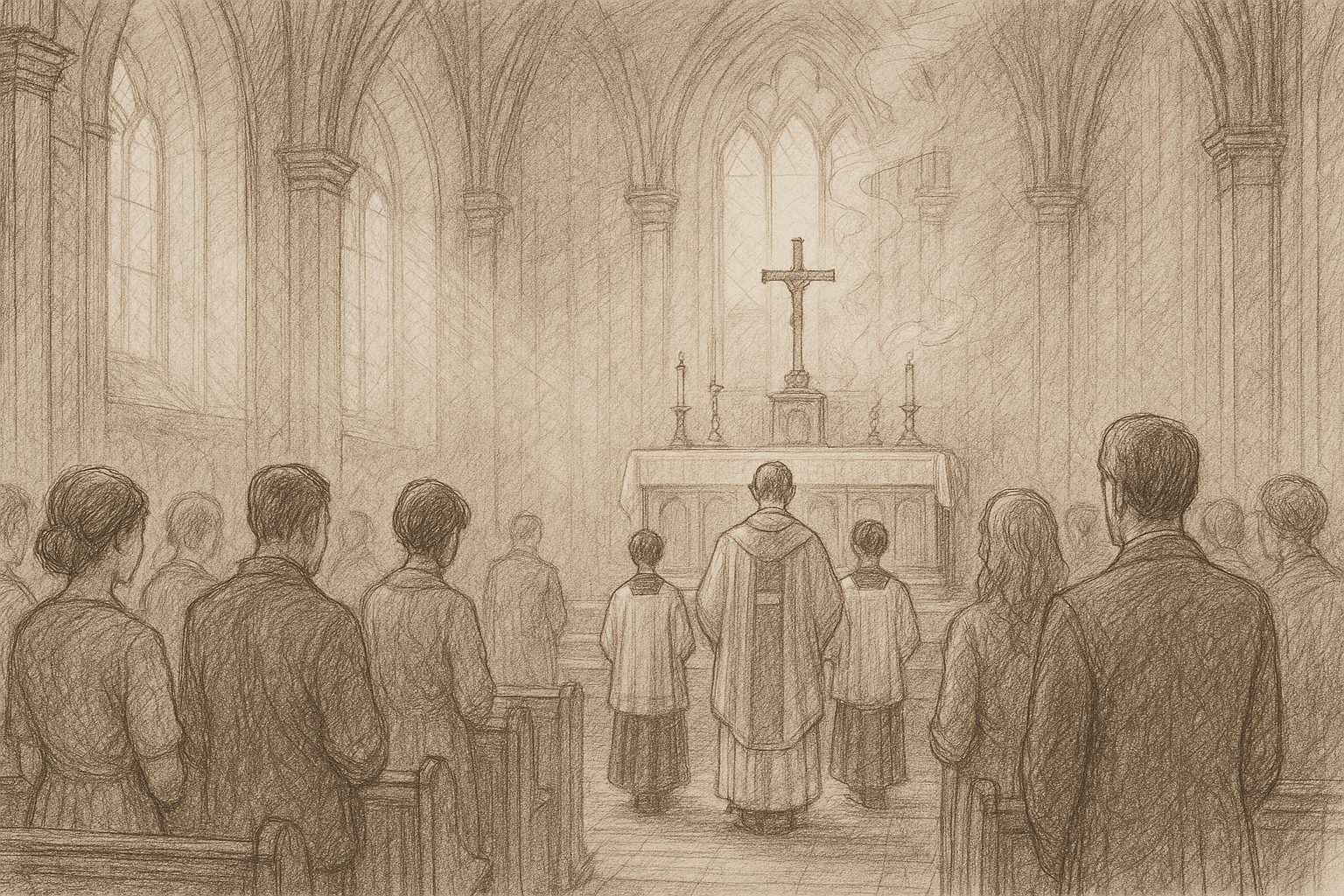
The Mass begins with an entrance chant or hymn while the priest and ministers process toward the altar. This is not simply a musical prelude. It is the Church singing herself into worship. The chant helps create a shared spiritual focus and expresses the unity of those who have gathered in Christ.
The procession also matters. The altar is not ordinary furniture. It signifies Christ himself and the sacrificial banquet of the Eucharist. By moving toward it in reverence, the clergy and ministers show that the whole assembly is approaching holy ground. This is an embodied reminder that worship is not first about our preferences, but about God's initiative and our response.
If there is music, it should serve prayer rather than distract from it. If there is silence, that too can be fruitful. The point is not to manufacture a mood, but to prepare souls for what comes next.
The Sign of the Cross and the greeting
When the priest says, In the name of the Father, and of the Son, and of the Holy Spirit, and the people answer, the Church is doing more than beginning a meeting. She is confessing the Most Holy Trinity. The sign of the cross places the entire Mass under the saving mystery of Christ's Passion and Resurrection.
Then comes the liturgical greeting, such as The Lord be with you. This is not a casual pleasantry. It is a scriptural and ecclesial blessing, recalling the Lord's presence among his people and the ordained ministry of the priest. The response, And with your spirit, is likewise a recognition that the priest acts in sacramental service, not merely in personal capacity.
These words are brief, but they are dense with meaning. They remind us that Mass is not something we manage by habit alone. It is an encounter with the living God, mediated through the Church's prayer.
The Penitential Act: mercy before mystery
One of the most important moments in the Introductory Rites is the Penitential Act. Before the Word is proclaimed and before the Eucharist is offered, the Church asks mercy. This is deeply biblical. Isaiah, Peter, and the tax collector in the temple all show the right instinct before God: humility.
The Penitential Act does not replace the Sacrament of Penance, and it does not forgive grave sin in the way Confession does. But it does dispose the faithful toward repentance and reminds us that we come before the Lord as sinners in need of mercy. That is not discouraging. It is freeing. God meets us in truth, not in pretense.
Often the rite includes the Confiteor, the striking admission that we have sinned in thoughts, words, deeds, and omissions. This language is honest because human sin is not only what we do, but also what we fail to do. The Church teaches us to name both.
The repeated cry Lord, have mercy is ancient and beautiful. It is a prayer that can be prayed by the weary, the distracted, the penitent, and the hopeful alike. In a world quick to excuse itself, the Church teaches us to ask for mercy with confidence.
How to pray the Penitential Act well
- Arrive a little early so your mind is not racing when Mass begins.
- Use the silence before Mass to recall one or two real sins, not vague feelings of guilt.
- Pray the words slowly and sincerely, avoiding automatic recitation.
- Remember that mercy is a gift, not a reward for performance.
The Kyrie and the Gloria
After the Penitential Act, the Mass often continues with the Kyrie. Though it is short, it is one of the Church's oldest and most beloved prayers. Kyrie eleison means Lord, have mercy. Repeated pleas like this are deeply scriptural and perfectly suited to the believer who knows his own need.
In many Masses, the Gloria follows on Sundays outside Advent and Lent, and on solemnities and feasts. This hymn of praise echoes the angels at Bethlehem and the Church's great doxology of thanksgiving. Where the Kyrie asks for mercy, the Gloria answers with adoration.
Together, these prayers express a full spiritual movement: contrition and praise, humility and joy. That balance is essential to Christian worship. We do not begin Mass by pretending we are already pure. We also do not remain trapped in sorrow. Mercy opens into praise.
The Collect: the prayer that gathers everything
The Introductory Rites culminate in the Collect, the prayer spoken by the priest after the invitation to pray. Its Latin name reflects what it does: it gathers the prayers and intentions of the people into one formal prayer addressed to the Father, through Christ, in the Spirit.
This is one of the most beautiful moments of the Mass. The assembly pauses, often in silence, and the priest voices the Church's prayer in a concise and careful way. The Collect is not improvised. It belongs to the liturgy's tradition and gives us a school of prayer. It teaches us to ask for what is fitting, not merely for what is immediate.
Here, the Introductory Rites reach their goal. The people are gathered, penitent, and attentive. The Church now stands ready to listen.
How these rites shape the soul
It is easy to think of the Introductory Rites as a sequence to get through before the readings begin. But spiritual life is often formed in the small, repeated acts that we might otherwise overlook. The way we begin Mass shapes how we receive the whole liturgy.
These rites teach at least four habits of the Christian life:
- Gathering: faith is communal, not solitary.
- Reverence: God is holy, and worship should show that.
- Repentance: we need mercy every time we come to Mass.
- Attention: the Lord speaks, and we must be ready to hear.
For many Catholics, growth in liturgical participation begins here. When the beginning of Mass is prayed well, the rest of Mass is easier to enter more deeply. The heart becomes less scattered. The body learns stillness. The mind begins to listen.
To participate more faithfully is not to do more things, but to let the Church's prayer do its work in us.
Practical ways to participate more faithfully
If you want to pray the Introductory Rites better, start with simple, realistic steps. Faithfulness in the liturgy is often built through attentiveness, not dramatic effort.
- Arrive before Mass begins. A few quiet minutes can make the difference between rushing and praying.
- Make a deliberate sign of the cross. Let it be a real act of faith, not a gesture done from habit alone.
- Listen to the words. The greeting, penitential prayers, and Collect are not filler. They are prayer.
- Unite your intentions to the Church. Bring your concerns, but do not let them dominate the liturgy.
- Prepare to hear the Word. The Introductory Rites are meant to open your ears and heart.
If distraction comes, do not be surprised. Return gently. The liturgy is not a performance of perfect concentration. It is an act of communion offered by imperfect people to a merciful God. God can work with that.
What the Introductory Rites reveal about Catholic worship
These opening moments reveal something essential about Catholic faith: grace comes to us through form. The Church does not trust bare spontaneity to carry the weight of divine worship. She prays with words, gestures, symbols, and sequence because the human person is body and soul.
The Introductory Rites also remind us that worship is ordered toward communion. We do not begin Mass as isolated believers trying to find our own experience. We come as members of a people, redeemed by Christ, forgiven by mercy, and called to listen together.
In that sense, the beginning of Mass is already a gift. It is the Church teaching us how to begin well: with the cross, with mercy, with praise, and with a listening heart.
When these rites are received with faith, they become more than familiar words. They become a doorway into worship, and through that doorway the Lord is already leading his people toward the table of his word and the table of his body.
Keep Reading on Lets Read The Bible
Frequently Asked Questions
What are the Introductory Rites of Mass?
They are the opening rites of the Roman Rite Mass, including the entrance, sign of the cross, greeting, penitential act, Kyrie or Gloria when appointed, and the Collect. Their purpose is to gather the faithful and prepare them for the Liturgy of the Word and the Eucharist.
Do the Introductory Rites forgive sins?
They dispose us toward repentance and include prayers for mercy, but they do not replace Confession for grave sin. The Penitential Act is a liturgical act of humility and sorrow, not the Sacrament of Penance.
Why is the Gloria not said every Sunday?
In the Roman Rite, the Gloria is used on Sundays outside Advent and Lent, as well as on solemnities and some feasts. Its placement gives those seasons and celebrations a more explicit note of praise and joy.