Sacraments and Liturgy
When the Word Is Received Slowly: A Catholic Way Into Lectio Divina
A practical, prayerful path for letting Scripture move from the page into the life of grace.
Site Admin | September 26, 2025 | 95 views
Many Catholics know the feeling of opening the Bible with good intentions and then closing it again after a few distracted minutes. We want to pray. We want to listen. We want God to speak. Yet our minds are crowded, our schedules are full, and Scripture can seem distant when we approach it like another task to complete.
Lectio divina offers a gentler way. It is not a technique for mastering the Bible, and it is not a spiritual performance. It is a slow, reverent listening to the Word of God in faith. In the Church, this ancient practice has helped believers receive Scripture not only as text to be studied, but as living speech from the Lord who still addresses His people. For anyone seeking a practical lectio divina Catholic guide, the first thing to know is that this way of praying is both simple and profound.
What lectio divina is and is not
The Latin phrase lectio divina means divine reading, or sacred reading. The heart of the practice is straightforward: a passage of Scripture is read, reflected on, prayed over, and quietly received. The goal is not to collect information, though understanding matters. The goal is encounter. In lectio divina, the Word is not treated as a puzzle to solve but as a gift to receive.
That also means lectio divina is not the same as ordinary Bible study, though the two can support one another. Study asks what the passage means in its historical, literary, and theological context. Lectio divina asks how the Lord is speaking to me through this passage today. Study informs prayer, and prayer opens the heart to deeper understanding. Catholics do not need to choose between them.
It is also important not to turn lectio divina into a test of spiritual feelings. Sometimes a word or phrase comes alive at once. Sometimes the prayer feels dry. The practice is still fruitful. The Catechism teaches that prayer is a gift and a covenant, a response to God who first seeks us. Lectio divina belongs to that humble response. It is an exercise in fidelity more than sensation.
Where the practice comes from
Lectio divina is deeply rooted in the life of the Church. Early Christians read the Scriptures in prayer, and monastic communities preserved and shaped this way of listening over the centuries. In the Benedictine tradition especially, sacred reading became part of the daily rhythm of conversion, worship, and contemplation. The Church did not invent the Word of God, of course, but she learned to receive it with discipline and love.
Saint Benedict asked his monks to live a steady, prayerful attentiveness to God. Their reading was not hurried. It was meant to be savored. In time, the Church recognized that this method of prayer could nourish all the faithful, not only those in monasteries. Scripture is not reserved for specialists. Because the Word became flesh in Jesus Christ, the Bible is meant to lead the whole Church into communion with Him.
The tradition also harmonizes beautifully with Catholic worship. At Mass, God speaks first. The Liturgy of the Word is not a warmup before the Eucharist. It is itself an encounter with the living Lord who addresses His people. Lectio divina extends that same posture into personal prayer. What the Church hears publicly in the liturgy, the believer receives quietly in the heart.
Why lectio divina matters for Catholics
In a noisy age, lectio divina re-trains the soul in attention. So much of modern life rewards speed, reaction, and constant novelty. Scripture asks for something else. God often speaks in the stillness, and the heart learns to recognize His voice only when it stops trying to fill every silence.
Lectio divina matters because it keeps Scripture close to prayer and prayer close to Scripture. A Catholic should not approach the Bible as though it were detached from the Church, the sacraments, or the life of grace. The Scriptures were written in the life of God's people, proclaimed in the liturgy, and fulfilled in Christ. When we pray with the Word, we enter that living current.
It also helps form the conscience. A repeated passage can expose our habits, soften our judgments, and awaken repentance. The Word of God is not merely consoling. It is searching. As the Letter to the Hebrews says, the word of God is living and effective. That living Word can comfort the afflicted and disturb the complacent, often in the same prayer.
For Catholics, lectio divina is especially fruitful because it naturally leads toward sacramental life. The one who listens to Christ in Scripture begins to desire communion with Christ in the Eucharist, reconciliation in confession, and deeper conformity to His will. Prayer with the Word does not replace the sacraments. It disposes the soul to receive them better.
A simple way to practice it
There is no single rigid formula, but the traditional pattern is often described in four movements: lectio, meditatio, oratio, and contemplatio. These are not separate boxes to check. They are more like stages in a conversation that deepens naturally.
1. Lectio, or reading
Choose a short passage. Start with something manageable, perhaps a Gospel reading, a psalm, or a passage from the letters of Saint Paul. Read slowly, maybe once or twice, and do not rush to explain everything. Notice the words, the actions, and the repeated images. Ask simply, what is here?
It can help to read the same passage several times. The first reading gathers the sense of the text. The second lets a phrase stand out. The third may open the heart to prayer. If a verse catches your attention, linger there. Let the Word be received, not consumed.
2. Meditatio, or reflection
After reading, think quietly about the passage. What word or phrase is drawing you? What is the Lord showing you? This is not speculation for its own sake. It is a prayerful pondering, like Mary who kept the words of God in her heart. The question is not only what does this mean, but what is God inviting me to see?
Reflection may reveal a promise, a command, a warning, or a consolation. A Psalm might expose fear. A Gospel scene might awaken trust. A verse about forgiveness might reveal where pride has taken root. The point is to let the Word speak personally without isolating it from the Church's faith.
3. Oratio, or prayer
Now answer God. Pray from the heart using the words or themes of the passage. Give thanks, ask forgiveness, intercede for others, or simply tell the Lord what is true. If the text speaks of mercy, ask for mercy. If it speaks of faith, ask for faith. If it shows Christ in action, ask to be drawn into His life.
This stage matters because Scripture is meant to lead into dialogue. The believer is not a passive reader. He is a son or daughter speaking to the Father through the Son, in the Holy Spirit. Even a few honest sentences can be a true act of prayer.
4. Contemplatio, or resting in God
Finally, rest in silence before the Lord. This is not emptying the mind for its own sake. It is peaceful attention. Having listened and prayed, remain still. Allow the Word to dwell in you. Sometimes contemplation is brief and quiet. Sometimes it feels like deep peace. Sometimes it seems almost hidden. All of it belongs to the prayer.
Many Catholics find it helpful to end with the Our Father, a Hail Mary, or a short aspiration from the passage. The prayer may be simple, but simplicity is not weakness. Often the deepest grace is a heart that has become quieter before God.
Practical habits that help the prayer bear fruit
Lectio divina is easier to keep when it has a real place in daily life. Choose a time that is realistic, even if it is only ten or fifteen minutes. Morning can be good because the day has not yet scattered your attention. Evening can also be fruitful, especially if it becomes a prayerful review of the day in light of Scripture.
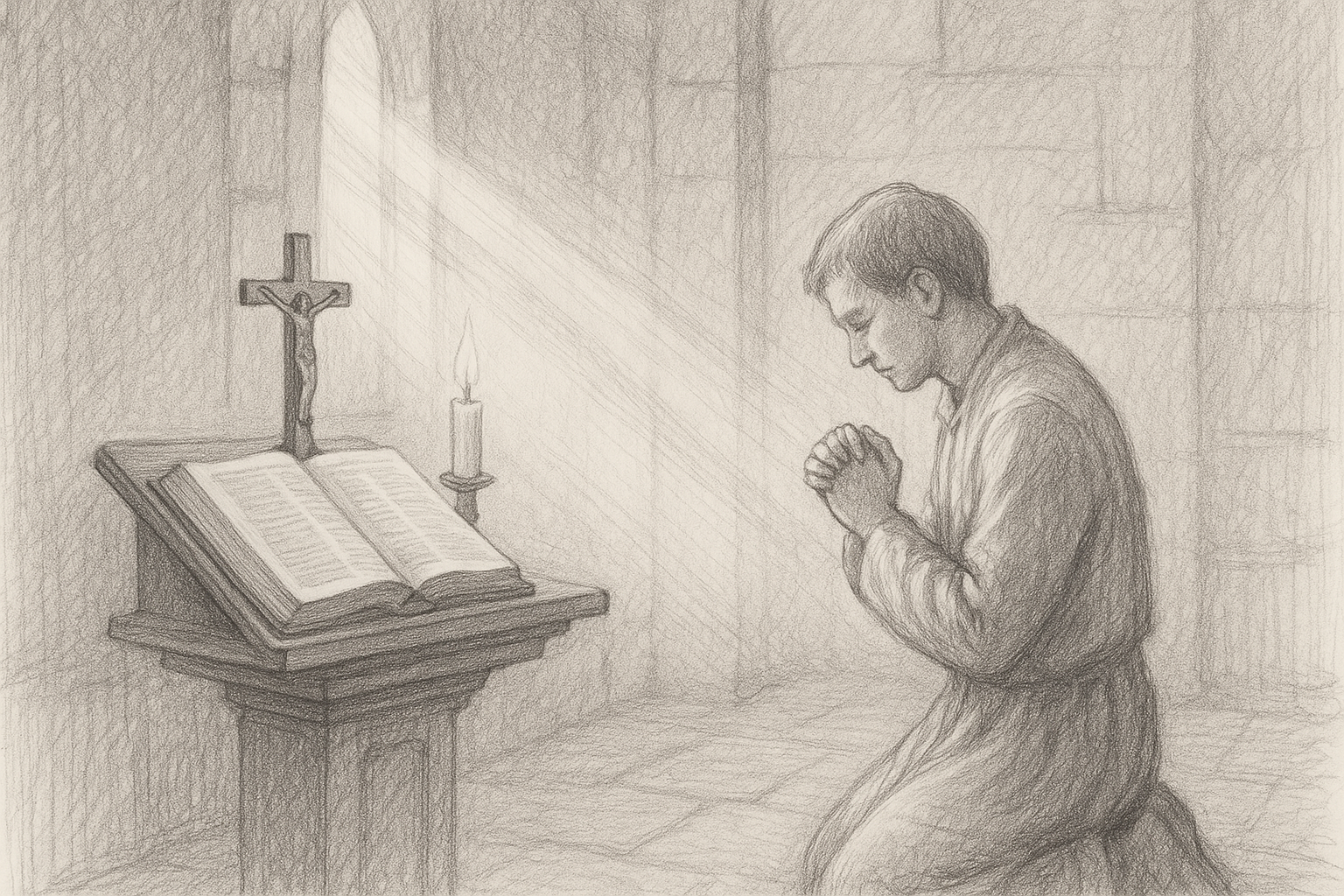
Keep the setting modest. A Bible, a candle, a crucifix, and a quiet corner are enough. The external simplicity can support an interior simplicity. Put away distractions if you can. You do not need special music, elaborate notes, or a perfect atmosphere. You need willingness.
It may also help to follow the liturgical readings of the day. In this way, your private prayer remains joined to the prayer of the Church. The same Word proclaimed at Mass can then continue to echo at home. This makes lectio divina feel less like an isolated exercise and more like part of a Catholic way of life.
Be patient with dryness. Do not judge the prayer by immediate results. A seed often works in the dark before it is seen. The quiet, repeated offering of time to God shapes the heart in ways that may not be obvious at first.
Common mistakes to avoid
One mistake is to rush. Lectio divina loses its character when it becomes hurried. If you only skim the text and move on, the prayer becomes another performance of efficiency. Slow down enough for the words to be heard.
Another mistake is to force a message. Not every prayer will yield a dramatic insight. Sometimes the grace is simply faithful presence. It is better to remain with a plain word from Scripture than to manufacture an emotional experience.
A third mistake is to separate lectio divina from obedience. The Word of God is not only to be admired. It is to be lived. If the passage calls for repentance, forgive. If it calls for trust, surrender. If it calls for mercy, practice mercy. Prayer becomes barren when it is not translated into charity.
Finally, do not isolate personal prayer from the Church. Catholics read Scripture within a living tradition, under the guidance of the Magisterium, and in continuity with the liturgy and the saints. Lectio divina flourishes when it remains rooted in that communion.
How this prayer can change ordinary Catholic life
A faithful lectio divina Catholic guide should end not with a technique but with a vision of life. Over time, this prayer can change the way a person hears the readings at Mass, how he meets temptation, how she comforts a suffering friend, and how both receive the daily burdens of family, work, and service.
It teaches receptivity. It makes room for God. It gives the heart a place to stand before the Word without anxiety. And because it is built on Scripture, it keeps the soul close to Christ, who is the living center of all the Church's prayer.
The Scriptures are not distant relics. They are addressed to a living people. When Catholics return to the Word with patience and reverence, they discover that the Lord who spoke in the beginning still speaks now. He speaks in mercy, in correction, in promise, and in peace. The task is not to outpace Him, but to listen.
And so the Bible is opened, the heart is quieted, and the Church's ancient habit begins again: a Christian receives the Word slowly, trusting that God knows how to work through even the smallest act of faithful attention.
Keep Reading on Lets Read The Bible
Frequently Asked Questions
How long should lectio divina take?
There is no fixed length. Many Catholics begin with 10 to 15 minutes, while others spend longer. The important thing is not the clock but a real period of prayerful listening.
Can lectio divina be done with the Sunday Mass readings?
Yes. Many Catholics pray with the upcoming Sunday readings or the daily lectionary. This can deepen participation in the liturgy and help the readings at Mass reach the heart more fully.
What if I do not feel anything during lectio divina?
That is common and does not mean the prayer failed. Lectio divina is an act of faith, not a search for emotional proof. Quiet fidelity is often where the deepest fruit grows.