Saints and Witnesses
A Saint in Armor, A Soul on Fire: Joan of Arc and the Courage of Holiness
Joan of Arc shows how faithful courage can be fierce, humble, and deeply Catholic.
Site Admin | May 19, 2026 | 133 views
Joan of Arc still arrests the imagination
Few saints are as instantly recognizable as Joan of Arc. A peasant girl, a soldier, a prisoner, a martyr, and now a canonized saint, she stands at the meeting point of history and holiness. Her story has been retold so often that it can be easy to miss what makes it so enduringly Catholic. Joan was not a legend built on confidence in herself. She was a baptized Christian who believed that God was real, that obedience mattered, and that fidelity to conscience could cost everything.
That is part of the lasting power of St. Joan of Arc Catholic inspiration. She does not inspire because she was ordinary in the sense of being unremarkable. She inspires because she was young, inexperienced, and socially powerless, yet she responded to grace with uncommon seriousness. In a world that often treats courage as self-expression, Joan presents a different vision. Courage is not the refusal of fear. It is the willingness to do what God asks even when fear remains.
The historical Joan was very young, and very exposed
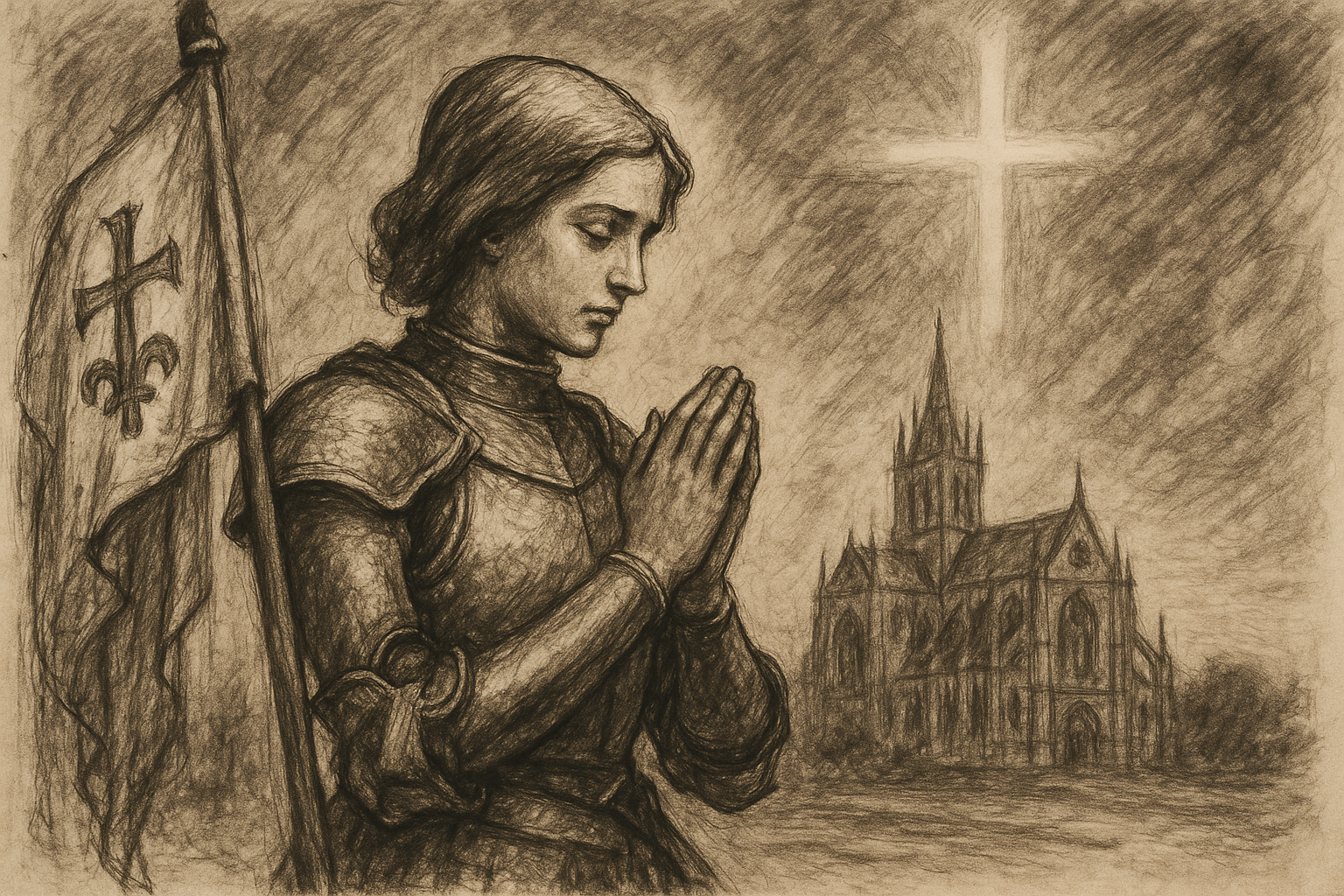
Joan was born around 1412 in Domremy, in what is now France. She grew up in a peasant family during the closing stages of the Hundred Years' War, a time of violence, instability, and political confusion. By her teenage years she reported experiencing visions and voices that she understood as coming from God. In these experiences she heard a call to prayer, to chastity, and to a mission on behalf of France. She sought support from Church authorities, was examined, and eventually gained permission to accompany French forces.
Her role was never that of a priest, theologian, or military strategist in the ordinary sense. Yet her presence strengthened morale and gave practical unity to a desperate cause. She helped lead French troops to lift the siege of Orleans in 1429, a turning point in the war. Later, she was captured, handed over to hostile authorities, and tried in a church court that was deeply compromised by political motives. The record of her trial shows a young woman under intense pressure, asked to deny what she had said and to submit to arguments designed to isolate and break her.
Joan remained remarkably steady. She had no worldly protection, no power base, and no advantage except her faith, her clarity, and her refusal to lie in order to save herself. That combination is one reason Catholics continue to remember her. She is proof that sanctity is not an abstraction. It can be tested under interrogation, in public humiliation, and in the slow grind of suffering.
Her holiness was not separated from obedience
Some portray Joan mainly as a patriotic symbol, while others focus on her as a visionary. Both aspects matter, but Catholic devotion sees something deeper. Her life was marked by obedience to what she believed God was asking of her. That obedience included prayer, moral purity, and willingness to submit herself to legitimate discernment. She did not claim to be above the Church. She wanted to be faithful within it, even as she suffered at the hands of corrupted men who used a church proceeding for unjust ends.
The saints often reveal that holiness is not dramatic independence. It is ordered surrender. Joan's courage was rooted in a life that had already been directed toward God. Her well-known concern for purity was not a narrow detail; it was part of her whole response to grace. She believed that her body and her mission belonged to the Lord. That conviction gave her dignity in a culture that could easily have reduced her to a political tool.
In this, she echoes a biblical pattern. God often chooses the unlikely, the young, and the underestimated. The Lord looks not as man looks, as Scripture says, for man looks on the outward appearance, but the Lord looks on the heart 1 Samuel 16:7. Joan's outward weakness was real, but it did not define her vocation. Grace did.
She faced fear without pretending fear was not there
Joan is sometimes described as fearless, but that can make her seem less human than she was. Her trial records and her final days suggest a woman who understood danger very clearly. She knew what it meant to be imprisoned, threatened, and alone. She was not carried by emotional certainty or by the confidence of a successful adult life. She was a teenager facing powerful men, uncertain outcomes, and the prospect of death.
This is part of why she speaks so directly to Catholic life. The Christian life does not promise that courage will feel easy. Rather, it promises that grace will be enough. Scripture repeatedly joins courage with trust: be strong and of good courage Joshua 1:9, fear not, for I am with you Isaiah 41:10, and take heart John 16:33. Joan's witness is not that fear vanished, but that fidelity remained possible inside fear.
That is a deep comfort for Catholics who feel overwhelmed by the demands of family life, work, illness, temptation, or public hostility. A saint like Joan does not ask us to become theatrical. She asks us to become faithful. The measure is not whether we feel heroic but whether we continue to choose the good when it is costly.
The martyrs teach that truth matters more than survival
Joan's death at the stake in 1431 was intended to silence her and discredit her cause. Instead, it became part of her witness. She died invoking the name of Jesus. She was about nineteen years old. The Church later recognized that her condemnation was unjust, and her rehabilitation helped make clear that her life and death had been misunderstood by those who judged her. She was beatified in 1909 and canonized in 1920.
Martyrdom, in the Catholic sense, is not a fascination with suffering for its own sake. It is the refusal to betray the truth of God even when the cost is severe. Joan's life presses that lesson into the conscience. She could have saved herself by recanting in a way that would have falsified what she knew to be true. Instead, she chose integrity over self-preservation. In this she resembles the saints who hear Christ's words in their bones: Whoever loses his life for my sake will find it Matthew 16:25.
For Catholics today, that witness has practical force. It reminds us that truth is not a luxury. It is something for which the baptized may have to suffer. That may happen in large, public ways, or in smaller hidden ones: refusing to cheat, refusing to lie, refusing to compromise chastity, refusing to mock the faith to gain approval. Joan's martyrdom gives shape to all those smaller acts of fidelity.
Joan's courage was also deeply Marian in spirit
Joan's life had a distinctly Marian atmosphere. Not because she was passive, but because she was receptive. Mary said yes before she understood every detail. Joan also said yes, even when the path was uncertain and costly. Catholic holiness often has this character. It listens first, then acts.
Joan's devotion fits the pattern of the Virgin Mary's fiat, the humble surrender that opens history to God's plan. Mary's words, let it be to me according to your word Luke 1:38, describe the logic of sanctity. Joan, in her own state of life, answered that same logic with a life of service. She was not trying to build a personal brand or establish a private spirituality. She was trying to do what God asked, in the time and place where she lived.
That Marian note matters because it keeps Joan from being misunderstood as merely aggressive or exceptional. Her strength was not the kind that seeks domination. It was the strength of consecration. She acted from prayer, from chastity, from obedience, and from confidence that God does not abandon those who serve him.
How her witness still helps Catholics now
Joan's witness can be especially helpful in three common areas of Catholic life.
- Discernment: She reminds us to test spiritual impressions carefully, seek wise counsel, and remain open to the Church's guidance.
- Purity of heart: Her concern for chastity shows that the body is not an accessory to the soul but part of the whole person offered to God.
- Fortitude under pressure: She teaches that pressure does not cancel holiness. Sometimes it reveals it.
She also helps Catholics see that vocation is not reserved for the comfortable or the old. God called a teenager to a mission that altered history. That does not mean every young Catholic is summoned to something dramatic, but it does mean that age is no barrier to grace. The Holy Spirit still works through the willing.
In a culture that often rewards cynicism, Joan offers something bracingly simple: believe God, tell the truth, and do not surrender your soul to fear. She remains relevant not because the medieval world is fashionable, but because the human heart has not changed. We still need courage. We still need purity. We still need witnesses who show that faith can be active, intelligent, and obedient all at once.
Joan of Arc did not become a saint by being impressive. She became a saint by belonging to Christ in a time of trial.
That is why her story keeps returning to Catholic memory. She shows what happens when grace meets youth, when obedience meets danger, and when love of God becomes stronger than the fear of men. For anyone searching for St. Joan of Arc Catholic inspiration, her life offers more than a quote or a symbol. It offers a summons to steady, humble courage in the exact place where God has placed us.
Keep Reading on Lets Read The Bible
Frequently Asked Questions
Why is St. Joan of Arc important to Catholics?
She is important because her life shows how a baptized Christian can respond to grace with courage, obedience, purity, and fidelity under pressure. Her witness is especially powerful because it joined action with prayer and ended in martyrdom.
Was St. Joan of Arc officially recognized by the Church?
Yes. The Church beatified Joan of Arc in 1909 and canonized her in 1920. Her rehabilitation also helped clarify that her condemnation was unjust.
What can Catholics learn from St. Joan of Arc today?
Catholics can learn to seek God's will seriously, to remain faithful when misunderstood, and to trust that courage is a grace given by God rather than a personality trait.