Saints and Witnesses
St. Dominic and the Quiet Fire of Preaching That Still Reaches Hearts
A look at the life of St. Dominic, his love for the truth of the Gospel, and the enduring Catholic inspiration his witness offers today.
Site Admin | May 1, 2026 | 76 views
St. Dominic Catholic inspiration does not come from spectacle. It comes from a man whose life was marked by prayer, sacrifice, study, and a deep confidence that the Word of God can still convert hearts. In an age when public speech is often loud but shallow, Dominic stands out for a different reason. He did not simply talk about the truth. He belonged to it, served it, and ordered his life around it.
Dominic de Guzman was born in Caleruega, in present day Spain, around 1170. He became a canon regular and later traveled with Bishop Diego of Osma. During those years, he saw firsthand how much confusion could spread when Christian teaching was thin, careless, or ignored. The needs of the Church in southern France, especially amid the Albigensian crisis, helped shape his mission. Yet what defined Dominic was not controversy. It was a priestly desire that people should know Christ truly, love Him deeply, and live in the light of His Church.
A life built on preaching and prayer
Dominic is remembered as the founder of the Order of Preachers, later known as the Dominicans. That title matters. He did not found a movement centered on status or worldly success. He founded an order for preaching the Gospel, and he wanted his brothers to be formed by truth before they ever spoke it aloud. The Dominican way joined study, prayer, poverty, and preaching in one coherent life.
This harmony matters because Catholic witness is often strongest when it is integrated. St. Dominic did not treat prayer as a private comfort and preaching as a separate skill. He believed the preacher had to be rooted in contemplation. His famous pattern was simple and demanding: to contemplate and then to hand on the fruit of that contemplation. That is not a slogan. It is a spiritual discipline. A soul cannot give what it does not first receive.
John 15:5 reminds us: apart from me you can do nothing. Dominic lived that truth in a very practical way. His fruit came from union with Christ, not from personality alone.
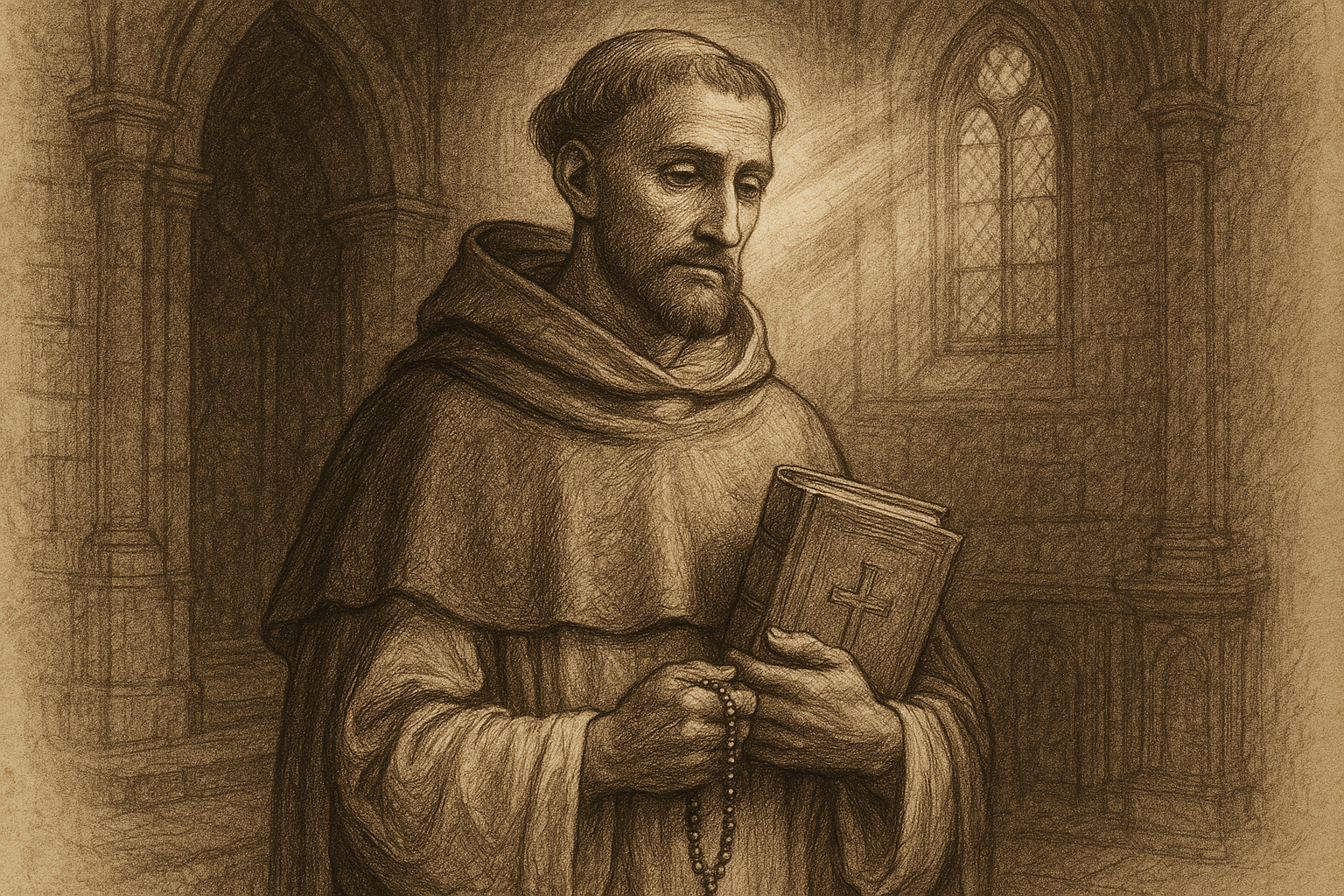
He was known for prayer that was both fervent and steady. Tradition remembers his nocturnal prayer, his tears for sinners, and his confidence in the Rosary, which is closely associated with Dominican spirituality. Catholics may rightly be cautious about simplifying history into neat legends, but the broader point remains firm. Dominic was a man who prayed with his whole life. He did not preach as an outsider critiquing the Church. He preached as a servant within her, dependent on grace.
Truth without charity is not the Dominican way
One reason St. Dominic Catholic inspiration remains powerful is that he shows how doctrine and charity belong together. Catholics sometimes imagine that zeal for truth must become harsh, or that kindness requires softening the faith. Dominic refuses both errors. He preached firmly because he loved souls. He defended orthodoxy because he believed error wounds. Yet he did so as a man of penance and compassion, not as a quarrelsome ideologue.
This is important for Catholics today. In conversation, online or in person, it is easy to treat disagreement as a contest to be won. Dominic points us in another direction. The Gospel is not a weapon for ego. It is good news for the conversion of sinners, beginning with the preacher himself. A Catholic who wants to imitate Dominic must learn to speak plainly, but also humbly; to love the truth, but also the person in front of him.
That balance is deeply biblical. Saint Paul told the Ephesians to speak the truth in love (Ephesians 4:15). Dominic embodied this not by diluting the truth, but by presenting it as something beautiful and saving. He trusted that Christ is credible in Himself. The preacher's task is to remove obstacles, not add them.
What his poverty teaches about credibility
Dominic also understood that a preacher's life should support his message. He and his companions embraced evangelical poverty so that they could be free for the mission. This was not poverty as an aesthetic choice. It was poverty as witness. The preacher who lives simply can more easily show that the Gospel is not for sale.
That lesson still matters. Catholics are often asked, implicitly or explicitly, whether the faith is merely an institution or whether it really changes a life. Dominic answers by example. He demonstrates that authentic preaching is credible when the messenger is willing to lose comfort, honor, and advantage for Christ. The Lord's words in the Sermon on the Mount frame this witness well: blessed are the poor in spirit (Matthew 5:3). Dominic's life made that beatitude visible.
His poverty also carried joy. True evangelical poverty is not despairing or gloomy. It is freedom. It allows a person to receive gifts with gratitude and to hold them lightly. Dominic's disciples would later develop a strong intellectual tradition, but that tradition was meant to serve holiness, not pride. The Dominican family has long shown that serious theology and deep reverence are not enemies. In fact, they flourish best together.
Why St. Dominic still speaks to Catholics now
Modern Catholics live amid constant messages, many of them fragmented and impatient. Dominic's witness is compelling because it is centered, disciplined, and fruitful. He reminds us that evangelization is not first a matter of technique. It begins with holiness. A Catholic may know many arguments and still not bear much fruit if prayer is thin. Another may have fewer words but greater power if those words rise from communion with God.
Dominic also reminds us that formation matters. He valued study because truth deserves careful thought. This is an important correction for our age, which often confuses sincerity with accuracy. The Church has never taught that zeal alone is enough. Love of God includes the mind. When Catholics study Scripture, the creed, the saints, and the teaching of the Church, they are not collecting religious trivia. They are being prepared to serve souls.
There is also something profoundly hopeful in Dominic's life. He preached in difficult conditions and did not live to see every result he desired, yet his work endured. The Church did not grow because he controlled outcomes. It grew because he was faithful. That is a consoling pattern for any Catholic who feels discouraged by slow progress in family life, catechesis, parish ministry, or personal conversion. God often works through patient fidelity rather than immediate success.
St. Dominic Catholic inspiration therefore has a practical shape. He encourages Catholics to make room for silence, Scripture, sacramental life, and disciplined study. He invites parents to teach the faith with confidence. He invites priests and deacons to preach with clarity and mercy. He invites ordinary laypeople to speak about Christ without embarrassment, while remembering that every act of witness must be rooted in prayer.
His legacy in the life of the Church
Dominic died in 1221, in Bologna, with his mission still young. Yet his spiritual family spread widely and helped the Church by preaching, teaching, missionary work, and theological clarity. Over time, the Dominican tradition became known for serious study, Marian devotion, and strong service to the intellectual life of the Church. But the deepest thing about Dominic is simpler than any later history. He wanted souls to belong to Christ.
That desire is timeless. Catholics do not need to become Dominicans in the formal sense to learn from Dominic. Every Christian is called to be available to the truth, to speak with charity, and to live in a way that supports the Gospel. In a culture that prizes image over substance, Dominic offers a different model. He teaches that holiness can be quiet, disciplined, and deeply persuasive. He shows that a life given to God can become a light for others without drawing attention to itself.
When we ask for his intercession, we are not asking for religious nostalgia. We are asking for courage to love the truth more than our own comfort, and for the grace to let prayer shape our speech. Dominic still helps Catholics because he points us to Christ. That is the heart of all true witness. The preacher decreases, so that the Word may increase.
And because Christ remains the Lord of the Church, Dominic's quiet fire still burns wherever Catholics seek to know the faith well, live it faithfully, and hand it on with reverence.
Keep Reading on Lets Read The Bible
Frequently Asked Questions
Who was St. Dominic in Catholic history?
St. Dominic de Guzman was a Spanish priest and founder of the Order of Preachers, now known as the Dominicans. He is remembered for preaching, prayer, poverty, and devotion to sound Catholic teaching.
Why is St. Dominic important to Catholics today?
He shows that preaching must be rooted in holiness, study, and charity. His life encourages Catholics to love the truth, pray deeply, and speak about the faith with clarity and humility.
Is the Rosary connected to St. Dominic?
Dominican tradition strongly associates St. Dominic with the spread of the Rosary, though historians distinguish between later devotional development and the basic facts of Dominic's life. What remains clear is that he fostered Marian devotion and a prayerful approach to evangelization.