Social Teaching
Before the Weapons Speak: Catholic Moral Reasoning About War
The Church's moral tradition places strict limits on the use of force while calling nations and individuals to the demanding work of peace.
Site Admin | September 27, 2026 | 3 views
War confronts the Christian conscience with a painful question. How can disciples of Jesus, who blesses the peacemakers in Matthew 5:9, respond when innocent people are attacked, nations are invaded, or grave injustice is carried out by force?
The Catholic tradition does not answer by treating every use of military force as righteous. Nor does it simply declare that all armed defense is morally forbidden. Instead, the Church offers a disciplined way of reasoning about peace, defense, authority, and human dignity. This tradition is commonly called just war reasoning.
Just war reasoning Catholic teaching is best understood as a set of moral restraints. Its purpose is not to make war respectable. It is meant to prevent violence when possible, limit it when unavoidable, and keep political leaders accountable to moral truth. The presumption is always in favor of peace.
Peace is more than the absence of fighting
Christian peace is not merely a pause between wars. It is rooted in right relationship with God and neighbor. It requires justice, protection for the vulnerable, respect for human life, and a social order shaped by truth and charity.
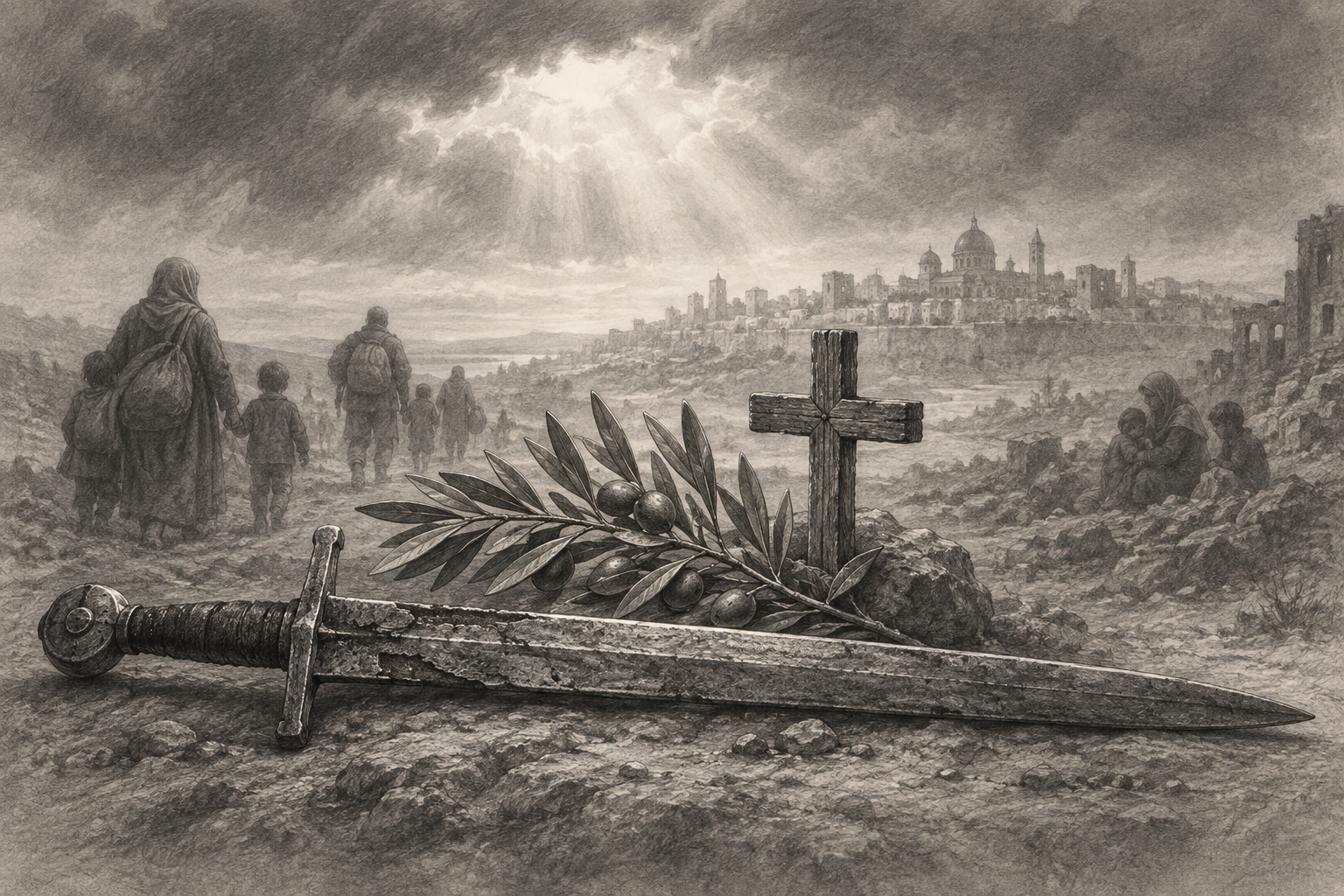
Scripture looks toward a world in which swords are beaten into plowshares and nations no longer train for war, as described in Isaiah 2:4. This vision does not encourage indifference to present dangers. It reveals the direction in which human society should move. Peace is not passive. It must be built through patient diplomacy, honest government, economic fairness, forgiveness, and the defense of those whose rights are threatened.
The Catechism of the Catholic Church teaches that all citizens and governments are obliged to work for the avoidance of war. This duty comes before any discussion of military action. Political leaders must pursue negotiation, mediation, sanctions, treaties, and other peaceful means with seriousness rather than using them as symbolic gestures before a decision already made.
At the same time, peace cannot be reduced to leaving the strong free to abuse the weak. Scripture repeatedly commands the defense of the poor and afflicted, including in [[VERSE|psalms|82|3-4|Psalm 82:3-4]]. A society may face situations in which refusing to protect innocent life allows grave injustice to continue. Catholic teaching therefore recognizes a right of legitimate defense, including a government's responsibility to defend the people entrusted to its care.
The strict conditions for legitimate defense
The Catechism summarizes the traditional conditions that must be considered before military force can be morally justified. These conditions are demanding, and all of them must be satisfied. The moral burden rests on those proposing force, not on those urging caution.
The harm must be grave, lasting, and certain
Military action cannot be justified by vague fears, wounded national pride, economic advantage, or a desire to display power. The aggression suffered by a nation or community must involve serious and demonstrable harm. Speculation alone is not enough.
This requirement calls for honesty about evidence. Leaders must distinguish between a real threat and a merely possible one. They must also resist propaganda that exaggerates danger or treats an entire people as an enemy. Moral judgment becomes distorted when fear replaces careful attention to facts.
Peaceful alternatives must have failed or be clearly ineffective
Force must be a last resort. This does not always mean that every imaginable diplomatic measure must be tried indefinitely. It does mean that nonviolent options must receive a genuine effort and that leaders must have serious reasons for judging them impractical or ineffective.
The last resort condition protects against impatience. Diplomatic work can be frustrating, slow, and politically costly. Yet the consequences of war are so severe that inconvenience is not a sufficient reason to abandon peaceful means.
There must be a serious prospect of success
It is not moral to send people into a conflict that has no reasonable chance of achieving the legitimate purpose for which force is proposed. Courage does not require recklessness. A decision that predictably multiplies death without protecting the innocent or restoring a just peace fails this condition.
Success must also be defined morally. Capturing territory, overthrowing an opponent, or winning a battlefield victory is not enough if the conflict leaves society in deeper chaos. Responsible judgment must consider what can realistically follow the fighting, including the protection of civilians, political stability, and the possibility of reconciliation.
The use of force must not cause greater evil
The anticipated destruction caused by military action must not be worse than the evil being resisted. This is a judgment of proportionality. It requires attention to civilian deaths, displacement, famine, environmental damage, social collapse, and the long consequences of modern weapons.
The Catechism specifically warns that the power of contemporary means of destruction weighs heavily in evaluating this condition. Military technology does not remove moral responsibility. Greater destructive capacity demands greater restraint.
The decision belongs to legitimate authority
Private individuals may not declare wars on their own authority. The judgment that the conditions for armed defense have been met belongs to those who hold responsibility for the common good. Saint Paul recognizes that public authority has a real duty to restrain wrongdoing in Romans 13:4.
Legitimate authority, however, is not the same as unlimited authority. Government decisions remain subject to God's law. An official declaration does not make an unjust action moral. Citizens, clergy, soldiers, and public servants retain consciences that must be formed by truth rather than surrendered to the state.
Moral limits remain during war
Even when resorting to force is judged legitimate, not every method of fighting becomes acceptable. Catholic moral teaching rejects the idea that war suspends the moral law. The distinction between justice in going to war and justice in conducting war is crucial.
Noncombatants must be protected. Civilians, wounded soldiers, prisoners, medical personnel, and others who are not taking part in combat may not be deliberately targeted. The Second Vatican Council firmly condemned acts of war directed toward the indiscriminate destruction of whole cities or vast areas with their inhabitants.
Force must be proportionate to a legitimate military objective. An attack cannot be justified merely because it may provide some military advantage. The expected good must be weighed against foreseeable harm, especially harm to civilians.
Intrinsically evil acts remain forbidden. Torture, rape, deliberate attacks on civilians, hostage taking, and extermination cannot become moral through orders or strategic calculation. The principle that a good end does not justify evil means applies on the battlefield as it does elsewhere.
Soldiers are moral agents. Those serving in armed forces deserve pastoral care, gratitude for honorable service, and support for the burdens they carry. They must also refuse commands that require crimes. Obedience can be a virtue, but obedience to a manifestly immoral order is not.
War does not create a moral world in which anything necessary for victory is permitted. Every person, including an enemy, remains made in the image of God.
This recognition does not require pretending that aggressor and victim are morally identical. It does require refusing hatred, cruelty, and dehumanization. Jesus commands love of enemies in Matthew 5:44. In wartime, that command may include opposing an aggressor while still rejecting vengeance and respecting the aggressor's human dignity.
Prudential judgment and the danger of easy certainty
The conditions for legitimate defense involve prudential judgment. Facts must be gathered, risks assessed, and likely consequences considered. Faithful Catholics may sometimes reach different conclusions about whether a particular conflict satisfies the traditional criteria.
This does not mean that every opinion is equally sound. Prudence is not personal preference. It is the virtue that applies moral truth to concrete circumstances. A responsible judgment should be informed by reliable evidence, the Church's principles, competent analysis, and concern for everyone likely to suffer.
Catholics should therefore be cautious about declaring a war unquestionably just on the basis of slogans, party loyalty, or selective reporting. Similar caution is needed before accusing every person who supports defensive action of rejecting the Gospel. Serious moral reasoning requires humility.
Bishops and pastors may help form consciences by teaching moral principles and addressing grave public concerns. Political and military leaders possess particular responsibility for factual and strategic judgments. Lay Catholics also have an important vocation in public life, diplomacy, law, medicine, journalism, and military service. Each must seek truth within the duties of his or her calling.
Conscientious objection and the witness of nonviolence
The Catholic tradition honors those who renounce violence as a form of evangelical witness. Christians who commit themselves to nonviolent action can remind the Church and the world that peace is not naive and that courage is not confined to armed service.
The Church also supports appropriate legal provision for those who refuse to bear arms for reasons of conscience, while recognizing that they may serve the human community in other ways. Conscientious objection should arise from sincere moral conviction, not contempt for soldiers or indifference to victims of aggression.
Likewise, Catholics who serve honorably in the military should not be presumed to love violence. Many understand their vocation as the defense of neighbors and the preservation of peace. The Church's pastoral task is to form and accompany both those who serve and those who object, calling everyone to integrity of conscience.
The Christian responsibility before conflict begins
Just war reasoning is often discussed only after a crisis erupts. By then, many opportunities for peace may already have been lost. Catholic social teaching directs attention to the conditions that make conflict more likely: injustice, persecution, corruption, arms trafficking, extreme poverty, ethnic hatred, and contempt for international obligations.
Ordinary Catholics may feel distant from decisions of war and peace, but they are not powerless. They can pray for leaders, support truthful public discourse, resist dehumanizing speech, assist refugees, care for veterans, and advocate for policies that protect human dignity. They can refuse the temptation to treat foreign suffering as unreal simply because it occurs far away.
Above all, Christians must not allow the language of just war to become a blessing placed over national ambition. The tradition asks harder questions. Have we pursued peace with perseverance? Are we defending the innocent or seeking advantage? Have we counted the cost to civilians? Are our methods morally lawful? What kind of peace can follow?
Catholic teaching permits legitimate defense under strict conditions, but it never asks the faithful to become comfortable with war. The wounds of conflict should move Christians toward prayer, penance, mercy, and practical peacemaking. Even when force becomes tragically necessary, peace remains the goal, human dignity remains the limit, and Christ remains the measure of every Christian conscience.
Keep Reading on Lets Read The Bible
Frequently Asked Questions
Does the Catholic Church teach that every war is sinful?
No. The Church teaches a strong presumption in favor of peace while recognizing a right of legitimate defense under strict conditions. Military force may be morally permissible only when the traditional criteria are satisfied, including grave and certain harm, last resort, a serious prospect of success, and proportionality.
Who decides whether the conditions for legitimate defense have been met?
The Catechism states that evaluating these conditions belongs to the prudential judgment of those responsible for the common good. Their authority is not unlimited. Decisions remain subject to moral law, and citizens and soldiers must not participate in intrinsically evil acts.
Can Catholics be conscientious objectors?
Yes. The Church recognizes the moral seriousness of conscientious objection and supports appropriate provision for those who refuse to bear arms for reasons of conscience. Such persons may still be required to serve the human community in another way. The Church also respects honorable military service directed toward legitimate defense and peace.