Catholic Living
Before You Tap Again: Social Media, the Catholic Conscience, and the Shape of Daily Life
A Catholic look at how online habits form the heart, and how grace can heal what scrolling quietly wears down.
Site Admin | August 18, 2025 | 78 views
Social media has become part of ordinary life for many people. We use it to keep in touch, to follow the news, to share family moments, to learn, and sometimes simply to fill a quiet minute. Because it feels so common, it can be easy to assume that our online habits are morally small, almost too ordinary to matter. Yet the Catholic moral life does not stop at the visible and obvious. It reaches into attention, speech, desire, self-control, and the choices we make when no one is looking.
For a Catholic, social media use and Catholic life belong together more closely than we may first think. What we post, what we repeat, what we linger on, and what we allow into our imagination all affect the condition of the heart. The Church does not ask the faithful to fear every new tool, but she does ask us to use every tool in the light of truth and charity. That includes screens.
Online life forms real habits of soul
Social media does not merely deliver information. It trains us. Repeated actions shape desire, and desire shapes character. If we spend hours seeking approval, comparing ourselves to others, or feeding our irritation, those habits do not disappear when we log off. They settle into the soul. The Catechism teaches that our moral life is built through repeated acts, and that virtue grows through practice, just as vice does. Social media is one of the places where this becomes very concrete.
Saint Paul writes, Do not be conformed to this world. That command speaks with special force in a culture that constantly asks for our attention. Online spaces often reward speed, outrage, self-display, and reaction. But the Christian life asks for something different: patience, truth, humility, and ordered love. If we are not careful, the digital rhythm of constant checking can make our minds restless and shallow.
There is also the matter of what we let ourselves see. The eye is not morally neutral when it is trained to stare at vanity, cruelty, immodesty, or envy. Even when nothing outwardly scandalous is happening, the repeated choice to look at what weakens reverence can dull the conscience over time. A Catholic approach to social media begins with honesty about that fact.
Charity should govern what we say and share
The command to love our neighbor does not stop at the comment box. Catholics are called to speak truthfully and kindly, and the same standard applies online. It is easy to forget the humanity of the person behind a post. We may answer too quickly, mock too lightly, or share a rumor because it fits our side of an argument. Yet every post enters the moral world. Words can heal, but they can also wound.
Scripture warns us, Let no evil talk come out of your mouths. That includes digital speech. Before posting, it is worth asking a few plain questions:
- Is it true?
- Is it necessary?
- Is it charitable?
- Would I say this in person, before Christ?
These questions do not mean that Catholics must be silent about important issues. The faith does not ask for cowardice. But it does ask for disciplined speech. There is a real difference between defending truth and feeding division. There is also a real difference between reporting something carefully and using a platform to humiliate someone.
When a Catholic shares a post, a meme, or a comment, that action may help form the tone of the wider conversation. A single swipe can contribute to a culture of contempt or a culture of mercy. This is one reason social media use matters so much in Catholic life: it is never only private consumption. It often becomes public witness.
Disordered comparison can quietly steal joy
One of the most common spiritual dangers of social media is comparison. We see the highlight reels of other people's lives and begin measuring our own hidden struggles against someone else's edited presentation. Another person's success becomes our discouragement. Another person's beauty becomes our resentment. Another person's family, work, or talents become proof, in our mind, that we are somehow behind.
This is not a small temptation. Comparison can lead directly to envy, sadness, ingratitude, and even contempt. It can also make us forget the particular gifts God has given us. The Lord does not call every Catholic to the same path, the same pace, or the same visible fruit. He calls each person to holiness in the state of life actually entrusted to them.
That is a freeing word. It invites us to measure life by faithfulness rather than image. The invisible acts of love that never get posted may matter far more before God than the performances that receive applause online. A quiet act of patience, a prayer said for an enemy, a patient conversation with a child, or fidelity in a hidden duty can be deeply holy even if no one notices.
For this reason, one practical step toward peace is to limit the accounts, pages, and feeds that reliably stir envy or anxiety. Not every account is equally helpful. A Catholic seeking virtue should be willing to prune what corrupts gratitude.
Attention is a moral good, not a disposable resource
We often think of social media in terms of time management, but the deeper issue is attention. Attention is how we receive reality. When it is scattered, prayer becomes harder. Reading becomes harder. Silence becomes harder. Even conversation can become harder because we are no longer fully present.
Christian prayer requires a certain recollection of the heart. Not perfect concentration every moment, but an honest willingness to be gathered by God. Constant scrolling can fragment that interior life. It conditions the mind to expect novelty at every turn, which makes ordinary duties feel dull. Yet the spiritual life is usually built from ordinary faithfulness, not novelty.
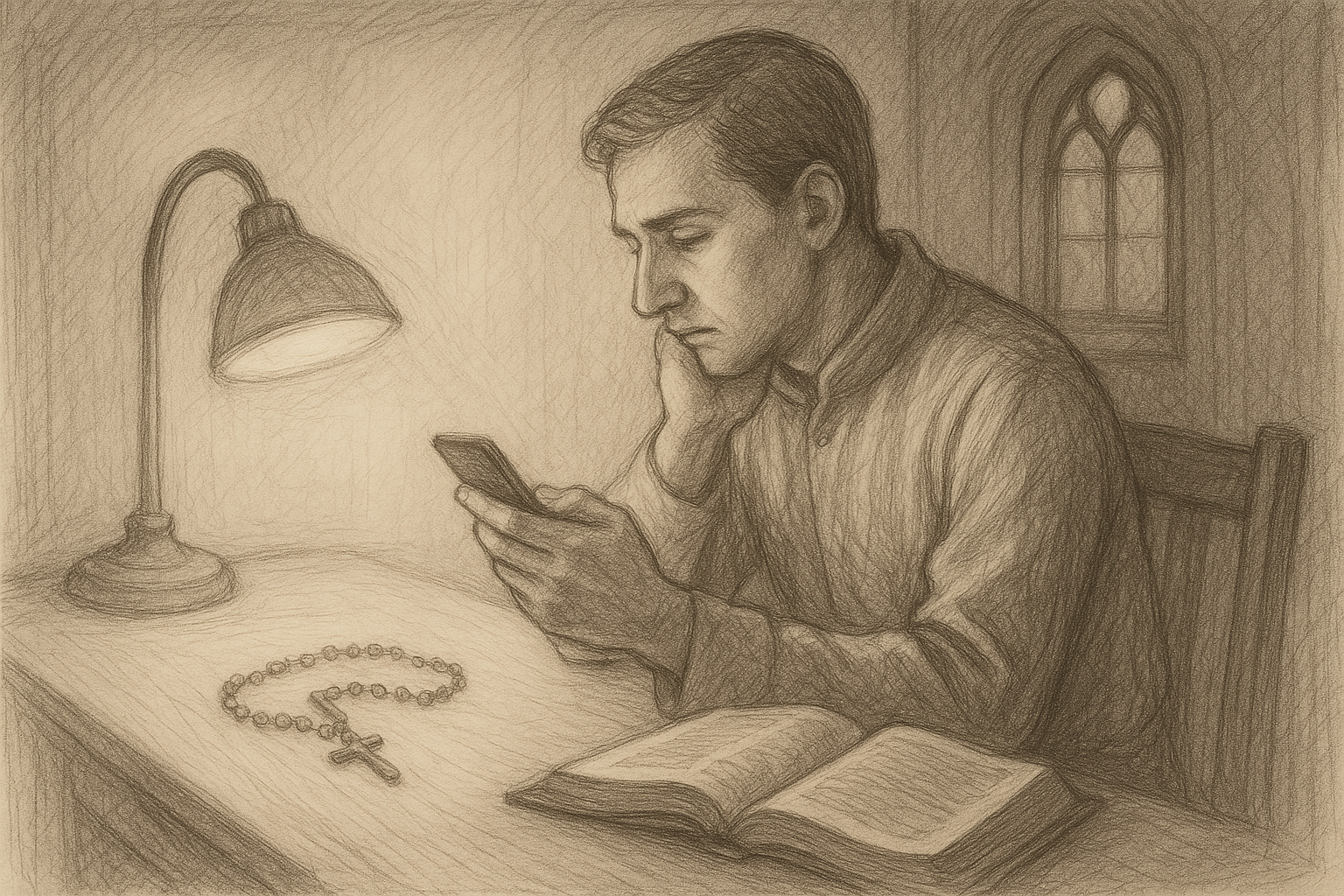
Jesus often withdrew to pray. He was never ruled by the demands of the crowd. His freedom is a rebuke to our compulsive checking. A Catholic may need to ask whether the phone has become a master that interrupts work, family life, study, and prayer. If it has, the answer is not shame, but repentance and order.
Helpful boundaries can include:
- Keeping the phone out of the bedroom.
- Setting specific times for checking apps.
- Turning off nonessential notifications.
- Leaving the phone aside during meals and prayer.
- Fasting from social media on Sundays or during part of Lent.
Such practices are not about punishing the body. They are about restoring freedom. They make room for attention to God, to other people, and to the real world in front of us.
Repentance belongs wherever sin has entered
Not every unwise post is a mortal sin, and not every use of social media is spiritually harmful. But Catholics should be ready to admit when online behavior has become sinful. That might include spreading falsehood, participating in cruelty, encouraging lust, nurturing hatred, or feeding pride in a way that damages the soul. If a person has used social media to insult others, provoke scandal, or neglect duties through compulsive use, repentance is appropriate.
Repentance begins with naming the truth without excuses. Then comes sorrow, resolution, and concrete change. Sometimes this includes deleting a post, apologizing privately or publicly, making restitution if harm was done, or taking a real break from the platform. Sometimes it means going to Confession and bringing the pattern into the light of mercy.
The sacrament of Reconciliation is not only for dramatic failures. It is also a place where hidden habits can be healed before they grow larger. A priest may help a penitent see patterns that were easier to excuse in the moment: impatience, vanity, detraction, or a needless attachment to attention. Grace is not merely forgiveness after the fact. It is strength for a new way of living.
Social media use and Catholic life can be reconciled when the user is willing to practice conversion. That may mean smaller steps than we expect. A person who cannot yet quit altogether may still begin by cutting back, cleaning up the feed, or choosing silence over reaction. God often works through such ordinary acts of humility.
Virtue gives the digital life its proper shape
The Christian answer to social media is not only avoidance. It is virtue. Prudence helps us know when to speak and when to stay quiet. Temperance helps us stop before excess takes over. Justice helps us give others what they are due, including honesty and respect. Charity helps us seek the good of the person, not the victory of the argument. These are not abstract ideas. They are habits that can guide very practical decisions.
A virtuous online life might look like this:
- Posting only after a brief pause for prayer or reflection.
- Sharing content that is true, useful, and fitting.
- Refusing to spread rumors, even if they are entertaining.
- Avoiding reply when anger is rising.
- Choosing silence when silence is wiser than comment.
- Using social media to encourage, inform, or bless rather than to perform.
There is also room for gratitude. Social media can genuinely help Catholics find good resources, support distant friends, and witness to faith in public ways. It can allow a grandmother to see a grandchild's life, a homebound person to remain connected, or a parish community to share a need quickly. The point is not that online life is evil in itself. The point is that every tool must be judged by the way it serves love of God and neighbor.
When social media becomes noisy, Catholics are not powerless. They can choose restraint. They can choose truth. They can choose to look away, to log off, to apologize, to pray, and to begin again. That is not failure. It is discipleship taking root in ordinary habits, one click at a time.
In the end, the question is simple, even if the answer takes daily effort: does this use of social media help me love God more fully and my neighbor more truly, or does it quietly draw my heart away from both?
Keep Reading on Lets Read The Bible
Frequently Asked Questions
Is social media sinful for Catholics?
Social media itself is not sinful. Its moral value depends on how it is used. It can be used for good purposes such as encouragement, communication, and witness, but it can also become a source of vanity, envy, gossip, lust, anger, or wasted time.
What should a Catholic do if social media has become a bad habit?
A Catholic should begin with honest examination of conscience, then make concrete changes such as limiting use, removing harmful accounts, turning off notifications, and bringing serious sin to Confession. Small, steady steps are often the best start.
Can scrolling too much be a spiritual problem even if I am not posting anything sinful?
Yes. Even passive scrolling can weaken attention, stir comparison, feed impurity, or make prayer and duty harder. A habit does not need to be scandalous to be spiritually unhealthy.