Doctrine and Questions
Bringing a Child to the Font: The Church's Ancient Faith in Infant Baptism
How Scripture, tradition, and the life of grace come together in the Church's practice of baptizing infants
Site Admin | July 4, 2025 | 79 views
Few Catholic practices stir as many questions as infant baptism. To some, it seems strange that a child who cannot yet speak for himself should receive a sacrament of faith. To Catholics, however, infant baptism is not an odd exception to the Gospel. It is a beautiful sign of how God acts first, how grace is given freely, and how the Church receives even her smallest members into the life of Christ.
The infant baptism Catholic teaching rests on something larger than a single proof text. It comes from the whole pattern of salvation history. God calls families, includes children in his promises, and gives covenant signs that are not dependent on human maturity. In the New Covenant, baptism is not less gracious than circumcision or less powerful than faith. It is the sacramental birth into Christ, and the Church has long understood that children should not be barred from that gift.
Baptism is first God's gift, not our achievement
Catholics do not treat baptism as a reward for religious performance. It is a sacrament, an outward sign instituted by Christ that truly gives the grace it signifies. In baptism, a person is cleansed from sin, reborn as a child of God, incorporated into Christ, and made part of the Church. That is why the Church speaks of baptism as necessary in the ordinary order of salvation. It is not simply a ceremony of welcome. It is new birth.
This matters greatly when we think about infants. A baby has not yet done anything to earn baptism, but that is precisely the point. Grace is not wages. It is gift. The Lord said, "Let the children come to me, and do not hinder them, for to such belongs the kingdom of heaven" Matthew 19:14. In the Catholic imagination, the child does not come to God after proving readiness. The child is carried to God by faith, mercy, and love.
That is also why the Church baptizes infants in the name of the Father, and of the Son, and of the Holy Spirit. The child is not left outside the covenant until he is old enough to make an informed decision. He is brought into the life of grace at once, so that he may grow within it.
Scripture and the household pattern
The New Testament does not contain a single verse that says, in so many words, "baptize infants." But that is not the only way Scripture teaches. The Bible also reveals a pattern of household faith, covenant inclusion, and the generous reach of God's promises.
At Pentecost, Peter tells the crowd, "Repent and be baptized every one of you in the name of Jesus Christ for the forgiveness of your sins; and you will receive the gift of the Holy Spirit. For the promise is to you and to your children" Acts 2:38-39. That phrase, to you and to your children, is striking. The promise of baptism is not framed as a private achievement for adults alone. It is spoken in a covenantal way, reaching forward to the next generation.
Acts also repeatedly speaks of households being baptized: the household of Lydia, the household of the jailer at Philippi, and the household of Stephanas Acts 16:15 Acts 16:33 1 Corinthians 1:16. Scripture does not spell out the age of every member of those households, and it does not need to. The biblical shape of salvation is familial. God saves persons, yes, but he also gathers families into covenant life.
Another important pattern comes from the Old Testament. Male infants were circumcised on the eighth day as a sign of belonging to God's covenant people Genesis 17:12. Circumcision did not wait for the child to understand the meaning of the sign. It marked the child as one already claimed by God's promise. Catholics see baptism as the fulfillment of that covenant pattern, not a denial of it. Saint Paul even links the two when he speaks of baptism as a kind of spiritual circumcision Colossians 2:11-12.
If the covenant sign once embraced infants, and if baptism is the New Covenant sign of belonging to Christ, it is not surprising that the Church from her earliest centuries baptized children.
The early Church did not invent infant baptism late in the game
It is sometimes assumed that infant baptism arose only after Christians became less serious about personal conversion. History points the other way. The Church's practice of baptizing children appears very early, and the Fathers of the Church speak of it as normal rather than innovative.
This is important because the Church does not believe she has the authority to invent sacraments. She receives them from Christ and hands them on. If infant baptism were a contradiction of the apostolic faith, we would expect early Christians to object loudly. Instead, we find a living tradition that understands baptism as the remedy for sin and the gift of new life, available even to the youngest.
That does not mean every Christian writer of the first centuries explains the practice with the same emphasis. Some stress the grace of baptism, others the Church's responsibility for children, and others the urgency of salvation. But the overall witness is remarkably consistent: the Church baptized children because she believed Christ's saving action was not limited by age.
What baptism gives to a child
It is worth being very plain here. The Church does not teach that baptism is an empty symbol. When a child is baptized, something real happens.
- Original sin is washed away.
- The child is reborn in Christ.
- Sanctifying grace is given.
- The child becomes a member of the Church.
- The indelible mark of baptism is impressed on the soul.
These are not abstract theological ideas. They describe a child being drawn into God's own life. A baptized infant is not a Christian in a merely social sense. He is truly marked as belonging to Christ and to his Church.
At the same time, baptism is the beginning, not the end, of the Christian life. An infant cannot yet make acts of personal faith, but the Church does not imagine grace as something that waits until adolescence. Instead, the child is placed within a believing community. Parents and godparents promise to raise him in the faith so that the grace received in baptism can flower in confession, Eucharist, prayer, moral life, and mature discipleship.
This is one reason Catholic baptismal preparation matters so much. The sacrament is not magic. It is God's action received within the Church's life. Parents who ask for baptism are asking for more than a rite. They are asking to hand their child over to Christ and to accept the responsibility of raising that child in the faith.
Common objections deserve real answers
Some Christians object that baptism should follow personal belief, and they worry that baptizing infants undermines conversion. Catholics should take that concern seriously. Personal faith matters. Conversion matters. No baptized person can live on the memory of a ceremony alone.
But the Church's answer is that infant baptism does not replace conversion. It makes conversion possible and provides its beginning. A child baptized in infancy must still be catechized, must still learn repentance, must still come to personal faith, and must still choose Christ as he grows. The sacrament does not bypass discipleship. It establishes the child within it.
Another objection says that infants cannot believe, so they should not be baptized. Yet in Scripture, God often acts through the faith of others. The friends who lower the paralytic through the roof are praised for their faith Mark 2:5. The centurion's servant is healed through a request made by another Matthew 8:5-13. At times, the faith of the household carries one who cannot yet act for himself. That is not a defect in faith. It is a sign of how communal faith works.
More deeply still, baptism is not simply our declaration to God. It is God's declaration over us. The infant does not initiate the sacrament, but neither does the adult. The Church baptizes because Christ commanded baptism and attached grace to it. The infant receives the sacrament by grace, and later he must ratify that gift with a lived faith of his own.
Why the Church insists on baptism for children
From the Church's point of view, delaying baptism can mean delaying grace. A child is not only an innocent little creature waiting for religious instruction. He is born into a wounded human condition, in need of Christ's redeeming life. The Church therefore speaks with urgency and tenderness. If it is possible to bring a child to baptism, why wait?
That urgency does not come from fear alone. It comes from hope. The Church believes the sacrament truly unites the child to Christ and opens the way of Christian life. It is an act of confidence in God's mercy and in the power of the sacrament Christ gave.
In pastoral life, this also explains why the Church asks parents and godparents to promise a Christian upbringing. The promise is not a bureaucratic hurdle. It is the human response to God's gift. The child is entrusted to a family and a community that must keep speaking the faith until the child can speak it for himself.
Infant baptism and the mercy of God
One of the most beautiful things about infant baptism is the way it reveals divine mercy. Before a child can reason, perform, achieve, or even choose, God can already bless, cleanse, claim, and save. That is not an insult to freedom. It is the foundation of freedom. We do not begin the Christian life by climbing toward God. We begin because God has come down to us.
For Catholic parents, this can be profoundly consoling. They are not asked to manufacture holiness in their own strength. They are asked to hand their child to Christ and then to cooperate with grace. For godparents, too, the responsibility is real. They are not decorative witnesses. They are part of the child's spiritual support system. For the whole parish, an infant baptism is a reminder that the Church is a family, not just an audience.
And for anyone still unsure about the practice, perhaps the simplest way to see it is this: if baptism is truly a gift of rebirth, then the Church is most herself when she brings even the smallest children to receive it. She is not waiting for them to earn membership. She is receiving them because Christ has first welcomed them.
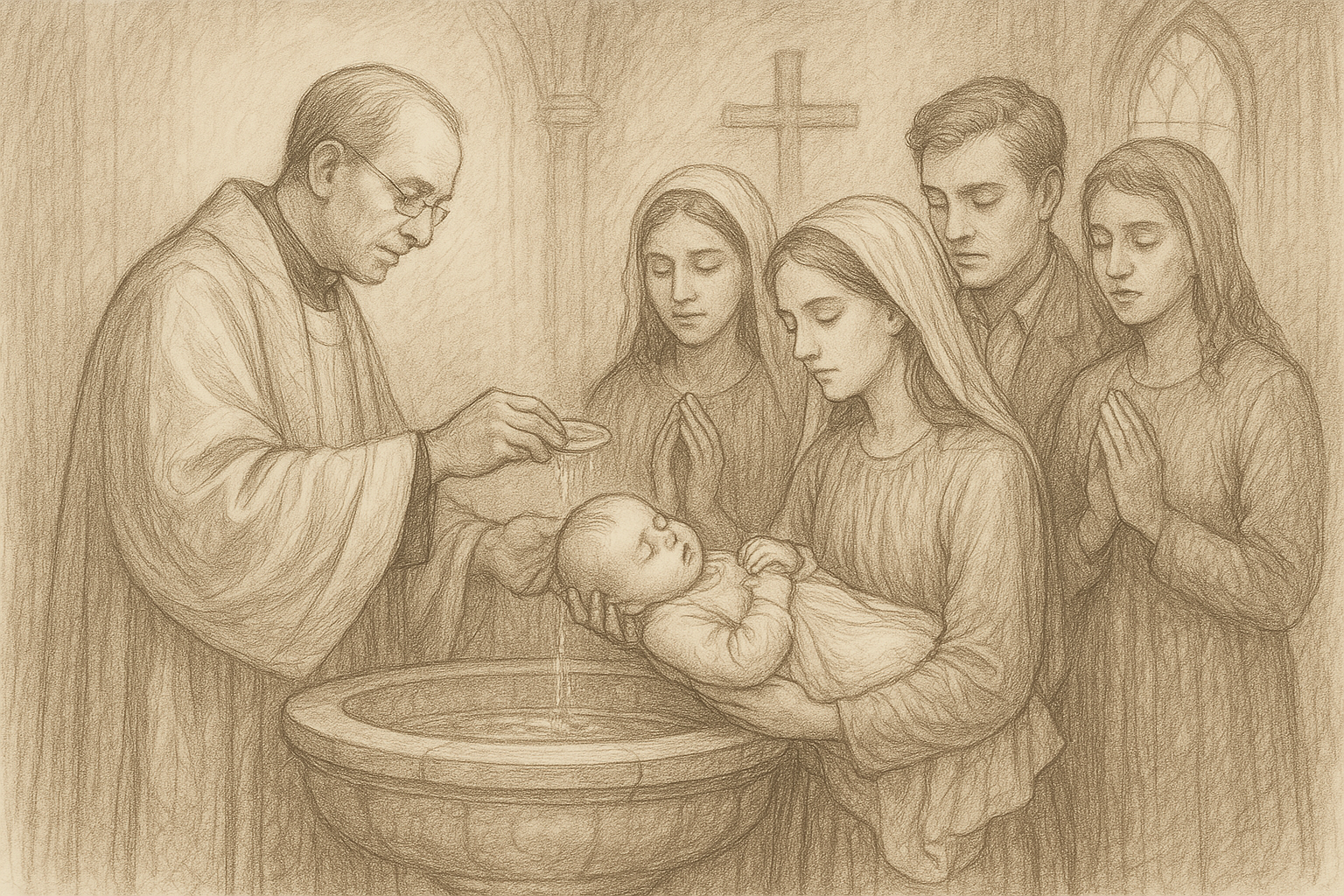
So when a Catholic child is carried to the font, the Church is not acting from sentiment alone, nor from custom detached from Scripture. She is obeying the Lord, trusting the power of grace, and confessing that salvation begins with God's initiative. The water is simple enough for a child, and the mystery it signifies is greater than any child can yet understand. That is exactly why the Church brings him there.
Keep Reading on Lets Read The Bible
Frequently Asked Questions
Does infant baptism save a child automatically?
Catholic teaching says baptism truly gives grace and removes original sin, but it does not replace the need for lifelong faith and perseverance. The child must still be raised in the Church and, when mature, embrace Christ personally.
Why baptize a baby who cannot yet believe?
Because baptism is first God's gift, not human achievement. The Church also sees faith as communal, so parents and godparents profess faith on behalf of the child until the child can make that faith his own.
Is infant baptism supported by Scripture?
Scripture shows a pattern of covenant inclusion, household baptisms, and the promise being given to parents and children. Catholics also read baptism in light of circumcision and the Church's earliest practice.