Doctrine and Questions
Confession in the Quiet: Why Catholics Go to a Priest for Mercy
A clear look at sacramental confession, biblical roots, and the grace Catholics seek when they kneel in the confessional.
Site Admin | June 6, 2026 | 42 views
For many people, confession to a priest explained simply sounds like a church rule added later to the Gospel. Yet Catholics do not approach the sacrament that way. Confession is not a spiritual performance, and it is not a replacement for direct prayer to God. It is one of the ordinary ways Christ continues his work of mercy in the Church. When a Catholic goes to confession, he is not speaking into emptiness. He is seeking the healing forgiveness of God through the ministry Christ entrusted to the apostles.
This is why the sacrament has such a quiet seriousness about it. The confessional is not a courtroom in the harsh sense, but it is also not a casual conversation. It is a sacred place where sin is named honestly and mercy is received concretely. In a time when guilt is often hidden, denied, or treated as meaningless, the Church insists that sin matters because persons matter. Grace matters because wounds are real. And forgiveness matters because Christ truly restores what sin has broken.
What the Church means by confession
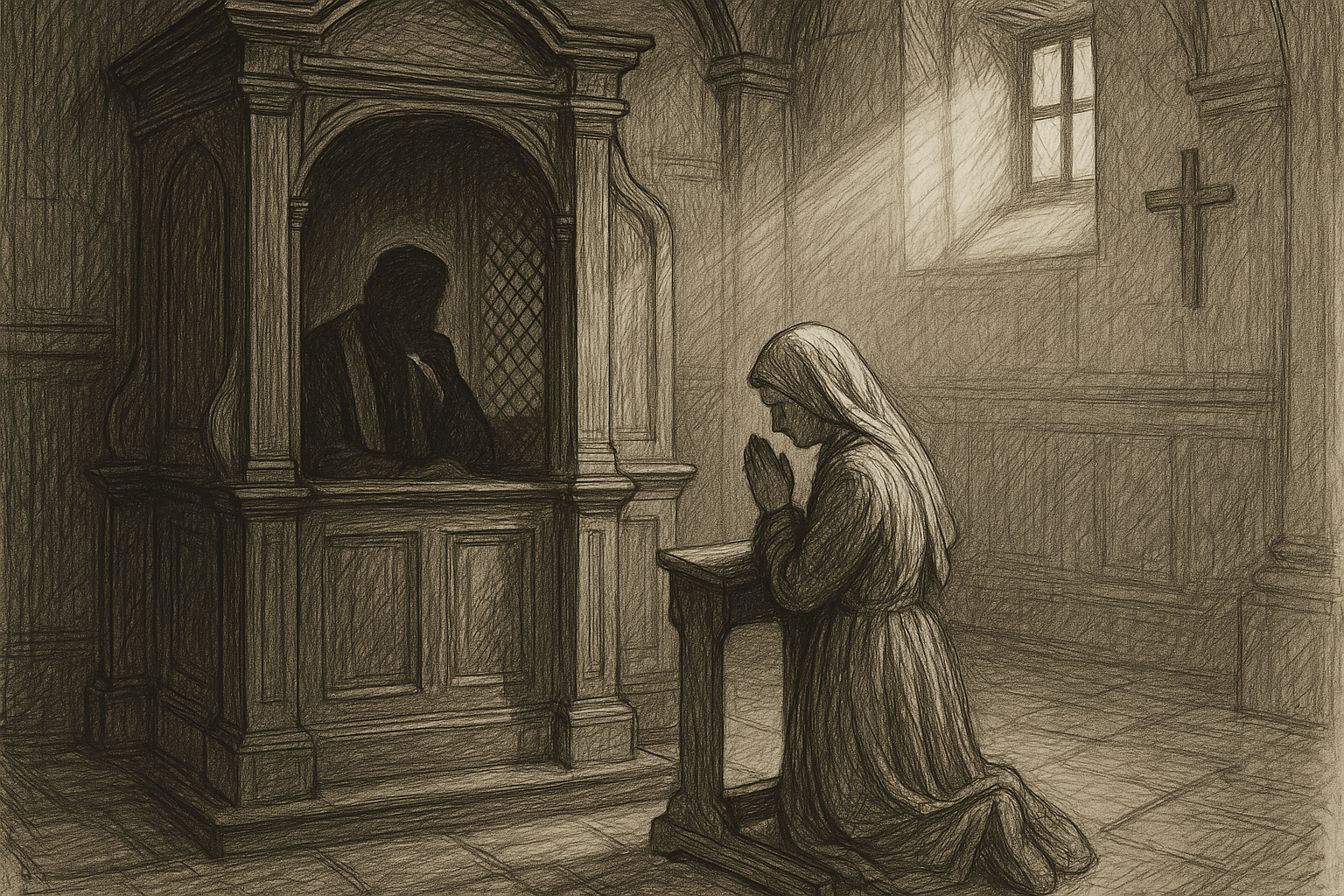
In Catholic teaching, the sacrament of Penance and Reconciliation is the ordinary means by which a baptized person who has sinned after Baptism receives sacramental forgiveness. The penitent confesses sins to a priest, expresses contrition, receives absolution, and performs a penance. The priest does not forgive by his own power. Rather, he acts in the person of Christ and by the authority Christ gave to the apostles and their successors.
This is a crucial point. Catholics do not believe that priests are independent judges standing between God and the soul. They believe that Christ chose to work through visible signs and human ministers. Just as he uses water in Baptism and bread and wine in the Eucharist, he uses the ministry of a priest in confession. The priest's role is not to compete with God's mercy, but to serve it.
That is why Catholics often speak of going to confession rather than simply praying for forgiveness in private. Private prayer is essential and never replaced by the sacrament. But sacramental confession gives something personal and objective. The sinner hears words of absolution spoken aloud. The Church, through the priest, formally reconciles the person to God and to the ecclesial community wounded by sin.
Scripture and the authority to forgive sins
The Catholic practice of confession is rooted above all in the New Testament. After the Resurrection, Jesus appears to the apostles and says, Receive the Holy Spirit, then immediately adds, Whose sins you forgive are forgiven. Catholics have long read this as a direct commission. The apostles are given a real share in Christ's reconciling work. Forgiveness remains God's work, but it is entrusted to human ministers.
The Gospels also show Christ healing souls and bodies in a way that is visible, personal, and authoritative. He tells the paralytic, Your sins are forgiven, and later proves that the Son of Man has authority on earth to forgive sins. The crowd sees that divine mercy is not abstract. It reaches a person through a concrete encounter with the Lord. Confession continues that pattern in the life of the Church.
Another important passage is Confess your sins to one another. This verse does not by itself prove the sacrament, but it does show that Christian life is not meant to be hidden and isolated. Sin is not only private damage. It affects the body of believers. Reconciliation therefore belongs to the Church's life, not merely to a secret inward feeling.
From the beginning, Christians understood that baptism did not eliminate the need for repentance. The New Testament repeatedly calls the faithful to conversion, and the early Church developed penitential discipline to help sinners return. The sacrament of confession grew out of this apostolic and pastoral reality, not from a desire to add burdens to the faithful.
Why a priest at all?
One of the most common questions is simple: if God already knows my sins, why do I need to tell a priest? The answer begins with the fact that Christianity is not only a private religion of individual souls. It is a visible communion. Sin harms our relationship with God, but it also wounds the Church and distorts our own hearts. Because the Church is a body, reconciliation normally takes a bodily form.
Confession to a priest also reflects how God often chooses to heal through mediation. Scripture is full of this pattern. God speaks through prophets. He blesses through priests. He forgives through appointed servants. None of that limits him. It reveals his kindness. He draws near in ways human beings can actually receive.
There is also a pastoral wisdom here. Many sins lose their secret power once spoken aloud in humility. Naming sin clearly before another person breaks the habit of self-deception. It puts shame in the light of mercy. The priest is bound by the seal of confession, so the penitent can speak with complete trust. This makes the confessional one of the safest places for honesty in the Christian life.
For many Catholics, the sacrament is also deeply freeing because it addresses the burden of conscience. People often carry guilt for years, trying to ignore it or minimize it. But a conscience does not heal by silence. It heals by truth and grace. In confession, the penitent hears not guesswork but sacramental certainty: your sins are forgiven. That certainty is not psychological comfort alone. It is a gift from Christ through the Church.
How the sacrament works in practice
The sacrament is simple in structure, though it demands real humility. A person examines his conscience, expresses sorrow for sin, confesses sins sincerely, receives absolution, and completes the penance given. The essential interior disposition is contrition, which means genuine sorrow for sin and a desire to turn away from it.
Catholic teaching distinguishes between mortal and venial sin. Mortal sin destroys charity in the soul and requires sacramental confession for forgiveness when one has the opportunity. Venial sins do not sever friendship with God in the same way, but confession remains a healthy and powerful means of growth. Many Catholics confess venial sins regularly because the sacrament forms conscience, strengthens virtue, and deepens humility.
The priest may offer counsel, but the heart of the sacrament is not advice. It is absolution. The words matter because Christ's mercy matters. After confession, the penitent is called to do the assigned penance and to make amends where justice requires it. Forgiveness does not erase moral responsibility. Instead, it opens the way to repair, healing, and renewed obedience.
It is also worth remembering that confession is not for the spiritually elite. It is for ordinary believers who know they are weak. The saint is not the one who never sins, but the one who returns quickly to the Lord. Frequent confession trains the soul to stop defending itself and start trusting mercy.
Common objections, answered plainly
Some Christians worry that confession to a priest takes away from Christ's unique role as mediator. But Catholic teaching is precisely the opposite. Christ remains the one mediator between God and man, and he chooses to share his reconciling ministry with his Church. A priest does not replace Christ. He is a servant through whom Christ acts.
Others say that private confession is unnecessary because all sins can be confessed directly to God. Catholics agree that personal prayer for forgiveness is necessary and good. Yet the sacrament is not redundant. It is a gift of certainty, accountability, and ecclesial reconciliation. When Jesus chose to give authority to forgive sins, he was not handing the apostles a symbol. He was giving a real ministry.
Still others fear the confessional because they imagine judgment and embarrassment. That fear is understandable, especially if a person has not gone in many years. But the confessional is meant to be a place of mercy, not humiliation. A good confessor listens carefully, protects the seal absolutely, and points the penitent back to Christ. The goal is not to expose a sinner. The goal is to raise a child of God from the dust.
Why this sacrament still matters today
Confession matters because modern life often treats sin as either trivial or hopeless. One attitude says nothing is really wrong, so there is nothing to repent of. The other says that whatever is wrong is permanent, so there is no point in trying to change. The sacrament rejects both lies. It says sin is real, but mercy is stronger. It says the human person can be transformed. It says God does not grow tired of beginning again with us.
It also matters because ordinary Catholic life depends on grace received over time. The Christian life is not sustained by willpower alone. It is built by repeated encounters with Christ's mercy. Confession gives rhythm to conversion. It teaches self-knowledge. It strengthens detachment from sin. It restores peace to the soul. In this sense, the sacrament is not only for crisis moments. It is a school of holiness.
Many Catholics discover that regular confession changes how they pray, how they speak, and how they see others. A person who knows his own need for mercy becomes less harsh. A person who has received forgiveness learns how to forgive. The sacrament shapes the whole moral imagination. It teaches that no sin is hidden from God, and no sinner is beyond his reach.
Mercy is not God's refusal to take sin seriously. Mercy is God's decision to heal what sin has ruined.
That is perhaps the deepest reason confession endures. It is not a relic of a less enlightened age. It is a living encounter with the Lord who still says to his Church, through ordained ministry, that sins can be forgiven, consciences can be cleaned, and hearts can begin again.
For Catholics, confession to a priest explained in full means this: Christ remains present, Christ remains merciful, and Christ continues to reconcile sinners to the Father through the sacramental life he entrusted to the Church.
Keep Reading on Lets Read The Bible
Frequently Asked Questions
Do Catholics believe the priest forgives sins instead of God?
No. Catholics believe God alone forgives sins, but he does so through the priestly ministry Christ established. The priest acts in the person of Christ and speaks the words of absolution by that authority.
Is confession required for every sin?
Catholics are bound to confess mortal sins in sacramental confession before receiving Holy Communion, unless there is a serious reason and no opportunity to confess first. Venial sins may also be confessed and are often brought regularly to the sacrament.
What if I am embarrassed or have not been to confession in a long time?
That is very common. Priests are used to helping people return after long absences, and the sacrament is meant to bring healing, not shame. A simple, honest confession is enough to begin again.