Social Teaching
Love Is Learned Around the Table
How daily family life forms the habits of dignity, solidarity, forgiveness, and service at the heart of Catholic social teaching
Site Admin | October 1, 2026 | 5 views
Before a child can define justice, solidarity, mercy, or the common good, that child usually encounters these realities in the life of a family. Someone answers a cry, prepares a meal, keeps a promise, corrects a fault, or offers forgiveness. Through such ordinary acts, a person begins to learn that love is more than affection. Love seeks the good of another, even when doing so requires patience, sacrifice, and fidelity.
This is why Catholic teaching gives the family such an important place in the moral and social order. The family is not merely a private arrangement or a convenient way to organize domestic life. It is a community of persons founded upon marriage, in which human beings are welcomed, known, and formed. The Church often speaks of the family as the first and vital cell of society and as a domestic church. These descriptions point to the same truth: family life has consequences far beyond the walls of a home.
Love begins with a gift already received
The Catholic vision of family life begins with the dignity of the human person. Scripture teaches that every human being is made in the image of God: Genesis 1:27. Human dignity is not earned by intelligence, independence, health, wealth, usefulness, or social approval. It is given by God.
A healthy family helps make this truth visible. A newborn child has contributed nothing to the household, yet the child is received as someone worthy of protection and care. An elderly relative may need more assistance than he or she can repay, yet remains a member of the family. A person who is sick, unemployed, grieving, or disabled does not lose the right to be loved.
Family life can therefore teach a basic grammar of Christian love: a person is not a problem to be managed or a tool to be used. A person is a neighbor to be loved. This lesson prepares children and adults alike to recognize the dignity of people outside their own household, including those who are poor, isolated, displaced, or otherwise overlooked.
Of course, no family reveals this truth perfectly. Sin, selfishness, exhaustion, and misunderstanding enter every home. The claim that the family is a school of love does not mean that every family experience is loving. It means that the family has a God-given vocation to become a place where love is received, practiced, repaired, and strengthened.
The first lessons are usually small
Much of what families teach is communicated through repeated habits rather than formal instruction. Children notice how adults speak to one another, how conflicts are handled, whether apologies are sincere, and who is welcomed at the table. They learn from the way money is discussed, work is shared, weakness is treated, and prayer is woven into daily life.
Saint Paul describes love as patient and kind, refusing envy, arrogance, and resentment: 1 Corinthians 13:4 and 1 Corinthians 13:5. These qualities may sound lofty, but they become concrete in a household. Patience is practiced when a parent answers the same question again. Kindness appears when siblings make room for one another. Humility grows when a husband or wife admits being wrong. Mercy becomes real when a family refuses to keep a permanent record of every failure.
This formation is reciprocal. Parents have a distinctive responsibility to educate and care for their children, but children also call adults toward generosity, wonder, and self-forgetfulness. Spouses help one another grow in fidelity. Grandparents can transmit memory and wisdom. Brothers and sisters learn that they are not the center of the world. Family members form one another, often without realizing it.
Christian love is not mere niceness. Jesus gives love the shape of self-gift: John 15:12. In family life, this often means choosing another person's good when affection feels weak or circumstances are difficult. It may involve keeping vigil beside a sickbed, listening after a tiring day, remaining faithful during hardship, or doing an unnoticed task simply because it needs to be done.
A living workshop of Catholic social teaching
The major principles of Catholic social teaching are not restricted to public policy or economic debate. They are first habits of seeing and acting, and many of them can be learned within family life.
Human dignity
The family teaches dignity when every member is treated as a person rather than valued according to achievement. This includes unborn children, people with disabilities, aging relatives, and those who require costly or inconvenient care. Respect for life begins with the conviction that dependence does not diminish worth.
The common good
The common good concerns the social conditions that help persons and communities flourish. Within a household, it is learned when members consider what benefits the family as a whole. Not every desire can govern the schedule, budget, or use of shared space. Each person matters, but each person also belongs to others.
This is not the erasure of individuality. Properly understood, the common good protects personal dignity while calling people beyond isolation. A family meal, a shared responsibility, or a decision made with attention to the weakest member can train the heart to seek goods that are truly shared.
Solidarity
Solidarity is more than a passing feeling of sympathy. It is a firm commitment to the good of others because human beings belong to one another. In a family, one member's suffering affects everyone. A child's fear, a parent's unemployment, or a grandparent's illness becomes a shared concern.
This lesson can widen beyond kinship. Jesus identifies himself with people who are hungry, thirsty, sick, imprisoned, or strangers: Matthew 25:40. Families can practice solidarity by praying for those in need, sharing resources, welcoming guests, serving in the community, and refusing language that degrades other groups of people.
Subsidiarity and participation
The principle of subsidiarity teaches that matters should be handled by the smallest competent community, while larger institutions provide needed support rather than unnecessarily taking over. The family has its own proper responsibilities and should be able to fulfill them. Parents, in particular, hold the primary responsibility for the care and education of their children.
At the same time, families do not flourish alone. They may need help from extended family, parishes, schools, medical professionals, charitable organizations, and public institutions. Subsidiarity does not mean abandonment. It respects the proper role of the family while recognizing that larger communities have duties toward families, especially when poverty, illness, violence, or disability creates serious burdens.
Participation also begins at home. Children can be given responsibilities appropriate to their age. Older family members should be heard rather than sidelined. Decisions can include attentive listening. These practices prepare people to contribute to parish, civic, and economic life rather than approaching society only as consumers.
Concern for the poor and vulnerable
Catholic social teaching gives special attention to people whose needs are easily ignored. A family forms this concern when it notices vulnerability without treating it as shameful. Children can learn that food, clothing, housing, education, and health care are serious human needs, not merely abstract topics.
Families do not need abundant wealth to be generous. They can share time, hospitality, prayer, practical assistance, and careful attention. The widow's small offering praised by Jesus shows that generosity is measured not only by quantity but also by the love and sacrifice involved: Mark 12:43.
The domestic church is formed by grace
Calling the Christian family a domestic church does not mean turning the home into a miniature parish or expecting every conversation to become a religious lesson. It means that the home is a real place of discipleship. Through Baptism, prayer, sacramental life, forgiveness, and service, family members help one another follow Christ.
Simple practices can nourish this vocation:
- Praying together regularly, even when the prayer is brief.
- Reading Scripture and allowing God's word to shape family decisions.
- Participating faithfully in Sunday Mass and the sacramental life of the Church.
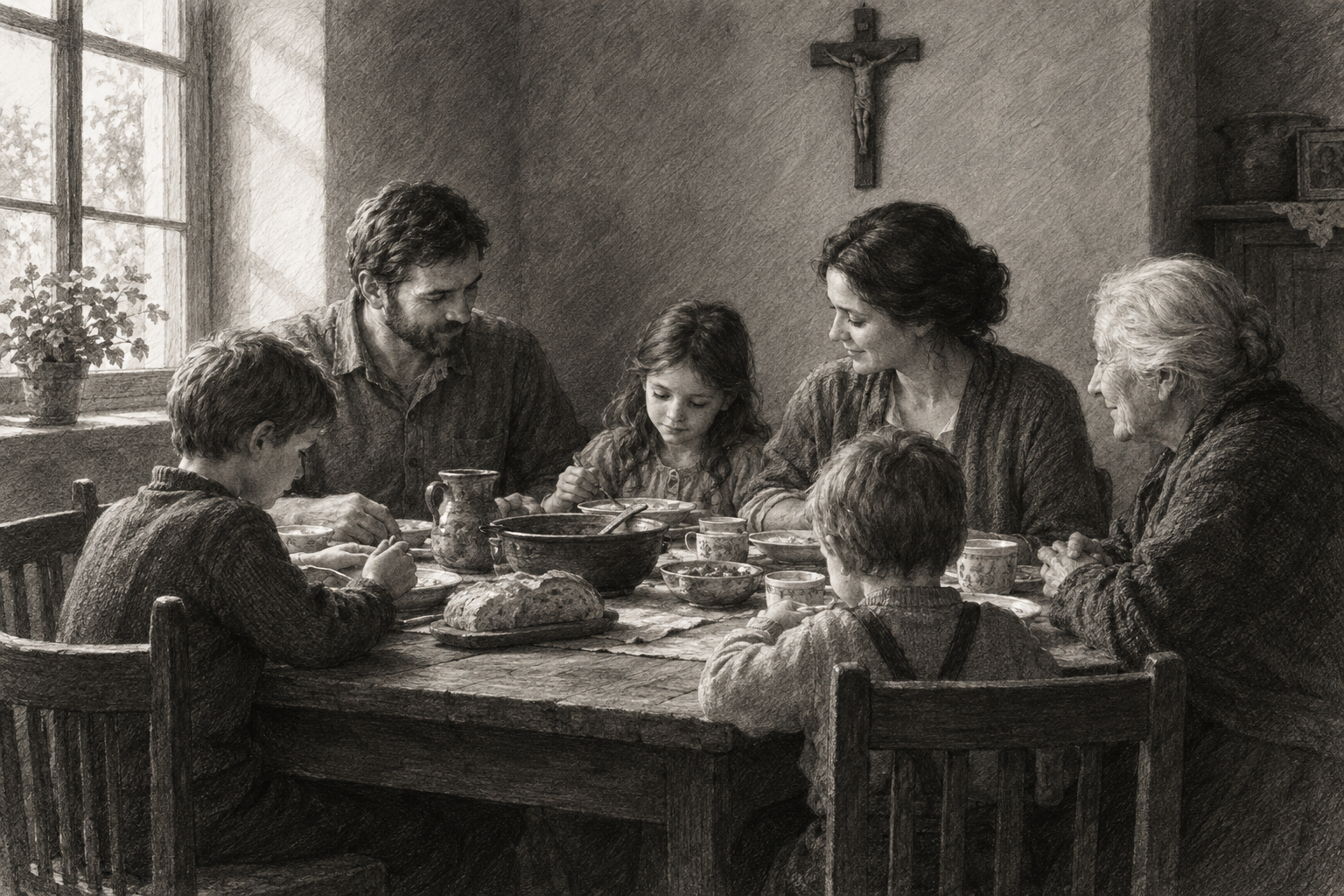
- Giving thanks before meals and remembering people who lack daily necessities.
- Practicing honest apologies and willing forgiveness.
- Marking the seasons of the liturgical year in the home.
- Serving neighbors, parishioners, and relatives in practical ways.
These acts do not guarantee a trouble-free household. They place ordinary family life before God, who can transform even incomplete efforts. The Holy Family itself knew displacement, danger, work, uncertainty, and sorrow. Family holiness is not a protected life without suffering. It is fidelity to God and one another in the midst of real human circumstances.
When the school of love is wounded
Any serious account of family life must acknowledge that many people carry deep wounds from home. Some have experienced abandonment, addiction, manipulation, neglect, or abuse. Others grieve divorce, estrangement, infertility, miscarriage, or the death of someone central to the household. Still others struggle under financial pressure, caregiving demands, or loneliness.
Catholic praise for the family should never be used to deny these realities or pressure someone to remain in immediate danger. Abuse is not an expression of marital sacrifice, parental authority, or Christian forgiveness. Seeking safety and appropriate help can be morally necessary. Pastoral care, professional counseling, lawful protection, and support from trusted people may all have important roles.
The Church also recognizes that families take many lived forms because of death, separation, adoption, migration, and other circumstances. A widowed parent, an adoptive household, grandparents raising grandchildren, or a person caring for an aging sibling can embody profound fidelity and self-giving love. The Christian community should support people in these situations without pretending that their burdens are light.
Where family love has failed, healing may be slow. Forgiveness does not erase truth, remove prudent boundaries, or eliminate the demands of justice. Yet Christian hope holds that wounds need not have the final word. God's grace can work through repentance, wise counsel, sacramental life, patient rebuilding, and the faithful presence of others.
Strong families serve more than themselves
A family faithful to its vocation does not close itself off from the world. Love learned at home is meant to overflow into friendship, parish life, work, and civic responsibility. Hospitality counters isolation. Care for relatives teaches reverence for the elderly. Shared sacrifice prepares people to serve neighbors whose needs bring no personal advantage.
Society, in turn, has a responsibility to respect and support family life. Work, housing, education, health, worship, and community institutions all affect a family's ability to fulfill its duties. Catholics can discuss the best practical approaches with prudence, but the underlying principle remains clear: social and economic life should serve the human person and strengthen, rather than casually weaken, the bonds of family responsibility.
The deepest work of family love is often hidden. It happens in kitchens, bedrooms, cars, hospital rooms, and quiet conversations after everyone else has gone to sleep. Its fruits may not appear for years. Yet each patient response, truthful apology, shared burden, and act of mercy teaches something essential: we are created by love, called to love, and never meant to seek the good alone.
Keep Reading on Lets Read The Bible
Frequently Asked Questions
Why does the Catholic Church call the family the first school of love?
The family is usually the first community in which a person experiences care, responsibility, sacrifice, forgiveness, and belonging. Through daily relationships, family members learn to respect human dignity and seek the good of others. These habits prepare them for life in the Church and society.
How is the family connected to Catholic social teaching?
Family life can form the virtues behind major principles of Catholic social teaching, including human dignity, the common good, solidarity, subsidiarity, participation, and concern for vulnerable people. The family is also a social institution with proper rights and responsibilities that larger communities should respect and support.
Does calling the family a school of love ignore harmful family experiences?
No. Catholic teaching does not require anyone to describe abuse, neglect, or manipulation as love. Families can be seriously wounded by sin and suffering. Seeking safety, justice, pastoral care, professional help, and prudent boundaries may be necessary. The Church's vision names the vocation of family life while also making room for truth, repentance, healing, and protection.