Family and Vocation
Grace at the Kitchen Table: Motherhood as a Daily Vocation
The ordinary work of nurturing a family can become a place of sacrifice, prayer, repentance, and deep communion with God.
Site Admin | November 6, 2026 | 35 views
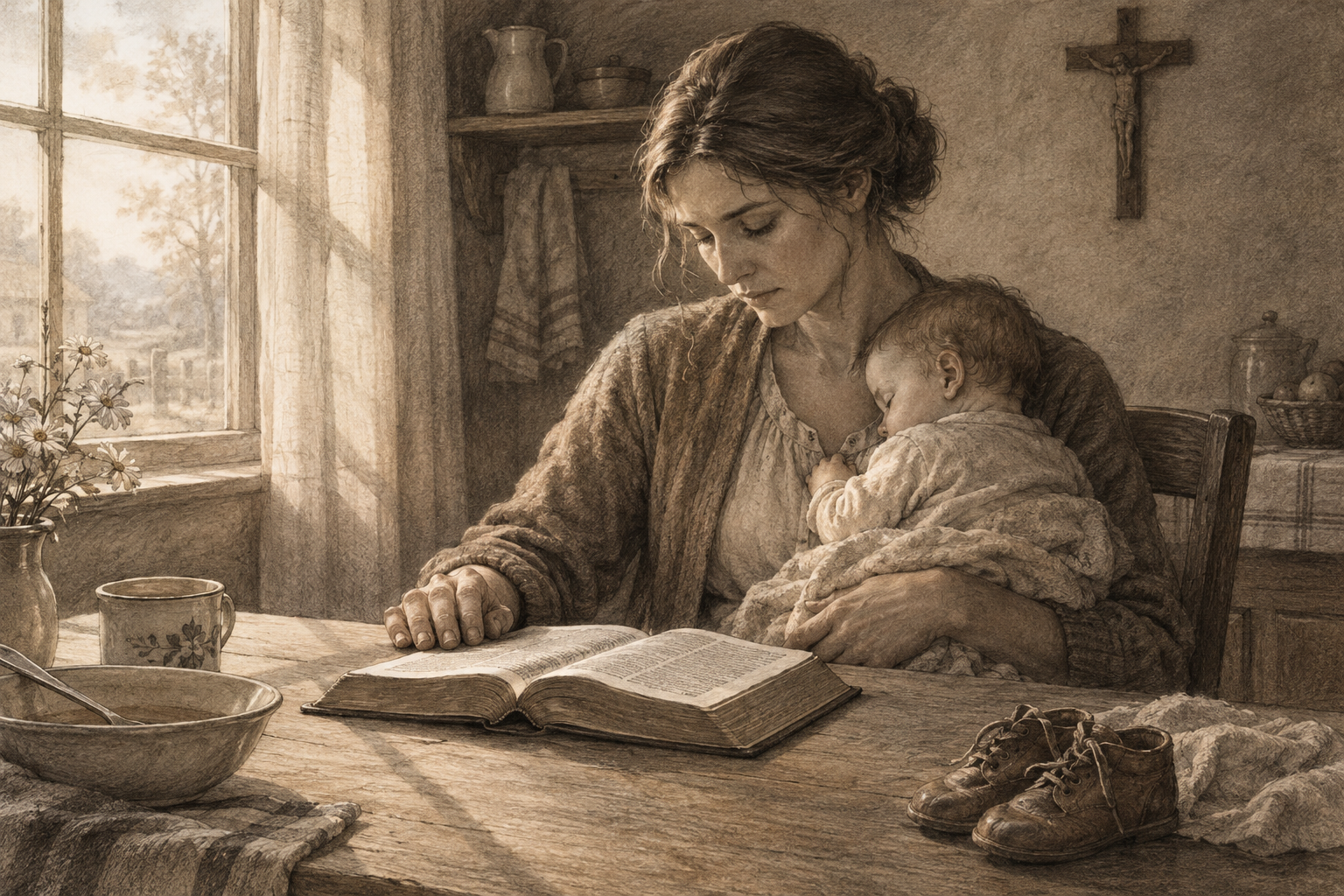
Motherhood is often described with words such as beautiful, rewarding, and life giving. All of them can be true. Yet they do not tell the whole story. Motherhood can also be exhausting, repetitive, lonely, and marked by sacrifice that few people notice. A mother may move through a single day carrying affection, irritation, gratitude, anxiety, humor, and grief. The Catholic faith does not require her to deny any of this. Instead, it reveals how grace can meet her within it.
From a Catholic perspective, motherhood is more than a private lifestyle choice or a set of domestic tasks. It is a vocation to receive and nurture life. That vocation takes different forms and unfolds under different circumstances. Some women become mothers through childbirth, adoption, or foster care. Some carry the sorrow of miscarriage, infertility, or the death of a child. Others exercise a genuine spiritual motherhood through teaching, mentoring, religious life, godparenthood, care for relatives, or faithful service to people entrusted to them.
These experiences are not interchangeable, and each has its own joys and wounds. Yet they can all reveal something about maternal love: it makes room for another person, protects life, and desires that the beloved grow into the person God calls him or her to become.
Motherhood begins with receiving a person
Scripture speaks of children as a gift from the Lord, not as possessions or personal achievements: Psalm 127:3. This conviction establishes the first principle of a Catholic vision of motherhood. A child belongs ultimately to God. Parents receive the responsibility and privilege of caring for a person who has an eternal destiny.
This does not mean that every pregnancy arrives at an easy moment or under peaceful circumstances. It does not make financial concerns, health complications, marital difficulties, or fear disappear. The language of gift is not meant to silence hardship. Rather, it affirms the dignity of the child and reminds the whole Christian community that mothers should not be left to bear their responsibilities alone.
Receiving a child also means gradually accepting that the child is not an extension of the mother. Temperament, talents, weaknesses, and vocation cannot be engineered according to a parent's preferred plan. Maternal love guides and disciplines, but it also learns to release control. A mother is called to help form a conscience, teach virtue, and provide safety while honoring the mysterious freedom of a person created in the image of God.
This is one reason motherhood requires continuing conversion. A mother's love may be generous while still becoming entangled with fear, comparison, or the desire to control outcomes. Grace does not destroy her natural concern. It purifies that concern so that protection can grow into trust and guidance can mature into wise freedom.
The holiness of work that must be done again
Much of motherhood consists of tasks that do not stay finished. Meals are prepared and dishes return. Clothes are washed and become dirty again. A conflict is settled, only for another to arise before bedtime. The same lesson may need to be taught dozens of times. Modern culture often prizes visible achievement, measurable progress, and public recognition. Maternal work frequently offers none of these.
The Gospel, however, gives Christians a different measure of greatness. Jesus places service at the heart of discipleship: Mark 10:45. In his kingdom, hidden acts of love are not wasted. A glass of water, a patient answer, a cleaned floor, or a wakeful hour beside a sick child can become an offering when it is united to Christ.
This does not mean that mothers should romanticize drudgery or accept an unjust division of family labor. Fathers have serious responsibilities toward their children and households. Spouses should communicate honestly, share burdens according to their circumstances, and seek help when strain becomes overwhelming. The recognition that ordinary work can be holy must never become an excuse for neglecting a mother or taking her labor for granted.
Still, there is deep hope in knowing that repetition can be spiritually fruitful. Christian love is rarely proved by one dramatic moment. It is ordinarily formed through small acts of fidelity. The repeated work of motherhood can train the heart in patience, humility, fortitude, and mercy, even when the person doing it feels far from saintly.
Grace does not require a flawless mother
Many mothers carry an exhausting image of the person they believe they should be. She is always patient, organized, prayerful, emotionally available, financially prudent, and able to provide memorable family traditions. Real life quickly exposes the impossibility of this standard.
Catholic faith does not teach that a good mother never fails. It teaches that every Christian depends upon grace. Mothers lose patience, misjudge situations, speak too sharply, and make decisions they later regret. The proper response is neither denial nor despair. It is repentance, repair, and renewed trust in God's mercy.
A sincere apology to a child does not erase parental authority. It can strengthen authority by showing that truth applies to everyone. When a mother says that she acted wrongly and asks forgiveness, she teaches that love does not depend upon pretending to be perfect. She also shows her child how Christians return to God and to one another after sin.
The sacrament of Reconciliation can be especially important in this vocation. It offers more than emotional relief. In the sacrament, Christ forgives sin and supplies grace for conversion. The Eucharist likewise places maternal self-giving within the greater self-giving of Christ. A mother does not save her family through sheer effort. She receives the life of Christ and learns, slowly, to love from that gift.
Mary points toward Christ, not toward comparison
Mary is the Church's foremost example of faithful motherhood, but she should not be turned into an impossible standard used to shame women. The Gospels do not present her life as sheltered from uncertainty or sorrow. Her assent to God was free and courageous: Luke 1:38. She gave birth in humble circumstances, fled danger with Joseph and the infant Jesus, searched anxiously for her son, and stood near the cross.
Mary's faithfulness was not passive. She listened, acted, pondered, endured, and remained open to God's will. Scripture says that she kept the events surrounding Jesus in her heart: Luke 2:19. Her example invites mothers to bring the lives of their children before God, especially when they do not understand what God is doing.
Devotion to Mary should lead a mother toward Jesus. In moments of fear, she can ask Mary to pray for her. In moments of joy, she can give thanks with Mary. In moments when a child's path cannot be controlled, she can remember that even the Mother of Jesus had to entrust her son to the Father's saving plan.
When motherhood includes grief
No reflection on motherhood is complete if it speaks only about healthy children and peaceful homes. Some women long to become mothers and encounter infertility. Some grieve a miscarriage or stillbirth. Some live with a child's serious illness, disability, estrangement, or addiction. Some raise children after abandonment or abuse. Some mourn children who have died.
Christian hope does not ask these mothers to call suffering good. Death, betrayal, illness, and loss remain painful realities. Jesus himself wept at the tomb of Lazarus: John 11:35. Faith permits lament because lament speaks honestly to God rather than turning away from him.
A parish community should not respond to such sorrow with easy explanations. Often the most faithful response is presence: listening without correction, bringing a meal, helping with transportation, remembering an anniversary, arranging practical support, or praying when the grieving person has no words. St. Paul instructs Christians to bear one another's burdens: Galatians 6:2. That command belongs to the whole Church, not only to the mother already carrying more than others can see.
Simple practices for a demanding vocation
A mother's prayer life may look different in various seasons. Long periods of silence may be possible at one stage and nearly impossible at another. The answer is not to abandon prayer until life becomes calmer. It is to build a realistic rhythm of turning toward God.
- Begin with a brief offering. Before checking messages or beginning the day's work, offer the coming hours to God. Name the people and worries already pressing on the heart.
- Pray with one verse. A short passage can remain in the mind during feeding, driving, cleaning, or waiting. Jesus' invitation to the burdened is a fitting place to begin: Matthew 11:28.
- Bless children aloud. A simple prayer before school, at bedtime, or during illness teaches children that their lives rest in God's care.
- Practice honest examination. At the end of the day, notice both grace and failure. Give thanks for one gift, ask forgiveness for one sin, and entrust one unresolved concern to God.
- Protect Sunday worship. Mass with children may feel distracted, but the family still comes before God as it is. The Eucharist is not a reward for a well managed week. It is food for pilgrims who need Christ.
- Ask for concrete help. Humility may mean telling a spouse, friend, relative, pastor, physician, or counselor what is actually happening rather than insisting that everything is fine.
These practices should serve family life rather than becoming another source of guilt. A missed prayer does not prove spiritual failure. Begin again. The Christian life is full of new beginnings, and motherhood offers many opportunities to practice them.
Mothers need the family and the Church
Although motherhood is personal, it is never meant to be isolated. Children ordinarily need the loving presence and responsibility of both father and mother, and mothers need support that respects their dignity. Widowed, separated, abandoned, and single mothers may carry especially heavy burdens. They deserve practical solidarity rather than suspicion or sentimental praise from a distance.
Parishes can honor motherhood through more than annual recognition. They can welcome noisy children, support families in crisis, accompany women facing unexpected pregnancies, provide friendship for mothers at home, respect mothers in paid employment, and remember women whose relationship with motherhood is marked by grief. They can also invite older women to share wisdom without turning differences in custom or circumstance into judgment.
The family is often called the domestic church because it is a primary place where faith is learned and lived. Yet no household can fulfill that calling by itself. The domestic church needs the parish, the sacraments, faithful friendships, and the larger Body of Christ.
Motherhood will not always feel sacred while it is being lived. It may feel like answering one more question, preparing one more meal, waiting through one more difficult night, or praying for a child who has walked away. Yet Christ is present in love that remains faithful. He receives what is offered, heals what is wounded, and supplies what human strength cannot. In his hands, even the most ordinary day can become a place where a mother and her family are quietly drawn toward holiness.
Keep Reading on Lets Read The Bible
Frequently Asked Questions
Is motherhood considered a vocation in the Catholic Church?
Yes. Motherhood can be understood as a vocation because it is a call to receive, nurture, protect, and form human life in love. For a married woman, motherhood is ordinarily lived within the vocation of marriage and the family. Maternal love can also be expressed through adoption, foster care, godparenthood, religious life, teaching, mentoring, and other forms of spiritual motherhood.
How can a busy mother maintain a Catholic prayer life?
A sustainable prayer life can begin with brief, faithful practices: a morning offering, one verse of Scripture, prayer during ordinary work, blessings at bedtime, Sunday Mass, and a short nightly examination of conscience. The goal is not an ideal schedule but a real habit of returning to God throughout the day.
Does Catholic teaching expect mothers to sacrifice their own health and needs?
No. Christian self-giving is not the same as accepting neglect, abuse, or preventable exhaustion. Mothers have human dignity and legitimate needs for rest, health care, friendship, prayer, and support. Fathers, relatives, parishes, and communities share a responsibility to help families and to ensure that mothers are not left to carry every burden alone.