Saints and Witnesses
Joan of Arc and the Kind of Courage That Still Prays
The Maid of Orleans remains more than a legend. Her witness shows how holiness can look fierce, obedient, and startlingly young.
Site Admin | June 1, 2025 | 66 views
A saint who did not fit the world's expectations
St. Joan of Arc is often remembered in terms that belong to history books: a peasant girl, a soldier, a national heroine, a martyr. Those descriptions are true, but they do not reach the center of her witness. The enduring St. Joan of Arc Catholic inspiration comes from something deeper than military success or civic symbolism. It comes from a young woman who believed that God was speaking, who tested what she heard in the light of faith, and who accepted suffering rather than betray the mission she believed had been entrusted to her.
Joan was born around 1412 in Domremy, in a France torn by war and political confusion. She was not educated in the ways of courts or command. She came from a humble family and knew the rhythm of rural life. Yet her story shows that God does not wait for the world to grant permission before raising up witnesses. The Lord chooses whom He wills, and He often does so in ways that unsettle human expectations. Scripture repeatedly shows this pattern: God calls the young, the hidden, and the weak to carry His purposes. Joan belonged to that biblical company of unlikely servants.
Her witness matters because it reminds Catholics that holiness is not a polished performance. It is obedience, purity of heart, and courage under pressure. Joan was not fearless in the sentimental sense. She was tested, questioned, mocked, and eventually condemned. Yet she continued to pray, to speak plainly, and to entrust herself to God. That is a form of courage many believers need today, especially in an age that praises confidence more than fidelity.
Prayer came before action
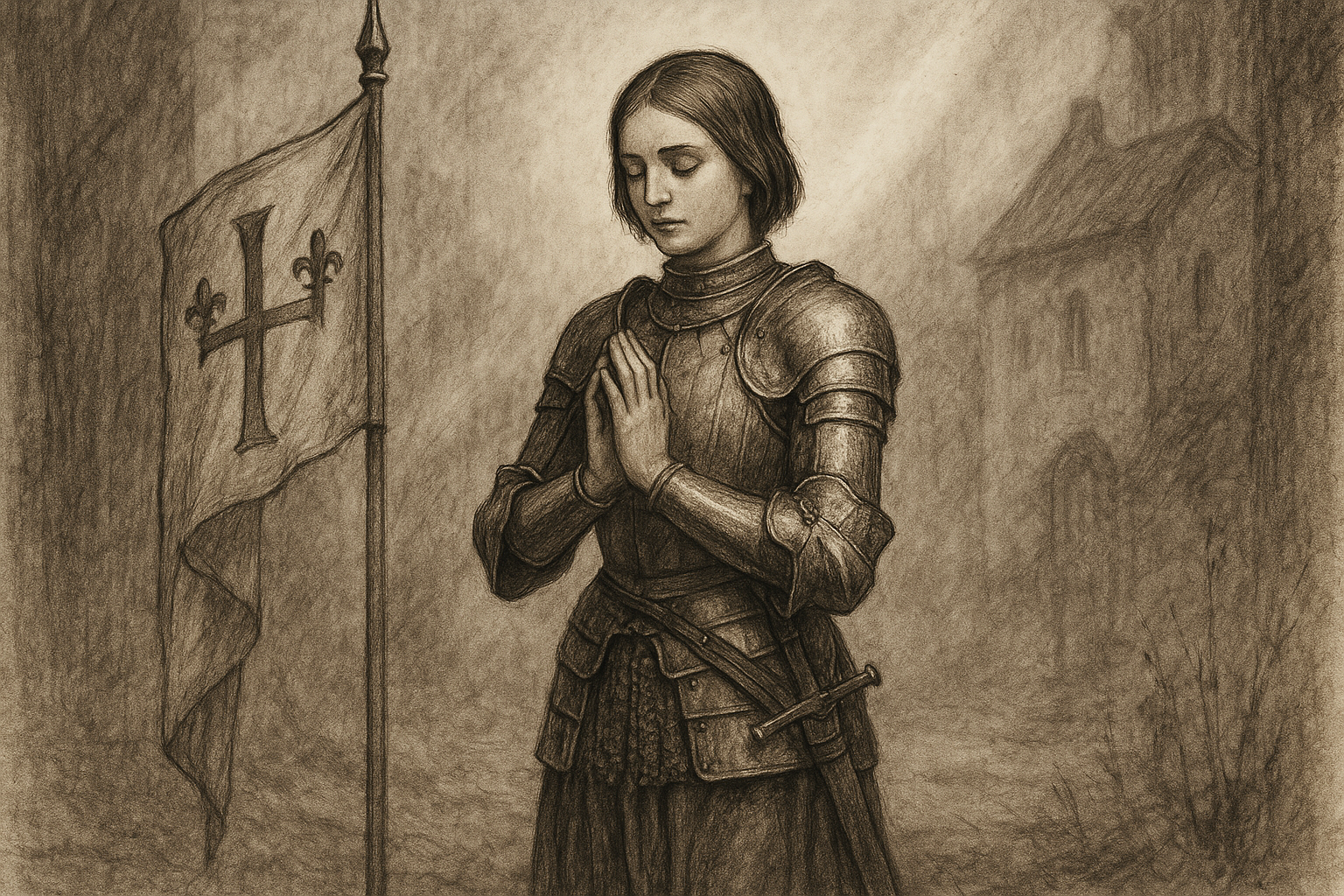
Joan did not begin as a warrior. She began as a girl who prayed. According to the historical record, she reported hearing heavenly voices and receiving guidance from saints, especially St. Michael, St. Catherine of Alexandria, and St. Margaret of Antioch. She did not treat these experiences as private fantasies or spiritual trophies. She submitted herself to ecclesial discernment and sought recognition from Church authorities. In a period when mystical claims could easily become reckless or deceptive, that willingness to be examined is itself significant.
Catholic tradition has always held that authentic grace is ordered toward humility and obedience. Joan's life reflects that order. Her mission was never simply about personal destiny. It was bound up with prayer, confession, the sacraments, and a serious sense of sin and grace. The great spiritual drama of her life was not that she heard voices, but that she tried to follow God's will faithfully in a chaotic world. Her strength did not come from self-invention. It came from trust.
Let it be to me according to your word
That Marian pattern is worth noticing. Joan's faith echoed the response of the Virgin Mary, who also gave herself to God's word before fully seeing how it would unfold. Joan's courage was never independent of prayer. She is compelling precisely because she joined interior surrender and outward action. Catholics can admire her daring, but they should not miss the source of that daring. She was first a listener.
A life shaped by discernment and obedience
Joan's encounter with Charles VII and the French court has long been part of her fame. She convinced leaders to allow her to accompany the army and help lead a campaign to relieve Orlans. Her presence had a powerful effect on morale, and the French achieved a crucial victory in 1429. That result is historically important, but it should not be reduced to military legend. The deeper point is that a young laywoman, with no worldly status, became a sign of hope because she was believed to be sent by God.
At the same time, Joan never belonged to the category of a triumphalist holy figure. She was not a saint of self-display. She wore armor because her mission required it, but she remained sharply aware that her authority was derivative. She insisted that the glory belonged to God. That disposition is profoundly Catholic. It resists the temptation to confuse usefulness with sanctity. A person can be effective and still spiritually hollow. Joan suggests the opposite possibility: a life can be humble and yet bear astonishing fruit.
Her fidelity also reveals something difficult about obedience. Joan obeyed divine direction as she understood it, but she also remained human, finite, and vulnerable. Her mission did not exempt her from suffering. In 1430 she was captured, and after a long and unjust trial she was condemned and burned at the stake in 1431. Her judges sought to discredit her spiritual claims and her political role. She was alone, young, and abandoned by many who had benefited from her courage. Yet she did not recant to save herself.
Here the St. Joan of Arc Catholic inspiration becomes especially strong. Many people can admire courage when victory seems likely. Joan's witness is more severe and therefore more beautiful: she remained faithful when faithfulness cost everything. Catholic holiness often has this shape. It is not simply success with religious language attached. It is fidelity when comfort disappears.
Her trial exposes the cost of speaking truth
Joan's trial remains one of the most sobering parts of her story. The proceedings were politically charged and spiritually distorted. The questions were designed not to seek truth but to trap her. She was pressed on visions, dress, obedience, and authority. Again and again she answered with clarity that belied her age. Even when isolated, she showed a steadiness that startled her interrogators.
One of the most striking elements of her trial is that she refused to surrender the conscience she believed God had formed in her. That does not mean Catholics should treat private discernment as if it automatically overrides the Church. Joan herself sought ecclesial confirmation and lived within the sacramental world of Catholic France. But her case does show that conscience, rightly formed, can require great interior firmness. She stands as a witness against cowardice, flattery, and the fear of human opinion.
Her martyrdom is not merely an example of political injustice. It is a testimony that truth can be hated when it disturbs entrenched power. Joan's words and actions did not fit neatly into the categories her judges wanted. She was too simple to manipulate and too certain to be dismissed. That combination made her dangerous. In that sense, she resembles many biblical witnesses who spoke because they had to, not because it was safe.
God gave us a spirit not of fear
That verse helps explain why so many Catholics continue to turn to Joan for help. Her courage was not a personality trait. It was grace at work in a tested soul. She reminds believers that fear does not have the last word. Fear can be real, even overwhelming, and still not be decisive. The Christian life is not the elimination of dread but the choice to obey God in spite of it.
What makes her witness Catholic, not merely heroic
Many cultures admire heroes, but saints are something more specific. A hero may inspire admiration; a saint points beyond himself or herself to God. Joan was heroic, but she was also a saint because her life was bound to prayer, sacrament, chastity, repentance, and fidelity to Christ. Her witness is Catholic in the fullest sense because it is ordered toward holiness rather than self-making.
Her virginity also mattered to her identity, as it does in the Church's remembrance of her. Joan lived with an unusual purity of purpose. This was not fragility or passivity. It was integrated dedication. In the Catholic imagination, virginity can signify undivided belonging to God. Joan's life, though lived in armor and danger, reflected that kind of belonging. She gave herself without reserve to the mission she believed God had placed before her.
Her canonization came centuries later, and her life was carefully examined by the Church before she was declared a saint. That process matters. The Church does not canonize legends merely because they are inspiring. It discerns witness. In Joan's case, the Church recognized a life that had been distorted by enemies, misunderstood by contemporaries, and finally vindicated by the truth of her holiness. That vindication is part of her appeal. God is not mocked forever. Truth may be condemned in one generation and honored in another.
Joan also speaks powerfully to lay Catholics. She was not a cloistered mystic, nor a priest, nor a theologian. She was a baptized young woman living in the world. Her sanctity reminds the faithful that holiness is not reserved for one state of life. The baptized are called to belong to Christ in the concrete circumstances of ordinary life, whether in homes, fields, offices, classrooms, or public service. Joan shows that a lay vocation can be luminous when it is surrendered to God.
Reasons her witness still steadies Catholics
There are many reasons St. Joan of Arc remains a source of Catholic inspiration, but a few stand out clearly.
- She joins prayer and action. Joan did not separate spiritual life from real responsibility. She prayed, listened, and then acted.
- She shows that holiness can be young. Her age is part of the force of her story. God does not wait for decades of worldly experience before calling someone to witness.
- She teaches fidelity under pressure. Joan endured interrogation, betrayal, and death without surrendering what she believed God had asked of her.
- She keeps courage from becoming pride. Her confidence was not self-celebration. It was rooted in obedience.
- She encourages Catholics who feel powerless. Joan had no institutional advantage at the beginning. She was poor, unimportant, and easily dismissed, yet God used her.
These reasons matter because many believers struggle to believe that their own lives can bear meaning. Joan argues otherwise. She suggests that God can work through the person who prays sincerely, acts faithfully, and does not measure success by worldly standards. Her witness tells the Church that fidelity is never wasted, even when the visible outcome looks tragic.
The courage of a saint who still points upward
It is tempting to remember Joan only as a symbol of national identity or feminine strength. Those themes are not false, but they are incomplete. The Church keeps her memory because her life points beyond itself. She directs attention upward. She teaches that courage is not a self-generated virtue but a gift received in trust. She reminds Catholics that prayer can produce astonishing resolve, and that suffering does not cancel holiness.
For believers who feel the pressure to compromise, Joan offers a bracing alternative. She invites Catholics to be truthful, clean of heart, and ready to obey God even when the cost is high. She also offers consolation to anyone who wonders whether a small life can matter. Joan's answer is yes, if it is given to God. Her life was short, but it was not small. Its significance continues because grace made it fruitful.
That is why St. Joan of Arc Catholic inspiration endures. She remains a witness to the fact that holiness can wear armor, speak plainly, and walk willingly into fire. She did not live to protect herself. She lived to serve the Lord she trusted. And in that service, she still steadies the Church.
Keep Reading on Lets Read The Bible
Frequently Asked Questions
Why is St. Joan of Arc important to Catholics today?
She shows that holiness can be active, courageous, and deeply prayerful. Catholics see in her a witness to obedience, chastity, and fidelity under pressure.
Was St. Joan of Arc mainly a military hero or a saint?
Historically she was both, but the Church remembers her foremost as a saint. Her military role mattered, yet her enduring meaning comes from her faith, prayer, and martyrdom.
What can Catholics learn from Joan of Arc's trial and death?
Her trial shows the cost of standing for truth when powerful people resist it. Her death teaches that faithfulness to God matters even when it leads to suffering.