Saints and Witnesses
Joan of Arc and the Strange Strength of Holiness
A Catholic look at a young saint who listened, acted, suffered, and remained faithful to Christ.
Site Admin | May 31, 2025 | 79 views
A saint whose life refused easy categories
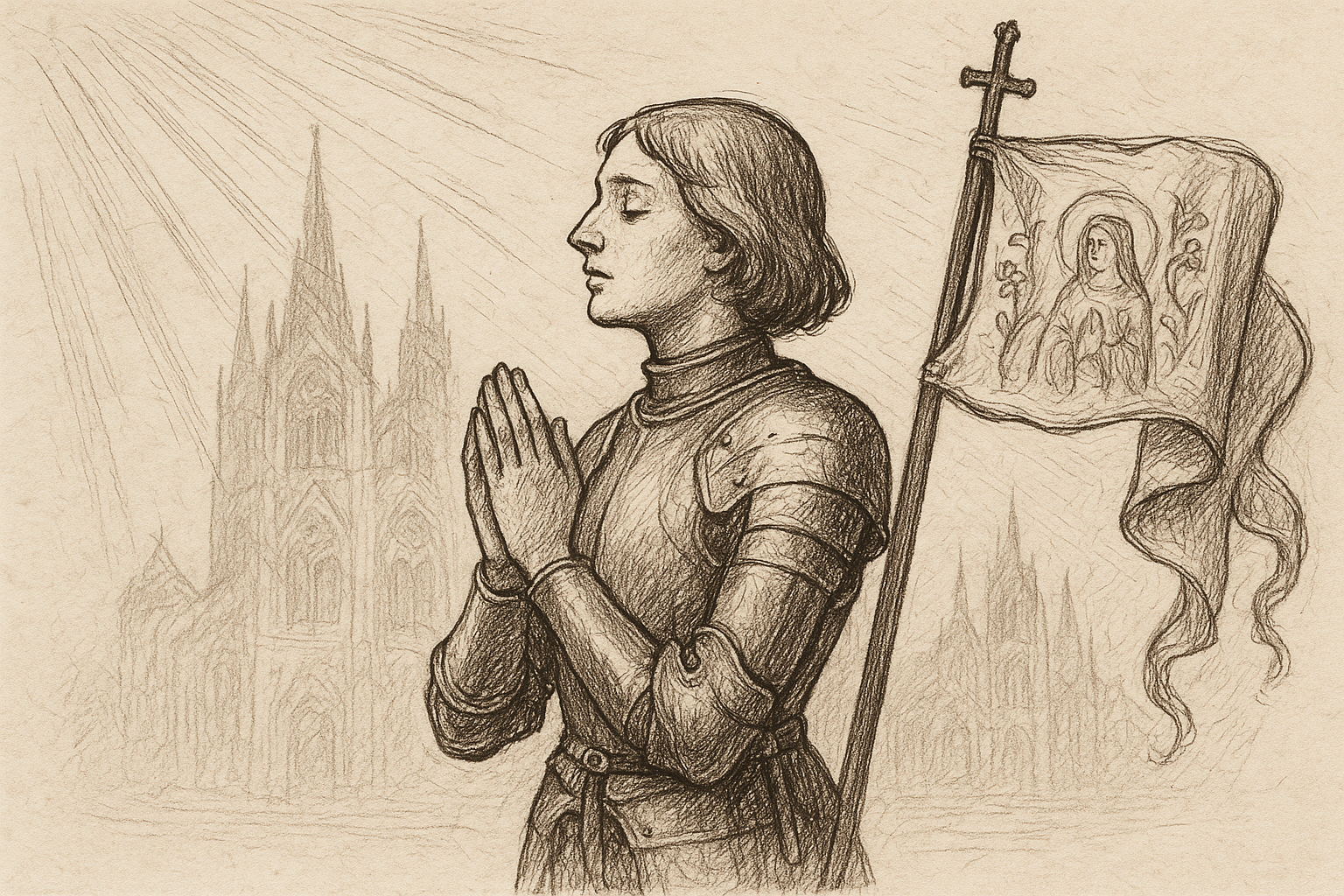
St. Joan of Arc is one of the most striking figures in Catholic history because her life does not fit neat assumptions about holiness. She was not a cloistered religious, a scholar, or a bishop. She was a young lay woman from Domremy in France, born around 1412, who lived in a time of war, political instability, and religious confusion. Yet the Church remembers her as a saint because her life, however brief, was marked by prayer, courage, and a steady willingness to obey God.
The phrase St. Joan of Arc life often brings to mind armor, banners, trials, and flames. Those events matter, but they are not the whole story. Joan's witness begins much earlier, in an ordinary village and in an extraordinary interior call. She belonged to the world of sheep, fields, and family labor before she belonged to history books. That ordinary beginning is part of what makes her so compelling. Holiness does not always begin with influence. Sometimes it begins with listening.
Her early life and the first stirrings of a call
Joan grew up in a devout Catholic family. The France of her childhood was divided by the long conflict with England, and many people lived under fear and uncertainty. Joan herself later testified that from about the age of thirteen she began to experience voices and visions that she understood as coming from St. Michael the Archangel, St. Catherine of Alexandria, and St. Margaret of Antioch. These experiences were central to her sense of vocation, though they were also the subject of intense scrutiny later on.
Whatever one thinks in abstraction about mystical experiences, the Church has always insisted on discernment. Private revelations are never equal to the Gospel, and they must be tested. Joan did not present herself as a prophet apart from the Church. She sought confession, Mass, and the judgment of ecclesiastical and civil authorities. Her life shows that authentic spiritual promptings do not make a person self-willed. They should lead to humility, clarity, and obedience to what is right.
At a young age, Joan believed she was called to help Charles VII and to support the defense of France. She did not arrive as a trained commander or a political strategist. She came as a believing daughter of the Church who thought God was asking something difficult. That alone makes her story worth pausing over. Many people are willing to admire sanctity when it stays private. Joan reminds us that God can ask for public witness as well.
From peasant girl to leader in a time of war
Joan's journey from Domremy to the French court was difficult and unusual. She had to convince skeptical men that she was not deranged or deceitful. Eventually she was allowed to meet Charles VII. Her presence, confidence, and apparent conviction made an impression. She was examined by theologians, and she was not simply given a military role without scrutiny. The record shows a mixture of caution, interest, and political calculation.
Once accepted, Joan became a visible symbol of hope for the French cause. She urged decisive action and accompanied troops in the defense and liberation of Orleans. Her role was not merely ceremonial. She was present, exhorting, praying, and encouraging the army. The campaign at Orleans became one of the most famous episodes in her life, and it helped shift the morale of the French forces.
Still, it would be a mistake to reduce Joan to battlefield success. Military victory is not holiness, and the saints are not canonized for winning. Joan's significance lies in the fact that she believed her duty came from God and then acted on that conviction with remarkable steadiness. Her courage was not bravado. It was rooted in a life shaped by prayer and sacrifice.
She is often remembered for the sword, but her deeper strength came from a soul willing to say yes to God.
Obedience, discernment, and the cost of fidelity
One of the most important lessons from the St. Joan of Arc life is that obedience to God can be costly. Joan's mission did not lead to public admiration without resistance. She was wounded, captured, and eventually handed over to her enemies. Even then, she did not collapse into despair. Her fidelity was tested not only in action but in suffering.
In prison, Joan was denied many basic forms of human dignity. Her trial at Rouen was shaped by politics as well as theology, and it became a tragic example of how authority can be misused. The accusations against her were complex, but at the center was a desire to discredit the young woman who had become an unsettling sign of conviction and national hope. She was questioned about her visions, her clothing, her obedience, and her motives. In the end, the trial led to her execution in 1431, when she was burned at the stake at about the age of nineteen.
Her death was not the final verdict on her life. Years later, a retrial examined the earlier proceedings and cleared her name. The Church ultimately recognized her sanctity, and she was canonized in 1920 by Pope Benedict XV. The long arc of her story shows that truth can be obscured for a time, but it does not disappear. God can vindicate the faithful in His own way and time.
What Joan's courage looked like in Catholic terms
Many people admire courage when it looks dramatic, but Christian courage is usually more demanding than spectacle. It means doing the next right thing when fear is present. It means remaining truthful when lies are rewarded. It means keeping one's conscience formed by prayer and the sacraments instead of by applause.
Joan's courage had several distinctly Catholic features:
- She prayed before she acted. Joan's mission was never simply activism. It was rooted in prayer and a sense of divine calling.
- She accepted the need for discernment. She did not treat her experiences as a private license to do whatever she wanted.
- She suffered without surrendering her conscience. Even under pressure, she did not simply say what her judges wanted to hear.
- She remained connected to the Church. Her devotion was not detached from sacramental life.
This is a useful pattern for Catholics today. We are often tempted to imagine courage as loud confidence or constant certainty. Joan suggests something different. Courage can be quiet, costly, and disciplined. It can look like obedience when no one else understands. It can look like standing alone for a truth that cannot be negotiated.
Lessons for Catholics living in a hesitant age
Joan's life speaks powerfully to Catholics who feel torn between fear and action. She was young, uncredentialed, and surrounded by forces far greater than herself. Yet she did what she believed God was asking. That does not mean every strong impression in our own lives should be acted upon immediately. It does mean we should not assume that holiness requires us to be older, safer, or more influential before we can serve.
Her example invites a few practical reflections.
- Take prayer seriously. A life that is always rushed will struggle to hear God clearly.
- Do not despise small beginnings. Joan came from an ordinary village, not a place of worldly importance.
- Respect discernment. Faith does not ask us to abandon reason. It asks us to submit reason to truth.
- Expect suffering with fidelity. Doing God's will does not guarantee comfort, but it does give meaning to suffering.
- Be willing to stand for what is right even when misunderstood. Joan was misunderstood by many, yet she remained faithful.
For Catholics, Joan is also a reminder that sanctity can involve public responsibility. Not everyone is called to the same work, and not every lay person will be placed in a position of national leadership. But all of us are called to witness in our own sphere, whether in family life, work, parish life, or moments of personal decision. The measure of holiness is not visibility. It is fidelity.
The young saint who still unsettles and inspires
St. Joan of Arc continues to fascinate because she is both accessible and extraordinary. She was not a mythic figure detached from history. She was a real girl who prayed, listened, acted, endured, and died. She also remains a challenge to modern assumptions about power. She was not given authority by age, class, or training. She was given a mission she believed came from God, and she answered with remarkable trust.
That trust did not make her life easy. It made her meaningful. Catholics who look at her life can see that holiness is not an abstract ideal. It has a shape, and sometimes that shape includes confusion, courage, sacrifice, and a willingness to be judged by the world while remaining faithful to Christ.
In the end, the story of Joan of Arc is not only about France, war, or martyrdom. It is about a young believer who would not let fear have the last word. Her life still asks whether we are willing to obey God when the path is costly, and whether we trust that truth is worth more than safety. That question has not grown old.
Keep Reading on Lets Read The Bible
Frequently Asked Questions
Was St. Joan of Arc a nun or a soldier?
Joan of Arc was not a nun. She was a lay woman who became associated with military leadership during the defense of France, but her deeper identity in the Church is as a saint and martyr.
What were the visions Joan of Arc reported?
Joan said she received visions and voices associated with St. Michael, St. Catherine of Alexandria, and St. Margaret of Antioch. The Church treats such private revelations with discernment and does not place them on the level of Scripture.
Why is St. Joan of Arc important for Catholics today?
Joan's life shows that holiness can include courage, discernment, obedience, and suffering. She is a reminder that God can call even the young and ordinary to strong witness.