Saints and Witnesses
St. Maximilian Kolbe and the Courage of a Life Offered Back to God
A brief life can still bear a vast witness when it is shaped by prayer, Marian devotion, and fearless charity.
Site Admin | May 27, 2025 | 81 views
Some saints are remembered first for what they built, taught, or wrote. St. Maximilian Kolbe is remembered above all for a final act of charity so radiant that it gathers up his whole life. Yet the martyrdom at Auschwitz was not an isolated moment. It was the fruit of years of prayer, discipline, missionary zeal, and a steady desire to belong entirely to Christ through the Immaculate Virgin Mary.
The St. Maximilian Kolbe life story is not the story of a man who drifted into holiness by accident. It is the story of a Franciscan friar who took grace seriously. He believed that the Church needed disciplined minds, courageous hearts, and souls willing to be spent for the salvation of others. That conviction shaped his preaching, his publishing apostolate, and finally his death.
From a Polish home to a lifelong yes to God
Maximilian Maria Kolbe was born in 1894 in Poland, then under foreign rule. His family was devout, and from an early age he was drawn to prayer and the Catholic faith. A childhood story often told about him describes a deep moment of grace in which he asked the Blessed Virgin Mary what would become of him. In response, he was shown two crowns, one white for purity and one red for martyrdom. Whether read as a vision or as a way of expressing a profound childhood conversion, the story points to a basic truth about his life: he wanted to belong to God entirely.
He entered the Conventual Franciscans and eventually took the name Maximilian. Franciscan life gave him a framework for poverty, obedience, and missionary service, but he did not become passive. He studied in Rome and was ordained a priest in 1918. His years of formation sharpened both his intellect and his apostolic instincts. He understood that modern unbelief did not only require pious feeling. It required truth, charity, and organized evangelization.
A Marian heart with missionary purpose
Kolbe's spirituality centered on the Immaculate Conception. For him, devotion to Mary was never a sentimental add-on. It was a way of belonging more perfectly to Jesus Christ. He entrusted himself to her completely and wanted others to do the same, not because Mary replaces Christ, but because she leads faithfully to him.
This Marian devotion was practical and missionary. In 1917 he helped found the Militia Immaculatae, or Army of the Immaculate. Its purpose was simple and bold: to seek the conversion and sanctification of souls through prayer, witness, and apostolic effort under Mary's patronage. Kolbe was not afraid of the modern world, but he also was not naive about it. He saw that secular ideologies could erode faith, family life, and moral clarity. His answer was not bitterness. It was evangelization.
He later founded and developed Niepokalanow, the City of the Immaculata, a large Franciscan center in Poland dedicated to publishing and missionary work. There, priests and brothers produced books and periodicals to spread the faith widely. This was a strikingly modern apostolate for a saint known above all for martyrdom. He believed printing presses could serve the Gospel if they were guided by prayer, humility, and fidelity to the Church.
Holiness in ordinary labor
It is easy to focus on Kolbe's death and miss the long obedience that made that death meaningful. He did not live by inspiration alone. He lived by routine. He prayed, he organized, he wrote, he served, and he kept working even when the task was hidden, repetitive, or burdensome.
That detail matters for Catholics today. Many people would like to be heroic in a single crisis, but the saints show that heroic charity usually grows from ordinary fidelity. Kolbe's life reminds us that a soul prepared for sacrifice is often a soul trained by daily prayer, disciplined habits, and concern for concrete apostolic work. The love that gives itself completely in one terrible hour has usually been practicing self-gift for years.
His missionary vision also had a strong sense of realism. He wanted to reach people through the media available to him, but always for the sake of conversion. He did not reduce the faith to slogans. He knew that souls need beauty, explanation, and witness. His publications were meant to make Christ known and loved, especially among those who had drifted far from the Church.
Auschwitz and the triumph of charity
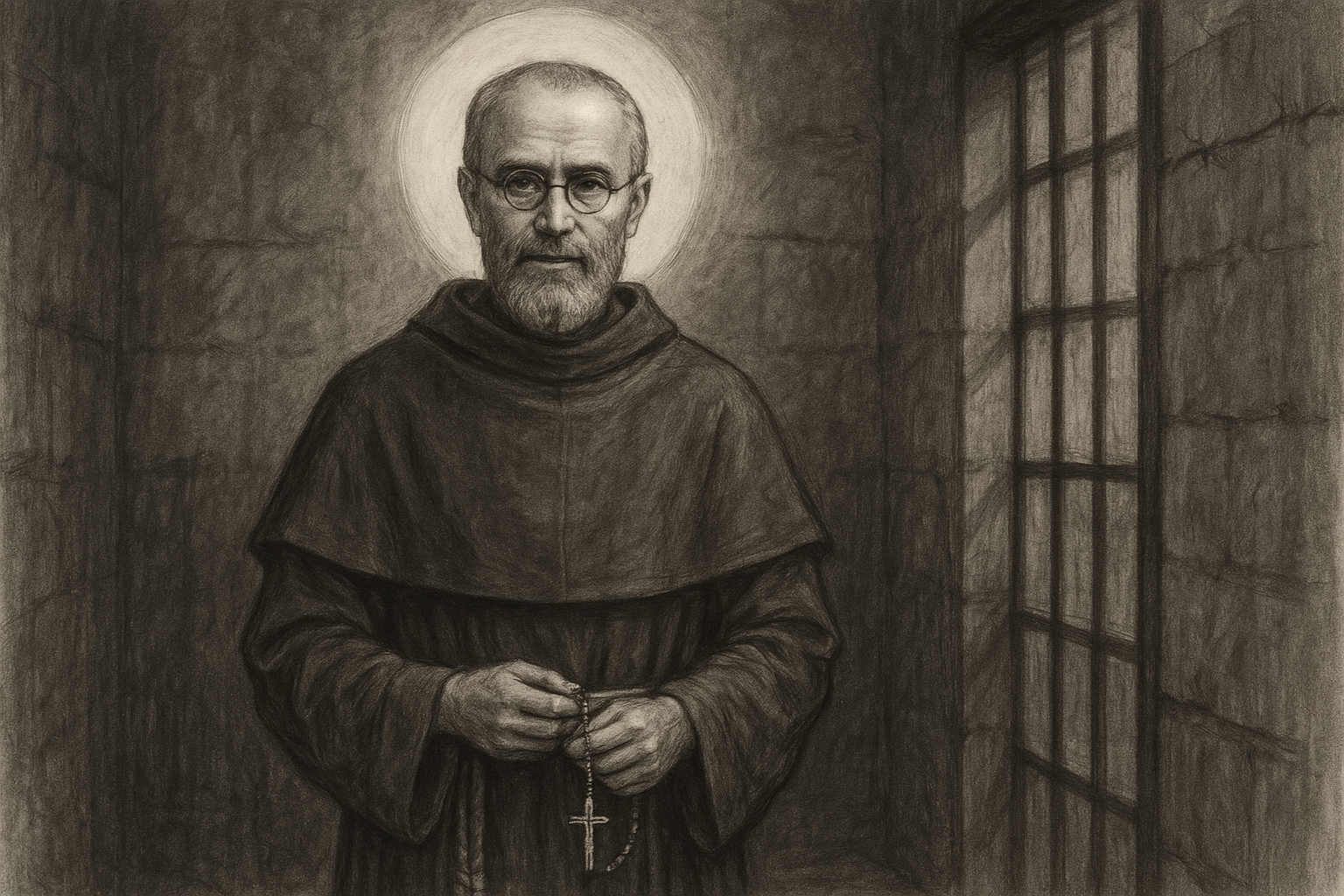
When Nazi Germany invaded Poland, Kolbe's apostolate was disrupted, and he was eventually arrested and sent to Auschwitz in 1941. There, the camp's brutal logic reduced human beings to numbers and terror. In that darkness, Kolbe's priesthood became luminous.
After a prisoner escaped, the camp authorities selected ten men to die by starvation as punishment. One of the condemned, Franciszek Gajowniczek, cried out for his wife and children. Kolbe stepped forward and offered to take his place. The request was not sentimental. It was an act of deliberate self-sacrifice, freely chosen in a place built to destroy freedom. The guards accepted the exchange.
In the starvation bunker, Kolbe helped sustain the other prisoners with prayer and calm. Witnesses later recalled that he remained serene, gathering the men around him as they faced death. After two weeks, he was still alive and was finally killed by lethal injection on August 14, 1941, the eve of the Assumption of the Blessed Virgin Mary.
The Church canonized him as a martyr of charity. That phrase is important. Kolbe did not merely die as a victim of violence. He made a conscious offering of his life out of love. His death was one final expression of the same self-giving charity that marked his ministry, his Marian consecration, and his life of apostolic labor.
Greater love has no one than this, that one lay down his life for his friends. John 15:13
What his witness asks of Catholics now
St. Maximilian Kolbe does not ask modern Catholics to imitate his death. He asks us to imitate his surrender. His life raises several practical questions.
Do I belong to Mary in a real way? Kolbe's Marian devotion was not decorative. He trusted that consecration to the Mother of God would deepen his union with Christ. Catholics today can learn from his confidence that Marian devotion strengthens, rather than distracts from, Christian discipleship.
Do I use my gifts apostolically? Kolbe recognized the power of communication. He used writing, publishing, and organization in service of the Gospel. Catholics with talents in teaching, media, design, administration, or public speaking can ask how those gifts might better serve the Church.
Am I willing to choose charity when it costs me? Kolbe's sacrifice at Auschwitz was extraordinary, but charity begins in smaller choices: patience, forgiveness, truthful speech, fidelity in hidden duties, and concern for those who cannot repay us.
Do I prepare now for suffering? No one knows what trials may come. Kolbe's life suggests that prayer, sacramental life, and steady discipline help the soul remain free under pressure. The Christian who learns to give thanks in ordinary hardship may be better prepared for grave suffering if it arrives.
A saint for a frightened age
Many Catholics feel pulled between fear and fatigue. The culture can seem restless, fragmented, and spiritually thin. Kolbe speaks into that atmosphere with unusual strength because he united contemplation and action. He loved the Blessed Virgin Mary, respected the modern world enough to address it directly, and did not shrink from sacrifice when love required it.
His witness also corrects a common misunderstanding of holiness. Holiness is not merely the absence of sin, though it is certainly that. It is also the active, deliberate offering of oneself to God. Kolbe's life shows that a saint can be a thinker, a builder, a communicator, a brother, a priest, and finally a martyr, all at once.
When Catholics ask how to remain faithful in difficult times, St. Maximilian Kolbe offers a clear answer: pray with confidence, work with purpose, trust Our Lady, and let charity have the last word. His life was brief in years, but not in fruit. It still calls the Church to a more generous surrender to Christ.
Keep Reading on Lets Read The Bible
Frequently Asked Questions
Why is St. Maximilian Kolbe called a martyr of charity?
He freely offered to take the place of another prisoner who had been sentenced to die at Auschwitz. Because he chose death out of love for another person, the Church honors him as a martyr of charity.
What was St. Maximilian Kolbe's relationship to the Blessed Virgin Mary?
Kolbe had a deep Marian devotion centered on the Immaculate Conception. He believed consecration to Mary leads souls more fully to Jesus Christ, and he built his apostolic work around that conviction.
What can Catholics learn from the St. Maximilian Kolbe life story today?
His life teaches the value of daily prayer, disciplined work, Marian devotion, and practical charity. He shows that holiness grows through ordinary fidelity long before it is revealed in extraordinary sacrifice.