Saints and Witnesses
St. Thomas Aquinas and the Peace of a Mind Ordered to God
A Dominican friar, teacher, and saint whose life shows how truth, prayer, and humility belong together.
Site Admin | May 16, 2025 | 76 views
A saint for thinkers, students, and ordinary believers
St. Thomas Aquinas is often remembered as the great Doctor of the Church who gave Christians a vast and careful theological legacy. Yet his lasting appeal is not only intellectual. He remains a powerful witness because his mind was never detached from prayer, obedience, or reverence before the mysteries of God. For Catholics, that is part of the enduring St. Thomas Aquinas Catholic inspiration: he shows that truth is not a possession to display, but a gift to receive.
Thomas was born around 1225 in the region of Aquino in central Italy. He was sent for education, entered the Dominican Order despite strong family resistance, studied at major centers of learning, and later taught in Paris and elsewhere. He wrote with remarkable clarity on God, creation, grace, virtue, the sacraments, and the moral life. But the details of his biography matter most when we see the shape of his soul. Thomas wanted to know reality as God made it, and he wanted that knowledge to lead him closer to God.
His life joined contemplation and discipline
Thomas Aquinas did not become a saint because he was merely brilliant. He became a saint because his brilliance was offered back to God. This is one reason Catholics return to him again and again. In an age that often separates intellect from devotion, he reminds us that the Christian life is meant to be integrated. We are called to love God with the mind as well as with the heart.
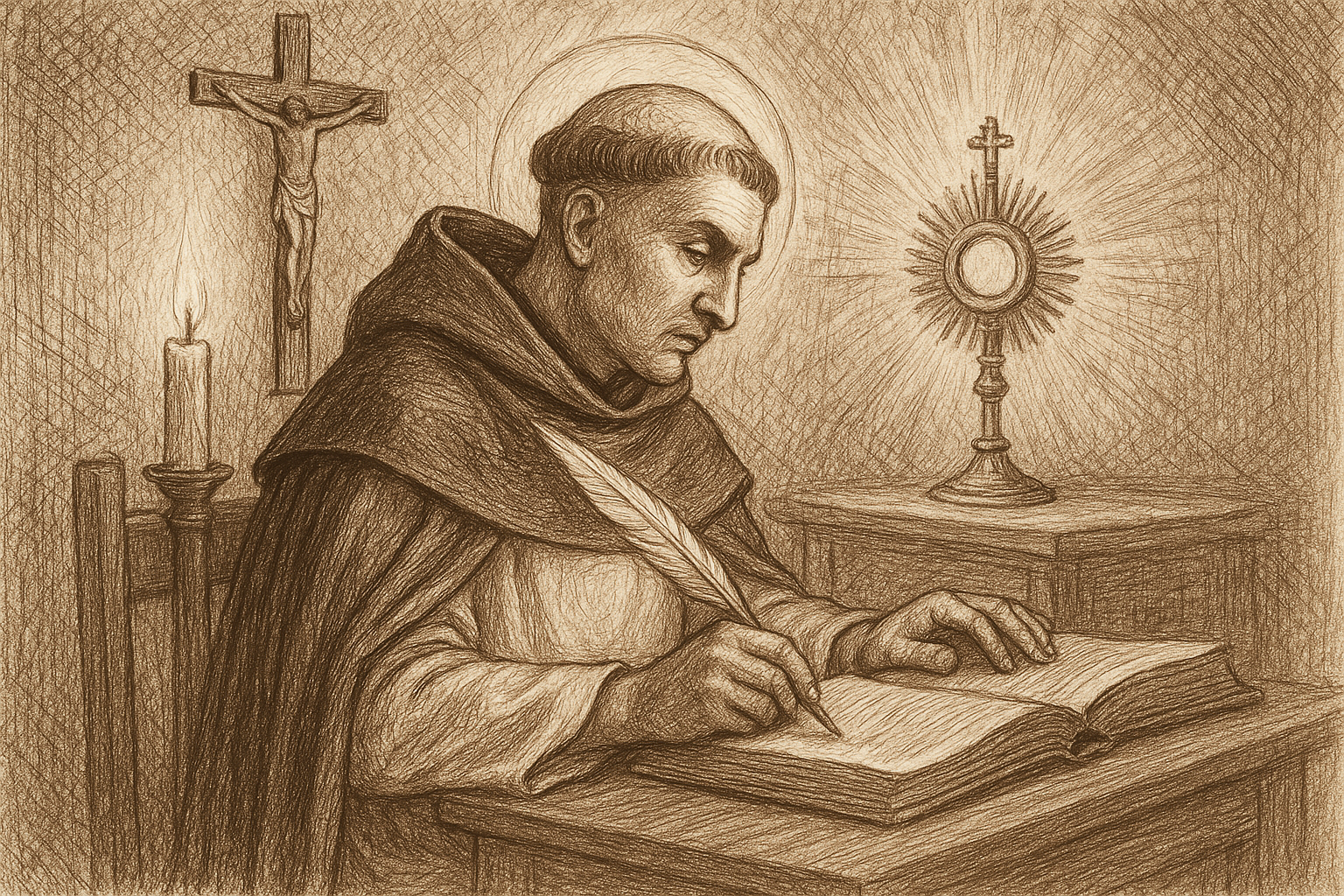
Thomas belonged to the Dominican Order, whose charism joined preaching with study. For the Dominicans, study was not a hobby for the gifted few. It was part of a larger mission to proclaim the truth of Christ faithfully. Thomas embraced that calling with seriousness, but he also lived as a religious man under vows of poverty, chastity, and obedience. The saint's learning never stood apart from his consecration.
His devotion to the Blessed Sacrament also reveals much about him. Catholic tradition remembers his Eucharistic hymns, including texts that express awe before Christ truly present in the sacrament. In Thomas, theology does not become dry analysis. It becomes worship. Doctrine, in the best Catholic sense, is never merely information. It is ordered toward adoration.
Faith seeks understanding, but understanding does not replace faith. For Thomas, the mind serves the mystery rather than trying to master it.
Why his doctrine still matters
Many Catholics know Thomas through the phrase angelic doctor, yet they may not know why his work has remained so influential. The reason is not that every line he wrote is easy or instantly accessible. It is that he gave the Church a way of thinking that respects both revelation and reason. He helped Catholics see that grace does not destroy nature but perfects it, and that created reality itself can point toward the Creator.
This matters because Catholics live in a world full of competing claims about truth. Some voices say that only measurable things are real. Others say that faith and reason can never meet. Thomas answers both errors quietly and firmly. He teaches that the world is intelligible because it comes from God, and that human reason is limited but real. We can know something true about God from creation, but we also depend on revelation because God has spoken more fully in Christ.
That balance remains spiritually useful. It protects Catholics from pride, because we are reminded that God exceeds our grasp. It also protects us from despair, because we are reminded that reason is not useless. In Thomas, doctrine becomes a service to peace. It gives the soul a stable way to think about God, morality, suffering, and hope.
The saint behind the scholar
It is easy to picture Thomas as a scholar surrounded by books, and that image is not wrong. But the saints are never merely their public achievements. Behind the major works stood a man who prayed, fasted, listened, and suffered. He knew the strain of study and the limits of language. He also knew that the things of God are not conquered by analysis. They are received in humility.
Tradition preserves an especially striking account of the end of his life. After experiencing a profound mystical event during prayer, Thomas is said to have set aside further writing, calling all that he had written like straw in comparison with what had been shown to him. Whatever precise wording one uses to tell that story, the meaning is plain. Even the greatest theological mind in the Latin Church recognized that human speech falls short of divine reality. His humility at the end of life harmonizes with his entire vocation.
Thomas died in 1274 while traveling to the Council of Lyon. He was later canonized, and his influence only grew. He was named a Doctor of the Church, and his thought became foundational for Catholic theology and philosophy. Yet his real significance cannot be measured only by honors. He helps Catholics remember that sanctity includes the disciplined use of reason, but it never stops there. Reason is meant to bow before the God who is Truth itself.
What ordinary Catholics can learn from him
St. Thomas Aquinas Catholic inspiration is not reserved for academics, seminarians, or theologians. His witness speaks to anyone who wants to live the faith with greater depth. He offers at least three practical lessons.
- Study can be prayerful. Reading Scripture, the Catechism, or the saints with attention can become an act of love when done before God.
- Humility protects the intellect. The more we learn, the more we should recognize how much remains beyond us.
- Truth should lead to charity. Catholic doctrine is not meant to make us argumentative. It should make us more faithful, patient, and generous.
These lessons are especially timely for Catholics who feel overwhelmed by confusion, surface-level opinions, or internal division. Thomas does not call us to perform intellectual strength for its own sake. He calls us to a more ordered life, one in which truth and holiness cooperate. A Catholic can be thoughtful without becoming severe, and devout without becoming anti-intellectual.
His witness in the light of Scripture
The life of Thomas Aquinas resonates strongly with the biblical vision of wisdom. Scripture does not oppose knowledge to holiness. Rather, it places wisdom under the fear of the Lord and under trust in God. As Proverbs says, The fear of the Lord is the beginning of knowledge. Thomas lived like a man who believed that. His intellectual life began in reverence.
The New Testament also speaks of the renewal of the mind. Be transformed by the renewal of your mind, St. Paul writes. That transformation was visible in Thomas's vocation. He did not simply accumulate arguments. He sought a mind made available to God. The same apostle also describes Christ as the one in whom are hidden all the treasures of wisdom and knowledge. For Thomas, that meant theology was always Christ-centered, never self-enclosed.
There is also a quiet Marian note in his life. The Church has long remembered his devotion to Our Lady, and Dominican spirituality places deep trust in the Rosary. Thomas's life suggests that Marian devotion and serious theology belong together. The more deeply one contemplates Christ, the more one comes to honor the Mother who led the Church to him.
Why his witness still feels fresh
Some saints endure because their heroic charity is easy to admire. Others endure because their thought remains useful. Thomas Aquinas endures for both reasons. He is a saint who can guide the student facing exams, the parent trying to explain the faith to a child, the catechist preparing a lesson, and the Catholic who simply wants to believe more intelligently.
He also offers something rarer: peace. Thomas shows that a mind can be ordered without becoming rigid, and that a life of study can be suffused with devotion. At a time when many people feel torn between skepticism and sentimentality, he points to a wiser path. God is real, truth is knowable, the soul is made for grace, and the Church is not ashamed to think carefully about what she believes.
That is why St. Thomas Aquinas continues to inspire Catholics. He does not merely represent a tradition of ideas. He represents a way of living before God with reverence, patience, and courage. His books endure, but his greater legacy is spiritual: he teaches us to seek truth as disciples, not as owners. And when that search is placed in Christ's hands, the mind itself begins to rest.
Keep Reading on Lets Read The Bible
Frequently Asked Questions
Why is St. Thomas Aquinas important to Catholics today?
He remains important because he shows how faith and reason belong together. His writings help Catholics think clearly about God, the moral life, grace, and the sacraments, while his humility reminds us that theology should lead to worship.
Was St. Thomas Aquinas only a philosopher?
No. He was a Dominican friar, priest, theologian, teacher, and saint. His life was marked by prayer, obedience, Eucharistic devotion, and a deep love for Christ, not only by intellectual work.
What is one simple way to follow St. Thomas Aquinas's example?
A good beginning is to study the faith prayerfully. Reading Scripture, the Catechism, or a trusted Catholic spiritual text with reverence can help unite the mind and heart in a more faithful life.